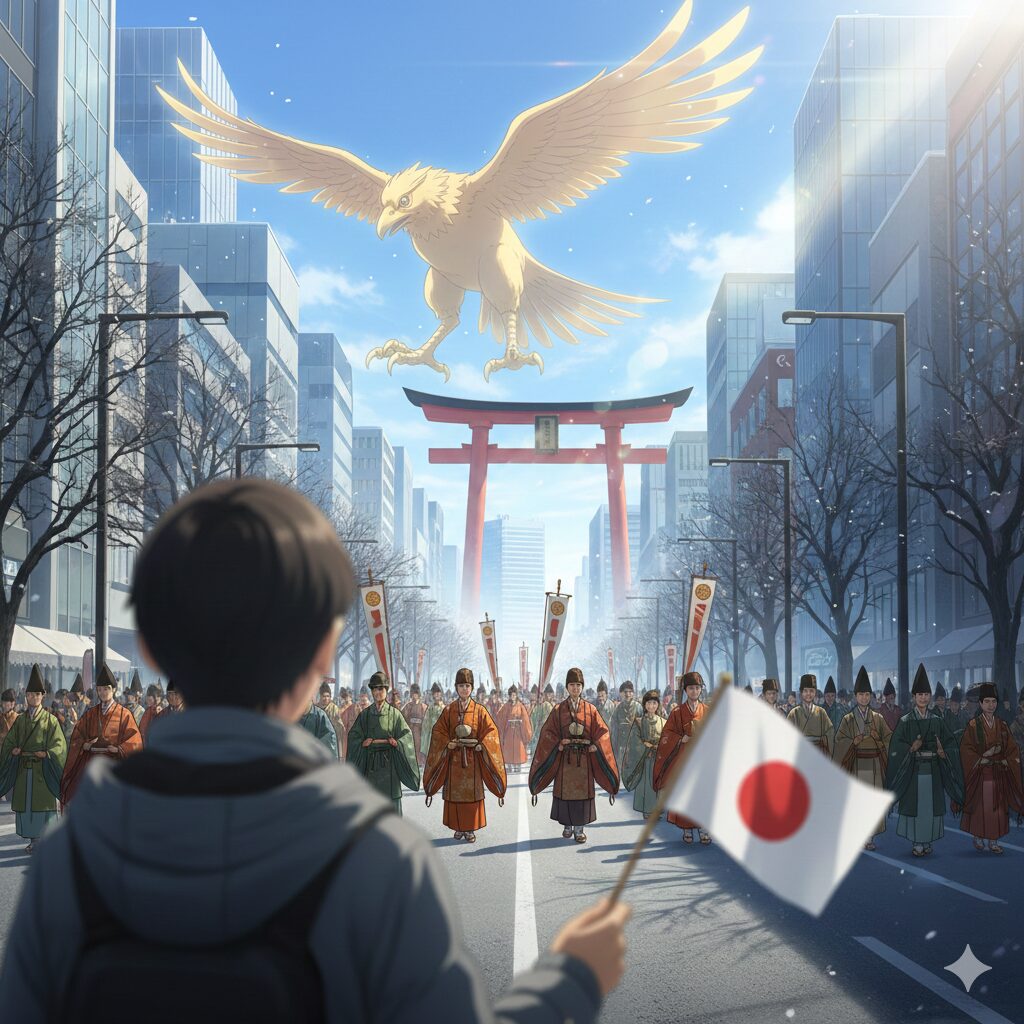
It is, in fact, Japan. February 11th marks “National Foundation Day” (Kenkoku Kinen no Hi) in Japan. However, this isn’t just a simple “birthday of the country.” It is a mysterious and intriguing day where mythology intersects with history, quietly illuminating the identity of modern Japanese people.
Why don’t Japanese people celebrate this day with wild festivities? Why is the name phrasing so specifically ambiguous? Unraveling these mysteries will bring you closer to the profound depths of Japanese culture.

A Story Beginning in Myth: The Promise of 660 BCE
The Enthronement of the First Emperor, Jimmu
The history of Japan’s foundation begins not in history books, but in the realm of mythology. According to Japan’s ancient chronicles, the Nihon Shoki and Kojiki, the first Emperor, “Jimmu Tenno,” ascended to the throne on the first day of the first lunar month in 660 BCE.
Converted to the modern Gregorian calendar during the Meiji era, this date became February 11th.
Jimmu’s Eastern Expedition and the Yatagarasu
Emperor Jimmu is said to be a descendant of Amaterasu Omikami, the Sun Goddess. He set out on a journey from Takachiho in Kyushu to the east, seeking a suitable place to govern the land (The Eastern Expedition). Guiding him along the way was the “Yatagarasu,” a three-legged crow, which is now famous as the symbol of the Japan Football Association.
Overcoming numerous hardships, he ascended the throne in what is now Kashihara, Nara Prefecture, marking the beginning of the nation of Japan.
From “Kigensetsu” to “National Foundation Day”
From the Meiji era until the end of World War II, this day was called “Kigensetsu” (Empire Day) and was celebrated grandly. However, after the war, it was abolished under the direction of GHQ (General Headquarters of the Allied Powers), as history based on mythology was seen as linked to militarism.
Later, in response to public demand for its revival, it was re-established as a national holiday in 1966. What is crucial here is the name. It was designated not as “Ken-koku Kinen-bi” (National Founding Day) but “Ken-koku Kinen no Hi” (National Foundation Day).
The addition of the particle “no” implies a subtle nuance: it is a day to “celebrate the fact that the country was founded and to cultivate a love for the nation,” rather than commemorating the specific historical accuracy of Emperor Jimmu’s enthronement. This is a unique and delicate linguistic consideration typical of Japanese culture.
A Quiet Celebration: Why No Frenzy?
Unlike Independence Day in the USA or Bastille Day in France, you rarely see fireworks or frenzied crowds on February 11th in Japan. While parades are held in Harajuku/Omotesando in Tokyo and solemn rituals take place at Kashihara Jingu Shrine in Nara, for most Japanese people, it is a “quiet holiday.”
The Spirit of “Wa” (Harmony) and Continuity
This stems from the fact that Japan was not born suddenly from a “revolution” or a “declaration of independence.” Japan is characterized by its continuity—it has existed naturally and gradually since ancient times, so long ago that its true beginning is unknown.
The fact that the Imperial line has continued for over 2,600 years (according to legend) means it is the oldest hereditary monarchy in the world, recognized by Guinness World Records. Japanese people find a certain sense of security and aesthetic beauty in this “unchanging” and “long-lasting” nature.
Significance in the Modern Era
Today, February 11th is not a day to boast about the past, but a day to quietly appreciate the peace and prosperity built by ancestors and to think about how to connect it to the future. The landscape of Japan, where ancient shrines stand in the shadows of modern skyscrapers and mythology coexists with science, perfectly embodies the spirit of this day.
What is the “Origin Story” of Your Country?
Japan’s foundation has its roots in myths that resemble tales of swords and magic. While this may differ from scientific fact, it is a vital narrative that shapes the “heart” of the people.
What kind of founding story does your country have? Is it a tale of heroes, or a story of revolution?
If you ever have the chance to visit Japan, please visit “Kashihara Jingu” in Nara Prefecture. There, you will feel a serene atmosphere that transcends 2,600 years of time. How would you spend this quiet commemorative day?
Related Links
世界で最も長く続いている国はどこか、ご存知でしょうか?
実は、それは日本です。2月11日は、日本の「建国記念の日」。しかし、この日は単なる「国の誕生日」ではありません。神話と歴史が交差し、現代の日本人のアイデンティティを静かに照らす、非常にミステリアスで興味深い1日なのです。
なぜ日本人はこの日を派手に祝わないのか?なぜ「建国記念日」ではなく「建国記念の日」なのか?その謎を紐解くとき、あなたは日本文化の奥深さに触れることになります。
神話から始まる物語:紀元前660年の約束
初代天皇、神武天皇の即位
日本の建国の歴史は、歴史書というよりは、神話の世界から始まります。日本の正史である『日本書紀』や『古事記』によると、初代天皇である「神武天皇(じんむてんのう)」が即位した日が、紀元前660年の旧暦1月1日とされています。
これを明治時代に太陽暦(グレゴリオ暦)に換算したのが、現在の2月11日です。
神武東征と八咫烏
神武天皇は、太陽の女神であるアマテラスオオミカミの子孫とされています。彼は九州の高千穂から、国を治めるのにふさわしい場所を求めて東へと旅立ちました(神武東征)。その道中、道案内をしたのが、日本サッカー協会のシンボルとしても有名な3本足の烏、「八咫烏(ヤタガラス)」です。
数々の困難を乗り越え、現在の奈良県・橿原(かしはら)の地で即位し、日本という国が始まったとされています。
「紀元節」から「建国記念の日」へ
かつて、明治時代から第二次世界大戦終結までは、この日は「紀元節(きげんせつ)」と呼ばれ、盛大に祝われていました。しかし、敗戦後、GHQ(連合国軍最高司令官総司令部)の意向により、「神話に基づく歴史は軍国主義につながる」として廃止されました。
その後、多くの国民からの復活を望む声に応え、1966年に再び祝日として制定されました。ここで重要なのが名称です。「建国記念日」ではなく、「建国記念の日」とされたのです。
これは、「神武天皇が即位した史実そのものを記念する(歴史的に正確か議論があるため)」のではなく、「建国されたという事実そのものを祝い、国を愛する心を養う日」という意味を込めるための、日本語特有の極めて繊細な配慮なのです。
静かなる祝典:なぜ日本人は熱狂しないのか
アメリカの独立記念日やフランスの革命記念日のような、花火が上がりパレードで熱狂するような光景は、日本の2月11日にはあまり見られません。東京の原宿・表参道でのパレードや、奈良県の橿原神宮での厳かな儀式は行われますが、多くの日本人にとっては「静かな休日」です。
「和」の精神と連続性
これは、日本という国が「革命」や「独立宣言」によってある日突然生まれたわけではないことに起因しています。いつ始まったのかわからないほど太古の昔から、自然発生的に、そして緩やかに続いてきたという「連続性」こそが日本の特徴です。
2600年以上(神話上ですが)も皇統が続いているという事実は、ギネス世界記録にも認定されている現存する世界最古の王家であることを意味します。日本人は、この「変わらないこと」「長く続くこと」に、ある種の安心感と美学を感じています。
現代における意義
現代の2月11日は、過去を誇示する日ではなく、先人たちが築き上げてきた平和と繁栄に感謝し、未来へどう繋いでいくかを静かに考える日となっています。神話と現代科学が共存し、摩天楼の影に古い神社が佇む日本の風景そのものが、この日のあり方を体現していると言えるでしょう。
あなたの国の「始まり」はどのような物語ですか?
日本の建国は、剣と魔法のような神話の中にルーツを持ちます。それは科学的な事実とは異なるかもしれませんが、民族の「心」を形作る大切な物語です。
この記事を読んでいるあなたの国には、どのような建国の物語がありますか?それは英雄の物語でしょうか、それとも革命の物語でしょうか?
もし日本を訪れる機会があれば、ぜひ奈良県の「橿原神宮」を訪れてみてください。そこには、2600年の時を超えた静謐な空気が流れています。あなたなら、この静かな記念日をどう過ごしますか?


コメント