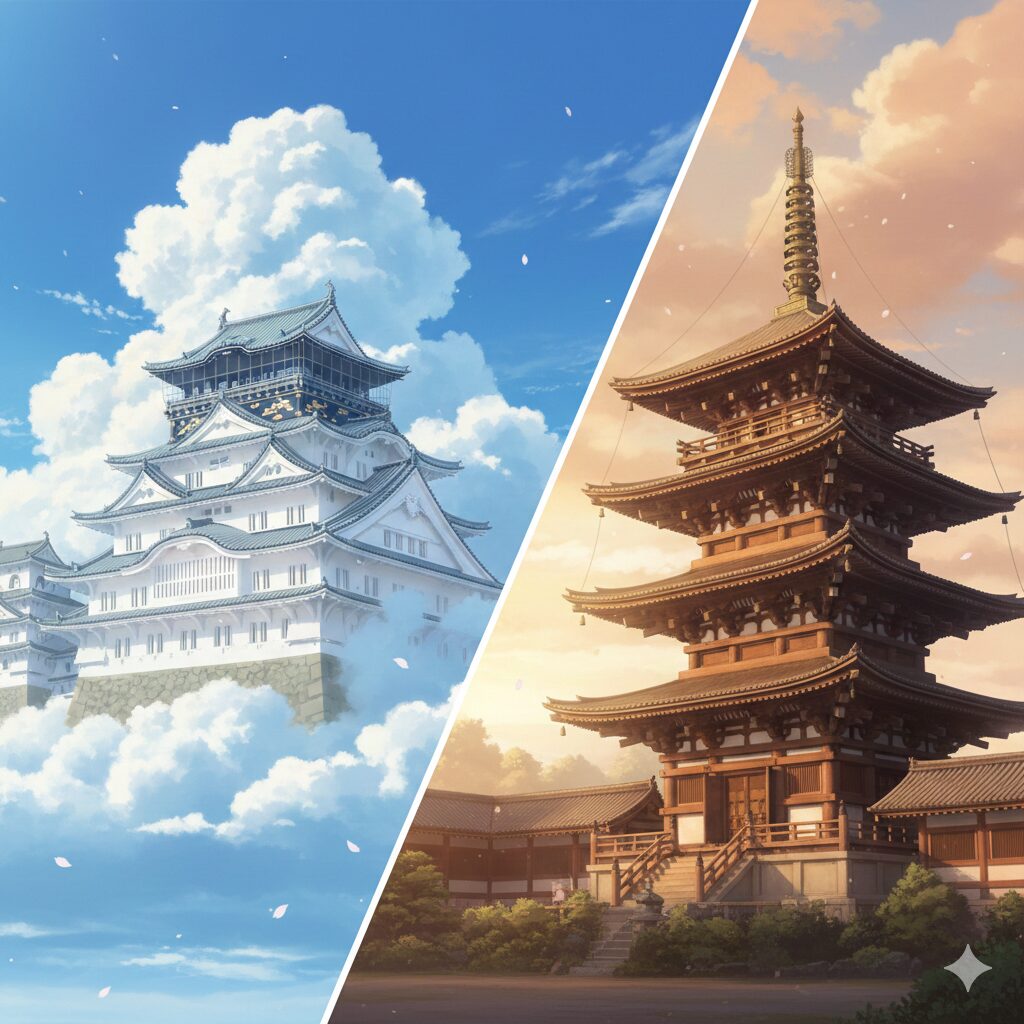
December 29th is typically a time of hustle and bustle in Japan, as people rush to finish their year-end cleaning and prepare for the New Year. However, amidst this seasonal flurry, few recall that this date marks a monumental anniversary in the history of Japanese art and culture.
On this day in 1993 (Heisei 5), Himeji Castle in Hyogo Prefecture and Horyu-ji Temple in Nara Prefecture were officially registered as Japan’s first UNESCO World Cultural Heritage sites. This was not merely a tourism accreditation. It was the moment when Japanese architectural beauty, composed of wood, paper, and earth, was formally recognized as a “Treasure of Humanity” by global standards, which had long been dominated by Western stone culture.
Why were these two chosen first? And what Japanese spirit resides within them? Today, we delve deep into the history and significance of this event.

The Dance of the White Heron: Himeji Castle’s Aesthetic of the Warrior
Standing tall in Himeji City, Hyogo, Himeji Castle is affectionately known as the “White Heron Castle” (Shirasagi-jo) due to its brilliant white plastered appearance. It is a masterpiece from the early 17th century, the peak of Japanese castle architecture, and boasts an overwhelming state of preservation among existing Japanese castles.
The Pinnacle of Functional Beauty
The beauty of Himeji Castle was not created solely for decoration. Its dazzling white walls are the result of coating everything in plaster to improve fire resistance. Furthermore, its maze-like complex is based on cold, calculated logic to confuse and defend against enemies.
However, the master builders of that era managed to coexist “beauty” within this functionality. The silhouette of the castle complex offers a different expression from every angle. Elevating a tool of war to such artistic heights reveals the spirit of Bushido—the philosophy that strength and beauty are two sides of the same coin.
Did you know? Himeji Castle miraculously survived the air raids of World War II. Legend has it that a firebomb dropped on the main keep failed to detonate, reinforcing the mystical belief that the castle is divinely protected.
A Prayer of a Thousand Years: Horyu-ji and the Spirit of Harmony
In contrast, Horyu-ji Temple, located in the quiet village of Ikaruga in Nara, exudes a completely different, serene atmosphere. Associated with Prince Shotoku, it is famous for housing the world’s oldest wooden structures.
The Terminus of the Silk Road
The architectural style of Horyu-ji shows influences from as far away as Greece and Rome. For instance, the columns of the corridors feature “entasis” (a slight convexity in the shaft), a visual correction technique also found in the Parthenon. This proves that 7th-century Japan was connected to global cultures via the Silk Road.
Yet, the essence of Horyu-ji lies in its spirituality rather than just its technology. Prince Shotoku taught that “Harmony is to be valued.” This teaching, which prioritizes peace and avoids conflict, is embodied by the temple complex itself, which has survived for over 1,300 years through countless wars. The fact that it has been preserved by splicing in new timber and repeated restorations is a symbol of the Japanese power of “continuity.”
The Philosophy of Circulation: What Wood Architecture Asks the World
The 1993 World Heritage registration can be seen as a triumph of Eastern “Wood Culture” over Western “Stone Culture.”
Stone architecture aims for “eternity” by resisting weathering. In contrast, Japanese wooden architecture acknowledges that materials will eventually return to the earth. Therefore, by periodically dismantling and repairing structures—or rebuilding them entirely as seen in the Shikinen Sengu of Shinto shrines—technology is passed down, preserving a spiritual eternity.
It is highly symbolic that Himeji Castle and Horyu-ji were the first to be registered together.
- Himeji Castle: Authority, military power, splendor, the pinnacle of Azuchi-Momoyama culture.
- Horyu-ji: Religion, peace, simplicity, the source of Asuka culture.
This contrast between “Dynamic” and “Static,” “White” and “Brown,” is the depth of Japanese culture. We are reminded of our duty not only to create the new but to keep the old alive through modern skill and passion.
Which “Eternity” Would You Choose?
I have a question for you reading this article. If you visited Japan and could go to only one place, would you choose Himeji Castle, piercing the sky with its overwhelming whiteness? Or would you choose Horyu-ji, wrapped in the scent of ancient wood and a thousand years of silence?
Furthermore, does your country have places that have been protected not by the strength of stone, but by the “spirit” of the people? Please share your thoughts on what constitutes a true World Heritage in your heart.
Useful Links
日本の美が世界に認められた日:12月29日と世界遺産
年末の喧騒に包まれる12月29日。多くの日本人が一年の煤(すす)を払い、正月を迎える準備に追われるこの時期に、かつて日本の歴史における「美の革命」とも言える大きな出来事が確定していたことをご存知でしょうか。
1993年(平成5年)、兵庫県の「姫路城」と奈良県の「法隆寺(法隆寺地域の仏教建造物)」が、日本で初めてユネスコ世界文化遺産に登録されました。これは単なる観光地認定ではありません。木と紙と土で構成された日本の建築美が、石の文化である西洋主導の世界基準において、「人類全体の宝」として正式に認められた瞬間だったのです。
なぜこの二つだったのか。そして、そこにはどのような日本人の精神が宿っているのか。今日はその歴史的背景と深層に迫ります。
白鷺の舞:姫路城が体現する「武」の美学
兵庫県姫路市にそびえ立つ姫路城は、その白漆喰の優美な姿から「白鷺城(しらさぎじょう)」と呼ばれています。17世紀初頭、日本の城郭建築が最盛期を迎えた時期の傑作であり、現存する日本の城の中でも圧倒的な保存状態を誇ります。
機能美の極致
姫路城の美しさは、装飾のためだけに作られたものではありません。あの眩いばかりの白い壁は、防火性を高めるための漆喰(しっくい)総塗りによるものです。また、迷路のように入り組んだ縄張り(要塞構造)は、敵を撹乱し、防御するための冷徹な計算に基づいています。
しかし、当時の棟梁たちは、そこに「美」を共存させました。大天守と小天守が渡櫓で結ばれた「連立式天守」のシルエットは、見る角度によって千変万化の表情を見せます。戦うための道具を、これほどまでに芸術的な高みへと昇華させた点に、日本の武士道精神――強さと美しさは表裏一体であるという思想――が見て取れます。
知っておきたいポイント:姫路城は第二次世界大戦中、奇跡的に空襲の焼失を免れました。天守閣に落ちた焼夷弾が不発だったという逸話は、この城が「守られている」という神秘性をさらに強めています。
千年の祈り:法隆寺が伝える「和」の精神
一方、奈良県斑鳩(いかるが)の里に佇む法隆寺は、姫路城とは全く異なる静謐な空気を纏っています。聖徳太子ゆかりの寺院であり、世界最古の木造建築群として知られています。
シルクロードの終着点
法隆寺の建築様式には、はるかギリシャ・ローマの影響が見られます。例えば、回廊の柱に見られる「エンタシス(胴張り)」と呼ばれる中央が膨らんだ形状は、パルテノン神殿の柱と同じ視覚補正の効果を持っています。7世紀の日本が、シルクロードを通じて世界の文化と繋がっていた証左です。
しかし、法隆寺の真髄は技術以上に、その精神性にあります。聖徳太子が説いた「和を以て貴しと為す」という思想。争いを避け、調和を重んじるその教えは、1300年以上の時を超え、幾多の戦乱を乗り越えて現代に残るこの伽藍そのものが体現しています。新しい木材で継ぎ足し、修復を重ねながら守り抜かれてきたその姿は、日本人の「継続する力」の象徴です。
木造建築が世界に問いかける「循環の哲学」
1993年の世界遺産登録は、西洋的な「石の文化」に対する、東洋的な「木の文化」の勝利とも言えます。
石の建築は「永遠」を目指し、風化に耐えることを是とします。対して日本の木造建築は、素材がいずれ土に還ることを知っています。だからこそ、定期的な解体修理や、式年遷宮のように建て替えることで技術を継承し、精神的な永遠性を保つのです。
姫路城と法隆寺が同時に最初の世界遺産となったことは非常に象徴的です。
- 姫路城:権威、武力、華麗さ、安土桃山文化の到達点。
- 法隆寺:宗教、平和、枯淡、飛鳥文化の源流。
この「動」と「静」、「白」と「茶」のコントラストこそが日本文化の深みです。私たちは、新しいものを作り出すだけでなく、古き良きものを現代の技術と情熱で「生かし続ける」義務を負っているのです。
あなたなら、どちらの「永遠」を選びますか?
この記事を読んでいるあなたに問いかけたいことがあります。もしあなたが日本を訪れ、たった一箇所だけしか行けないとしたら、圧倒的な白さで空を突く「姫路城」を選びますか?それとも、木の香りと千年の静寂に包まれた「法隆寺」を選びますか?
あるいは、あなたの国にも、素材は違えど「魂」だけで守り抜かれてきた場所はありますか?ぜひ、あなたの心の中にある世界遺産について考えてみてください。


コメント