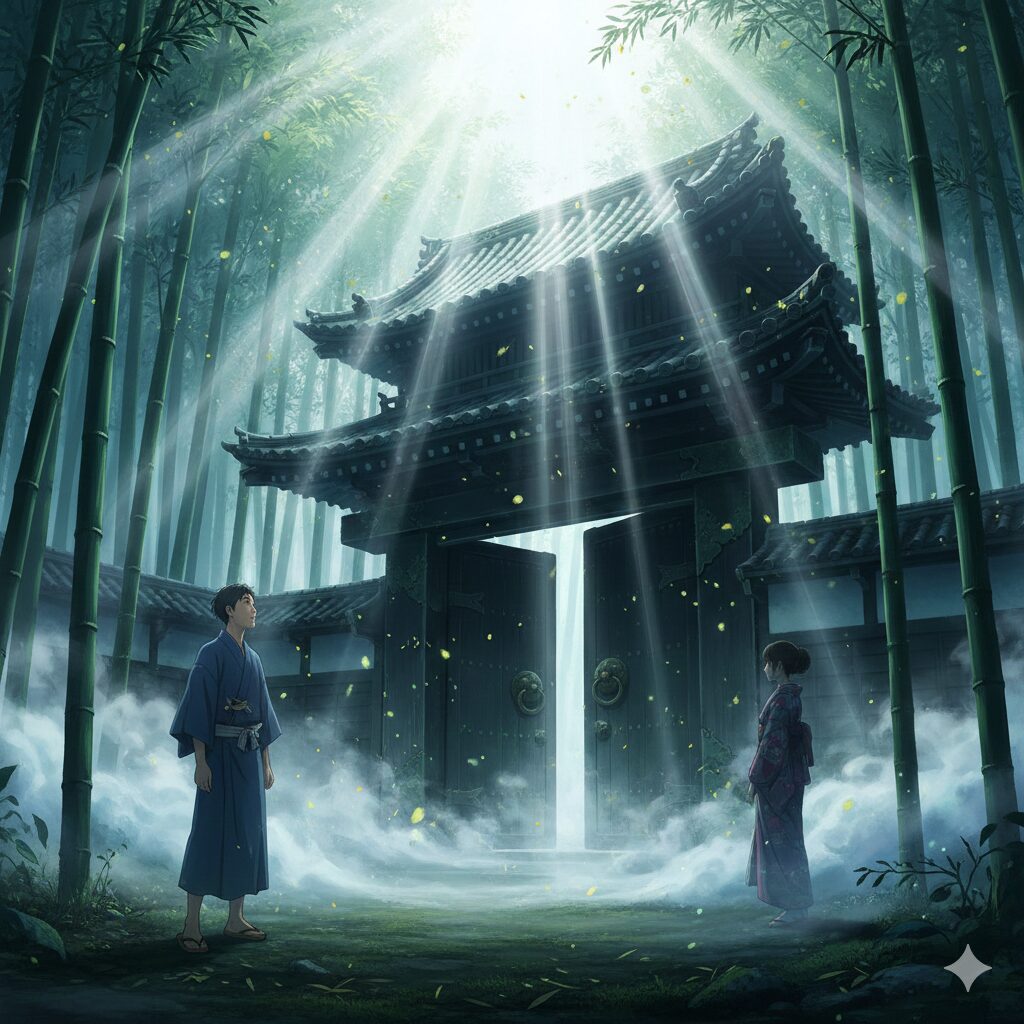
Japanese folklore is filled with stories that are beautiful yet undeniably melancholic. Today, I want to introduce you to a tale called “Uguisu Chōja” (The Nightingale Millionaire). This isn’t just a simple story of an animal returning a favor. It is a fantastical narrative that explores human curiosity, broken promises, and the longing for a lost paradise.

1. The Story: The Dream Mansion Vanishing into the Bamboo Thicket
Once upon a time, there lived a man. He was hardworking, but his life was far from easy. One day, he ventured deep into the mountains to gather firewood.
Before he knew it, he was surrounded by a fog deeper than anything he had ever seen. Losing his way home and wandering aimlessly, he suddenly stumbled upon a magnificent black-lacquered gate. It was a grand mansion, resembling a castle, completely out of place in the deep mountains.
“Does someone actually live in a place like this?” he wondered.
As he timidly called out, a woman of unearthly beauty appeared from within. Dressed in an exquisite kimono, she gently invited the man inside.
He was led into a tatami room adorned with gold-leaf folding screens and was served a feast unlike anything he had ever tasted. The man spent several days there, feeling as if he were in a dream.
One day, the woman said to him:
“I must go out for a short while. Please relax in the mansion while I am away. However, you must never open the ‘Northern Warehouse’ in the back.“
The man firmly promised, “I will never open it.” But once the woman left, a demon called “Curiosity” began to creep into his mind in the silence of the vast mansion.
“When told not to look at the one thing, it makes me want to see it even more…”
With trembling hands, the man reached for the door of the forbidden warehouse. Creak… The heavy door opened.
To his astonishment, the scenery inside the warehouse was completely different from the season outside.
In the first room, spring plum blossoms were in full bloom, and nightingales (Uguisu) sang beautifully.
In the second room, summer greenery flourished, and cuckoos called out.
In the third room, autumn leaves burned red, and wild geese flew across the sky.
Mesmerized by the beauty, he lost track of time and finally peeked into the innermost room. There, a single nightingale, clad in golden light, was resting its wings in sorrow.
At that moment— “Even though you promised so faithfully…”
A sorrowful voice came from behind. He turned to find the beautiful woman standing there, shedding tears.
“Now that you have seen me, I can no longer stay here. I was the master of this mountain, the Uguisu. I wanted to let you live a rich life, but…”
As the woman hid her face with her sleeve, her form transformed into a nightingale. With a cry of “Ho-hokekyo,” she flew away into the distant sky.
When he came to his senses, the man was sitting alone in the original dim bamboo thicket. The luxurious mansion and the delicious food had all vanished, leaving only an old nightingale’s nest fallen on the ground.
2. Analysis: Why Do We Look When Told Not To?
“Uguisu Chōja” is a classic example of the “Prohibition of Looking” (Miruna no Taboo) motif found in myths and folklore around the world. Similar to the Greek myth of Orpheus or the biblical story of Lot’s Wife, this tale depicts a “promise” and its “inevitable breach.”
However, what makes this story unique is that the consequence of breaking the taboo is not “death” or “punishment,” but “loss.” The man is not physically harmed. He simply wakes up from a “beautiful dream” and is pulled back into his reality of poverty.
This illustrates the ancient Japanese concept that the “Spiritual World” and the “Human World” cannot intersect permanently. The woman (the Nightingale) is a symbol of nature itself. Humans can enjoy its blessings, but they must not try to expose its depths or true form. The moment the true form is known, the magic breaks, and nature distances itself from humanity.
Furthermore, the depiction of “seasons” being sealed within the warehouse is uniquely Japanese. Japanese people deeply cherish the changing seasons. The idea that this Nightingale incarnation controlled and managed these beautiful seasons expresses a profound sense of awe toward nature.
3. Decoding Japanese Culture: The Aesthetic of Transience
The core of Japanese culture that can be read from this story is “Mono no aware” (the pathos of things) and “Transience.”
- Nature Worship: Since ancient times, Japanese people have believed that gods and spirits dwell in mountains, forests, and animals (Animism). The Uguisu is also called the “Haru-tsuge-dori” (Spring-Heralding Bird) and is considered a sacred bird. This story serves as a quiet warning to humans who have forgotten their respect for nature.
- The Aesthetic of Concealment: Japanese culture often finds beauty in concealment rather than full exposure. The light through a Shoji screen, scenery in the mist, and the mystery of “not showing.” Because the protagonist opened the door and “saw everything,” that beauty collapsed.
Perhaps this story teaches us about the “heart to believe in the unseen” and the “appropriate distance from nature” that we have lost in modern society.
4. A Question for You
If you were in this man’s shoes, what would you have done?
You have a luxurious life right in front of you, with only one door you are told “never to look at.” Are you confident you could keep that door closed forever and live happily? Or would you risk losing everything to open the door and know the truth?
There is a Japanese proverb: “Ignorance is bliss” (Shiranu ga hotoke). Do you want to know the truth? Or would you rather stay in a beautiful dream?
References
If you want to know more about Japanese folktales, please check the series below.
Japanese Folktale Series – KIRI53
Also, for more on the theme of “The Prohibition of Looking,” the following page is helpful.
Taboo (Wikipedia)
霧深き森の奥、禁じられた扉の向こう側:「うぐいす長者」
日本の昔話には、美しいけれどどこか物悲しい、不思議な物語が数多く存在します。今回ご紹介するのは「うぐいす長者(Uguisu Chōja)」という物語です。これは単なる動物の恩返しではありません。人間の好奇心、約束、そして失われた楽園への憧れを描いた、幻想的なストーリーです。
1. 物語:竹藪に消えた夢の館
むかしむかし、あるところに一人の男がいました。彼は働き者でしたが、暮らしは楽ではありませんでした。ある日、彼は薪を拾うために深い山奥へと入っていきました。
気がつくと、あたりは今まで見たこともないような深い霧に包まれていました。帰り道を見失い、途方に暮れて彷徨い歩いていると、突然、目の前に立派な黒塗りの門が現れました。山奥には似つかわしくない、まるでお城のような大御殿です。
「こんなところに人が住んでいるのだろうか」
恐る恐る男が声をかけると、中からこの世のものとは思えないほど美しい女性が現れました。彼女は着物を艶やかに着こなし、男を優しく招き入れました。
通された座敷には金箔の屏風が置かれ、見たこともないような豪華な食事が振る舞われました。男は夢見心地で数日を過ごしました。
ある日、女性は男に言いました。
「私は少し出かけて参ります。その間、この屋敷でゆっくりしていてください。ただし、奥にある『北の蔵』だけは、決して開けてはいけませんよ」
男は「決して開けない」と固く約束しました。しかし、女性が出かけてしまうと、静まり返った広い屋敷の中で、男の心に「好奇心」という魔物が忍び寄ります。
「一つだけ見るなと言われると、余計に見たくなるものだ…」
男は震える手で、禁じられた蔵の戸に手をかけました。ギギギ…と重い音を立てて扉が開きます。
するとどうでしょう。蔵の中には、外の季節とは全く違う風景が広がっていました。
一番目の部屋には、春の梅が咲き乱れ、ウグイスが美しい声で鳴いています。
二番目の部屋には、夏の緑が生い茂り、ホトトギスが鳴いています。
三番目の部屋には、秋の紅葉が燃えるようで、空には雁が渡っています。
男はその美しさに時を忘れ、ついには一番奥の部屋を覗き込みました。そこには、金色の光を纏った一羽のウグイスが、悲しげに羽を休めていました。
その時です。「あれほど約束したのに…」
背後から悲痛な声が聞こえました。振り返ると、あの美しい女性が涙を流して立っています。
「あなたに見られてしまっては、もうここにはいられません。私はこの山の主、ウグイスでした。あなたに豊かな暮らしをさせてあげようと思ったのに…」
女性が袖で顔を隠すと、その姿は一羽のウグイスに変わり、ホーホケキョと鳴いて空の彼方へ飛び去ってしまいました。
気がつくと、男は元の薄暗い竹藪の中に一人ポツンと座っていました。豪華な御殿も、美味しい食事も、全ては消え失せ、そこには古いウグイスの巣が一つ落ちているだけでした。
2. 考察:なぜ人は「見るな」と言われると見てしまうのか
「うぐいす長者」は、世界中の神話や伝承に見られる「見るなのタブー(Prohibition of Looking)」の典型的な物語です。ギリシャ神話の「オルフェウス」や、聖書の「ロトの妻」と同様に、この物語は「約束」と「不可避な破り」を描いています。
しかし、この物語が特異なのは、タブーを破った結果が「死」や「罰」ではなく、「喪失」である点です。男は傷つけられることはありません。ただ、「美しい夢」から覚め、現実の貧しい生活に引き戻されるだけです。
ここには、「異界(Spiritual World)」と「人間界(Human World)」は交わることができないという、日本古来の境界線の概念があります。女性(ウグイス)は自然そのものの象徴であり、人間はその恵みを享受することはできても、その深淵(正体)を暴こうとしてはいけないのです。正体を知った瞬間、魔法は解け、自然は人間から離れていきます。
また、蔵の中に「四季」が封じ込められていたという描写は非常に日本的です。日本人は四季の移ろいを非常に大切にします。その美しい四季を支配・管理しているのが、このウグイスの化身であったという設定は、自然への畏敬の念を表しています。
3. 日本文化を読み解く:儚さ(Hakanasa)の美学
この物語から読み取れる日本文化の核心は、「もののあわれ(Mono no aware)」と「儚さ(Transience)」です。
- 自然崇拝(Nature Worship): 日本では古くから、山や森、そして動物たちに神や精霊が宿ると信じられてきました(アニミズム)。ウグイスは「春告鳥(Haru-tsuge-dori)」とも呼ばれ、春の訪れを知らせる神聖な鳥です。この物語は、自然を敬う心を忘れた人間への静かな警告でもあります。
- 隠すことの美学: 日本文化では、全てを露わにするよりも、隠すことに美を見出します。障子越しの光、霧の中の景色、そして「見せない」ことによる神秘性です。主人公が扉を開けて全てを「見てしまった」ことで、その美しさは崩壊しました。
私たちが現代社会で失ってしまった「見えないものを信じる心」や「自然との適切な距離感」を、この物語は教えてくれているのかもしれません。
4. あなたへの問いかけ
もし、あなたがこの男の立場だったらどうしたでしょうか?
目の前に豪華な生活があり、ただ一つ「決して見てはいけない」と言われた扉がある。永遠にその扉を閉ざしたまま、幸せに暮らす自信がありますか? それとも、真実を知るために、全てを失うリスクを冒してでも扉を開けますか?
「知らぬが仏(Ignorance is bliss)」という日本のことわざがあります。あなたは、真実を知りたいですか? それとも、美しい夢を見ていたいですか?
参考リンク
日本の昔話についてもっと知りたい方は、以下のシリーズをご覧ください。
Japanese Folktale Series – KIRI53
また、この物語のテーマである「見るなのタブー」については、以下のページも参考になります。
見るなのタブー (Wikipedia)


コメント