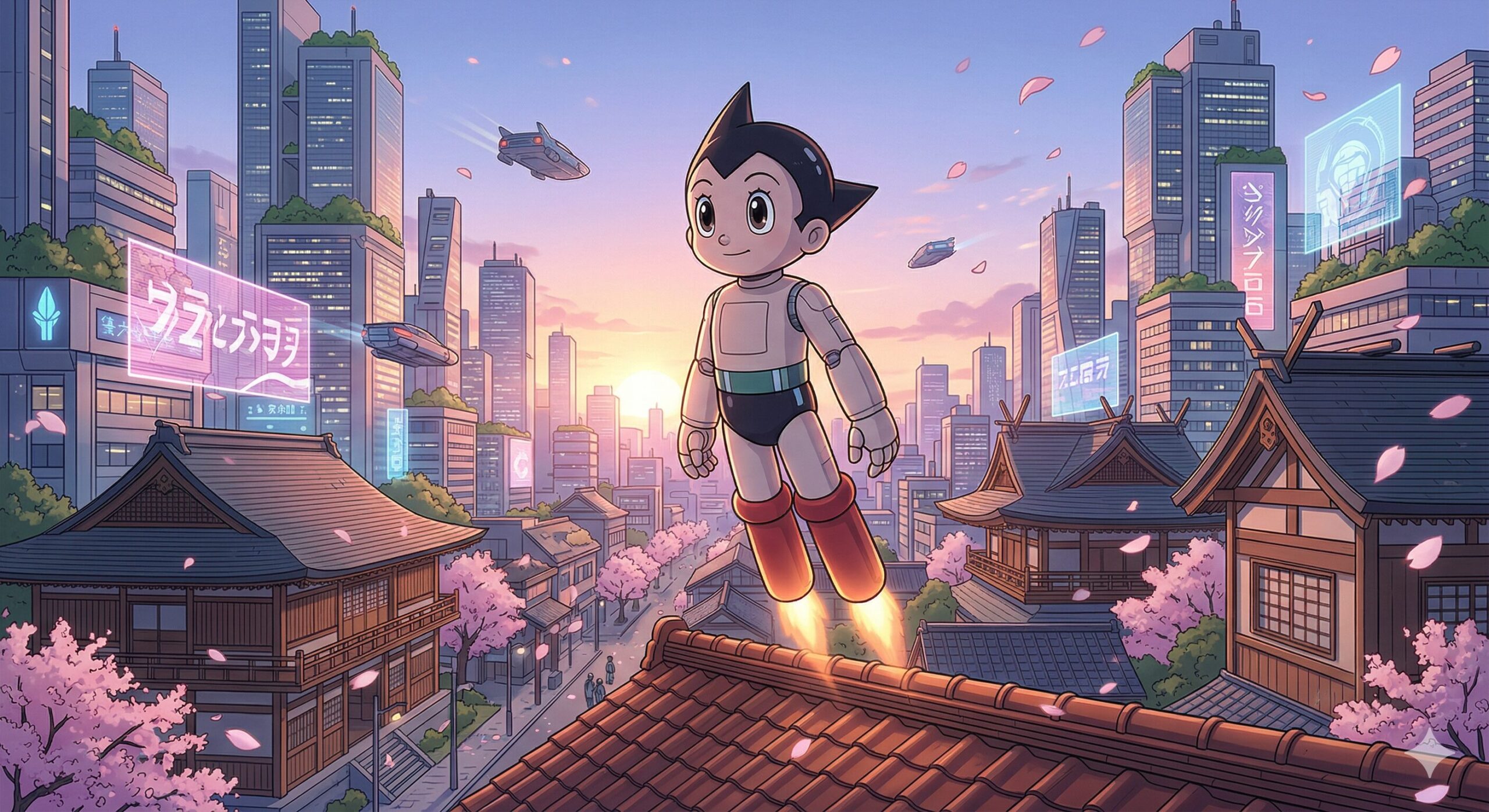
April 7, 2003. This date holds profound significance in the history of Japanese manga, animation, and global robotics. It marks the fictional birthday of “Astro Boy” (Tetsuwan Atom), the iconic national character created by Osamu Tezuka, widely known as the Godfather of Manga.
In the original manga, Astro Boy was created on this exact day in 2003 by Dr. Tenma, the head of the Ministry of Science. Built to replace the doctor’s beloved son, Tobio, who died in a tragic traffic accident, this boy-shaped robot was depicted as possessing 100,000 horsepower and seven amazing abilities, yet fully capable of understanding human hearts and emotions. When the manga debuted in 1952, 2003 was the “distant future.” Osamu Tezuka accurately foresaw a society where advanced science and artificial intelligence would be commercialized half a century later.
Why Do the Japanese Love Robots? The Fusion of Animism and Technology
The most important element to decode from Astro Boy is the intimate relationship between the Japanese perspective on robots and the deep-rooted spirituality of Japanese culture.
In Western literature and film, artificial humans and AI are often depicted as “threats” that rebel against their creators. This is known as the “Frankenstein Complex,” rooted in a deep fear of encroaching on God’s territory. However, the situation is entirely different in Japan. Here, robots are widely embraced as “human partners” and “reliable friends.”
This stark difference stems from Japan’s ancient spiritual belief of “Animism” (Yaoyorozu no Kami, or eight million gods). In Japan, it has long been believed that spirits dwell not only in nature, like mountains and rivers, but also in tools and objects created by humans. Because of this, Japanese people feel affection rather than fear toward robots made of metal and electronic circuits. Astro Boy is the very first embodiment of this uniquely Japanese mindset. In fact, the reason many robots developed in Japan—such as Honda’s “ASIMO” and SoftBank’s “Pepper”—are humanoid and emphasize friendliness is a direct testament to the massive influence Astro Boy had on generations of Japanese engineers.
The Conflict Between Technology and the Heart: Osamu Tezuka’s Message
Astro Boy is not just an invincible hero. He carries the deep sorrow of “never being able to become completely human” and constantly struggles in the crossfire between humans and robots. Facing human follies such as discrimination, environmental destruction, and war, Astro Boy continuously fights for peace and mutual understanding.
Today, we live in an era where generative AI and autonomous driving technologies are rapidly spreading. As the “Singularity”—the point where technology surpasses human intelligence—becomes a realistic prospect, the theme of “how machines and hearts can coexist,” which Astro Boy confronted over half a century ago, has become an urgent and relevant issue for us living in the modern world.
How Will You Face AI and Robots?
Decades have passed since Astro’s fictional birthday in 2003, and we are now living in the future that Osamu Tezuka dreamed of. The AI assistants in our smartphones and the smart home appliances that support our daily lives are already our “partners.”
I want to ask you, the reader of this article: If a robot with real emotions appeared right in front of you, would you treat it merely as a “convenient tool”? Or would you welcome it as a “new friend”? No matter how much technology advances, what is ultimately tested is the nature of our own human “hearts.” Please, think about this and find your own answer.
Reference Links
4月7日:未来の扉を開いたヒーロー「鉄腕アトム」の誕生日
2003年4月7日。この日は、日本の漫画・アニメーションの歴史、そして世界のロボット工学において極めて重要な意味を持つ記念日です。日本を代表する漫画家・手塚治虫が生み出した国民的キャラクター、「鉄腕アトム(Astro Boy)」が誕生した日だからです。
原作漫画の中で、アトムは2003年のこの日、科学省長官の天馬博士によって作られました。交通事故で亡くした愛息・飛雄(とびお)の身代わりとして生み出されたこの少年型ロボットは、10万馬力のパワーと7つの威力を持ちながら、人間の心と感情を理解する存在として描かれています。1952年に連載が開始された当時、2003年は「はるか先の未来」でした。手塚治虫は、半世紀後の未来に高度な科学技術と人工知能が実用化される社会を正確に予見していたのです。
なぜ日本人はロボットを愛するのか?「アニミズム」とテクノロジーの融合
鉄腕アトムという作品から読み解くべき最も重要な要素は、「日本人のロボット観」と「日本文化の根底にある精神性」の密接な関係です。
西洋文学や映画において、人間が創造した人造人間やAIは、しばしば人間に反旗を翻す「脅威」として描かれます。これは「フランケンシュタイン・コンプレックス」とも呼ばれ、神の領域を侵すことへの根強い恐怖に基づいています。しかし、日本ではまったく異なります。日本では、ロボットは「人間のパートナー」「頼もしい友人」として受け入れられています。
この違いは、日本古来の「アニミズム(八百万の神)」の精神に由来します。日本では古くから、山や川などの自然だけでなく、人間が作った道具や物体にも「魂が宿る」と考えられてきました。そのため、金属と電子回路でできたロボットに対しても、恐怖ではなく親愛の情を抱くのです。鉄腕アトムは、この日本独自の精神性を体現した最初の存在です。事実、ホンダの「ASIMO」やソフトバンクの「Pepper」など、日本で開発されるロボットの多くが人型(ヒューマノイド)であり、親しみやすさを強調しているのは、アトムが日本のエンジニアたちに与えた影響の大きさを物語っています。
テクノロジーと心の葛藤:手塚治虫からのメッセージ
アトムは単なる無敵のヒーローではありません。彼は「完全な人間にはなれない」という苦悩を抱え、人間とロボットの対立の狭間で常に葛藤しています。差別、環境破壊、戦争といった人間の愚かさに直面しながらも、アトムは平和と相互理解のために戦い続けます。
現在、私たちは生成AIや自動運転技術が急速に普及する時代を生きています。テクノロジーが人間の知能を超えようとする「シンギュラリティ(技術的特異点)」が現実味を帯びる中、アトムが半世紀以上前に直面した「機械と心はどう共存するのか」というテーマは、現代を生きる私たちにとって極めて切実な課題となっています。
あなたなら、AIやロボットとどう向き合いますか?
2003年の「アトムの誕生日」からすでに数十年が経過し、私たちは手塚治虫が夢見た未来を実際に生きています。スマートフォンに搭載されたAIアシスタントや、日常生活をサポートするスマート家電は、すでに私たちの「相棒」です。
この記事を読んでいるあなたに問いかけたいと思います。もし、感情を持ったロボットがあなたの目の前に現れたら、あなたは彼らを「便利な道具」として扱いますか?それとも「新しい友人」として迎え入れますか?テクノロジーがどれほど進化しても、最後に試されるのは私たち人間の「心」のあり方です。ぜひ、あなた自身の答えを見つけてみてください。


コメント