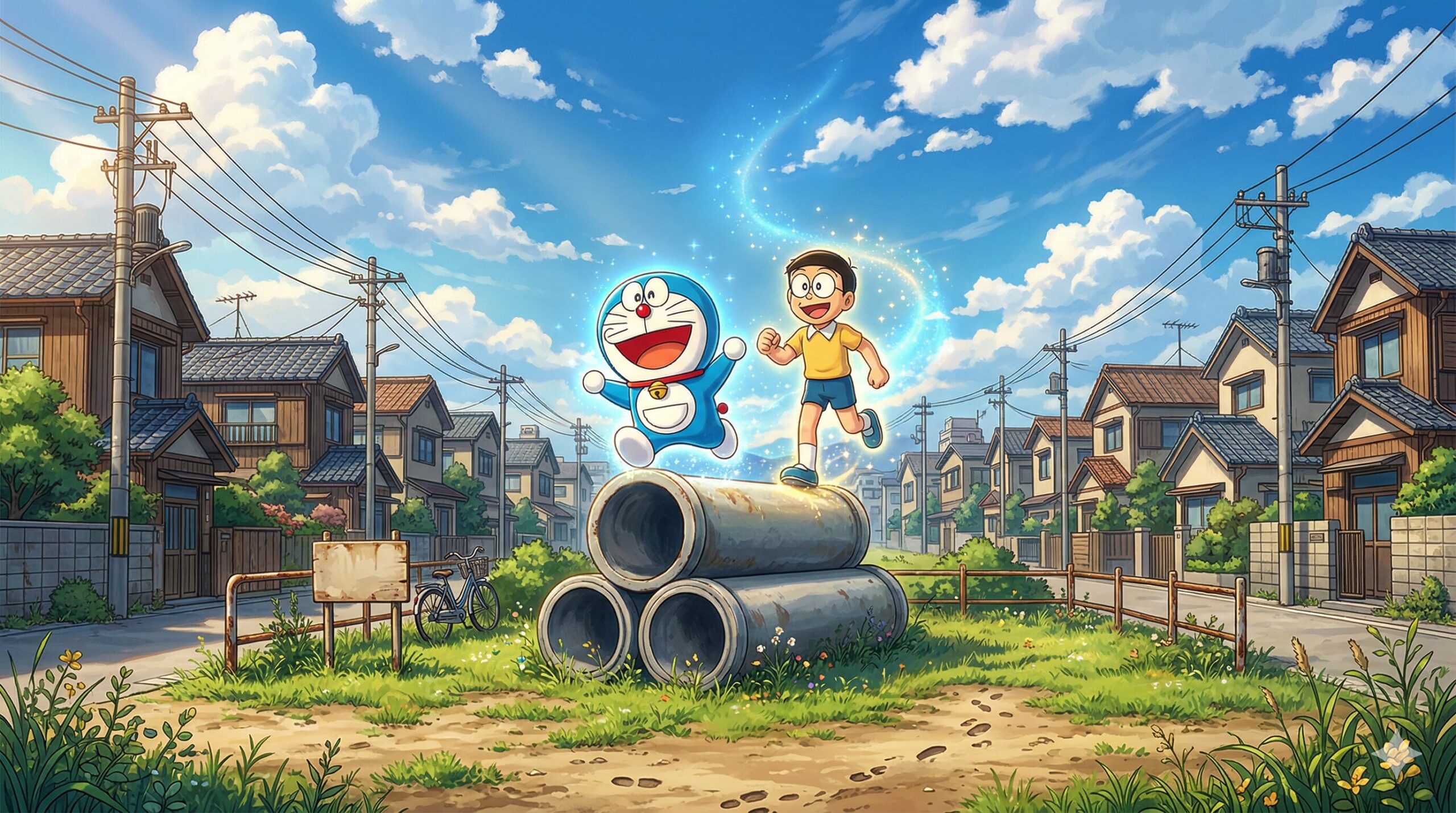
In the history of Japanese animation, April 2, 1979, stands as a monumental milestone. On this day, the anime series “Doraemon” began broadcasting on the TV Asahi network. Created by Fujiko F. Fujio, this blue robotic cat instantly captured the hearts of children across Japan and, over the following decades, soared across the globe as a definitive symbol of Japanese culture.
In this article, we will thoroughly explore the history of “Doraemon,” which transcends the boundaries of a mere children’s cartoon to become deeply rooted in Japan’s views on technology and spirituality. We will also decipher the essence of Japanese culture hidden within its narrative.
The Impact Brought by a Robotic Cat from the 22nd Century
The basic premise of “Doraemon” is remarkably simple, yet highly innovative. To change the disastrous future of Nobita Nobi, an elementary school boy who is terrible at both studying and sports, Nobita’s great-great-grandson Sewashi sends a caretaker robotic cat named “Doraemon” from the 22nd century. From the “4D Pocket” on Doraemon’s stomach emerges an endless array of futuristic “Secret Gadgets” (Himitsu Dogu) that make the impossible possible.
When the broadcast began in 1979, Japan had gone through its period of rapid economic growth and was overflowing with hope for the development of science and technology. The Secret Gadgets in “Doraemon,” such as the “Anywhere Door” (Dokodemo Door) and the “Take-Copter” (Bamboo Copter), perfectly embodied the pure dreams of the people of that era (“I wish I could do this!”) and the optimistic vision for Japan’s technological prowess.
“Sukoshi Fushigi” (A Little Wondrous) and the Original Landscape of the Showa Era
The original creator, Fujiko F. Fujio, defined his work not as hard “Science Fiction,” but as “SF” standing for “Sukoshi Fushigi” (A Little Wondrous). This very concept is the primary reason why “Doraemon” established a special status in Japanese popular culture.
The setting of the story is not a distant galaxy or a futuristic metropolis, but a typical suburban Japanese town in the 1970s. Rooms with tatami mats, Doraemon sleeping in a sliding closet (oshiire), empty neighborhood lots with stacked concrete pipes, and the formidable local neighborhood bully. Into this traditional and nostalgic everyday Japanese space, hyper-advanced future technology is suddenly introduced. This fusion of the “overwhelmingly ordinary” and “extraordinary technology” strongly reflects the Japanese cultural foundation of embracing technological advancement not as something to be feared, but as a familiar presence that enriches daily life.
Learning from Failure: A Reflection of Japanese Moral Values
The most important cultural aspect to decipher from “Doraemon” is its educational nature. While Doraemon provides convenient gadgets, if Nobita misuses them, acts selfishly, or relies too heavily on the gadgets while neglecting his own effort, a disastrous outcome inevitably awaits.
This demonstrates a distinctly Japanese ethical and moral view: “Technology is merely an aid for humans; ultimately, it is a person’s own personal growth and compassion that solve problems.” No matter how advanced civilization becomes, the value of friendship, courage, and steady effort remains unchanged. This universal message is exactly why the series continues to be loved across generations and borders.
The Legacy of “Doraemon” in the Real World
Today, the influence of “Doraemon” extends far beyond the realm of anime. Many Japanese robotics engineers and scientists publicly state, “I watched Doraemon as a child and wanted to build robots that help people.” Behind Japan’s global leadership in the development of humanoid and life-support robots undoubtedly lies the vision of “friendly coexistence between humans and robots” planted by this blue cat.
For those who wish to dive deeper, please utilize the following links:
- Internal Link: What’s Today’s Special Day Series
- External Link: Doraemon Official Website (Doraemon Channel)
- External Link: Fujiko F. Fujio Museum in Kawasaki City
Which “Secret Gadget” Would You Choose?
If Doraemon appeared before you right now and offered to take out just one Secret Gadget from his 4D pocket, what would you choose? Would it be the “Time Machine” because there is something in your past you wish to redo? Or perhaps the “Anywhere Door” to instantly visit a loved one far away? The gadget you choose inevitably reflects your current desires and struggles. Please take a moment to face the wishes in your heart, and use this as a catalyst to take a new step toward your own future.
- The Impact Brought by a Robotic Cat from the 22nd Century
- “Sukoshi Fushigi” (A Little Wondrous) and the Original Landscape of the Showa Era
- Learning from Failure: A Reflection of Japanese Moral Values
- The Legacy of “Doraemon” in the Real World
- Which “Secret Gadget” Would You Choose?
- 4月2日:未来からの使者、アニメ『ドラえもん』が日本のテレビを席巻した日(1979年)
4月2日:未来からの使者、アニメ『ドラえもん』が日本のテレビを席巻した日(1979年)
日本のアニメーションの歴史において、1979年4月2日は極めて重要なマイルストーンです。この日、テレビ朝日系列でアニメ『ドラえもん』の放送が開始されました。藤子・F・不二雄が生み出したこの青い猫型ロボットは、瞬く間に日本中の子どもたちの心を掴み、その後数十年にわたり、日本文化の象徴として世界中へ羽ばたくことになります。
この記事では、単なる子供向けアニメの枠を超え、日本のテクノロジー観や精神性にまで深く根付いている『ドラえもん』の歴史と、そこから読み解ける日本文化の真髄について詳しく解説します。
22世紀から来たネコ型ロボットがもたらした衝撃
『ドラえもん』の基本的なストーリーは非常にシンプルでありながら、革新的でした。勉強も運動も苦手な小学生、野比のび太の悲惨な未来を変えるため、のび太の孫の孫であるセワシが、22世紀の未来からお世話係のネコ型ロボット「ドラえもん」を送り込みます。ドラえもんのお腹にある「四次元ポケット」からは、不可能を可能にする未来の「ひみつ道具」が次々と飛び出します。
1979年の放送開始時、日本は高度経済成長期を経て、科学技術の発展に対する希望に満ち溢れていました。『ドラえもん』に登場する「どこでもドア」や「タケコプター」、「タイムマシン」といったひみつ道具は、当時の人々が抱いていた「こんなことができたらいいな」という純粋な夢と、日本の技術力に対する楽観的な未来像を完璧に体現していました。
「すこし・不思議(SF)」と昭和の原風景
原作者の藤子・F・不二雄は、自身の作品を「サイエンス・フィクション(Science Fiction)」ではなく、「すこし・不思議(Sukoshi Fushigi)」の略である「SF」と定義しました。この概念こそが、『ドラえもん』が日本の大衆文化において特別な地位を築いた最大の理由です。
物語の舞台は、遠い宇宙や近未来の都市ではなく、1970年代の日本の典型的な郊外の町です。畳敷きの部屋、押し入れで眠るドラえもん、空き地に置かれた土管、そして近所の手ごわいガキ大将。こうした日本の伝統的でノスタルジックな日常空間の中に、突如として超高度な未来のテクノロジーが持ち込まれます。この「圧倒的な日常」と「非日常のテクノロジー」の融合は、技術発展を恐れるのではなく、生活を豊かにする身近なものとして受け入れる日本の文化的な土壌を色濃く反映しています。
失敗から学ぶ、日本的道徳観の反映
『ドラえもん』から読み解くべき最も重要な文化的側面は、その教訓性にあります。ドラえもんは便利な道具を出してくれますが、のび太がその道具を悪用したり、自分の努力を怠って道具に依存しすぎたりすると、必ずしっぺ返しを食らう結末が待っています。
これは、「テクノロジーはあくまで人間の補助であり、最終的に問題を解決するのは人間自身の成長と思いやりの心である」という、日本特有の倫理観と道徳観を示しています。どんなに文明が発達しても、友情、勇気、そして地道な努力の価値は変わらない。この普遍的なメッセージが、時代や国境を越えて愛され続ける理由です。
現実社会における『ドラえもん』の遺産
現在、『ドラえもん』の影響はアニメの枠に留まりません。日本の多くのロボット工学者や科学者は、「子供の頃にドラえもんを見て、人間を助けるロボットを作りたいと思った」と公言しています。日本がヒューマノイドロボットや生活支援ロボットの開発において世界を牽引している背景には、間違いなくこの青いロボットが植え付けた「人間とロボットの友好的な共存」というビジョンがあります。
さらに深く知りたい方は、以下のリンクもご活用ください。
- 内部リンク:今日は何の日シリーズ一覧
- 外部リンク:ドラえもん公式サイト(ドラえもんチャンネル)
- 外部リンク:川崎市 藤子・F・不二雄ミュージアム
あなたなら、どの「ひみつ道具」を選びますか?
もし今、あなたの目の前にドラえもんが現れて、四次元ポケットから一つだけひみつ道具を出してくれるとしたら、あなたは何を選びますか? 過去に戻ってやり直したいことがあるから「タイムマシン」でしょうか。それとも、遠く離れた大切な人に一瞬で会いに行ける「どこでもドア」でしょうか。あなたが選ぶ道具には、あなた自身の現在の願いや悩みが投影されているはずです。ぜひ、あなたの心の中の願いと向き合い、未来への一歩を踏み出すきっかけにしてみてください。


コメント