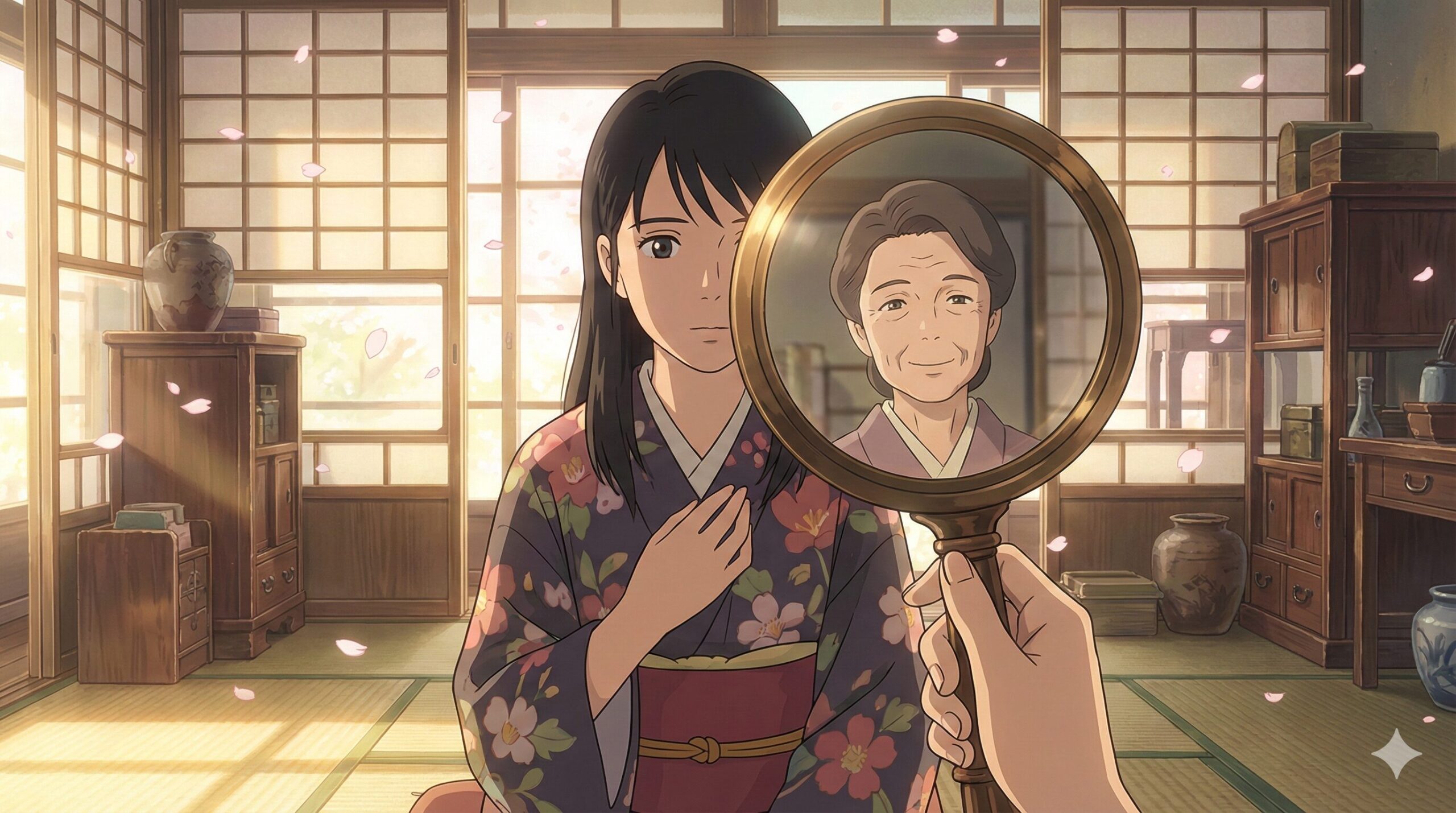
While Japan boasts countless folktales, few are as poignant or reflective of the Japanese soul as “Miyako Kagami” (The Mirror of the Capital), also known as “The Mirror of Matsuyama.” This story is not merely a fairy tale; it is a profound lesson on the spiritual significance of mirrors in Japanese culture and the eternal bond of family. Let us rediscover the truth that modern mirrors often fail to show us.

1. The Story of “Miyako Kagami”
Once upon a time, in a quiet village called Matsuyama in Echigo province (modern-day Niigata Prefecture), there lived a devoted couple and their adorable young daughter.
One day, the father had to travel to the capital, Kyoto, for business. For villagers of that era, Kyoto was a distant dream, a dazzling world far removed from their rustic lives.
The wife and daughter prayed for his safety and waited patiently. Days turned into weeks, until finally, the father returned safely.
As a souvenir for his wife, the father produced a beautiful wooden box.
“This is called a ‘mirror’ (Kagami),” he explained. “In the capital, women use this to reflect their appearance and groom themselves.”
Mirrors were unknown in the countryside at that time. The wife timidly opened the box and peered into the shining silver disc inside.
To her astonishment, a beautiful woman was smiling back at her.
“Oh my! What a beautiful lady is looking at me,” she exclaimed, blushing. She did not realize she was looking at herself. The father laughed and gently explained that the image was her own reflection.
The wife cherished the mirror deeply. However, she did not use it for vanity. Thinking, “I will give this to my daughter when she grows up,” she hid it away deep in a chest of drawers, showing it to no one.
Time passed, and the daughter grew into a beautiful young woman. Sadly, the mother fell ill. Realizing her time was short, she called her daughter to her bedside and handed her the wooden box.
“When I am gone and you feel overcome with loneliness, open this box. You will find me there. I will always be with you.”
With these words, the mother passed away.
The daughter’s grief was immeasurable. She cried day after day. Then, she remembered her mother’s promise and opened the wooden box.
Trembling, she looked into the mirror. There, she saw her beloved mother.
“Mother! You really are here!”
The daughter was overjoyed. The face in the mirror was actually her own, grown to look exactly like her mother, but in her innocence, she believed it was her mother’s spirit.
From that day on, the daughter spoke to the mirror every day. She shared her joys, her sorrows, and her daily life. The mother in the mirror always listened with a gentle smile, and the daughter gradually regained her cheerfulness.
Eventually, the father noticed his daughter talking happily to someone in her room.
Puzzled, he peeked in and saw her earnestly addressing the mirror.
“Who are you talking to?” he asked.
The daughter turned with a radiant smile. “I am talking to Mother. She is always in the mirror, watching over me.”
The father was struck with a realization. The reflection was his daughter, yet the expression was the living image of his late wife.
Tears streamed down his face as he held his daughter’s hand.
“Yes, you are right. Your mother is always with you. Because your heart is so pure, she smiles back at you just as purely.”
The father and daughter, together with the mother in the mirror, lived happily ever after.
2. Analysis: Why Did She See Her Mother?
From a modern perspective, one might ask, “How could she not know her own face?” However, this plot point carries deep psychological and cultural weight.
- Innocence and Lack of Information: In rural Japan of the past, distinct reflections were rare, seen only in still water. A polished metal mirror was akin to magic technology.
- Psychology of Identification: The daughter loved her mother deeply. Children naturally mimic their parents’ expressions. When the daughter looked in the mirror, the face she saw—perhaps fighting back tears or smiling with relief—perfectly matched her memory of her mother.
- Biological Truth: As the daughter aged, she naturally resembled her mother. The story illustrates the biological and spiritual truth that “parents live on within their children.”
- The Purity of Heart: In Japanese folklore, only the pure of heart can see the truth. Her inability to recognize her “ego” (herself) highlights her selflessness.
3. Decoding Japanese Culture: The Mirror is Divine
The core of this story lies in the Japanese concept of the “Mirror” (Kagami).
“Kagami” without “Ga” (Ego) is “Kami” (God)
There is a famous teaching in Shintoism derived from wordplay:
“Kagami” (Mirror) – “Ga” (Ego/Self) = “Kami” (God)
This means that when you remove your ego and impurities from your reflection, the divine nature within you surfaces. The daughter saw her mother (a revered ancestor/spirit) because her heart was free of “Ga” (ego).
The Mirror as a Sacred Object
One of the Three Sacred Treasures of the Japanese Imperial Family is the Yata no Kagami (The Sacred Mirror). In mythology, the Sun Goddess Amaterasu said, “Worship this mirror as if it were me.”
Thus, in Japan, a mirror is historically considered a vessel for the soul (Yorishiro).
The mother’s claim that “I am inside the mirror” was not a lie; it was consistent with the ancient Japanese belief that spirits reside in mirrors.
4. A Question for You
We look in the mirror every morning to check our hair or makeup. But is that all we see?
If you were to look into a mirror with a heart as pure as the daughter in the story, what—or who—would you see?
Can you smile at your reflection with true honesty?
The next time you face a mirror, try to look beyond the surface and gaze into your own soul.
Japanese folktales hold many such beautiful secrets. Please explore more stories here.
Category: Japanese Folktale Series
Reference (Cultural Background): Wikipedia – Yata no Kagami (The Sacred Mirror)
魂を映す銀盤:日本の昔話「みやこ鏡」が教える真実の愛
日本には、無数の昔話が存在しますが、これほどまでに美しく、そして日本人の宗教観や家族愛を象徴する物語はありません。今回は「みやこ鏡(Miyako Kagami)」、またの名を「松山鏡」と呼ばれる物語をご紹介します。現代の私たちが忘れてしまった「鏡」の本当の意味を、この物語は教えてくれます。
1. 昔話「みやこ鏡」のあらすじ
むかしむかし、越後(現在の新潟県)の松山という村に、とても仲の良い夫婦と、その二人の間に生まれた愛らしい娘が住んでいました。
ある日、夫は用事で都(京都)へ行くことになりました。当時の田舎の人々にとって、都は夢のような場所であり、一生に一度行けるかどうかの遠い世界でした。
妻と娘は、夫の無事を祈りながら留守を守りました。そして数日後、夫は無事に村へ帰ってきました。
夫は、妻への土産として、美しい木箱を取り出しました。
「これは『鏡』というものだ。都では、これで自分の姿を映して身だしなみを整えるのだそうだ」
当時の田舎には、まだ鏡というものがありませんでした。妻はおそるおそる箱を開け、中にある銀色に輝く円盤を覗き込みました。
すると、そこには驚くほど美しい女性がこちらを見て微笑んでいるではありませんか。
「あら、まあ。なんと美しい方がこちらを見ているのでしょう」
妻は、それが自分の姿だとは気づかず、恥ずかしそうに言いました。夫は笑いながら、それが自分自身の姿であることを教えました。
妻は、その鏡をとても大切にしました。しかし、自分が鏡を見るためではなく、「いつか娘が大きくなった時のために」と、誰にも見せず、箪笥の奥深くにしまっておいたのです。
時は流れ、娘は美しく成長しましたが、悲しいことに母は病に倒れてしまいました。
死期を悟った母は、娘を枕元に呼び、あの木箱を渡しました。
「私が死んで、どうしても寂しくてたまらなくなったら、この箱を開けてごらん。そこには私がいて、いつでもお前に会えるからね」
そう言い残し、母は息を引き取りました。
母を失った娘の悲しみは深く、来る日も来る日も泣いてばかりいました。そんなある日、娘は母の言葉を思い出し、木箱を開けました。
恐る恐る鏡を覗き込むと、そこには懐かしい母の姿があったのです。
(お母さん!やっぱりここにいたのね!)
娘は驚き、喜びました。鏡に映っていたのは、母によく似て美しく成長した自分自身の姿でしたが、純粋な娘はそれを母だと信じ込んだのです。
それからというもの、娘は毎日鏡に向かって語りかけました。楽しかったこと、悲しかったこと、今日の出来事。鏡の中の母は、いつも優しく微笑み、娘の話を聞いてくれました。
娘は悲しみを乗り越え、明るさを取り戻していきました。
ある時、父は娘が部屋で一人、誰かと楽しそうに話しているのに気づきました。
不思議に思い部屋を覗くと、娘が鏡に向かって一生懸命に話しかけているのです。
「お前、一体誰と話しているんだい?」
父が尋ねると、娘は輝くような笑顔で答えました。
「お母さんと話しているの。お母さんはいつも鏡の中にいて、私を見ていてくれるのよ」
父はハッとしました。鏡に映っているのは娘自身ですが、その表情は亡き妻に生き写しだったのです。
父は涙を流し、娘の手を取りました。
「そうか、そうだな。お母さんはいつもお前の中にいる。お前の心が清らかだから、お母さんも同じように微笑んでくれるんだ」
父と娘は、鏡の中の母と共に、いつまでも幸せに暮らしました。
2. 考察:なぜ娘は自分の顔を母と間違えたのか?
この物語には、現代的な視点で見ると「自分の顔を知らないなんてありえない」という疑問が湧くかもしれません。しかし、ここには深い心理的、文化的背景があります。
- 情報の欠如と純粋性: 当時の農村部では、水鏡(水面に映る姿)以外に自分の顔を見る手段はほとんどありませんでした。鮮明に映る金属製の鏡は、未知のテクノロジーであり、魔法のような物体だったのです。
- 同一化の心理: 娘は母を深く愛していました。心理学的に、子供は親の表情や仕草を模倣します。娘が鏡を見た時、そこに映った「泣き出しそうな、でも必死に耐えている顔」あるいは「母に会えて嬉しそうな顔」は、記憶の中の母の表情と完全にリンクしたのです。
- 血のつながりという真実: 娘が成長するにつれ、亡き母に似てくるというのは自然の摂理です。この物語は、「子供の中に親は生き続ける」という生物学的かつ精神的な真実を、ファンタジーとして描いています。
3. 日本文化の解読:「鏡」は神である
この物語の核心は、「鏡(Kagami)」という存在にあります。日本の精神文化において、鏡は単なる化粧道具ではありません。
「かがみ」から「が」を取ると「かみ」になる
日本語の言葉遊びのようですが、これは神道の教えの一つです。
「かがみ(Kagami)」―「が(Ga = 自我/Ego)」=「かみ(Kami = God)」
鏡に映る自分から、欲や汚れ(我)を取り除いた時、そこには神の性質が現れるという意味です。
娘が鏡の中に母を見出したのは、彼女の心が「我(エゴ)」のない、純粋無垢な状態だったからです。彼女の曇りのない心が、鏡というメディアを通して、神聖な存在(母の魂)と接続したと言えます。
三種の神器としての鏡
日本の皇室に伝わる「三種の神器」の一つは「八咫鏡(やたのかがみ)」です。日本の神話において、最高神である天照大御神(アマテラスオオミカミ)は、「この鏡を私だと思って祀りなさい」と言いました。
つまり、日本では古来より「鏡 = 魂の依り代」なのです。
母が「鏡の中に私がいる」と言ったのは、単なる慰めではなく、日本古来の信仰に基づいた「魂の継承」の儀式だったと解釈できます。
4. 読者の皆様へ:あなたの鏡には何が映りますか?
現代の私たちは、毎朝鏡を見ます。しかし、そこに映っているのは、単なる「物理的な顔」だけでしょうか?
もし、あなたがこの物語の娘のように、純粋な心で鏡を覗き込んだとしたら、そこには愛する誰かや、あなた自身の魂の形が映るのかもしれません。
あなたは、鏡の中の自分に胸を張って微笑むことができますか?
ぜひ、次に鏡を見る時は、表面的な美しさだけでなく、その奥にある「心」を見つめてみてください。
日本の昔話には、このような美しい心がたくさん隠されています。他の物語もぜひ読んでみてください。
カテゴリー:Japanese Folktale Series
参考リンク(文化背景):Wikipedia – 八咫鏡(Yata no Kagami)について

コメント