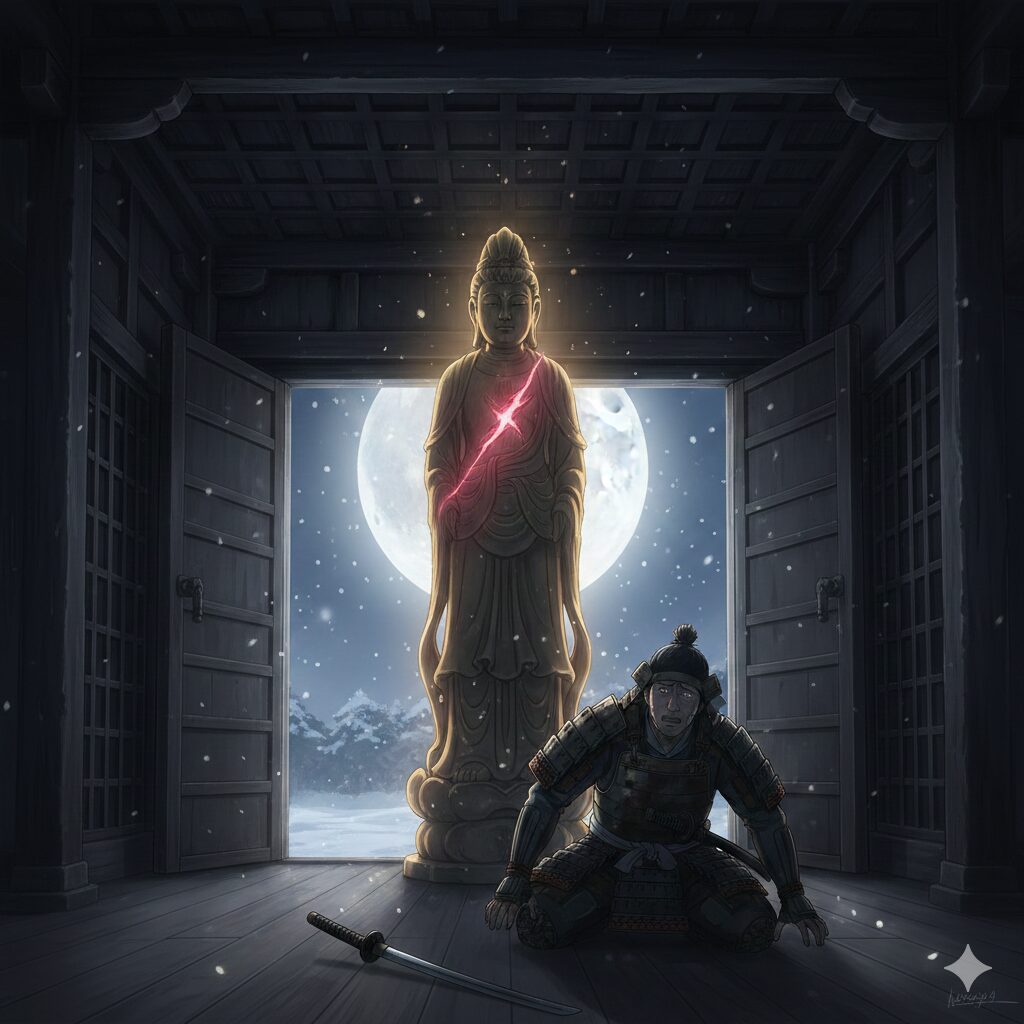
Japanese legends often tell of the invisible power of prayer creating physical miracles. Today, I want to introduce a story that is particularly famous and strikes a deep chord even in the modern heart: the tale of the “Migawari Kannon” (The Substitute Kannon). It is a story about the strength of belief and the great presence that protects it. Please read on with a quiet heart.

- Chapter 1: The Pious Osato and Her Violent Husband
- Chapter 2: The Forbidden Prayer
- Chapter 3: The Blade in the Moonlight
- Chapter 4: An Impossible Morning
- Chapter 5: The Miracle of Substitution
- Analysis: Why Did Kannon Become a “Substitute”?
- Cultural Connection: Animism and Compassion
- A Question for You
- 第一章:信心深いお里と乱暴な夫
- 第二章:禁じられた祈り
- 第三章:月夜の刃
- 第四章:ありえない朝
- 第五章:身代わりの奇跡
- 考察:なぜ観音は「身代わり」になったのか
- 日本文化との関連:アニミズムと慈悲
- 読者への問いかけ
Chapter 1: The Pious Osato and Her Violent Husband
Long, long ago, in a small village, there lived a very good-natured young woman named Osato. She was kind to everyone, a hard worker, and praised by all the villagers. However, Osato had one worry she could not tell anyone.
That worry was her husband, Jingoro. Jingoro was a skilled samurai, but he was short-tempered, violent, and above all, a man who openly declared that “Gods and Buddhas are useless.”
Osato’s emotional support was the “Kannon” (Goddess of Mercy) enshrined in a small hall on the outskirts of the village. Every day, between her work in the fields, she would go to the small hall and press her hands together in prayer. “Please let my husband’s heart find peace. Let this home be peaceful.” It was a prayer not for herself, but for her husband.
Chapter 2: The Forbidden Prayer
One day, Jingoro found out that Osato was visiting the hall daily. “What is the use of bowing your head to a wooden doll without making my meals!” he raged at Osato. “From now on, you are forbidden to go to that hall. If you break this rule, you will pay dearly.”
Osato held back her tears and agreed. However, she could not extinguish her faith in Kannon. Late at night, after her husband had fallen asleep, she began to sneak out of the house and head to the hall in the darkness. Even on snowy nights, even on stormy nights, she never missed a visit.
Chapter 3: The Blade in the Moonlight
It happened on a night of the full moon. Jingoro suddenly woke up and realized Osato was not next to him. “That woman, she broke my command again.”
Jingoro’s anger reached its peak. He grabbed the sharp katana hanging on the wall and ran out of the house barefoot. Under the moonlight, he saw Osato’s small back as she prayed intently in front of the hall.
“I will finish you!”
With a shout, Jingoro swung his sword down with all his might from behind her.
SLASH!
There was a definite sensation. With a dull sound like cutting through bone, Osato collapsed on the spot.
“Hmph, you got what you deserved.” Jingoro shook the blood off his sword and, without even checking on his fallen wife, returned home with trembling legs. He crawled into his futon, but excitement and fear kept him from sleeping until morning.
Chapter 4: An Impossible Morning
The next morning, Jingoro woke up to the chirping of sparrows. From inside the house, he could hear the rhythmic chopping sound of a knife. And then, the savory smell of miso soup wafted through the air.
“…It can’t be.”
When Jingoro fearfully peeked into the kitchen, there was Osato, making breakfast as usual. She was without a single scratch and smiling. “Good morning, darling. Breakfast is ready.”
Jingoro was so shocked he nearly collapsed. “Y-You… you were at the hall last night, weren’t you? I definitely… I killed you…”
“Yes, I went to the hall, but I came back right after saying my prayers,” Osato said with a puzzled look. Jingoro, unable to understand, ran out of the house and dashed to the hall at the edge of the village.
Chapter 5: The Miracle of Substitution
When Jingoro arrived at the hall, he threw the doors open violently. There stood the Kannon statue, standing quietly. But Jingoro gasped.
From the left shoulder to the chest of the Kannon statue, there was a deep, terribly deep sword cut, at the exact same angle as the blow he had struck last night. And from that wound, red lacquer, resembling blood, was flowing down.
“Ah… what have I done…”
Jingoro fell to his knees. Osato’s pure prayer had reached Kannon. And Kannon, to protect Osato’s life, had taken Jingoro’s blade upon her own body.
Jingoro rubbed his forehead against the ground, weeping loudly and apologizing. Afterward, it is said that he changed his ways and, together with Osato, cherished and protected Kannon for the rest of his life.
Analysis: Why Did Kannon Become a “Substitute”?
This story does not end as a mere “mysterious tale.” It contains deep implications regarding the Japanese view of religion and the repair of human relationships.
1. Mechanism for Forgiving Sin
Jingoro committed the grave sin of attempted murder. Usually, this means ruin. However, because Kannon became a “substitute” (Migawari), Osato’s life was saved, and at the same time, Jingoro avoided committing the definitive sin of “wife-killing.” Kannon saved Osato’s physical life while simultaneously saving Jingoro’s soul (his path as a human).
2. Visualization of Faith
Osato’s faith was incomprehensible to Jingoro. However, it was only through the physical phenomenon of the “wooden statue being wounded” that Jingoro came to believe in the “invisible power.” Since ancient times, Japanese people have tended to sense the divine through such “worldly benefits” and “miraculous phenomena” rather than through verbal persuasion.
Cultural Connection: Animism and Compassion
The core of Japanese culture deciphered from the story of the “Substitute Kannon” is the fusion of Animism (the belief that souls dwell in objects) and the Buddhist concept of Compassion.
- Statues are not mere sculptures: In Japan, Buddhist statues are not just wood or stone. Statues that have undergone the “eye-opening ceremony” (a ritual to instill a soul) are treated as living deities. That is why they can shoulder human pain.
- The Role of Kannon (Bodhisattva): Kannon Bodhisattva is said to hear the voices of all suffering in this world and offer salvation. The “substitution” in this story is the ultimate form of self-sacrifice and overlaps with the ideal image of a leader or mother figure in Japan.
A Question for You
If you were in Jingoro’s position, what would you think upon seeing the “wounded Kannon statue” before your eyes? Would it be fear, or would it be gratitude?
And if you were Osato, could you forgive the husband who tried to kill you and continue to live with him?
This story quietly asks us in the modern world: “What is forgiveness?” and “What does it mean to be protected?”
Related Links:
- Japanese Folktale Series (Internal)
- Buddhism in Japan (Japan Guide) – Learn more about Japanese religious beliefs.
【日本昔話】身がわり観音:刃を受け止めた慈悲の心
日本の古い伝説には、目には見えない「祈りの力」が物理的な奇跡を起こす物語が数多く存在します。今回紹介するのは、その中でも特に有名で、現代人の心にも深く刺さる「身がわり観音(Migawari Kannon)」のお話です。信じることの強さと、それを守る大いなる存在についての物語。どうぞ、静かな気持ちで読み進めてください。
第一章:信心深いお里と乱暴な夫
むかしむかし、ある小さな村に、お里(Osato)という名のたいへん気立ての良い娘がいました。彼女は誰に対しても優しく、働き者で、村の誰もが彼女を褒め称えていました。しかし、お里には一つだけ、誰にも言えない悩みがありました。
それは、彼女の夫である甚五郎(Jingoro)の存在です。甚五郎は腕の立つ侍でしたが、短気で乱暴者、そして何より「神や仏など役に立たない」と公言してはばからない男でした。
お里の心の支えは、村外れのお堂に祀られている「観音様(Kannon)」でした。彼女は毎日、畑仕事の合間を縫っては小さなお堂へ行き、手を合わせていました。「どうか夫の心が穏やかになりますように。この家が平和でありますように」。それは自分のためではなく、夫のための祈りでした。
第二章:禁じられた祈り
ある日、甚五郎はお里が毎日お堂に通っていることを知ります。「俺の飯も作らずに、ただの木偶の坊(でくのぼう)に頭を下げて何になる!」彼は激昂し、お里に言い放ちました。「今後、あのお堂に行くことは許さん。もし破れば、ただでは済まさんぞ」
お里は涙をこらえて承知しました。しかし、彼女の観音様への信仰心まで消すことはできません。彼女は夫が寝静まった深夜、そっと家を抜け出し、暗闇の中をお堂へと向かうようになりました。雪の降る夜も、嵐の夜も、彼女は欠かしませんでした。
第三章:月夜の刃
ある満月の夜のことです。甚五郎はふと目を覚まし、隣にお里がいないことに気づきました。「あの女、また俺の言いつけを破ったな」
甚五郎の怒りは頂点に達しました。彼は壁にかけてあった鋭い日本刀を手に取り、裸足のまま家を飛び出しました。月明かりの下、お堂の前で一心不乱に手を合わせるお里の小さな背中が見えました。
「成敗してくれる!」
甚五郎は叫び声と共に、背後から思い切り刀を振り下ろしました。
ズドン!
確かな手応えがありました。骨を断つような鈍い音と共に、お里はその場に崩れ落ちました。
「ふん、自業自得だ」。甚五郎は血のついた刀を振り払い、倒れた妻を確認もしないまま、震える足で家に戻りました。布団に潜り込みましたが、興奮と恐怖で朝まで眠ることはできませんでした。
第四章:ありえない朝
翌朝、雀の鳴き声と共に甚五郎は目を覚ましました。家の中からは、トントンと小気味よい音が聞こえてきます。そして、味噌汁の香ばしい匂いが漂ってきました。
「……まさか」
甚五郎が恐る恐る台所を覗くと、そこには普段と変わらない様子で朝食を作るお里の姿があったのです。傷ひとつなく、微笑んでいます。「あなた、おはようございます。ご飯ができましたよ」
甚五郎は腰を抜かさんばかりに驚きました。「お、お前、昨夜お堂にいただろう? 俺は確かにお前を……」
「はい、お堂には行きましたが、お祈りを済ませてすぐに帰りましたよ」とお里は不思議そうな顔をします。甚五郎は訳が分からず、家を飛び出して村外れのお堂へと走りました。
第五章:身代わりの奇跡
お堂に着いた甚五郎は、扉を乱暴に開け放ちました。そこには、静かに佇む観音像があります。しかし、甚五郎は息を飲みました。
観音像の左肩から胸にかけて、昨夜彼が振り下ろした刀傷と同じ角度で、深い、あまりにも深い刀傷が入っていたのです。そして、その傷口からは、赤い血のような漆が流れ落ちていました。
「ああ……なんとことだ……」
甚五郎はその場に崩れ落ちました。お里の純粋な祈りが、観音様に届いていたのです。そして観音様は、お里の命を守るために、自らの身を呈して甚五郎の刃を受け止めたのでした。
甚五郎は地面に額を擦り付け、大声で泣きながら詫びました。その後、彼は心を入れ替え、お里と共に観音様を生涯大切に守り続けたといいます。
考察:なぜ観音は「身代わり」になったのか
この物語は、単なる「不思議な話」では終わりません。ここには日本人の宗教観と、人間関係の修復に関する深い示唆が含まれています。
1. 罪を許すためのメカニズム
甚五郎は殺人未遂という重罪を犯しました。通常であれば、これは破滅を意味します。しかし、観音様が「身代わり」になることで、お里の命は助かり、同時に甚五郎は「妻殺し」という決定的な罪を犯さずに済みました。観音様は、お里の命を救うと同時に、甚五郎の魂(人間としての道)をも救ったのです。
2. 信仰心の可視化
お里の信仰は、甚五郎には理解できないものでした。しかし、「木像が傷つく」という物理的な現象を通して初めて、甚五郎は「目に見えない力」を信じることになりました。日本人は古来より、言葉での説得よりも、こうした「現世利益」や「不思議な現象」を通じて神仏を感じ取る傾向があります。
日本文化との関連:アニミズムと慈悲
「身代わり観音」の物語から読み解ける日本文化の核心は、「物にも魂が宿る」というアニミズム的思考と、仏教の「慈悲(Compassion)」の融合です。
- 仏像は単なる彫刻ではない: 日本では、仏像はただの木や石ではありません。開眼供養(魂を入れる儀式)を経た仏像は、生きている神仏そのものとして扱われます。だからこそ、人間の痛みを肩代わりすることができるのです。
- Kannon (Bodhisattva) の役割: 観音菩薩は、この世のあらゆる苦しみの声を聴き、救済するとされています。この物語における「身代わり」は、自己犠牲の究極の形であり、日本人が理想とするリーダー像や母親像にも重なります。
読者への問いかけ
もしあなたが甚五郎の立場だったら、目の前の「傷ついた観音像」を見て何を思いますか? 恐怖でしょうか、それとも感謝でしょうか。
そして、もしあなたがお里なら、自分を殺そうとした夫を許し、共に生きていくことができるでしょうか?
この物語は、現代の私たちに「許し」とは何か、「守られる」とはどういうことかを静かに問いかけています。
関連リンク(Related Links):
- Japanese Folktale Series (Internal)
- 観音菩薩について (Wikipedia) – 日本における観音信仰の基礎知識

コメント