Japanese folktales sometimes introduce heroes who defy modern common sense. They are neither brave nor hardworking. They simply “exist,” and yet, they attract incredible good fortune. The story I will introduce today, “Koban no Mushiboshi” (The Airing of the Gold Coins), depicts the interaction between such a mysteriously charming “greedy-less hero” and mice, which are symbols of wealth in Japan. Why did doing absolutely nothing result in the greatest reward? Let’s unravel this mystery.

1. The Story of “The Airing of the Gold Coins”
Long, long ago, in a quiet village in Japan, there lived a boy named Taro.
Taro was known as the laziest person in the village. Even though he was old enough to work, he didn’t help around the house or till the fields with a hoe. Every single day, he would just spend his time gazing blankly at the clouds floating in the sky or staring at the flowers by the roadside. The villagers were exasperated, saying, “He is hopeless,” but Taro’s heart was always calm and free from conflict.
One sunny autumn day, invited by a pleasant breeze, Taro wandered up to the mountain behind the village as usual.
“Ah, this feels so good…”
Taro lay down on the grassy field with his arms and legs spread wide. The soft autumn sunlight warmed his eyelids, and before he knew it, he fell into a deep sleep.
How much time had passed? When Taro suddenly woke up, he heard a strange sound right by his ears.
“Charin, Charin… Charin, Charin…”
It was a cool, mysterious sound, like bells ringing or beautiful metals touching each other.
“What could that be?”
When Taro gently turned his gaze toward the sound, an unbelievable scene unfolded before him.
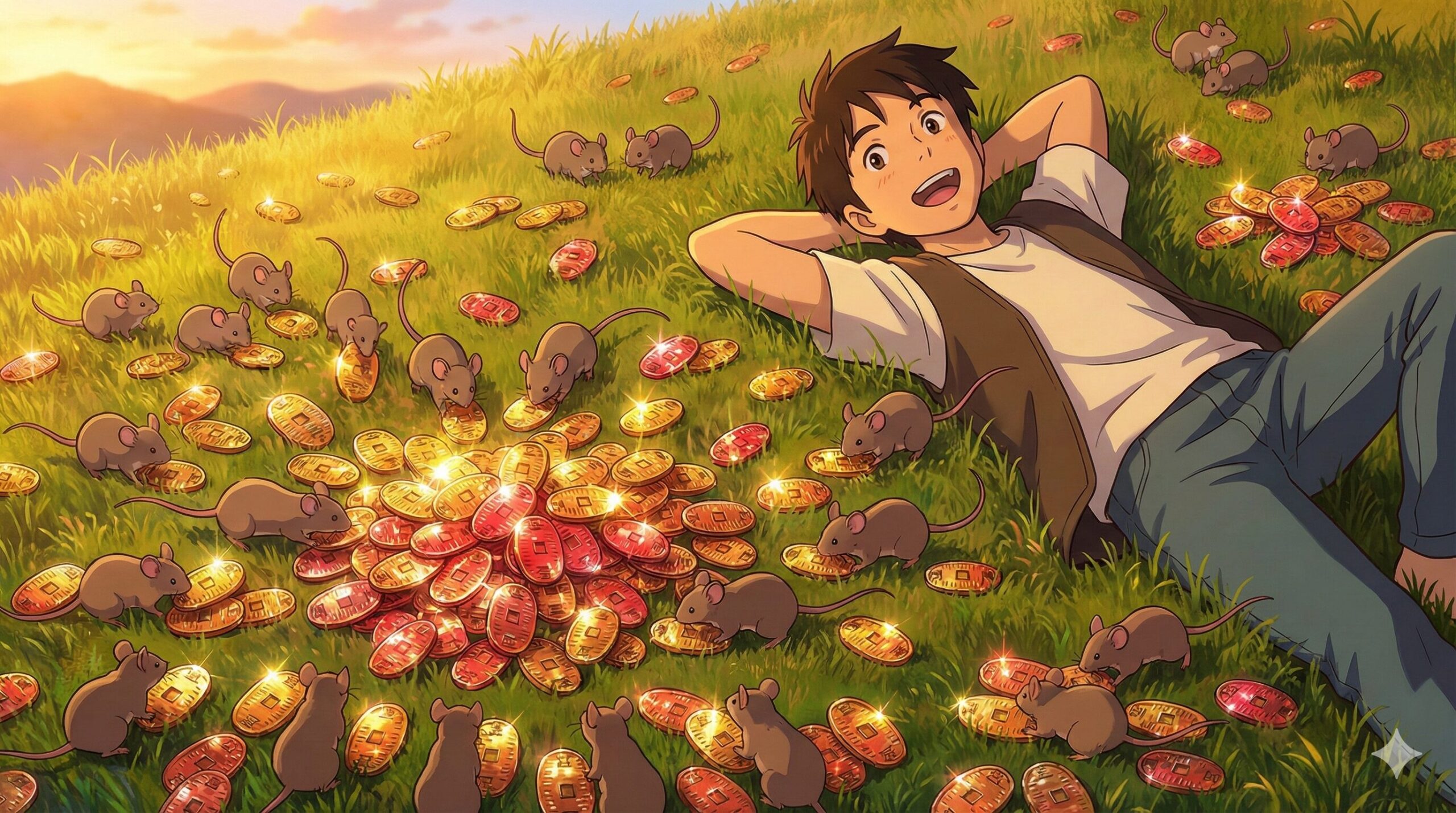
Surprisingly, countless mice were climbing up the mountain in a line. And they weren’t just ordinary mice. On their backs, they carried large “golden coins” (Koban) that were as big as their own bodies.
The mice carried the coins to an open space in the grass, as if shouting “Heave-ho, heave-ho.” Then, one by one, they carefully began to line them up on the ground. It was the task of “Mushiboshi” (airing out), a practice of exposing kimonos and tools to the wind to prevent mold and moisture.
Before long, the entire field was dyed in gold.
The light of the setting sun reflected off the gold coins, emitting a dazzling sparkle. Sometimes it looked like a burning red, sometimes a clear blue, and sometimes a divine gold. The spectacle was so beautiful it seemed unearthly.
An ordinary person would likely feel greed here. They might think, “I’ll steal one,” or “I’ll scare them and take it all for myself.”
But Taro was different.
“Wow, it’s so beautiful…”
Taro was simply captivated by the pure beauty of the shine. He didn’t want the coins, nor did he try to catch the mice; he just gazed at the fantastic scenery as if looking at a beautiful painting.
Eventually, as the sun set and the surroundings began to dim, the mice started moving again. Skillfully shouldering the lined-up coins, they lined up just as they had come and returned deep into their hole in the ground.
“Ah, that was fun.”
Having watched everything, Taro descended the mountain satisfied and went home.
That night, while Taro was having dinner with his family, someone knocked on the door, Ton, ton.
“Who could it be at this late hour?”
When Taro’s father and mother opened the door in wonder, there was no human figure, but one of the mice from earlier in the day, sitting politely.
The mouse spoke in human language:
“Taro-san, thank you for today. Because you were on the mountain all day, we were able to air out our precious treasures in peace, without being attacked by natural enemies like cats or other humans. This is a token of our gratitude.”
Saying so, the mouse left several shining gold coins at the entrance, bowed deeply, and vanished into the dark night.
Taro’s act of “watching without doing anything” had resulted in him becoming a bodyguard for the mice, bringing him great wealth.
2. Analysis: Why Was the “Lazy Man” Chosen?
At first glance, this story might seem like a tale of a man who just got lucky. However, reading it deeply reveals that it heavily reflects Japanese spirituality and views on nature.
The Power of “Mushin” (No Mind) and Nature
By social standards, Taro is a “lazybones.” However, his actions (or inaction) represented a state of purity without artifice, similar to “Mushin” (no mind/innocence) in Buddhism or Taoism. If he had been a diligent and calculating person, the moment he saw the gold coins, “greed” would have been born. That “bloodlust” or “desire” would have alerted the sensitive wild animals, the mice, causing them to flee.
Because Taro naturally blended into the scenery, the mice did not see him as a threat but rather accepted him as a “guardian.” This contains the paradoxical teaching that “surrendering to the natural flow often yields the best results, rather than trying to achieve something artificially.”
The Value of “Watching”
In modern society, “productivity” and “action” are prioritized. However, Taro in this story performed the act of “just gazing at beauty.” The sensibility to feel beautiful things as beautiful, and the kindness to watch over them without intervening—isn’t this the true reason he was rewarded? He was not “surveilling” them; he was “appreciating” them.
3. “Mice” and “Wealth” in Japanese Culture
To international readers, the ending where mice bring wealth might seem surprising. However, in Japanese culture, mice are very auspicious animals.
- Messenger of Daikokuten: The messenger of “Daikokuten,” one of Japan’s Seven Lucky Gods who governs wealth and fertility, is the mouse. Mice are often depicted with bales of rice at the feet of Daikokuten statues.
- Symbol of Prosperity: Because mice are prolific breeders, they are considered symbols of the prosperity of descendants. Also, through wordplay, “Nezumi” (mouse) is sometimes interpreted as “Nezu-mi” (sleeping-not body), implying working so hard without sleeping that the house prospers.
- Guardian of the House: In old Japanese houses, it was said that a house with mice would not catch fire and would not be poor (because there is food, mice are there), suggesting a kind of symbiotic relationship.
The “airing of gold coins” in this story looks like a sacred ritual to maintain abundant harvest (wealth), rather than mere money management. Taro was a rare human who was allowed to witness that ritual.
4. What Would You Do?
If you were in Taro’s position, what would you have done?
Seeing a mountain of gold spreading before your eyes, could you have just quietly stared at it, thinking, “It’s beautiful”? Or would you have wanted to slip one into your pocket?
We may be losing the time to just stop and gaze at beautiful things because we value busy movement too much. Taro’s way of life seems to teach modern people the “luxury of doing nothing” and the “victory of selflessness.”
Does your country’s folklore have stories where such “lazy people” succeed? Please let us know your thoughts.
References & Related Links
- Source: Manga Nippon Mukashibanashi Database (Koban no Mushiboshi)
- Japanese Folktale Series Category
【日本昔話】「小判の虫干し」に見る、無欲と幸運の不思議な関係
日本の昔話には、時として現代人の常識を覆すようなヒーローが登場します。彼らは勇敢でもなければ、勤勉でもありません。ただ、そこに「居る」だけで幸運を引き寄せてしまうのです。今回ご紹介する物語『小判の虫干し(こばんのむしぼし)』は、そんな不思議な魅力を持つ「無欲な主人公」と、日本における富の象徴「ネズミ」との交流を描いた物語です。なぜ、何もしないことが最大の報酬を生んだのか?その謎を紐解いていきましょう。
1. 昔話「小判の虫干し」のストーリー
むかしむかし、日本のとある静かな村に、太郎という男の子が住んでいました。
太郎は村一番の「怠け者」として知られていました。もう十分に働ける年齢だというのに、彼は家の手伝いをするでもなく、鍬(くわ)を持って畑を耕すでもありません。毎日毎日、ただ空に浮かぶ雲を眺めたり、道端の草花をぼんやりと見つめたりして過ごしていました。村の人々は「あいつは困ったもんだ」と呆れていましたが、太郎の心はいつも穏やかで、争い事とは無縁でした。
ある晴れた秋の日のことです。心地よい風に誘われて、太郎はいつものようにふらりと裏山へ登っていきました。
「ああ、いい気持ちだなぁ……」
太郎は景色の良い草原に大の字になって寝転がりました。秋の柔らかな日差しが彼のまぶたを温め、いつしか太郎は深い眠りに落ちてしまいました。
どれくらい時間が経ったでしょうか。太郎がふと目を覚ますと、耳元で不思議な音が聞こえてきました。
「チャリン、チャリン……チャリン、チャリン……」
それは、まるで鈴が鳴るような、あるいは美しい金属が触れ合うような、涼やかで神秘的な音でした。
「なんだろう?」
太郎が音のする方へそっと視線を向けると、そこには信じられない光景が広がっていました。
なんと、数え切れないほどのたくさんのネズミたちが、列をなして山を登ってくるのです。しかも、ただのネズミではありません。彼らの背中には、彼らの体ほどもある大きな「黄金の小判」が乗せられていたのです。
ネズミたちは「よいしょ、よいしょ」と掛け声をかけるように、草原の開けた場所へ小判を運び込みます。そして、一枚、また一枚と、丁寧に地面に並べ始めました。それは、湿気を防ぐために着物や道具を風に当てる「虫干し(むしぼし)」の作業でした。
やがて、草原一面が黄金色に染まりました。
夕暮れ時の太陽の光が小判に反射し、キラキラと眩い輝きを放ちます。ある時は燃えるような赤に、ある時は澄んだ青に、そして神々しい金色に。その光景は、この世のものとは思えないほど美しいものでした。
普通の人間であれば、ここで欲が出るでしょう。「一枚くらい盗んでやろう」とか、「驚かして独り占めしてやろう」と考えるかもしれません。
しかし、太郎は違いました。
「うわぁ、きれいだなぁ……」
太郎はただ純粋に、その美しい輝きに心を奪われていました。小判が欲しいとも思わず、ネズミを捕まえようともせず、ただただ、その幻想的な風景を、美しい絵画を見るように眺めていたのです。
やがて日が沈み、辺りが薄暗くなり始めると、ネズミたちは再び動き出しました。並べた小判を器用に背負うと、来た時と同じように整列して、地面の穴の奥深くへと帰っていきました。
「ああ、面白かった」
すべてを見届けた太郎は、満足して山を降り、家に帰りました。
その夜のことです。太郎が家で家族と夕食を囲んでいると、誰かが戸をトントンと叩きました。
「こんな夜更けに誰だろう?」
太郎のお父さんとお母さんが不思議に思って戸を開けると、そこには人間の姿はなく、昼間に見たあのネズミが一匹、ちょこんと座っていました。
ネズミは人間の言葉でこう言いました。
「太郎さん、今日はありがとうございました。あなたが一日中、山にいてくれたおかげで、私たちは天敵の猫や他の人間に襲われることなく、安心して大切な宝物の虫干しをすることができました。これは、そのお礼です」
そう言うと、ネズミは数枚の輝く小判を玄関に置き、深々と頭を下げて闇夜に消えていきました。
太郎の「何もしないで見守っていたこと」が、結果としてネズミたちの用心棒となり、大きな富をもたらしたのです。
2. 考察:なぜ「怠け者」が選ばれたのか?
この物語は一見すると、「運が良かった男の話」に思えるかもしれません。しかし、深く読み解くと、日本人の精神性や自然観が色濃く反映されていることが分かります。
「無為自然」と「無心」の力
太郎は社会的な基準で見れば「怠け者」です。しかし、彼の行動(あるいは非行動)は、作為のない純粋な状態、仏教や道教で言うところの「無心(Mushin)」に近い状態でした。もし彼が勤勉で計算高い人間だったら、小判を見た瞬間に「盗もう」という「欲」が生まれたはずです。その「殺気」や「欲」は、敏感な野生動物であるネズミたちを警戒させ、逃げ出させてしまったでしょう。
太郎が風景の一部として自然に溶け込んでいたからこそ、ネズミたちは彼を脅威とみなさず、むしろ「守り神」として受け入れたのです。これは、「作為的に何かを成し遂げようとするよりも、あるがままの流れに身を任せることが、時として最良の結果を生む」という逆説的な教えを含んでいます。
「見る」ことの価値
現代社会では「生産性」や「行動」が重視されます。しかし、この物語の太郎は「ただ美しさを眺める」という行為を行いました。美しいものを美しいと感じる感性、そしてそれに介入せずに見守る優しさ。これこそが、彼が報酬を得た真の理由ではないでしょうか。彼は「監視」していたのではなく、「鑑賞」していたのです。
3. 日本文化における「ネズミ」と「富」
海外の方には、ネズミが富をもたらすという結末は意外に思われるかもしれません。しかし、日本文化においてネズミは非常に縁起の良い動物です。
- 大黒天の使い: 日本の七福神の一人、富と豊穣を司る「大黒天(Daikokuten)」の使いはネズミです。大黒天の像の足元には、しばしば米俵とネズミが描かれています。
- 繁栄の象徴: ネズミは多産であることから、子孫繁栄の象徴とされます。また、「寝ず身(ねずみ)」という語呂合わせから、「寝ずに働くほど勤勉で、家が栄える」という意味を持たせることもあります。
- 家の守り神: 古い日本の家屋では、ネズミが住み着く家は火事にならない、貧乏にならない(食べるものがあるからネズミがいる)と言われ、ある種の共存関係にありました。
この物語における「小判の虫干し」は、単なる金銭の管理ではなく、豊かな実り(富)を維持するための神聖な儀式のようにも見えます。太郎はその儀式に立ち会うことを許された、稀有な人間だったのです。
4. あなたならどうしますか?
もしあなたが太郎の立場だったら、どうしたでしょうか?
目の前に広がる黄金の山を見て、ただ静かに「綺麗だなぁ」と見つめ続けることができたでしょうか? それとも、一枚くらいポケットに入れたくなったでしょうか?
私たちは日々、忙しく動き回ることに価値を置きすぎて、ただ立ち止まって美しいものを眺める時間を失っているのかもしれません。太郎の生き方は、現代の私たちに「何もしない贅沢」と「無欲の勝利」を教えてくれているようです。
あなたの国の昔話にも、このような「怠け者」が成功する物語はありますか? ぜひ、あなたの考えを聞かせてください。
コメント