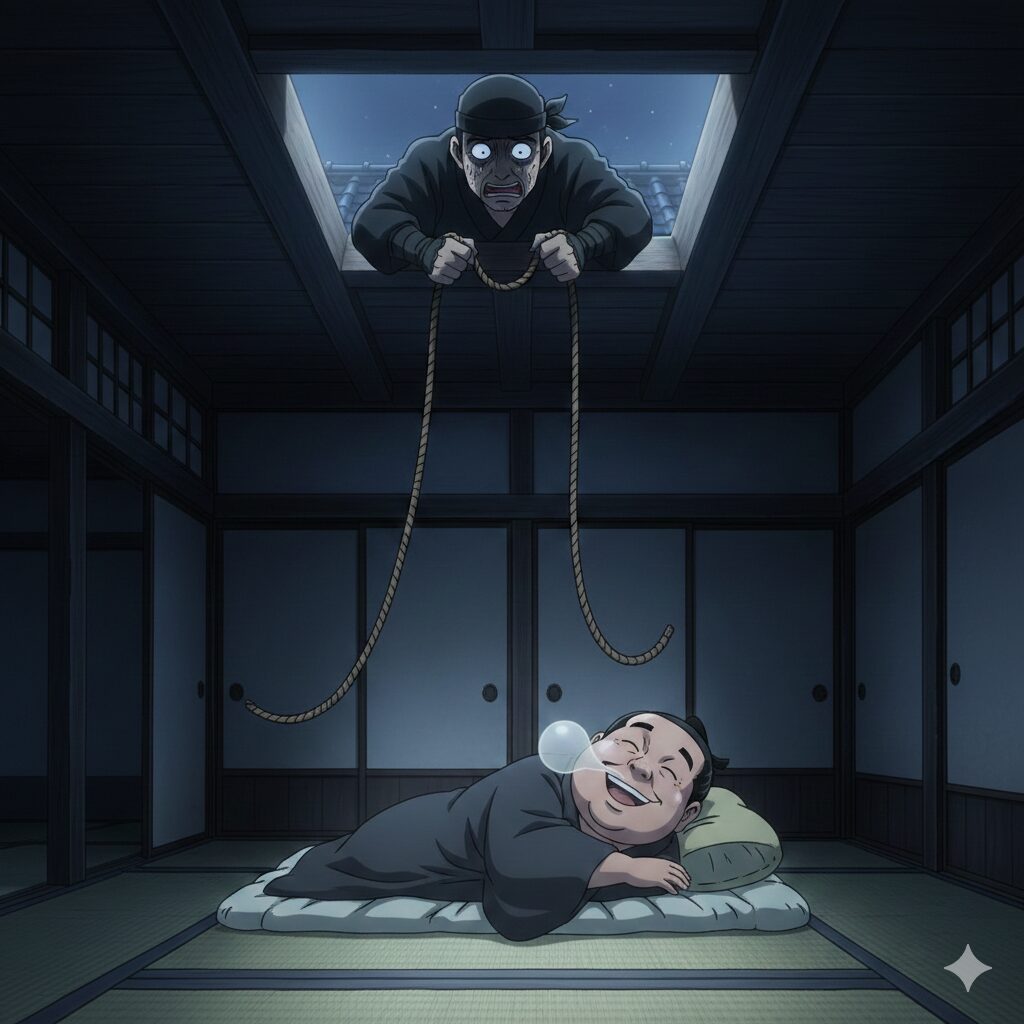
Japanese folklore isn’t just about brave heroes fighting demons. It is also filled with humorous stories where the “foolishness” or “accidental luck” of common people brings happiness. Today, I’d like to introduce a particularly funny masterpiece that strikes at the heart of human psychology: “Maa da mada wakaran” (Not Yet, I Don’t Know). Enjoy this tale where innocent obliviousness triumphs over calculated intelligence.
The Story: A Silent Night and a Thief
Once upon a time, in a certain village, there lived a very wealthy but somewhat dim-witted man. Let’s call him Kichibei. Kichibei was a good-natured man who knew no suspicion, and his daily routine involved drinking sake and sleeping soundly every night.
One stormy night, a notorious and skilled thief in the village set his eyes on Kichibei’s mansion. “There must be treasure sleeping in that storehouse. And the master is surely snoring away, drunk on sake by now.”
The thief silently climbed onto the roof. Old Japanese houses have ventilation openings called kemuridashi (smoke vents). The thief lowered a long rope from there and attempted to descend slowly into the tatami room.
A Moment of Tension
The thief lowered the rope inch by inch. The inside of the mansion was pitch black.
“Just a little more, just a little more until I hit the floor…”
Just as the thief muttered this in his mind and extended his legs, it happened.
“Not yet… I don’t know yet…” (Maa da, mada wakaran…)
A deep voice echoed from the darkness.
The thief felt his heart stop. Was he spotted? The thief hurriedly pulled up the rope, clung to the roof beam, and held his breath.
After a while, the sound of quiet breathing returned. “Phew, now’s my chance.”
The thief began to lower the rope again, ever so slowly. Just as his feet were about to touch the floor…
“Not yet! I still don’t know…”
It was that voice again. And this time, it sounded more confident. The thief trembled with fear.
“Is the master of this house a psychic? Does he see through all my movements in the dark?”
Sweating cold bullets, the thief decided to try one last time, lowering the rope even more carefully, millimeter by millimeter.
But the moment he tried to land on the floor:
“Hmmm, NOT YET! It’s too early!”
Kichibei shouted loudly.
“Eek! Forgive me!”
Thinking he was doomed, the thief panicked, tumbled off the roof, and ran away as fast as he could. He swore, “I will never go near a house with such a terrifying master again!”
The Truth the Next Morning
The next morning, Kichibei woke up with a big yawn.
“Ah, I had such a good dream last night.”
His wife asked, “What kind of dream was it? You were shouting in the middle of the night.”
Kichibei laughed and replied:
“Well, in my dream, I was waiting for the best sake to brew. Someone asked me, ‘Is it ready to drink?’ and I kept saying, ‘Not yet, I don’t know yet, let it age more,’ waiting patiently for the perfect flavor.”
Yes, what drove the thief away was nothing more than sleep-talking about waiting for sake.
Analysis: Phantoms Created by Fear
This story offers more than just a laugh; it contains deep psychological insight. To the thief, Kichibei’s words sounded like a “warning against his actions.” But in reality, they were unrelated mumblings.
This is close to the psychological phenomenon known as “confirmation bias” or “projection.” When people feel guilty or anxious, they interpret unrelated surrounding phenomena as “messages directed at them.” It’s the same reason why the sound of the wind or a creaking floor sounds like footsteps when you are scared.
The thief’s “guilty conscience” transformed Kichibei’s innocent sleep-talking into an “omniscient prophecy.” This story teaches us that “those who do evil are frightened by the demons living in their own hearts.”
Decoding Japanese Culture: Kotodama and “Ma”
1. The Irony of Kotodama (Spirit of Words)
In Japan, there is a belief called Kotodama—the idea that spirits dwell in words and have the power to alter reality. Usually, Kotodama is used intentionally, but in this story, “unconscious words” altered reality (by repelling the thief). The fact that unintentional words became the ultimate defense depicts the Japanese concept of “Mushin” (no-mind or innocent state) in an ironic yet positive light.
2. Structure of Japanese Houses
Key to the story is the architecture. Traditional Japanese houses (Kominka) are made of wood, paper, and earth, with thick beams in the attic that could easily become entry routes. This story might have been passed down as a form of “security wisdom(?)” in an era before modern alarms existed.
A Question for You
What do you think? A thief with a perfect plan was defeated by the sleep-talking of a man with no plan. In life, we always try to control and plan everything. However, sometimes, like Kichibei, going with the flow and having an innocent mind might bring unexpected luck (or protection).
Do you believe logical planning or intuitive coincidence saves lives?
If you were the thief, how would you have reacted to that voice?
Please explore more of the mysterious world of Japanese folktales.
References
- Japanese Folktale Series (Category)
- Japan National Tourism Organization (JNTO) – Learn more about Japanese culture and tradition.
【日本の昔話】無欲の勝利?泥棒を撃退した「寝言」の奇跡 ― まあだまだわからん
日本の民間伝承には、勇者が鬼を退治する壮大な物語だけでなく、一般庶民の「滑稽さ」や「偶然」が幸福をもたらすユーモラスな物語が数多く存在します。今回は、その中でも特に面白く、かつ人間の心理を突いた名作「まあだまだわからん(Not Yet, I Don’t Know)」をご紹介します。計算された知性よりも、無欲な天然さが勝る瞬間をお楽しみください。
物語:静寂の夜と、一人の泥棒
むかしむかし、ある村に、とても裕福ですが、少し間の抜けた男が住んでいました。名前を仮に「吉兵衛(きちべえ)」としましょう。吉兵衛は人が良く、疑うことを知りませんでしたが、毎晩お酒を飲んでぐっすり眠るのが日課でした。
ある嵐の夜のことです。村でも評判の悪い、腕利きの泥棒が吉兵衛の屋敷に目をつけました。「あの家には蔵に宝が眠っているに違いない。しかも主人は今頃、酒に酔って高いびきだろう」
泥棒は音もなく屋根に上りました。日本の古い家屋には「煙出し」と呼ばれる天窓のような通気口があります。泥棒はそこから長い縄を垂らし、そろりそろりと座敷へ降りようとしました。
緊迫の瞬間
泥棒は縄を少しずつ下ろしていきます。屋敷の中は真っ暗です。
「あと少し、あと少しで床に着くぞ…」
泥棒が心の中でそう呟きながら、足を延ばしたその瞬間でした。
「まあだ、まだわからん……」
暗闇の中から、野太い声が響きました。
泥棒は心臓が止まるかと思いました。見つかったのか? 泥棒は慌てて縄をたぐり寄せ、屋根の梁(はり)にしがみついて息を潜めました。
しばらくすると、また静かな寝息が聞こえてきます。「ふう、今のうちに」
泥棒は再び、そろりそろりと縄を下ろします。足が床に届きそうになった、まさにその時。
「まあだ、まだわからんぞ……」
またしても、あの声です。しかも、先ほどよりも確信に満ちた声色です。泥棒は恐怖に震え上がりました。
「まさか、この家の主人は超能力者なのか? 暗闇の中で俺の動きをすべて見透かしているのか?」
泥棒は冷や汗をかきながら、三度目の正直とばかりに、今度はさらに慎重に、ミリ単位で縄を下ろしていきました。
しかし、床に着地しようとしたその瞬間。
「うーん、まあだまだわからん! まだ早い!」
吉兵衛が大声で叫びました。
「ひえっ! 許してくれ!」
泥棒はもはやこれまでと思い、慌てふためいて屋根から転げ落ち、一目散に逃げ出しました。「あんな恐ろしい主人のいる家には二度と近づかない!」と誓いながら。
翌朝の真実
翌朝、吉兵衛は大きなあくびをして目を覚ましました。
「ああ、昨夜はいい夢を見たなあ」
妻が尋ねます。「どんな夢を見たのですか? 夜中に大声を出していましたよ」
吉兵衛は笑って答えました。
「いやあ、夢の中でな、一番うまい酒ができるのを待っていたんだ。『もう飲めるか?』と聞かれるんだが、わしは『まあだまだわからん、もっと熟成させろ』と言って、最高の味になるのをじっと待っていたのさ」
そう、泥棒を撃退したのは、ただの「酒の熟成を待つ寝言」だったのです。
考察:恐怖心が生み出す幻影
この物語は、単なる笑い話以上の心理的な洞察を含んでいます。泥棒にとって、吉兵衛の言葉は「自分の行動に対する警告」に聞こえました。しかし実際は、全く関係のない寝言でした。
これは心理学でいう「確証バイアス」や「投影」に近い現象です。人は、自分が後ろめたいことをしている時や不安な時、周囲の無関係な現象を「自分へのメッセージ」として解釈してしまいます。風の音や床のきしみさえも、誰かの足音に聞こえるのと同じです。
泥棒の「罪の意識」が、吉兵衛の無邪気な寝言を「全知全能の予言」へと変換させてしまったのです。この物語は、「悪いことをしている人間は、自らの心に住む鬼に怯える」という教訓を含んでいるとも言えます。
日本文化の読み解き:言霊と「間」
1. 言霊(Kotodama)の皮肉
日本には「言霊(ことだま)」という信仰があります。発した言葉には魂が宿り、現実を動かす力があるという考え方です。通常、言霊は意図的に使われるものですが、この物語では「無意識の言葉」が現実(泥棒の撃退)を動かしました。意図せぬ言葉が最強の防衛策になったという点は、日本的な「無心の強さ」を皮肉っぽく、かつ肯定的に描いています。
2. 日本家屋の構造
物語のキーとなるのは、泥棒が侵入を試みた屋根や梁の構造です。日本の伝統的な家屋(Kominka)は、木と紙と土で作られており、天井裏の梁が太く、外部からの侵入経路になりやすい構造をしていました。この物語は、セキュリティシステムが存在しなかった時代の、一種の「防犯の知恵(?)」としても語り継がれてきたのかもしれません。
読者への問いかけ
いかがでしたでしょうか。完璧な計画を持って挑んだ泥棒が、無計画な男の寝言に敗北する。人生において、私たちは常にコントロールし、計画しようと努力します。しかし、時には吉兵衛のように、流れに身を任せ、無心でいることが予期せぬ幸運(あるいは守護)をもたらすこともあるのかもしれません。
あなたは、論理的な計画と、直感的な偶然、どちらが人生を救うと思いますか?
もしあなたが泥棒の立場だったら、その声を聞いてどうしたでしょうか?
ぜひ、日本の不思議な昔話の世界をもっと探求してみてください。
参考リンク
- Japanese Folktale Series (Category)
- Japan National Tourism Organization (JNTO) – 日本の文化や伝統についてさらに詳しく知る

コメント