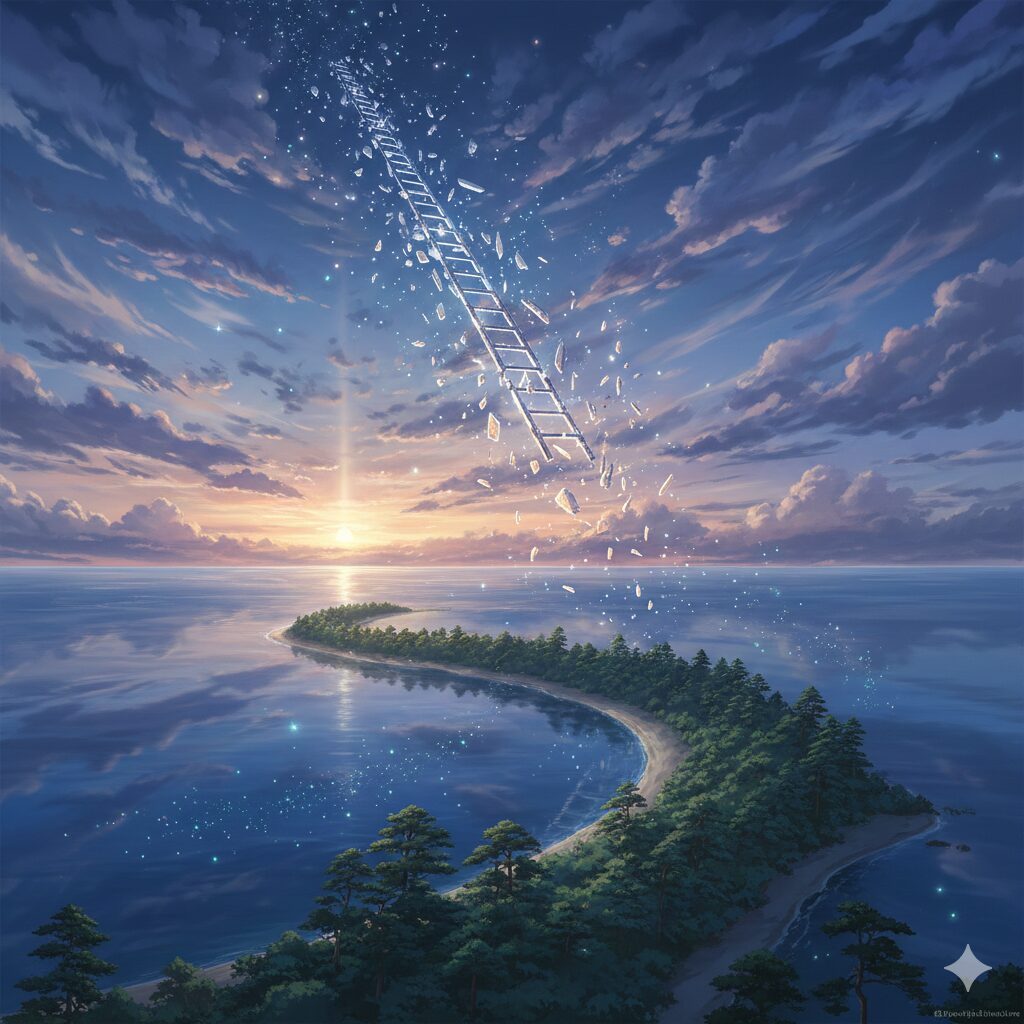
Located in Miyazu Bay in northern Kyoto Prefecture lies a mystical sandbar known as “Amanohashidate” (Bridge of Heaven). As one of the “Three Views of Japan,” this beautiful site attracts tourists from all over the world. However, hidden behind its scenic beauty is a grand tale of “love and failure.” Why does a single bridge span across the sea? It was not merely a coincidence of nature, but perhaps the will of the gods.
In this article, we will unravel the legend of the “Ladder of Heaven” related to the Japanese creation myth and explore how it connects to the modern Japanese mindset.

[The Story] The Ladder Connecting Heaven and Earth
This story takes place long ago, when gods still traveled freely between heaven and earth.
Izanagi-no-Mikoto, the male god who created the lands of Japan, lived in the High Plain of Heaven (Takamagahara). However, he was deeply in love with the goddess Izanami-no-Mikoto, who lived on earth, specifically at a place called Manai in northern Kyoto.
Determined to see her, Izanagi built a massive ladder connecting heaven and earth. This ladder, also known as the “Floating Bridge of Heaven” (Ame-no-Ukihashi), pierced through the clouds and extended down to the lower world. Every night, he would descend this ladder from heaven to visit Izanami. Their love was deep, and their time together was blissful even for the gods.
One day, after enjoying his time on earth, Izanagi accidentally fell asleep on the ground. The sunlight was warm, and the breeze was gentle. Even as a god, the peaceful atmosphere caused him to let his guard down.
Suddenly, the earth rumbled with a deep roar.
When Izanagi woke up with a start, the ladder he used to descend from heaven had fallen into the sea with a tremendous crash. The bridge that connected heaven and earth had completely collapsed, becoming a long, single sandbar lying across the sea of Miyazu.
Although Izanagi was not stranded, the physical bond directly connecting heaven and earth was severed at that moment. However, the fallen ladder transformed into a magnificent pine-covered sandbar, remaining as a stunning natural formation dividing the sea.
It is said that this is the origin of “Amanohashidate” as we see it today.
[Analysis] The Paradox of Divine Failure Creating Beauty
The source of this legend can be found in the *Tango no Kuni Fudoki* (Records of the Culture and Geography of Tango Province). What is fascinating here is that Izanagi, a powerful creator god, commits a very human mistake: “napping and letting the ladder fall.”
In monotheistic worldviews, God is often seen as perfect and infallible. However, in Japanese mythology, gods fall in love, get jealous, get angry, and sometimes fail. The episode of “falling asleep and losing the ladder” symbolizes how close Japanese gods are to human emotions and nature.
Furthermore, this story depicts the moment when “loss” turns into “creation.” Instead of the functional ladder to heaven, an unparalleled scenic beauty was born on earth. This reflects the Japanese aesthetic of *Wabi-Sabi* and impermanence: “failures or unexpected events result in creating new value.”
[Culture] “Matanozoki” and the Ascending Dragon
Knowing this legend, let me introduce the modern way to enjoy Amanohashidate. It is called “Matanozoki” (peering between one’s legs).
You stand on the viewing platform overlooking Amanohashidate, turn your back to the view, bend over, and look at the scenery upside down through your legs. Suddenly, the sky and sea are reversed, and the sandbar spanning the sea looks like a “dragon” soaring up into the sky.
This is not just a visual trick. Based on the legend, it is the moment when the fallen ladder is revived as a “bridge to heaven” once again by changing your perspective. Through “Matanozoki,” we are arguably re-experiencing the true form Izanagi saw, or the energy of the dragon trying to return to heaven.
In Japanese culture, the act of seeing the essence of things by changing perspectives connects to Zen teachings. By discarding fixed ideas and looking upside down, the fallen ladder becomes a bridge to the sky again. This experience is why Amanohashidate is considered a sacred place.
[Question] What Would You Do with Your Fallen Ladder?
Izanagi’s ladder fell and never returned to its original form. Yet, it became a beautiful landscape loved for thousands of years.
In your life, there may be moments when your cherished plans or “ladders” collapse. When that happens, will you continue to lament the loss? Or will you change your perspective and try to find new beauty and meaning there?
When you walk on Amanohashidate or look at its photos, please imagine: if the ladder hadn’t fallen, this scenery would not exist.
Related Links & Info
- Category: Japanese Folktale Series
- Tourist Info (Official): Amanohashidate Tourism Association
- Location: Miyazu City, Kyoto Prefecture, Japan
天から落ちた愛の架け橋:日本三景「天の橋立」とイザナギの伝説
京都府の北部、宮津湾に横たわる神秘的な砂州、「天の橋立(あまのはしだて)」。日本三景の一つとして世界中から観光客が訪れるこの美しい場所には、実は壮大な「愛と失敗」の物語が隠されています。なぜ、海の上に一本の橋がかかっているのか。それは自然の偶然ではなく、神の意志によるものかもしれません。
今回は、日本の国生み神話に関わる「天のはしご」の伝説を紐解き、現代日本人の精神性にどう繋がっているのかを深掘りします。
【物語】天と地をつなぐ梯子(はしご)
遥か昔、神々がまだ地上と天を行き来していた頃のお話です。
日本の国土を生み出した男神、イザナギノミコトは、天界(高天原)に住んでいました。しかし、彼は地上、具体的には現在の京都府北部の真名井(まない)という場所に住む女神、イザナミノミコトに恋をしていました。
イザナギは、彼女に会いたい一心で、天と地をつなぐ巨大な梯子(はしご)を作りました。この梯子は「天の浮橋(あめのうきはし)」とも呼ばれ、雲を突き抜け、下界へと伸びる壮大なものでした。彼は毎夜、この梯子を使って天から降り、イザナミのもとへと通いました。二人の愛は深く、その時間は神々にとっても至福の時でした。
ある日のこと、イザナギは地上での逢瀬を楽しみ、ついうっかり地上で昼寝をしてしまいました。日差しは暖かく、風は心地よい。神である彼も、その平和な空気に警戒心を解いてしまったのです。
その時です。ゴゴゴゴ……という地響きと共に、世界が揺れました。
イザナギがハッと目を覚ますと、彼が天から降りてくるために使っていたあの梯子が、大きな音を立てて海へと倒れ落ちてしまったのです。天と地をつないでいた架け橋は、完全に崩れ去り、宮津の海に横たわる長い一本の砂州となってしまいました。
イザナギは天へ帰る手段を失った……わけではありませんでしたが、天と地を直接つなぐ物理的な絆はここで断たれてしまいました。しかし、その倒れた梯子は、美しい松並木となり、海を分ける見事な造形美として残り続けました。
これが、現在私たちが目にする「天の橋立」の始まりだと伝えられています。
【考察】神の失敗が絶景を生むというパラドックス
この伝説の出典は『丹後国風土記(たんごのくにふどき)』の逸文に見られます。ここで非常に興味深いのは、全能であるはずの神、イザナギが「昼寝をして梯子を倒す」という、非常に人間臭い失敗をしている点です。
通常、一神教的な世界観では神は完全無欠であり、過ちを犯しません。しかし、日本の神話において神々は、恋をし、嫉妬し、怒り、そして時には失敗もします。この「寝落ちして梯子が倒れた」というエピソードは、日本の神々がいかに人間に近い感情や性質を持っているかを象徴しています。
また、この物語は「喪失」が「創造」に変わる瞬間を描いています。天への梯子という機能を失った代わりに、地上には類まれなる絶景が生まれました。これは、「失敗や予期せぬ出来事が、結果として新しい価値を生み出す」という、日本的な「わび・さび」や無常観にも通じる美学を感じさせます。
【文化】「股のぞき」と龍の昇天
この伝説を知った上で、現代の天の橋立の楽しみ方を紹介しましょう。それは「股のぞき(Matanozoki)」です。
天の橋立を望む展望台に立ち、背を向けて立ち、自分の股の間から景色を逆さまに覗き込むのです。するとどうでしょう。空と海が逆転し、海にかかる砂州が、まるで空へと舞い上がる「龍」のように見えます。
これは単なる視覚トリックではありません。伝説に基づけば、倒れてしまった梯子が、視点を変えることでもう一度「天にかかる橋」として蘇る瞬間なのです。私たちは「股のぞき」を通して、イザナギが見ていた本来の姿、あるいは天へ帰ろうとする龍のエネルギーを追体験していると言えます。
日本文化において、視点を変えることで物事の本質を見るという行為は、禅の教えにも通じます。固定観念を捨て、逆さまに見ることで、倒れた梯子が再び天への架け橋となる。この体験こそが、天の橋立が聖地とされる所以でしょう。
【問いかけ】あなたなら、倒れた梯子をどうしますか?
イザナギの梯子は倒れ、二度と元には戻りませんでした。しかし、それは何千年も愛される美しい風景となりました。
あなたの人生においても、大切にしていた計画や「梯子」が崩れ落ちる瞬間があるかもしれません。そんな時、あなたはそれを嘆き続けますか? それとも、視点を変えて、そこに新しい美しさや意味を見出そうとしますか?
天の橋立を歩くとき、あるいは写真を見るとき、ぜひ想像してみてください。もしも梯子が倒れていなかったら、この景色は存在しなかったのだと。
関連リンク・情報
- カテゴリー: Japanese Folktale Series
- 観光情報(公式): 天橋立観光協会(海の京都)
- 場所: 京都府宮津市(Japan, Kyoto Prefecture, Miyazu City)

コメント