
- Introduction: Twilight of Humanity Locked Within Walls
- 1. Synopsis: Despair and the Thirst for Freedom
- 2. Critique: Why Attack on Titan Was Born in Japan and Resonated Globally
- 3. Recommended Points: Why You Should Read/Watch It
- Conclusion: To Us Living in a Cruel World
- 序章:壁の中に閉ざされた人類の黄昏
- 1. 作品内容の要約:絶望と自由への渇望
- 2. 論評:なぜ『進撃の巨人』は日本で生まれ、世界で響いたのか
- 3. 本作を読む・観るべきおすすめポイント
- 結び:残酷な世界で生きる私たちへ
Introduction: Twilight of Humanity Locked Within Walls
In 2009, Attack on Titan (Shingeki no Kyojin), drawn by a newcomer manga artist named Hajime Isayama, took the world by storm in the blink of an eye. With its overwhelming sense of despair, an intricate plot where mysteries beget more mysteries, and philosophical themes questioning “what is justice,” this work is acclaimed not merely as entertainment, but as a “modern myth” highlighting universal issues faced by contemporary society. In this article, we will summarize this masterpiece and delve deep into why it is so beloved not only in Japan but around the world, weaving in perspectives from Japanese history and culture.
1. Synopsis: Despair and the Thirst for Freedom
The story is set in a world where humanity is on the brink of extinction due to the sudden appearance of mysterious predators known as “Titans.” The surviving humans built three massive walls—Wall Maria, Wall Rose, and Wall Sina—and enjoyed 100 years of peace within them. However, that peace was nothing more than the “tranquility of livestock.”
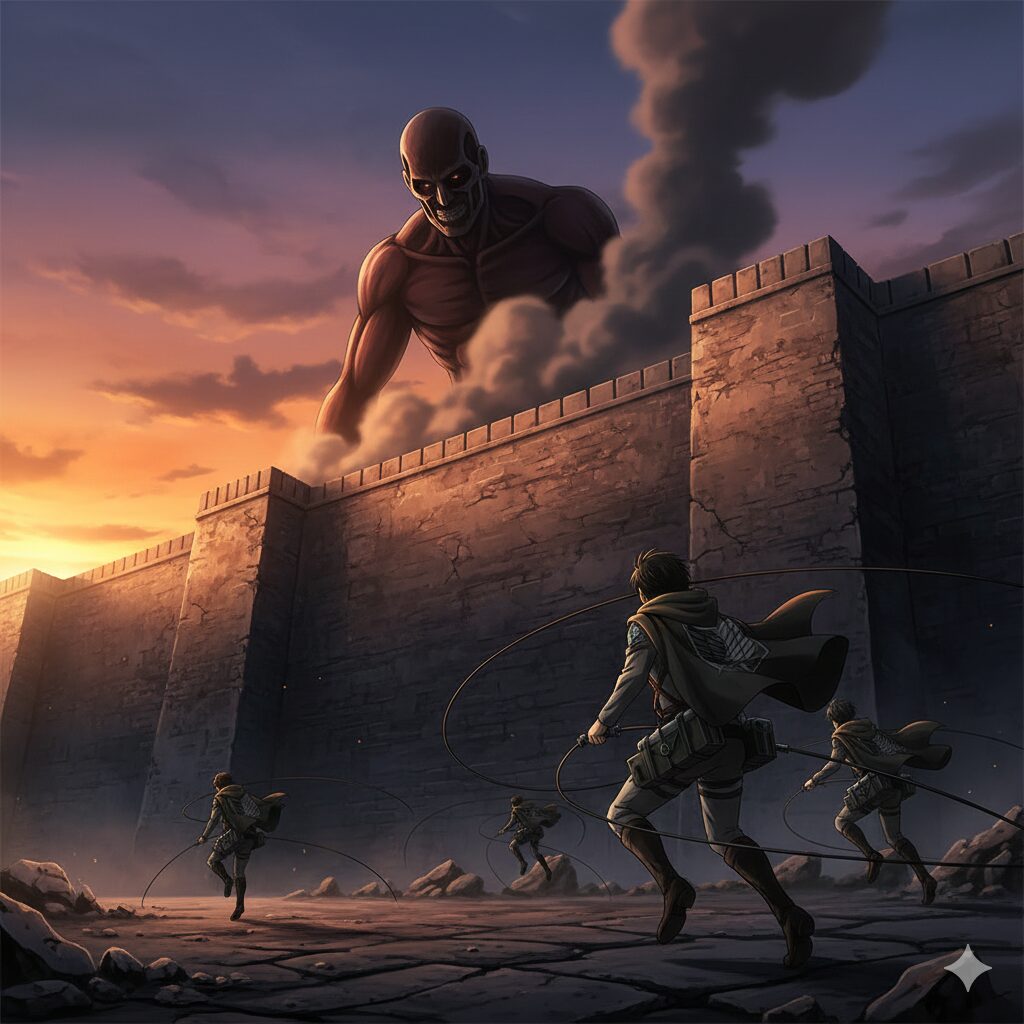
The protagonist, Eren Yeager, is a boy who yearns for the world outside the walls. One day, a “Colossal Titan,” larger even than the walls, appears and breaches the gate. Titans flood in, and Eren’s mother is devoured before his very eyes. “I’ll wipe them out… every last one of them from this world!” Driven by intense hatred, Eren joins the “Survey Corps,” a military branch dedicated to fighting Titans, along with his childhood friends Mikasa and Armin.
Initially, the story begins with a simple composition of Humans vs. Titans, but the situation changes drastically as Eren awakens the ability to transform into a Titan himself. The secrets of the royal family hidden within the walls, the true identity of the Titans, and the existence of the “real world” outside. As the Survey Corps approaches the truth, the narrative transforms from survival horror into a profound political drama involving international warfare, racial discrimination, and historical revisionism. In the final chapter, a poignant drama unfolds where Eren transforms from humanity’s hope into a threat that could destroy the world, and his former comrades stand up to stop him.
2. Critique: Why Attack on Titan Was Born in Japan and Resonated Globally
What makes Attack on Titan unique is its brutal realism and the deep reflection of Japan’s historical and spiritual soil. To help overseas readers understand this work more deeply, we analyze it from several perspectives.
(1) The “Walls” and the Spirit of Isolation (Sakoku)
The “Walls,” symbols of the story, represent both physical barriers and mental insularity. Japan has a history of “Sakoku” (national isolation), where it cut off exchanges with foreign countries for about 200 years. For Japan, an island nation, the other side of the sea (the wall) was unknown, a threat, and simultaneously infinite possibility. The setting where the people inside the walls were led to believe that “humanity outside the walls has perished” recalls the mentality of Japanese people during times of information control or the era before they knew the outside world. The Colossal Titan that suddenly appears before the peaceful residents can be interpreted as a metaphor for the “Black Ships” that forced Japan to open its borders in the mid-19th century. The fear of peaceful daily life being destroyed by external pressure shakes the historical memory etched into Japanese DNA.
(2) Impermanence and Beyond Good and Evil
Many Western comics and movies depict a clear conflict between “Good (Hero)” and “Evil (Villain).” However, absolute justice does not exist in Attack on Titan. Even the protagonist, Eren, eventually becomes a perpetrator committing mass genocide. This connects to the Japanese Buddhist concept of “Mujō” (impermanence/all things are transient) and the Shinto concept of “Aratama” (the rough/violent side of a spirit). The enemy nation Marley has its justice, and Eldia has its tragedy. As the phrase “it couldn’t be helped” is repeated, the perspective that anyone can be a victim or a perpetrator within the surge of history beyond individual will is very characteristic of Japanese literature. This ambiguity is what attracts adult viewers and sparks deep discussions.
(3) “Article 9” and the Dilemma of Peace
The “Vow Renouncing War” appearing in the story is a pledge to abandon military force and seek peace, but it also meant discarding the power to protect the people. This overlaps with the conflicts of modern Japan regarding Article 9 of the post-war Constitution (Renunciation of War). Eren’s assertion, “If you don’t fight, you can’t win. If you fight, you can survive,” is a scream of survival instinct in a harsh reality. Peace is precious, but should it be protected by force or by dialogue? Hajime Isayama threw this unanswerable question to the world using the framework of entertainment.
3. Recommended Points: Why You Should Read/Watch It
Catharsis of Foreshadowing
Casual lines and backgrounds from the first episode turn out to have significant meaning near the final episode. The shock of realizing “So that description back then meant this!” hits you repeatedly. It has a structure that makes you want to re-read it from the beginning after finishing it once; it is truly the work of a genius.
Action of the Omni-Directional Mobility Gear
The combat scenes using “Omni-Directional Mobility (ODM) Gear” in the anime adaptation (especially Seasons 1-3 produced by WIT STUDIO) are masterpieces in anime history. The sense of speed as they fly freely through the air like Spider-Man and slice the napes of Titans—their weak point—provides the highest level of excitement as a visual experience.
Epic Music by Hiroyuki Sawano
The soundtrack by Hiroyuki Sawano, incorporating German choruses and majestic sounds, defined the world view of the work. The beautiful yet sad melodies played during desperate scenes strongly shake the viewer’s emotions.
Conclusion: To Us Living in a Cruel World
Attack on Titan is by no means a pleasant story. However, it contains fundamental questions: “What is freedom?” and “What does it mean to live?” If you haven’t touched this work yet, please witness the way of life of Eren and his friends with your own eyes. It is sure to be an experience that shakes your values.
References (For those who want to know more)
If you want to know more about Japanese culture and history, please visit:
Japanese Culture Articles on Kiri53.com
【進撃の巨人】世界を震撼させたダークファンタジーの金字塔。日本文化と歴史から読み解くその魅力
序章:壁の中に閉ざされた人類の黄昏
2009年、一人の新人漫画家・諫山創によって描かれた『進撃の巨人(Attack on Titan)』は、またたく間に世界中を席巻しました。 圧倒的な絶望感、謎が謎を呼ぶ緻密なプロット、そして「正義とは何か」を問いかける哲学的なテーマ。 本作は単なるエンターテインメントの枠を超え、現代社会が抱える普遍的な問題を浮き彫りにする「現代の神話」として評価されています。 本記事では、この傑作の内容を要約し、なぜこれほどまでに日本のみならず世界中で愛されたのか、日本の歴史や文化的背景を交えて深掘りしていきます。
1. 作品内容の要約:絶望と自由への渇望
物語の舞台は、突如として出現した謎の捕食者「巨人」によって人類が絶滅の危機に瀕した世界。 生き残った人類は、「ウォール・マリア」「ウォール・ローゼ」「ウォール・シーナ」という三重の巨大な壁を築き、その内側で100年の平和を享受していました。 しかし、その平和は「家畜の安寧」に過ぎませんでした。
主人公エレン・イェーガーは、壁の外の世界に憧れを抱く少年です。 ある日、壁をも超える大きさの「超大型巨人」が出現し、壁を破壊。雪崩れ込んできた巨人たちによって、エレンの母親は目の前で捕食されてしまいます。 「駆逐してやる…この世から一匹残らず!」 激しい憎悪を抱いたエレンは、幼馴染のミカサ、アルミンと共に、巨人と戦う組織「調査兵団」に入団します。
物語は当初、人類対巨人というシンプルな構図で始まりますが、エレン自身が巨人化能力に目覚めることで事態は急変します。 壁の中に隠された王家の秘密、巨人の正体、そして壁の外に広がる「本当の世界」の存在。 調査兵団が真実にづくにつれ、物語はサバイバルホラーから、国家間の戦争、人種差別、歴史修正主義といった重厚な政治劇へと変貌を遂げていきます。 最終章では、エレンは人類の希望から、世界を滅ぼしかねない脅威へと変わり、かつての仲間たちが彼を止めるために立ち上がるという、痛切なドラマが展開されます。
2. 論評:なぜ『進撃の巨人』は日本で生まれ、世界で響いたのか
『進撃の巨人』が特異なのは、その残酷なまでのリアリズムと、日本の歴史的・精神的土壌が色濃く反映されている点にあります。 海外の読者が本作をより深く理解するために、いくつかの視点から分析します。
(1) 「壁」と日本の鎖国精神(Sakoku)
物語の象徴である「壁」。これは物理的な防壁であると同時に、精神的な閉鎖性を表しています。 日本にはかつて、約200年間にわたり海外との交流を断った「鎖国(Sakoku)」の歴史があります。 島国である日本にとって、海(壁)の向こう側は未知であり、脅威であり、同時に無限の可能性でもありました。 作中で壁の中の人々が「壁外人類は滅んだ」と信じ込まされていた設定は、情報統制下の戦時中や、外の世界を知らなかった時代の日本人のメンタリティを想起させます。 平和ボケした壁内の住人に、突如として現れる超大型巨人は、幕末の日本に開国を迫った「黒船(Black Ships)」のメタファーとして読み解くことも可能です。 平和な日常が外圧によって破壊される恐怖は、日本人のDNAに刻まれた歴史的記憶を揺さぶるのです。
(2) 諸行無常と善悪の彼岸
西洋のコミックや映画の多くは、明確な「善(ヒーロー)」と「悪(ヴィラン)」の対立を描きます。 しかし、『進撃の巨人』には絶対的な正義が存在しません。 主人公のエレンでさえ、最終的には大量虐殺を行う加害者となります。 これは、日本の仏教的観念である「諸行無常(すべてのものは移ろいゆく)」や、神道における「荒魂(神の荒々しい側面)」に通じます。 敵国マーレにはマーレの正義があり、エルディアにはエルディアの悲劇がある。 「仕方なかった」という言葉が繰り返されるように、個人の意思を超えた歴史のうねりの中で、誰もが被害者であり加害者になり得るという視点は、非常に日本文学的です。 この「割り切れなさ」こそが、大人の視聴者を惹きつけ、深い議論を巻き起こす要因となっています。
(3) 「第9条」と平和へのジレンマ
作中に登場する「不戦の契り」は、戦力を放棄し平和を希求する誓いですが、それは同時に民を守る力を捨てることでもありました。 これは、戦後の日本国憲法第9条(戦争の放棄)を巡る現代日本の葛藤と重なります。 「戦わなければ勝てない、戦えば生き残れる」というエレンの主張は、過酷な現実世界における生存本能の叫びです。 平和は尊いものですが、それは力によって守られるべきなのか、対話によって守られるべきなのか。 諫山創氏は、この答えのない問いを、エンターテインメントの枠組みを使って世界中に投げかけました。
3. 本作を読む・観るべきおすすめポイント
伏線回収のカタルシス
第1話の何気ないセリフや背景が、最終話近くになって重大な意味を持っていたことが判明します。 「あの時の描写はこれだったのか!」という衝撃が何度も押し寄せます。一度読み終わった後に、必ずもう一度最初から読み返したくなる構成は、まさに天才の所業です。
立体機動装置のアクション
アニメーション版(特にWIT STUDIO制作のシーズン1〜3)における「立体機動装置」の戦闘シーンは、アニメ史に残る傑作です。 スパイダーマンのように空中を自在に飛び回り、巨人の弱点であるうなじを削ぐスピード感は、映像体験として最高峰の興奮を与えてくれます。
澤野弘之による壮大な音楽
劇中音楽を担当した澤野弘之氏のサウンドトラックは、ドイツ語のコーラスを取り入れた荘厳な響きで、作品の世界観を決定づけました。 絶望的なシーンで流れる美しくも悲しい旋律は、視聴者の感情を強く揺さぶります。
結び:残酷な世界で生きる私たちへ
『進撃の巨人』は、決して気持ちの良い物語ではありません。しかし、そこには「自由とは何か」「生きるとは何か」という根源的な問いがあります。 まだこの作品に触れていない方は、ぜひその目で、エレンたちの生き様を目撃してください。 それは、あなたの価値観を揺るがす体験になるはずです。
参考リンク(もっと詳しく知りたい方へ)
日本の文化や歴史についてもっと知りたい方は、以下の記事もご覧ください:
コメント