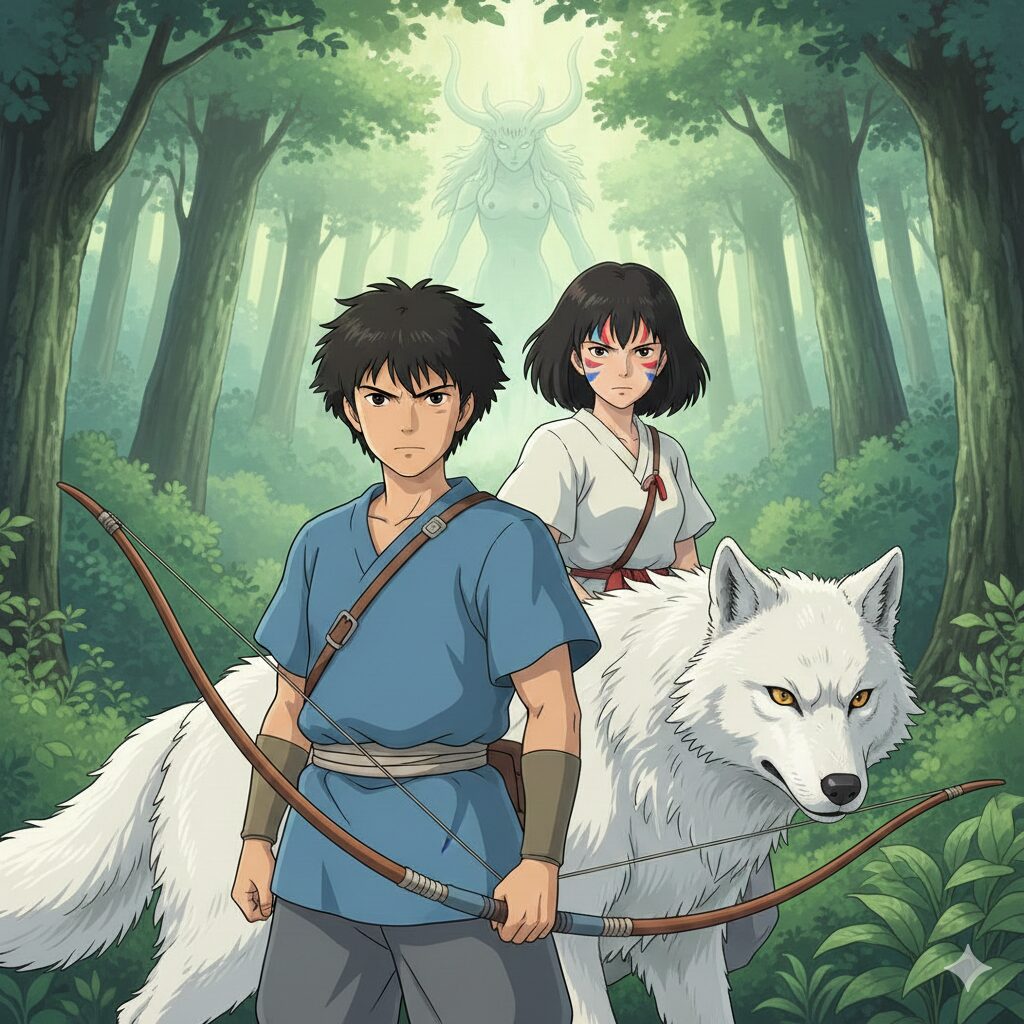
Unraveling the complex tapestry of Shinto philosophy, historical warfare, and environmental ethics in Hayao Miyazaki’s 1997 epic.
When discussing the pinnacle of Japanese animation, one title invariably rises to the top: Princess Mononoke (Mononoke Hime). Released in 1997 by Studio Ghibli, this film did not just break box office records in Japan; it shifted the global perception of what animation could achieve.
Unlike the whimsical worlds of My Neighbor Totoro or Kiki’s Delivery Service, Princess Mononoke is a visceral, intense, and philosophically dense epic. It is a story that refuses to offer simple answers to complex questions. For international audiences, it serves as a stunning introduction to Japanese history, folklore, and the spiritual concept of Animism.
In this comprehensive review, we will explore the narrative depths of the film, analyze why it holds such a significant place in Japanese culture, and discuss why its message is more relevant today than ever before.

The Story: A Cursed Prince and the Wolf Girl
The narrative is set in the Muromachi period (approximately 1336–1573), a time of chaotic transition in Japan. The protagonist, Ashitaka, is the last young prince of the hidden Emishi tribe. His journey begins not with a desire for adventure, but with a tragedy. To protect his village, he is forced to kill a “Tatarigami” (a curse god)—a giant boar god driven mad by pain and hatred. In the process, Ashitaka is afflicted with a deadly curse that grants him superhuman strength but will eventually consume his life.
Exiled from his home, Ashitaka travels west to find the source of the iron ball found inside the boar god. His quest leads him to a fierce battleground between two opposing forces:
- Lady Eboshi and Irontown (Tatara-ba): A fortress of human industry where outcasts and lepers find purpose by manufacturing iron and firearms. They are destroying the forest to fuel their progress.
- San (Princess Mononoke) and the Forest Gods: San is a human girl raised by the giant wolf god Moro. She despises humans and fights alongside the ancient animal deities to protect their sanctuary.
Ashitaka refuses to side with either faction. Instead, he attempts to see “with eyes unclouded by hate,” acting as a mediator in a war where both sides have valid grievances. The conflict escalates until it draws in the Shishigami (The Forest Spirit), the god of life and death, leading to a cataclysmic finale that questions the very price of human civilization.
Why is “Princess Mononoke” Culturally Significant in Japan?
To truly appreciate this film, one must look beyond the surface action. The movie is deeply rooted in Japanese historical and religious contexts that offer a profound commentary on the human condition.
1. Shinto and the Concept of Animism
At the heart of the film is the Japanese concept of Animism and Shinto belief. In Japan, it is traditionally believed that Kami (spirits or gods) reside in all things—mountains, rivers, trees, and rocks. This is encapsulated in the phrase “Yaoyorozu no Kami” (Eight Million Gods).
In Western fairy tales, nature is often just a backdrop or a resource. In Princess Mononoke, nature is a sentient, powerful, and sometimes terrifying character. The forest gods are not cute animals; they are ancient, intelligent, and capable of wrath. The “Tatarigami” represents the destructive power of nature when it is disrespected and corrupted by human malice. This reflects the Japanese reverence and fear of natural disasters, acknowledging that nature is not something to be conquered, but something to coexist with.
2. Breaking Historical Stereotypes: The Muromachi Era
Miyazaki chose the Muromachi period specifically because it was an era where the rigid class structures of the later Edo period were not yet fixed. It was a time of fluidity, freedom, and chaos.
Lady Eboshi is a revolutionary character. In a male-dominated feudal society, she leads a community where women (bought from brothels) are given work, respect, and the means to defend themselves. She even cares for lepers, who were traditionally shunned by society. While she is the “villain” to the forest, she is a hero to her people. This duality challenges the viewer: Can we condemn a leader who destroys nature if it is done to save the marginalized?
3. The Absence of Absolute Evil
Perhaps the most “Japanese” aspect of the film is its moral ambiguity. There is no “Dark Lord” to defeat. Lady Eboshi is pragmatic and compassionate to her people. The monks and samurai are politically motivated. Even San is blinded by her hatred of humans. Ashitaka’s role is not to defeat a villain, but to find a way for these conflicting groups to live. This reflects a Buddhist-influenced worldview where conflict arises from ignorance and suffering rather than inherent evil.
Why You Must Watch This Masterpiece Today
Even decades after its release, Princess Mononoke feels incredibly modern. Here are three reasons why this film deserves your attention right now.
1. Unmatched Hand-Drawn Animation
This film represents the peak of cel animation. While there is some early CGI used for “demon worms,” the vast majority of the film consists of tens of thousands of hand-painted frames. The depiction of the lush, dripping forests, the dynamic movement of the wolf gods, and the terrifying fluidity of the curse are artistic achievements that modern digital animation rarely captures. The visual of the Shishigami transforming into the Nightwalker is one of the most iconic sequences in cinema history.
2. The Philosophy of “To Live” (Ikiro)
The film’s tagline in Japan was simply “Ikiro” (Live). In a world filled with cursing, hatred, and seemingly inevitable destruction, the film argues that life itself is worth living. Ashitaka, despite being cursed to die, continues to struggle for a peaceful solution. In our current era of climate anxiety and global conflict, this message of resilience is deeply empowering.
3. Joe Hisaishi’s Legendary Score
No discussion of Ghibli is complete without mentioning the music. Joe Hisaishi’s score for Princess Mononoke is grand, operatic, and haunting. The use of traditional Japanese taiko drums mixed with a full orchestra creates a soundscape that feels both ancient and immediate. The music tells the story as much as the dialogue does.
Conclusion: A Prayer for Coexistence
Princess Mononoke is not a lecture on environmentalism; it is a tragedy about the difficulty of coexistence. Miyazaki acknowledges that humans must use nature to survive, but he questions the extent of that exploitation.
The film ends not with a “happily ever after” where everything is resolved, but with a tentative balance. The forest begins to regrow, but it is different. Humans and nature have both been scarred, yet they agree to live on. It leaves the viewer with a lingering question: How do we live in a world we are simultaneously destroying?
If you are looking for an anime that combines breathtaking action with deep philosophical questions about Japanese culture and the future of our planet, Princess Mononoke is essential viewing.
Share Your Thoughts
Have you watched Princess Mononoke? Do you side with San or Lady Eboshi? Let us know in the comments below or share this article with fellow anime fans!
もののけ姫:自然と人間の共存を問う壮大な叙事詩
宮崎駿監督が描いた、日本のアニミズムと近代化の葛藤を読み解く
宮崎駿監督の代表作の一つである「もののけ姫」は、日本だけでなく世界中で多くの人々を魅了し続けているアニメーション映画の金字塔です。1997年の公開以来、その深遠なテーマ、息をのむような映像美、そして心に残るキャラクターたちは、観る者に強い印象を与え、世代を超えて語り継がれてきました。
この記事では、「もののけ姫」の作品内容を深く掘り下げ、日本での人気の理由、文化的な背景、そして作品が持つ現代的な意義について、多角的な視点から考察します。海外の読者にとっても、日本の精神性を理解するための最高の一冊(一本)となるはずです。
作品内容の要約:神々と人間、そして森の物語
物語の舞台は、室町時代。人と自然がまだ密接に関わり合い、そして時に激しく対立していた日本です。主人公のアシタカは、蝦夷(えみし)の村に住む若き王子。彼は村を襲った「タタリ神」となったイノシシを討ちますが、その際に右腕に死の呪いを受けてしまいます。
呪いを解く方法を探すため、アシタカは西の国へと旅立ちます。そこで彼を待ち受けていたのは、二つの勢力の激しい対立でした。
- もののけ姫・サン:犬神に育てられ、人間を憎み、森を守るために戦う少女。
- エボシ御前:製鉄集団「タタラ場」を率い、森を切り開いて人々の豊かな暮らしを築こうとする冷静沈着な女性リーダー。
アシタカは、どちらか一方に加担することなく「曇りなき眼(まなこ)」で事態を見つめ、人間と自然が共に生きる道を探して奔走します。森の最高神「シシ神」の首を巡る戦いは、やがて世界そのものを揺るがす事態へと発展していきます。
なぜ「もののけ姫」は日本で愛され続けるのか:歴史と文化の視点
本作が日本で社会現象を巻き起こし、今なお特別な地位にあるのは、日本人の根底にある「自然観」を鮮やかに描き出したからです。
1. アニミズムと「八百万(やおよろず)の神」
日本には古来より、山や川、森、そして言葉にさえも神が宿るという「アニミズム」の思想が根付いています。劇中のシシ神や乙事主(おっことぬし)といった神々は、単なるモンスターではなく、人間が畏敬すべき自然そのものの象徴です。日本人は、自然を「管理するもの」ではなく「恐れ、敬うもの」として捉える感覚をこの作品に強く見出すのです。
2. 室町時代という「転換点」の描写
宮崎監督が舞台に選んだ室町時代は、日本の自然が人間の経済活動によって大きく作り変えられ始めた時代です。鉄を作るために大量の木を切り倒すタタラ場の描写は、日本の近代化の原風景でもあります。この歴史的リアリティが、物語に重厚な説得力を与えています。
3. 善悪で割り切れない「共存」の難しさ
本作の最大の特徴は、「絶対的な悪」が存在しないことです。エボシ御前は森を壊しますが、虐げられた女性やハンセン病患者に仕事を与え、救う聖母のような側面も持っています。一方、森の神々も誇り高く、時に人間に対して残酷です。この複雑な対立構造こそが、多様な価値観がぶつかり合う現代社会に生きる人々の心に深く刺さるのです。
「もののけ姫」を楽しむためのおすすめポイント
1. 圧倒的な手描きアニメーションの極致
現在のアニメでは主流となったCGがまだ限定的だった時代、背景の緻密な描き込みや、タタリ神の禍々しい動きの多くが手描きで表現されました。森の湿り気や空気感まで伝わってくるような映像美は、まさに芸術品です。
2. 久石譲による壮大な音楽
音楽担当の久石譲による旋律は、日本の古雅な雰囲気とオーケストラの壮大さを融合させています。主題歌「もののけ姫」のカウンターテナーの歌声は、一度聴いたら忘れられない神秘的な響きを持っています。
3. 「生きろ。」というメッセージ
公開当時のキャッチコピー「生きろ。」は有名です。呪いを受け、絶望的な戦いに巻き込まれながらも、生きることを諦めないアシタカの姿は、困難な時代を生きる私たちに勇気を与えてくれます。
まとめ:未来への問いかけ
「もののけ姫」は、単なるエンターテインメントの枠を超えた、人類への警鐘であり、希望の物語です。自然を征服するのではなく、かといって文明を捨てるのでもない。その中間にある「苦しみながら共に生きる」という覚悟。この作品を観ることで、私たちは自分たちの生き方や、地球との向き合い方を再考するきっかけを得るでしょう。
まだ観ていない方は、ぜひこの壮大な世界観を体験してください。そして、鑑賞後はあなたの心の中にどのような「森」が残ったか、ぜひ考えてみてください。
コメント