In Japan, there are said to be eight million gods (Yaoyorozu no Kami), but perhaps none are as terrifying, yet charmingly common, as “Kaminari-sama” (The Thunder God).
The folktale I will introduce today, “Ochita Kaminari” (The Fallen Thunderbolt), is a humorous and insightful story where a god possessing immense power makes a mistake and is helped by a human. Through this story, we will explore the depths of Japanese culture, including views on nature and strange superstitions regarding the “belly button.”

1. The Story: The Fallen Thunderbolt
Long, long ago, on a certain summer day.
From the morning, the humidity clung to the skin, and towering cumulonimbus clouds swelled like mountains in the sky. As evening approached, the sky suddenly turned dark as if ink had been spilled, and an ominous sound began to rumble in the distance: “Goro-goro…”
A skilled doctor lived in that village. While the doctor was cooling off in the evening, a roar that seemed to tear heaven and earth apart echoed directly overhead.
“FLASH! BOOM!”
Along with a tremendous flash of lightning, something crashed violently near the well in the doctor’s backyard. The garden trees were scorched, and dust billowed into the air.
“This is a disaster! Lightning must have struck!”
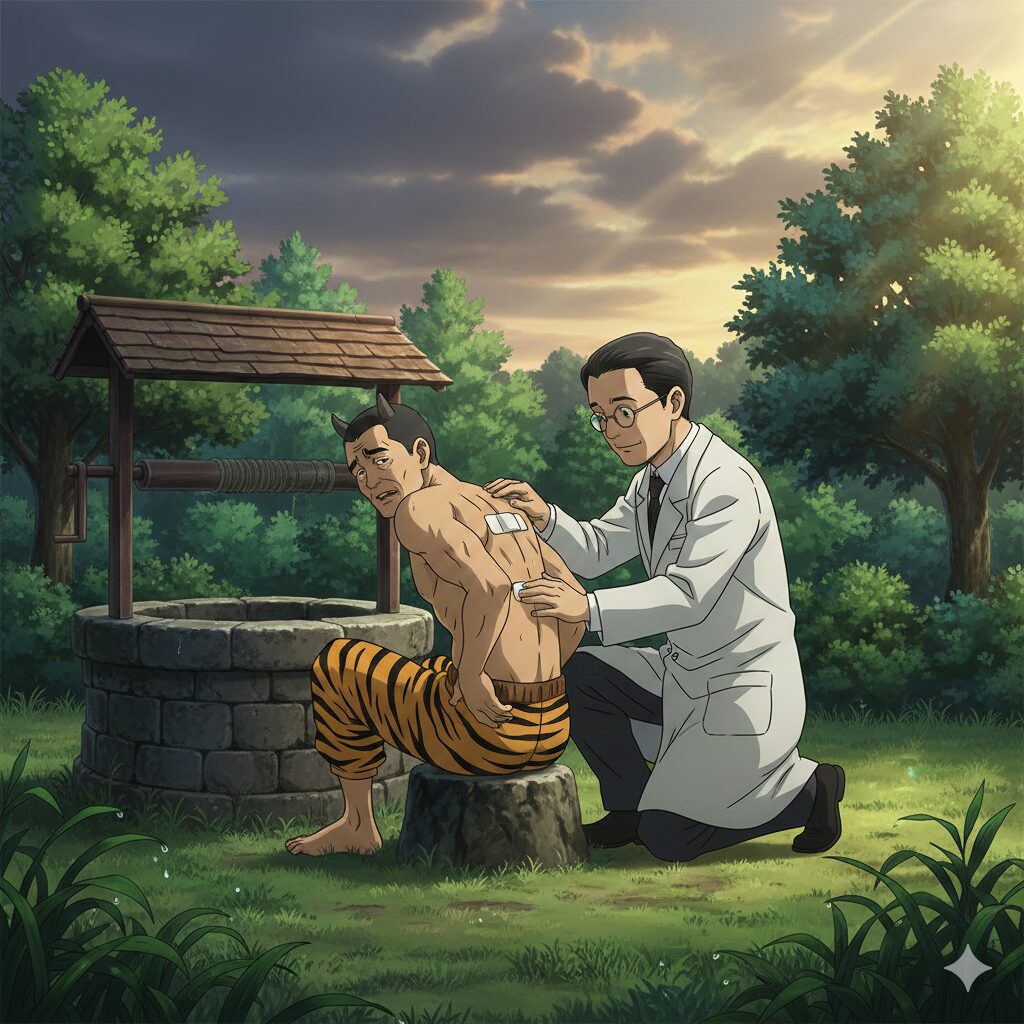
When the doctor fearfully went to the backyard, he found a man lying there. He looked like an ogre (Oni), with horns on his head, wearing a tiger-skin loincloth and carrying drums on his back. It was Kaminari-sama, the Thunder God. However, far from his majestic appearance in the sky, he was groaning while rubbing his lower back.
“Ouch, ouch… My back…”
The doctor was astonished, but as a professional, he could not ignore an injured person (even if it was a god).
“Hey now, are you alright? You must be the Thunder God. Why are you in a place like this?”
With tears in his eyes, the Thunder God replied:
“Oh, it is so embarrassing. I was beating my drums and raging upon the clouds when I lost my footing due to too much momentum and fell headfirst. It seems I have severely bruised my back. Human, I beg you. Will you treat me?”
Smiling wryly, the doctor brought the Thunder God inside and applied a poultice to treat the injury. As the medicine took effect, the Thunder God completely regained his energy.
“Ah, that feels much better. I thank you, human. As a reward for saving me, is there anything you desire?”
The doctor thought for a moment and said:
“I do not need money or fame. But I have one request. From now on, could you please stop taking human belly buttons?”
In Japan, it has long been said that “When thunder roars, your belly button will be taken.” The Thunder God scratched his head and replied:
“Understood. It is the request of my lifesaver. I promise never to take the belly buttons of the people in this village again.”
“But how will you distinguish the people of this village?” the doctor asked. The Thunder God said:
“Plant mulberry trees (Kuwa). We hate mulberry trees, so we do not strike lightning or take belly buttons from houses where mulberry trees grow.”
Leaving those words behind, the Thunder God rode a cloud back into the sky. Since then, it is said that people in that village began to chant “Kuwabara, Kuwabara” (Mulberry field) as a spell to ward off lightning.
2. Analysis: The Fall of a God and Humanity
This story perfectly blends Japanese religious views with humor. Typically, “Thunder Gods” in Western mythology (such as Zeus or Thor) are objects of awe with absolute power; it is unthinkable for them to clumsily fall by a well.
However, in Japanese folktales, gods and Yokai are depicted as very “human-like” beings. They fail, get injured, ask humans for help, and feel gratitude. This is evidence that Japanese people have accepted natural phenomena (thunder) not just as objects of terror, but with a sense of familiarity, like a neighbor.
The Meaning of “Falling”
The sense of personifying the physical phenomenon of lightning “striking” (in Japanese, we say lightning “falls”) as the god himself “falling down” is brilliant. Here, we can see the wisdom of the common people trying to soften their fear by relativizing the overwhelming threat of nature through “laughter.”
3. Cultural Connections: “Belly Buttons” and “Kuwabara”
Why Does the Thunder God Want Belly Buttons?
The doctor’s request in the story—”Please don’t take our belly buttons”—stems from a superstition every Japanese child is taught: “Hide your belly button when the thunder roars.”
Interpreted from a scientific and medical perspective, the temperature drops rapidly during a thunderstorm. If you expose your stomach (belly button), you get cold and are prone to diarrhea or stomach aches. It is believed that adults threatened children by saying “The Thunder God will take it!” to make them cover their stomachs and manage their health. Folktales were also media for conveying such wisdom of living.
The Spell “Kuwabara, Kuwabara”
The phrase “Kuwabara,” which Japanese people chant to avoid lightning or misfortune, is said to originate from the legend that lightning hates “Mulberry trees,” as mentioned in the story (there is also a theory that lightning never struck the land of Kuwabara belonging to Sugawara no Michizane).
Even in modern Japan, many elderly people unconsciously use this word when they have a bad feeling or want to avoid trouble. This story serves as the etymology for such Japanese phrases.
4. What Would You Do?
If a Thunder God fell from the sky, would you help him? Or would you run away in fear?
The doctor in this story showed morality by treating the “Thunder,” a threat to humans, because he was suffering right in front of him. As a result, the village was protected.
This old tale might be teaching us that even with different or terrifying beings, a path to coexistence can be opened through dialogue and mercy.
What is the personality of the Thunder God in your country? If a god fell into your backyard, how would you interact with them? Please let me know your thoughts.
References & Links
はじめに:日本の空から落ちてきた神様
日本には八百万(やおよろず)の神が存在しますが、これほど庶民的で、恐ろしく、かつ愛嬌のある神は他にいないでしょう。それが「雷様(Kaminari-sama)」です。
今回紹介する昔話「落ちた雷」は、強大な力を持つはずの神様が失敗をし、人間に助けられるという、非常にユーモラスで示唆に富んだ物語です。日本の自然観、そして「へそ」にまつわる奇妙な迷信まで、この物語を通して日本文化の深淵を覗いてみましょう。
1. 昔話「落ちた雷」の物語
むかしむかし、ある夏の日のことでした。
朝から肌にまとわりつくような湿気が立ち込め、空には入道雲が山のように膨れ上がっていました。夕暮れ時になると、空は急に墨を流したように暗くなり、遠くで「ゴロゴロ……」という不気味な音が響き始めました。
その村には、腕の良い医者が住んでいました。医者が夕涼みをしていると、突然、頭上で天地が裂けるような轟音が鳴り響きました。
「ピカッ! ドカーン!」
凄まじい稲光と共に、何かが医者の家の裏庭にある井戸のそばへ激しく落下しました。庭の木々は焦げ、土煙が舞い上がっています。
「こりゃあ大変だ! 雷が落ちたに違いない」
医者が恐る恐る裏庭へ行ってみると、そこには虎の皮のフンドシを締め、背中に太鼓を背負った、角の生えた鬼のような姿の男が倒れていました。雷様です。しかし、空の上の威厳ある姿とは程遠く、彼は腰をさすりながら呻いています。
「痛ててて……。あいたた……」
医者は驚きましたが、職業柄、怪我人(神ですが)を放っておけません。
「おいおい、大丈夫か? お前さんは雷様だろう。どうしてこんなところに?」
雷様は涙目で答えました。
「いやはや、面目ない。雲の上で太鼓を叩いて暴れまわっていたら、勢い余って足を踏み外し、真っ逆さまに落ちてしまったのだ。どうやら腰を強打してしまったらしい。人間よ、頼む。わしを治してくれんか」
医者は苦笑いしながらも、雷様を家に入れ、湿布を貼って手当てをしてやりました。薬が効いてくると、雷様はすっかり元気を取り戻しました。
「ああ、楽になった。礼を言うぞ、人間。助けてもらったお礼に、何か望むものはないか?」
医者は少し考えてから言いました。
「金や名誉はいらん。だが一つだけ頼みがある。これからは、人間のへそを取るのだけはやめてくれないか」
日本では昔から『雷が鳴るとへそを取られる』と言われていました。雷様は頭をかきながら答えました。
「わかった。命の恩人の頼みだ。この村の者のへそは二度と取らんことを約束しよう」
「しかし、どうやってこの村の者だと見分けるのだ?」と医者が尋ねると、雷様は言いました。
「桑(くわ)の木を植えておけ。わしらは桑の木が嫌いだから、桑の木がある家には雷を落とさないし、へそも取らん」
そう言い残すと、雷様は雲に乗って空へ帰っていきました。それ以来、その村では雷避けのおまじないとして「くわばら、くわばら(桑原)」と唱えるようになったといいます。
2. 考察:神の失墜と人間味
この物語には、日本の宗教観とユーモアが見事に融合しています。通常、西洋の神話における「雷神(ゼウスやトールなど)」は、絶対的な力を持つ畏怖の対象であり、ドジを踏んで井戸端に落ちるなど考えられません。
しかし、日本の昔話において、神や妖怪は非常に「人間臭い」存在として描かれます。彼らは失敗し、怪我をし、人間に助けを求め、恩義を感じます。これは、日本人が自然現象(雷)を単なる恐怖の対象としてだけでなく、生活の一部、あるいは隣人のような親しみを持って受け入れてきた証拠です。
「落ちる」ことの意味
雷が「落ちる」という物理現象を、神様自身が「落下する」という擬人化で表現するセンスは秀逸です。ここには、圧倒的な自然の脅威を「笑い」によって相対化し、恐怖を和らげようとする庶民の知恵が見て取れます。
3. 日本文化との関連:「へそ」と「くわばら」
なぜ雷様は「へそ」を狙うのか?
物語の中で医者が頼んだ「へそを取らないでくれ」という願い。これは日本の子供たちが必ず教えられる迷信「雷が鳴ったらへそを隠せ」に由来します。
科学的・医学的な見地から解釈すると、雷雨の時は気温が急激に下がります。お腹(へそ)を出していると冷えて下痢や腹痛を起こしやすいため、「雷様に取られるぞ」と脅して、子供にお腹を隠させ、体調管理をさせたという説が有力です。昔話は、こうした生活の知恵を伝えるメディアでもありました。
「くわばら、くわばら」の呪文
日本人が雷や災難を避ける時に唱える「くわばら(Kuwabara)」という言葉。物語にある通り、雷が「桑の木」を嫌うという伝承が起源の一つとされています(菅原道真の領地である桑原にだけ雷が落ちなかったという説もあります)。
現代の日本でも、嫌な予感がした時や厄介事を避けたい時に、無意識にこの言葉を使う高齢者は少なくありません。この物語は、そんな日本語のフレーズの語源となっているのです。
4. あなたならどうしますか?
空から落ちてきた雷神を、あなたは助けますか? それとも、恐怖で逃げ出しますか?
この物語の医者は、相手が人間にとって脅威である「雷」であっても、目の前で苦しんでいるならば治療するという道徳心を見せました。その結果、村は守られることになります。
異なる存在、あるいは恐ろしい存在であっても、対話と慈悲によって共存の道が開けることを、この古い物語は教えてくれているのかもしれません。
あなたの国の雷の神様はどんな性格ですか?もし庭に神様が落ちてきたら、あなたならどう接しますか?ぜひ考えてみてください。

コメント