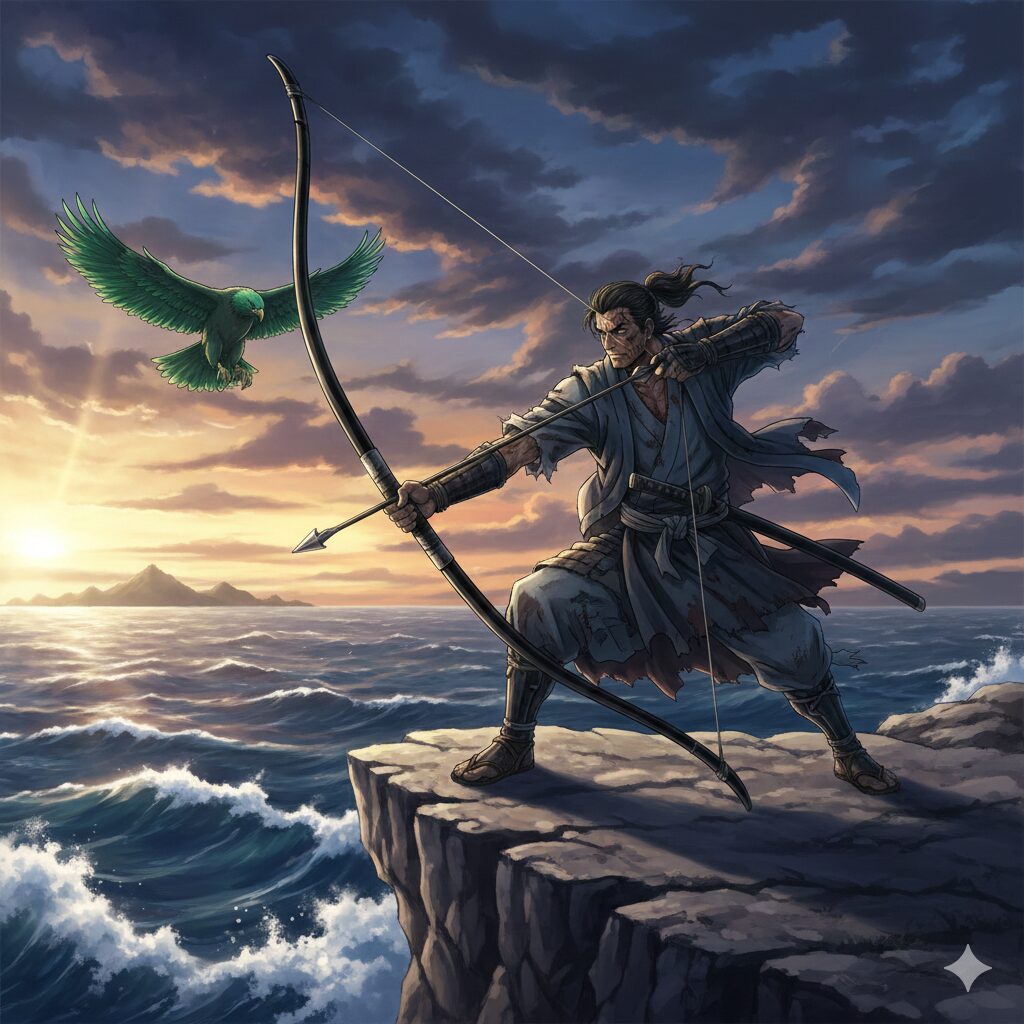
Within the tapestry of Japanese folklore, there are stories whose origins are shrouded in mystery. Among them, the tale of “Yuriwaka Daijin” stands out uniquely. A hero wielding a massive iron bow, an expedition to defeat demons across the sea, a despicable betrayal, survival on a desolate island, and a dramatic return for vengeance. This story is not only incredibly dramatic but also bears a striking resemblance to a certain “world-famous epic.”
Today, we will unravel the magnificent heroic saga of Yuriwaka Daijin, passed down mainly in the Kyushu region, and guide you through the depths of Japanese culture that lie behind it.

1. The Story: The Glory and Hardship of Yuriwaka Daijin
The Birth of a Rare Hero
Long ago, in Bungo (present-day Oita Prefecture), there lived a warrior named Yuriwaka Daijin. Born with a robust physique, he stood over eight feet tall (about 2.4 meters) and was said to possess the strength of thousands of men. His weapon of choice was a massive lacquered iron bow. It was so heavy and powerful that no one but him could even string it.
The Emperor at the time admired Yuriwaka’s valor and granted him the title of “Daijin” (Minister). Yuriwaka married the beautiful Princess Kasuga (Kasuga-hime) and was at the pinnacle of glory, envied by all.
Expedition to Onigashima (Demon Island) and Victory
One day, news arrived that a horde of tens of thousands of “Mongol” forces (or demons, in some versions) were crossing the northern seas to invade Japan. By the Emperor’s command, Yuriwaka led a great army to intercept them. The battle at sea was fierce, but Yuriwaka’s iron bow struck true every time. Once he shot down the enemy general, the opposing forces crumbled, and Yuriwaka secured a magnificent victory.
The Traitor, Beppu Taro
On the way back in triumph, Yuriwaka decided to rest on a certain solitary island at the suggestion of his subordinate, Beppu Taro. Perhaps exhausted from the battle, Yuriwaka fell into a deep sleep.
However, this was Beppu Taro’s trap. Beppu had long coveted Yuriwaka’s prestige and his beautiful wife, Princess Kasuga. “Now is the chance!” Beppu abandoned the sleeping Yuriwaka on the island, ordered all ships to set sail, and returned to Japan.
Upon returning, Beppu falsely reported, “Yuriwaka Daijin died in battle,” and assumed the position of general himself. He then began to persistently court the grieving Princess Kasuga.
Solitude on the Island and Midori-maru the Hawk
When Yuriwaka awoke, he realized he had been betrayed. There were no ships, no food. It was a hopeless situation, but he did not give up. He survived by sipping rainwater and eating moss from the rocks. His once mighty body wasted away, his hair grew wild, and he transformed into a figure resembling a moss-covered rock.
He was saved by his beloved hawk, “Midori-maru.” The hawk had flown across the sea to find its master. Yuriwaka bit his own finger and used the blood to write a message on a piece of torn cloth: “I am on a solitary island. I am alive.”
Midori-maru delivered the letter to Princess Kasuga. Learning of her husband’s survival, she wept with joy. She entrusted an inkwell and brush to the hawk for a reply. Thanks to the hawk’s devoted trips, Yuriwaka’s location was finally revealed, and he was rescued by fishermen.
Return as “Kokemaru” and Vengeance
Yuriwaka returned to Japan but did not reveal his identity immediately. Calling himself “Kokemaru” (Moss Boy), he hid his identity as a hideous servant and infiltrated Beppu Taro’s mansion.
At that time, Beppu Taro was holding a “First Bow Ceremony” for the New Year to display his power. Many warriors competed, but none could draw the “iron bow” that Yuriwaka had left behind.
Just as Beppu laughed, “Hmph, it is merely a decoration that no one can draw,” the filthy Kokemaru stepped forward from the corner of the garden. “Let me try.”
Amidst the ridicule of those around him, Kokemaru quietly took the iron bow. As he put his strength into it, the bow bent like a crescent moon, and the string snapped taut with a sound like thunder.
“That form… it cannot be!”
Kokemaru nocked an arrow and released it. The arrow shattered the target and continued on to sever the head of the traitor, Beppu Taro.
“I am Yuriwaka Daijin!”
The voice was that of the hero of old. Yuriwaka reunited with Princess Kasuga and reclaimed his stolen lands and honor.
2. Analysis: Why is “Yuriwaka” so similar to “Odysseus”?
Reading this story, many of you likely thought of Homer’s epic, *The Odyssey*. The protagonist drifts after an expedition, his wife is plagued by suitors in his absence, and finally, the protagonist returns, reveals his identity through an archery contest, and exacts revenge. This plot is too similar to be a mere coincidence.
Key Similarities
- Long Exile and Return: Both Odysseus and Yuriwaka were unable to return home for a long time after the war.
- Suitors for the Wife: The suitors courting Penelope and Beppu Taro courting Princess Kasuga.
- The Trial of the Bow: The strong bow that only Odysseus could draw, and Yuriwaka’s iron bow.
- Disguise: Both disguised themselves as wretched figures to infiltrate the enemy’s midst.
One prominent theory suggests that during the Sengoku period (16th century), stories told by Jesuit missionaries who came to Japan were incorporated into Japanese storytelling (Kodamu and Joruri) and merged with indigenous legends. If so, the tale of Yuriwaka Daijin can be called a hybrid masterpiece born of cultural exchange between Japan and the West.
3. Cultural Perspective: The Spiritual Power of the Bow and “Kishu Ryuritan”
There are two key concepts of Japanese culture to be read from this story.
The Spiritual Meaning of Bow and Arrow
In Japan, the bow and arrow are more than just weapons; they are “sacred tools to exorcise evil.” Bows are used in Shinto rituals almost without exception (such as *Hamaya*, demon-breaking arrows). The moment Yuriwaka drew the iron bow, it was not merely a display of military force, but a ritualistic act to exorcise and purify the “evil” (Beppu Taro’s treachery) infesting his home.
Kishu Ryuritan (The Tale of the Noble Exile)
Japanese people have a profound fondness for stories where “a noble person is driven from the capital without sin, undergoes hardships, gains divine power, and returns (or becomes a god).” Figures like Minamoto no Yoshitsune and Sugawara no Michizane are typical examples. Yuriwaka Daijin is also a hero who “died” socially once, underwent trials in the otherworld (the solitary island), and was reborn. In this process of “fall and rebirth,” Japanese people find a sense of impermanence (*mujo*) and catharsis.
4. Questions for the Reader
The story of Yuriwaka Daijin depicts trust, betrayal, and an indomitable spirit.
If you were in Yuriwaka’s shoes, could you have kept hope alive for years on a lonely island? Also, could you have approached the subordinate who betrayed you in calm disguise, as he did?
And do you think this story is purely a Japanese original? Or do you believe it is a variation of the Greek epic that traveled across the distant seas? We would love to hear your thoughts.
Related Links
【日本昔話】百合若大臣:海を渡った英雄と愛と復讐の叙事詩
日本の伝説の中には、その起源が謎に包まれているものが数多く存在します。その中でも異彩を放つのが「百合若大臣(ゆりわかだいじん)」です。巨大な鉄の弓を操る英雄、海を越えた鬼退治、卑劣な裏切り、孤島でのサバイバル、そして劇的な帰還と復讐。この物語は、あまりにもドラマチックであり、同時にある「世界的な叙事詩」との奇妙な一致を見せます。
今回は、九州地方を中心に語り継がれる壮大な英雄譚、百合若大臣の物語を紐解き、その背後にある日本文化の深層へご案内します。
1. 物語:百合若大臣の栄光と苦難
希代の英雄、誕生
昔、豊後(現在の大分県)に百合若大臣という武将がいました。彼は生まれながらにして強靭な肉体を持ち、身長は八尺(約2.4メートル)を超え、その力は数千人の男に勝ると言われていました。彼が愛用していたのは、漆塗りの強大な鉄の弓。あまりに重く、強いため、彼以外の誰も弦を張ることさえできませんでした。
時の帝は百合若の武勇を愛し、彼に「大臣」の位を与えました。そして百合若は、美しい妻・春日姫(かすがひめ)を娶り、誰もが羨む栄光の絶頂にありました。
鬼ヶ島への遠征と勝利
ある時、海を越えた北の海域から、数万の「蒙古」の軍勢(物語によっては鬼)が日本に押し寄せてくるとの報せが入りました。帝の命を受けた百合若大臣は、大軍を率いて出陣します。海上の戦いは熾烈を極めましたが、百合若の放つ鉄の弓は百発百中。敵の大将を射抜くと、敵軍は総崩れとなり、百合若は見事に勝利を収めました。
裏切り者、別府太郎
凱旋の途中、百合若は部下の別府太郎(べっぷたろう)らの勧めで、とある孤島で休息をとることにしました。戦いの疲れからか、百合若は深い眠りに落ちてしまいます。
しかし、これは別府太郎の罠でした。別府は百合若の威光と、美しい妻・春日姫を我が物にしようと企んでいたのです。「今こそ好機なり!」別府は眠る百合若を孤島に置き去りにし、船をすべて出して日本へ帰ってしまいました。
帰国した別府は、「百合若大臣は討ち死にした」と嘘の報告をし、自らが将軍の地位に就きます。そして、悲しみに暮れる春日姫に対し、執拗に言い寄るようになったのです。
孤島での孤独と鷹の緑丸
目を覚ました百合若は、自分が裏切られたことを悟りました。船はなく、食料もない。絶望的な状況でしたが、彼は諦めませんでした。雨水を啜り、岩についた苔を食べ、生き延びました。かつての屈強な体は痩せ細り、髪は伸び放題となり、まるで苔むした岩のような姿に変わり果ててしまいました。
そんな彼を救ったのは、彼が愛していた鷹の「緑丸(みどりまる)」でした。緑丸は海を越えて主人のもとへ飛んできたのです。百合若は指を噛み切り、血で着物の端切れに妻への手紙を書きました。「我、孤島にあり。生存せり」
緑丸はその手紙を春日姫のもとへ届けました。姫は夫の生存を知り、涙を流して喜びます。そして墨壺と筆を緑丸に託し、返事を書かせました。緑丸の献身的な往復により、ついに百合若の居場所が判明し、彼は漁師たちの手によって救出されたのです。
苔丸としての帰還と復讐
日本に戻った百合若ですが、すぐに正体を明かすことはしませんでした。「苔丸(こけまる)」と名乗り、醜い下男として身を隠しながら、別府太郎の屋敷に入り込みました。
その頃、別府太郎は自らの権力を誇示するため、正月の祝いに「弓始めの儀」を開催していました。多くの武将が弓を競いましたが、誰も百合若が残したあの「鉄の弓」を引くことはできません。
「ふん、所詮は誰も引けぬ飾り物よ」と別府が笑ったその時、庭の隅にいた薄汚い苔丸が進み出ました。「私が引いてみましょう」
周囲が嘲笑する中、苔丸は静かに鉄の弓を手に取りました。彼が力を込めると、弓は三日月のようにしなり、弦が雷鳴のような音を立てて張り詰められました。
「あの姿は……まさか!」
苔丸は矢をつがえ、放ちました。矢は的を砕き、そのまま裏切り者・別府太郎の首を刎ね飛ばしました。
「我こそは、百合若大臣なり!」
その声はかつての英雄そのものでした。百合若は春日姫と再会を果たし、奪われた領地と名誉を取り戻したのです。
2. 考察:なぜ「百合若」は「オデュッセウス」に似ているのか?
この物語を読んで、ホメロスの叙事詩『オデュッセイア』を思い出した方も多いでしょう。主人公が遠征先で漂流し、留守中に妻が求婚者たちに悩まされ、最後は主人公が帰還して弓の競技で正体を明かし、復讐を果たす。このプロットは偶然の一致にしてはあまりにも似すぎています。
主要な類似点
- 長期の漂流と帰還:オデュッセウスも百合若も、戦争の後に長く帰還できませんでした。
- 妻への求婚者:ペネロペに言い寄る求婚者たちと、春日姫に言い寄る別府太郎。
- 弓の試練:オデュッセウスだけが引ける強弓と、百合若の鉄の弓。
- 変装:両者とも、みすぼらしい姿に変装して敵の懐に入り込んでいます。
有力な説の一つとして、戦国時代(16世紀)に日本に来たイエズス会の宣教師たちが伝えた西洋の物語が、日本の講談や浄瑠璃に取り入れられ、土着の伝説と融合したのではないかと言われています。もしそうだとすれば、百合若大臣の物語は、日本と西洋の文化交流が生んだハイブリッドな傑作と言えるでしょう。
3. 文化的視点:弓矢の霊力と「貴種流離譚」
この物語から読み取れる日本文化のキーワードは2つあります。
弓矢の霊的意味
日本では、弓矢は単なる武器以上の意味を持ちます。それは「魔を祓う神聖な道具」です。神社の神事では必ずと言っていいほど弓が使われます(破魔矢など)。百合若が鉄の弓を引いた瞬間、それは単なる武力の誇示ではなく、屋敷に蔓延る「邪悪(別府太郎の裏切り)」を祓い清める儀式としての側面を持つのです。
貴種流離譚(きしゅりゅうりたん)
日本人は「高貴な人が罪なくして都を追われ、苦難の末に神的な力を得て帰還する(あるいは神となる)」というストーリーを非常に好みます。源義経や菅原道真などがその典型です。百合若大臣もまた、一度社会的に「死んだ」存在となり、異界(孤島)での試練を経て再生するヒーローです。この「没落と再生」のプロセスに、日本人は無常観とカタルシスを感じるのです。
4. 読者への問いかけ
百合若大臣の物語は、信頼と裏切り、そして不屈の精神を描いています。
もしあなたが百合若の立場だったら、孤独な島で何年もの間、希望を捨てずにいられたでしょうか? また、あなたを裏切ったかつての部下に対して、彼のように冷静に変装して近づくことができるでしょうか?
そして、あなたはこの物語が純粋な日本オリジナルだと思いますか? それとも、遠い海を越えて伝わったギリシャの叙事詩の変奏曲だと思いますか? ぜひ、あなたの考えを聞かせてください。
コメント