Japanese folktales often contain more than just moral lessons; they reflect “primal fears” and “prayers to the divine.” The story I am introducing today, “The Moon and the Golden Chain” (Otsukisan Kin no Kusari), is a classic thriller folktale that has sent shivers down the spines of Japanese children as they listened from the safety of their futons.
While it shares a similar structure with Western tales like “The Wolf and the Seven Young Kids” or “Little Red Riding Hood,” this story stands out due to the eerie presence of the uniquely Japanese monster, the “Yamamba” (Mountain Witch), and the mystical role of the moon. Let’s unravel this story and the Japanese spirituality hidden within it.

1. The Story: The Moon and the Golden Chain
Long, long ago, in the depths of a mountain, lived a mother and her three children.
One day, the mother had to go to the town for work. “Listen carefully,” she warned. “No matter who comes, do not open the door. A terrifying Yamamba lives in these mountains.” With those words, she descended the mountain path.
However, a shadow was watching them intently. It was the Yamamba, a fearsome crone who eats humans.
The Yamamba’s Trap
As the sun set, there was a knock on the door. “Knock, knock. Open up, it’s your mother.”
The children answered wisely, “Our mother’s voice is much gentler.”
The Yamamba then sweetened her voice and replied, “I caught a cold, so my voice is raspy.”
“Then show us your hand.” When the children peeked through the crack, they saw a hairy, terrifying hand.
“Our mother’s hands are white and smooth!”
The Yamamba, using her cunning, covered her hand in white powder and tricked the children once again.
Finally, the children unlocked the door. In walked the Yamamba, wearing their mother’s kimono. She intended to eat the children immediately, but they quickly said, “We need to go to the outhouse,” and escaped outside, climbing up a tall tree.
Desperation and Salvation from the Sky
Realizing the children were gone, the Yamamba rushed outside and found them high up in the tree.
“How did you climb up so high?” the Yamamba asked. The youngest child accidentally let it slip:
“We used an axe to cut notches and climbed up.”
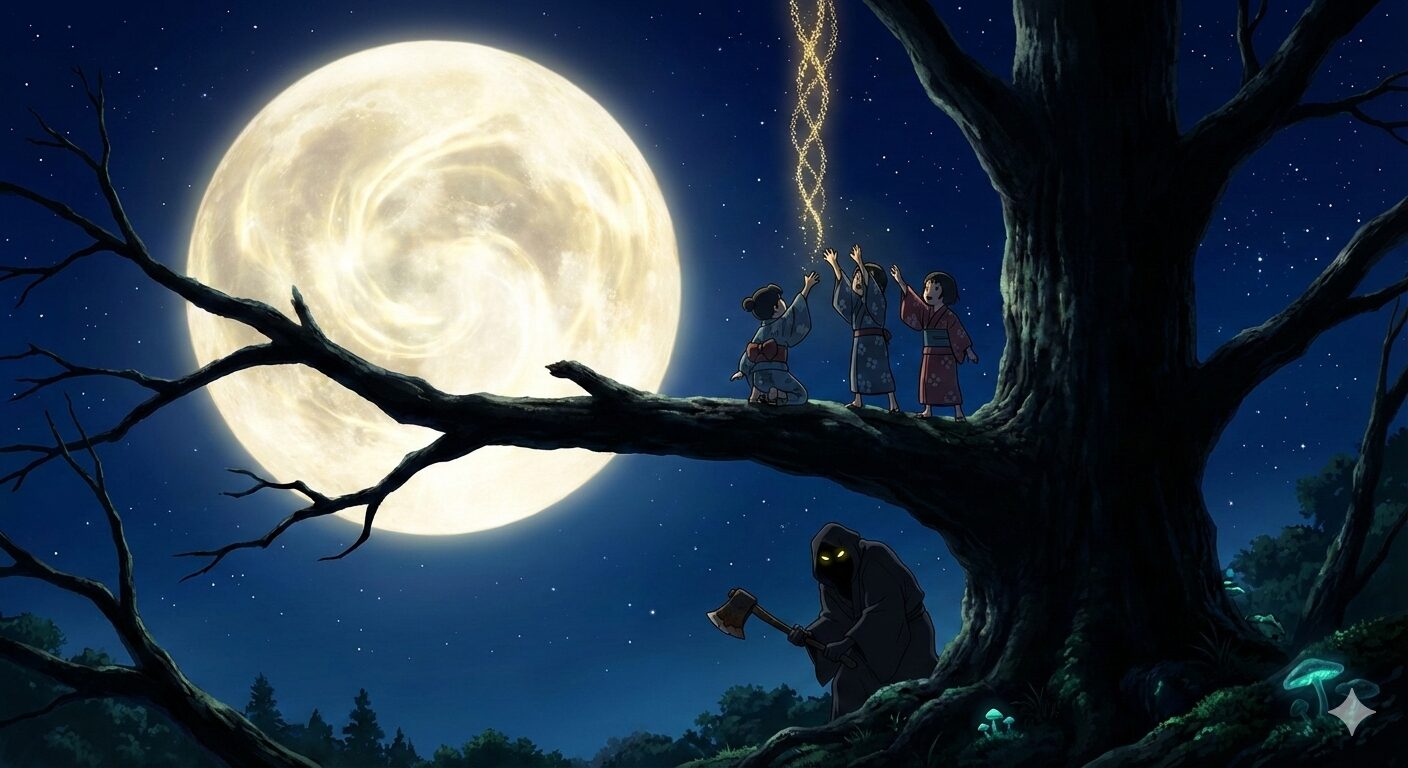
The Yamamba grabbed an axe and began hacking at the tree, climbing with terrifying speed. Just as her sharp fangs were closing in, the children looked up at the full moon shining in the night sky and prayed with all their hearts.
“Oh, Moon Spirit! If you wish to save us, please lower a golden chain! If you do not wish to save us, lower a rotten rope!”
Suddenly, the dark sky lit up, and from between the clouds, a glittering Golden Chain descended smoothly. The children grabbed onto the chain and were lifted up into the heavens.
Seeing this, the Yamamba shouted in imitation:
“Hey Moon! Lower a golden chain for me too!”
The moon lowered something again. But this time, it was a tattered, Rotten Rope. The Yamamba grabbed it, but as she was lifted into the air, the rope snapped. The Yamamba plummeted straight down to the ground.
The Yamamba fell to her death, blood splattering everywhere. It is said that in the fields where her blood landed, “Soba” (Buckwheat) with red stems began to grow.
2. Analysis: Wisdom Cultivated by Fear
While this is one of many folktales found worldwide depicting “the crisis of children left home alone,” the Japanese version carries a unique horror.
- Suspense of Sound and Touch: The monster doesn’t reveal itself immediately but instills fear through sensory anomalies like a “raspy voice” or “hairy hands.” This connects to the “fear of presence” found in Japanese ghost stories (Kaidan).
- The Mimicking Monster: The Yamamba is not just a beast; she has intelligence and acts as a “trickster” pretending to be the mother. This can be read as a metaphor for “malice wearing a kind face” that lurks in society.
3. Deep Japanese Culture: Moon Worship and the Origin of Soba
There are two key elements of Japanese culture to decode from this story.
1. Moon Worship
Since ancient times in Japan, the moon was believed to house gods (such as Tsukuyomi) and was a symbol of salvation illuminating the dark night. The fact that the children pray specifically to “Otsuki-sama” (Mr. Moon) rather than a generic god reflects Japanese Animism. They sought mercy not from the sun, but from the moon shining in the terror of the night.
2. The Role of Origin Myths
The story concludes with the episode of the Yamamba’s blood staining the stems of “Soba” (Buckwheat) red. This serves as a mythological explanation for a child’s question, “Why are buckwheat stems red?” The connection between death and fertility (food) provides a fascinating glimpse into the Japanese view of life and death.
4. What Would You Do?
If you realized in the middle of a dark forest that someone you trusted was actually “something else,” what would you do?
And do you have something to pray to when looking up at the sky in a moment of desperation?
This story is not just an old tale; it questions our modern ability to “see the truth” and “the power of belief.”
Does your country have a similar folktale? Please let me know in the comments.
References & Categories
【日本昔話】お月さん金の鎖:恐怖と救済のサスペンス
日本の昔話には、単なる教訓を超えた「根源的な恐怖」と「神仏への祈り」が色濃く反映された物語が数多く存在します。今回ご紹介する「お月さん金の鎖(The Moon and the Golden Chain)」は、日本の子供たちが布団の中で聞きながら震え上がった、代表的なスリラー昔話です。
西洋の「狼と七匹の子ヤギ」や「赤ずきん」に似た構造を持ちながら、日本独特の妖怪「山姥(Yamamba)」の不気味さと、神秘的な月の存在が際立つこの物語。その全貌と、そこに隠された日本人の精神性を紐解いていきましょう。
1. 物語:お月さん金の鎖
むかしむかし、ある深い山の中に、母親と三人の子供たちが住んでいました。
ある日、母親は町へ仕事に出かけることになりました。「いいかい、誰が来ても決して戸を開けてはいけないよ。山には恐ろしい山姥(やまんば)がいるからね」そう言い残して、母親は山を下りていきました。
しかし、その様子をじっと見つめる影がありました。人を食らう恐ろしい老婆、山姥です。
山姥の罠
日が暮れると、戸を叩く音がしました。「トントン。開けておくれ、おっかあだよ」
子供たちは賢く答えました。「おっかあの声はもっと優しいよ」
すると山姥は声を甘く変えて再び言いました。「風邪を引いて声がガラガラなのさ」
「じゃあ、手を見せて」子供たちが隙間から覗くと、そこには毛むくじゃらの恐ろしい手がありました。
「おっかあの手はもっと白くてすべすべだよ」
山姥は知恵を働かせ、自分の手に白い粉を塗りたくり、再び子供たちを騙しました。
ついに子供たちは戸を開けてしまいます。家に入ってきたのは、母親の着物を着た山姥でした。山姥は子供たちをすぐに食べようとしましたが、子供たちは「便所に行きたい」と言って家の外へ逃げ出し、大きな高い木によじ登りました。
絶体絶命と天からの救い
山姥は子供たちがいないことに気づき、外へ飛び出しました。そして、木の上にいる子供たちを見つけます。
「どうやってそんな高いところへ登ったんだい?」山姥が聞くと、一番下の子供がつい口を滑らせました。
「斧で足場を刻んで登ったんだよ」
山姥は斧で木を切り込みながら、恐ろしい速さで登ってきます。鋭い牙がすぐそこまで迫ったとき、子供たちは夜空に輝く満月を見上げ、必死に祈りました。
「お月さま、お月さま。助けてくださるなら金の鎖を、助けてくださらぬなら腐った縄を下げてください!」
すると、暗い空がぱっと明るくなり、雲の間からキラキラと輝く「金の鎖」がルスルスと降りてきました。子供たちはその鎖に掴まり、天へと引き上げられていきました。
それを見た山姥も真似をして叫びました。
「お月さま、おれにも金の鎖を下げろ!」
月は再び何かを降ろしました。しかし、それはボロボロの「腐った縄」でした。山姥はそれに掴まりましたが、空中で縄がブチリと切れ、山姥は真っ逆さまに地面へ落下しました。
山姥は血まみれになって死に、その血が飛び散った畑には、今でも茎の赤い「蕎麦(そば)」が生えるようになったと言われています。
2. 考察:恐怖が育てる知恵
この物語は、世界中に分布する「子供だけで留守番をする際の危機」を描いた民話の一つですが、日本版には特有の恐ろしさがあります。
- 聴覚と触覚のサスペンス: 最初から姿を見せるのではなく、「声(ガラガラ声)」や「手(毛むくじゃら)」という感覚的な違和感を通じて恐怖を煽ります。これは日本の怪談における「気配の恐怖」に通じます。
- 模倣する怪物: 山姥は単なる猛獣ではなく、知能を持ち、母親になりすます「トリックスター」です。これは、社会の中に潜む「親切そうな顔をした悪意」のメタファーとも読み取れます。
3. 日本文化の深層:月信仰とソバの起源
この物語から読み解ける日本文化の重要な要素が2つあります。
① 月への信仰(Moon Worship)
日本では古来より、月には神(月読命など)が宿るとされ、闇夜を照らす救済の象徴でした。子供たちが「神様」ではなく具体的に「お月さま」に祈る点は、日本人の自然崇拝(アニミズム)の表れです。太陽(お天道様)ではなく、夜の恐怖の中で輝く月にこそ、慈悲を求めたのです。
② 起源説話としての役割
物語の結末で、山姥の血が「蕎麦(Buckwheat)」の茎を赤く染めたというエピソードが語られます。これは「ソバの茎はなぜ赤いのか?」という子供の疑問に答えるための神話的説明です。死と豊穣(食料)が結びついている点は、死生観として非常に興味深い部分です。
4. あなたならどうしますか?
もしあなたが、真夜中の森で、信頼していた誰かが「別の何か」だと気づいてしまったら、どうしますか?
そして、絶体絶命の時に空を見上げ、祈るべき何かを持っていますか?
この物語は、単なる昔話ではなく、現代を生きる私たちに「真実を見抜く目」と「信じる力」を問いかけています。
あなたの国の民話にも、似たような物語はありますか?ぜひコメントで教えてください。
コメント