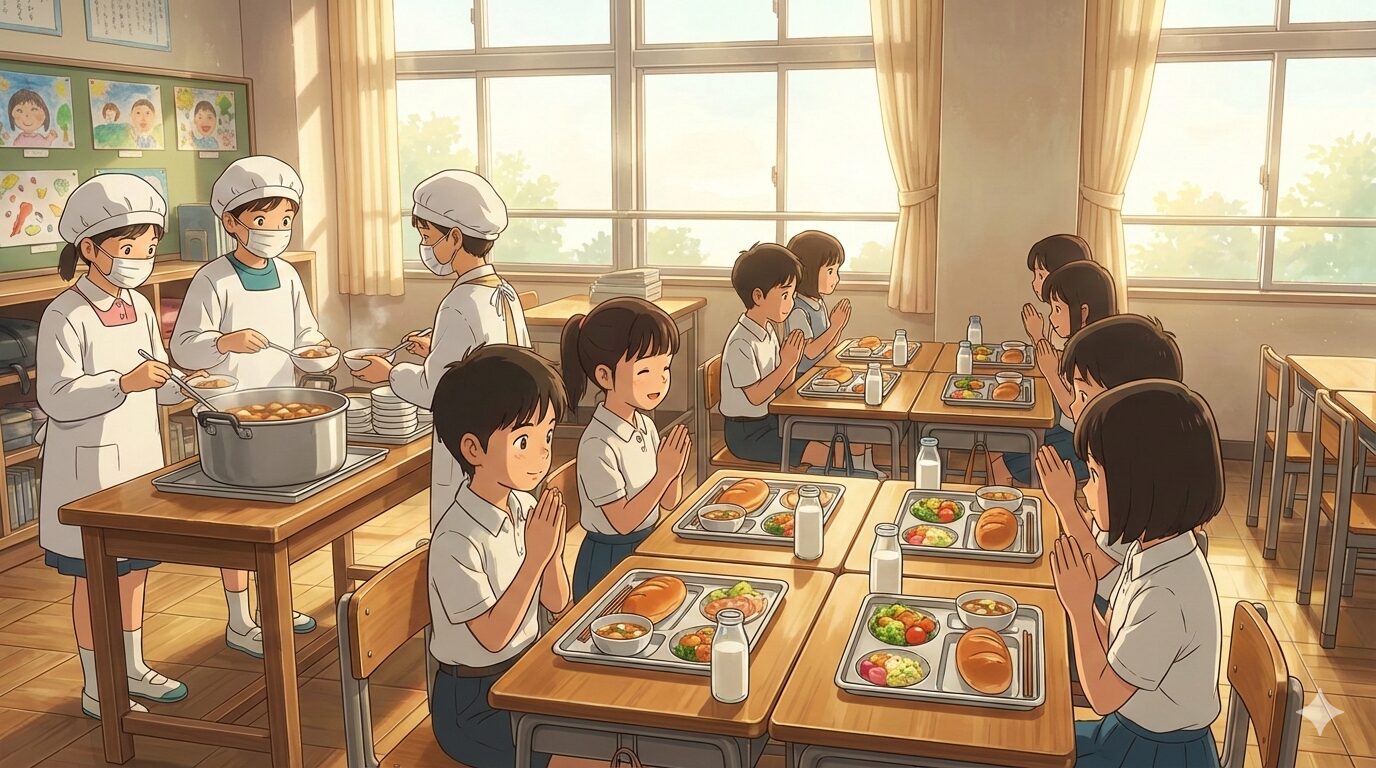
If you’ve ever watched Japanese anime or dramas, you might have seen scenes where students wear white aprons, serve food themselves, and eat together at their desks in the classroom. That is Japan’s “Kyushoku” (school lunch).
More than just a lunch break, Kyushoku culture is deeply rooted as a part of education. Why is January 24th the commemorative day? What history and Japanese spirit are hidden behind it? Today, let’s unravel the history of the Japanese school lunch system, which is garnering attention from around the world.

- January 24th: Memories of Post-War Hope and Gratitude
- Evolution of Kyushoku: From Rice Balls to Fried Bread, and Diversity
- Decoding Japanese Culture: Lunch as “Edible Educational Material”
- Significance and Challenges in the Modern Era
- A Question for You: Society Created by Meals
- 1月24日:戦後の希望と感謝の記憶
- 給食の変遷:おにぎりから揚げパン、そして多様化へ
- 日本文化を読み解く:給食は「食べる教材」
- 現代における意義と課題
- 問いかけ:食事が作る社会
January 24th: Memories of Post-War Hope and Gratitude
First, why does the “School Lunch Day” start on January 24th? Actually, the history of school lunches in Japan is quite old, dating back to 1889. However, the establishment of this commemorative week has a deep story related to the food shortages after World War II and support from the world.
The Restart of Lunch with LARA Aid
Japanese school lunches, said to have started in Yamagata Prefecture in 1889, were forced to stop as the war intensified. After the defeat in 1945, Japan fell into a serious food shortage, and many children suffered from malnutrition.
What saved this critical situation was relief supplies from “LARA” (Licensed Agencies for Relief in Asia), mainly American private organizations. Supplies such as skim milk, flour, and canned goods were delivered to Japan. On December 24, 1946, school lunches were experimentally restarted in schools in Tokyo, Kanagawa, and Chiba.
Normally, December 24th would be the anniversary. However, since Japanese schools enter winter break around that time, the date was shifted one month later to “January 24th.” It was established as National School Lunch Day to express gratitude, marking the beginning of National School Lunch Week.
Evolution of Kyushoku: From Rice Balls to Fried Bread, and Diversity
Looking at the history of school lunch menus is synonymous with looking at the history of Japan’s economic growth.
- 1889 (Meiji 22): Private Chuai Elementary School in Yamagata Prefecture provided free lunch for children living in poverty. The first meal was simple but warm: “Rice balls (Onigiri), grilled fish, and pickles.”
- Post-War (Late 1940s~): Bread made from American aid flour and skim milk. Skim milk at that time had a distinct flavor, and for many elderly Japanese today, it is often spoken of as a bitter memory of “drinking while holding one’s nose.”
- 1950s-1970s: The arrival of “Soft Noodles.” A noodle style halfway between udon and spaghetti, served with meat sauce, is the ultimate nostalgia for Japanese people born in the Showa era. Also, “Agepan” (fried bread coated with sugar or soybean flour), invented to make stale bread taste better, became a hugely popular menu item.
- 1976 (Showa 51): Official introduction of rice lunches. “Rice,” the staple food of Japanese people, appeared in school lunches which had been bread-based. This dramatically improved nutritional balance and introduced diverse menus like curry rice and Japanese cuisine.
Decoding Japanese Culture: Lunch as “Edible Educational Material”
What I want international readers to know most is that Japanese Kyushoku is fundamentally different from the system of “buying what you like at a cafeteria.”
1. Equality: Everyone Eats the Same Thing
Except for allergy accommodations, everyone from the principal to the students basically eats the same menu. The experience of eating the same meal regardless of wealth forms the foundation of group consciousness and solidarity in Japanese society.
2. Responsibility of the “Kyushoku Toban”
There are no lunch ladies to serve the food in Japanese classrooms. Instead, students take turns serving as the “Kyushoku Toban” (Lunch Duty) on a weekly basis. Wearing white coats, masks, and caps, they carry heavy tableware and pots to the classroom and serve portions equally to all classmates. Through this daily lunch time, children learn public spirit and responsibility: “Do your own things yourself” and “Work for your peers.”
3. Practice of “Shokuiku” (Food Education)
Lunchtime is part of the class. Through menus carefully planned by nutritionists, students learn about nutritional balance, local ingredients (“Chisan-Chisho”: local production for local consumption), and seasonal event foods. Before eating, everyone puts their hands together and says “Itadakimasu” (I humbly receive this life), and after eating, says “Gochisousama-deshita” (It was a feast), and cleans up by themselves.
Significance and Challenges in the Modern Era
Today, Japan’s school lunch program is evaluated as one of the most successful nutrition programs in the world. However, challenges exist. Issues like food loss and the increase of “solitary eating” in modern society are redefining the significance of eating together in the classroom.
Recently, school lunches continue to evolve, incorporating organic ingredients and offering dishes from around the world to deepen international understanding.
A Question for You: Society Created by Meals
On January 24th, Japanese schools often recreate the simple school lunches of the past or serve local traditional dishes. It is a ritual to remember past hunger and give thanks for peace and abundance.
What is lunchtime like at schools in your country?
If children were to handle everything from meal preparation to cleanup themselves, how do you think society would change?
If we only sought efficiency, bringing a packed lunch or using a cafeteria style might be faster. However, the Japanese system, which deliberately chooses to take time to “prepare together and eat together,” may be packed with “consideration for others” and “respect for food”—values that modern people are starting to forget.
Reference Links
日本のカレンダーをめくると、1月24日から30日までは特別な期間として記されています。それは「全国学校給食週間」です。
もしあなたが日本のアニメやドラマを見たことがあるなら、生徒たちが白い割烹着を着て、自分たちで食事を配膳し、教室で机を並べて食事をするシーンを見たことがあるかもしれません。あれこそが、日本の「給食(Kyushoku)」です。
単なる昼食の時間を超え、教育の一環として深く根付いている日本の給食文化。なぜ1月24日が記念日なのか、そしてそこにはどのような歴史と日本人の精神が隠されているのか。今日は、世界が注目する日本の給食システムとその歴史を紐解いていきましょう。
1月24日:戦後の希望と感謝の記憶
まず、なぜ1月24日が「給食の日」の起点となっているのでしょうか。実は、日本の学校給食の歴史は非常に古く、明治22年(1889年)にまで遡ります。しかし、この記念日が制定された背景には、第二次世界大戦後の食糧難と、世界からの支援という深い物語があります。
LARA(ララ)物資による給食の再開
1889年に山形県で始まったとされる日本の給食は、戦争の激化とともに中断を余儀なくされました。1945年の敗戦後、日本は深刻な食糧不足に陥り、多くの子どもたちが栄養失調に苦しんでいました。
この危機的状況を救ったのが、アメリカの民間団体を中心とした「アジア救済公認団体(LARA)」からの支援物資でした。脱脂粉乳や小麦粉、缶詰などが日本に届けられ、1946年12月24日、東京・神奈川・千葉の学校で試験的に給食が再開されました。
本来であれば12月24日が記念日となるはずですが、日本の学校は冬休みに入ってしまうため、1ヶ月ずらした「1月24日」を、感謝の意を込めて学校給食記念日とし、その後の1週間を学校給食週間と定めたのです。
給食の変遷:おにぎりから揚げパン、そして多様化へ
日本の給食メニューの歴史を見ることは、日本の経済成長の歴史を見ることと同義です。
- 明治22年(1889年):山形県の私立忠愛小学校で、貧困児童のために無償で昼食を提供。「おにぎり、焼き魚、漬物」という質素ながらも温かい食事が最初でした。
- 戦後(1940年代後半〜):アメリカからの支援による小麦粉を使ったコッペパンと、脱脂粉乳(スキムミルク)。当時の脱脂粉乳は独特の風味があり、今の高齢者にとっては「鼻をつまんで飲んだ」という苦い思い出として語られることもあります。
- 昭和30〜40年代(1950s-1970s):「ソフト麺」の登場。うどんとスパゲッティの中間のような麺にミートソースをかけるスタイルは、昭和生まれの日本人にとって最強のノスタルジーです。また、硬くなったパンを美味しく食べるために考案された「揚げパン(砂糖やきな粉をまぶした揚げたパン)」も大人気メニューとなりました。
- 昭和51年(1976年):米飯給食の正式導入。それまでパン主体だった給食に、日本人の主食である「ご飯」が登場します。これにより、カレーライスや和食の献立が増え、栄養バランスが劇的に向上しました。
日本文化を読み解く:給食は「食べる教材」
海外の読者の皆様に最も知っていただきたいのは、日本の給食は「カフェテリアで好きなものを買って食べる」システムとは根本的に異なるという点です。
1. 全員が同じものを食べる「平等性」
アレルギー対応を除き、校長先生から生徒まで、基本的に全員が同じメニューを食べます。貧富の差に関係なく、同じ釜の飯を食べるという体験は、日本社会における集団意識や連帯感の基礎を形成しています。
2. 給食当番(Kyushoku Toban)という責任
日本の学校には配膳スタッフがいません。その代わり、生徒たちが週替わりで「給食当番」を務めます。白衣とマスク、帽子を着用し、重い食器や鍋を教室まで運び、クラスメート全員分を均等に配膳します。 「自分のことは自分でする」「仲間のために働く」という公共心と責任感を、子どもたちは日々のランチタイムを通じて学んでいるのです。
3. 食育(Shokuiku)の実践
給食の時間は授業の一部です。栄養士が考え抜いた献立を通じて、栄養バランス、地元の食材(地産地消)、季節の行事食について学びます。食事の前には全員で手を合わせ「いただきます(命をいただきます)」と感謝し、食後には「ごちそうさまでした」と言って、自分たちで片付けを行います。
現代における意義と課題
現在、日本の給食は世界で最も成功した栄養プログラムの一つとして評価されています。しかし、課題がないわけではありません。食品ロスの問題や、個食(一人で食べること)が増える現代社会において、教室でみんなで食べる給食の意義が再定義されています。
また、最近ではオーガニック食材を取り入れたり、世界各国の料理を提供して国際理解を深めたりと、給食は常に進化し続けています。
問いかけ:食事が作る社会
1月24日、日本の学校では当時の質素な給食を再現したり、地域の郷土料理が出されたりします。それは、過去の飢餓を忘れず、平和と豊かさに感謝するための儀式でもあります。
あなたの国の学校のランチタイムはどのようなものですか?
もし、子どもたちが食事の準備から片付けまでを自分たちで行うとしたら、社会はどのように変わると思いますか?
効率だけを求めれば、お弁当を持参したり、カフェテリア形式にする方が早いかもしれません。しかし、あえて時間をかけて「共に準備し、共に食べる」ことを選んだ日本のシステムには、現代人が忘れかけている「他者への配慮」や「食への敬意」が詰まっているのではないでしょうか。
参考リンク
- 文部科学省:学校給食週間について
- カテゴリー:今日の記念日シリーズ


コメント