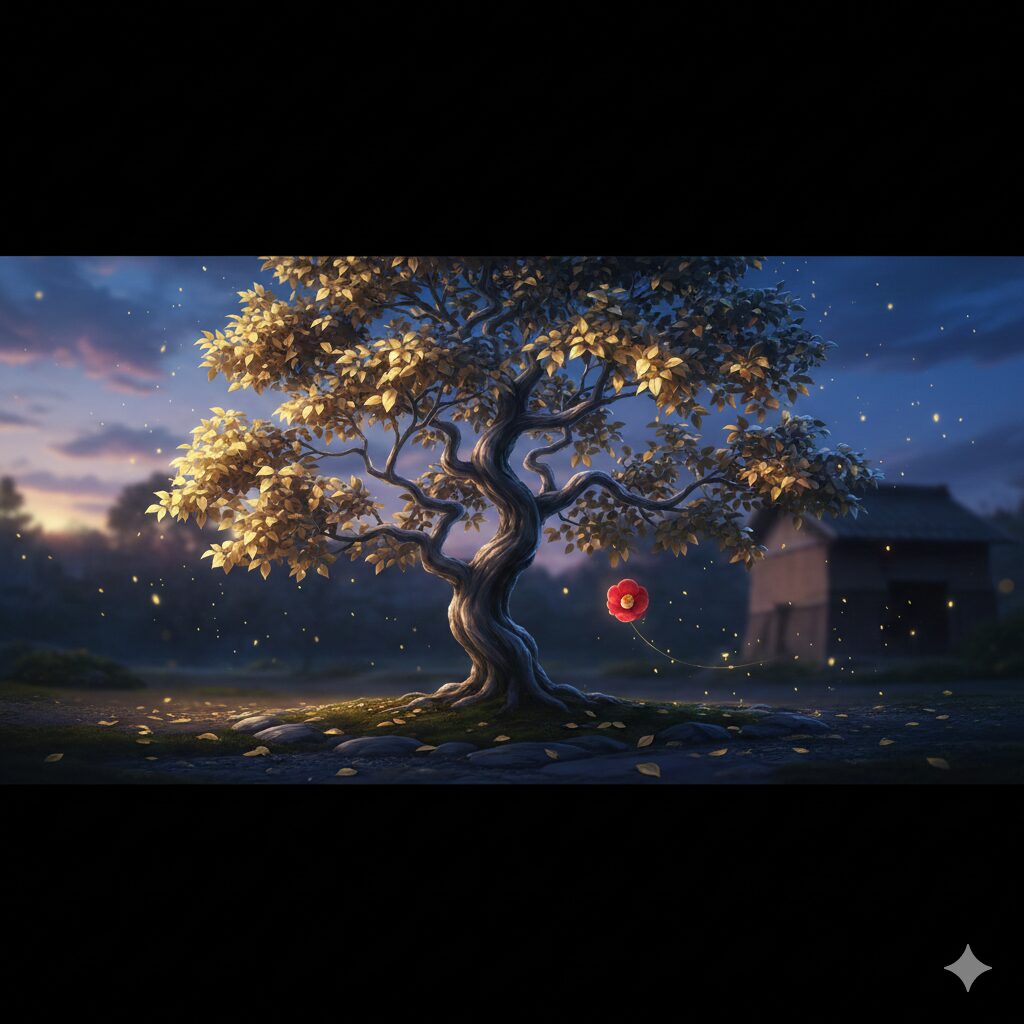
In the snowy northern region of Niigata, Japan, lies a mysterious legend where human greed intersects with the mystical power of nature. Today, I introduce “Tamaya no Tsubaki” (The Camellia of Tamaya), a story about a secret that could not be kept.

1. The Story: The Tree That Bloomed Gold
Long ago, in a seaside village called Kujiranami in Echigo Province (modern-day Niigata Prefecture), there stood a grand merchant house known as “Tamaya.” The master, Tokubei, was a diligent man. From his youth, he worked tirelessly from dawn till dusk, and after twenty years of labor, he amassed a massive fortune.
Tokubei married a beautiful wife and was blessed with a healthy son. He seemed to be at the height of happiness as the wealthiest man in the village. However, as his wealth grew, a darkness began to creep into Tokubei’s heart.
“Someone must be after my money. Thieves will break in and steal everything I have built.”
Consumed by paranoia, Tokubei could no longer sleep at night. Even locking his storehouse brought him no peace. One night, he secretly carried his gold and silver out of the storehouse and dug a deep hole at the roots of an old Camellia tree (Tsubaki) in his backyard.
“It is safe now. No one would ever suspect that gold is buried under a tree,” he thought.
Relieved of his burden, Tokubei decided to visit a distant hot spring to rest his weary mind. While soaking in the bath, feeling like he was in paradise, he heard the voices of children singing outside.
♪ Echigo Kujiranami, the Camellia of Tamaya,
♪ Its branches are silver, its leaves are gold,
♪ It blooms with coins in the wind.
Tokubei doubted his ears. Why were children in this distant land singing about his camellia tree? And why did the lyrics describe the very treasure he had hidden?
“It cannot be!”
Pale with fear, Tokubei rushed back home. Gasping for breath, he ran into his backyard and was met with an unbelievable sight.
The camellia tree was glowing with an eerie light. The branches had turned into solid silver, the leaves into pure gold. Every time the wind blew, the tree chimed with the sound of coins. The camellia had absorbed the spiritual energy of the gold and silver Tokubei had buried.
Tokubei frantically dug up the roots, but found only stones. The treasure had completely fused with the tree. Legend says that eventually, the entire Tamaya estate sank into the sea, and to this day, the waves in that area sparkle with a mysterious golden glimmer.
2. Analysis: Psychological Burden and Animism
This story offers more than a simple lesson against greed.
The Terror of Attachment
Tokubei was not a villain; he was a hard worker. However, his possession possessed him. In Buddhist philosophy, this is a classic example of “Attachment” (Bonno) destroying peace of mind. The moment he tried to return his wealth to the earth (nature), it ceased to be his property and became part of the natural world.
Nature Reveals All
Japanese folklore often features the motif that “secrets always leak.” Here, the Camellia acts as the whistleblower. In Japanese Animism (Shinto roots), old trees are believed to have spirits. The spirit of the Camellia fed on the intense energy of Tokubei’s obsession (the gold) and exposed it to the world in a form that was both beautiful and grotesque.
3. Cultural Insight: The Duality of the Camellia
The Tsubaki (Camellia) is a highly symbolic flower in Japan.
- Vitality and Holiness: Blooming vividly in the harsh winter, it symbolizes resilience and life force.
- Image of Death: Conversely, because the flower head falls off whole rather than petal by petal, it historically reminded the Samurai class of “beheading.” Thus, it is sometimes considered taboo for sick visits.
In this tale, the Camellia plays a role that is both magnificent (turning to gold) and tragic (sinking into the sea). It suggests that material glory is as fleeting as a dream.
4. A Question for You
If you, like Tokubei, possessed a treasure you wanted no one to know about, where would you hide it? And if that treasure transformed into a beautiful living tree, would you admire its beauty, or mourn your lost wealth?
This folktale asks us to consider what we truly need to protect: our material possessions or our peace of mind.
References & Resources
- Enjoy Niigata (Official Travel Guide) – Discover the region where this legend was born.
- Wikipedia: Camellia Japonica – Learn about the botany and cultural significance of the Tsubaki.
- Japanese Folktale Series Category – Read more Japanese folktales here.
越後の不思議な物語:玉屋の椿
日本の雪深い北国、新潟県。この地には、人間の欲望と自然の不可思議な力が交差する、美しくも恐ろしい伝説が残されています。今日は、隠しても隠しきれない「秘密」にまつわる物語、「玉屋の椿(たまやのつばき)」をご紹介します。
1. 昔話:黄金の木になった椿
むかしむかし、越後の国(現在の新潟県)の鯨波(くじらなみ)という海辺の村に、「玉屋(たまや)」という屋号の大きな家がありました。主人の徳兵衛(とくべえ)は、若い頃から朝から晩まで泥まみれになって働き、二十年もの歳月をかけて莫大な財産を築き上げました。
徳兵衛は美しい妻をめとり、玉のような男の子にも恵まれ、村一番の長者として幸せの絶頂にいました。しかし、お金が増えれば増えるほど、徳兵衛の心にはある「闇」が生まれました。
「誰かが俺の金を狙っているのではないか。泥棒が入って、全てを盗まれてしまうのではないか」
疑心暗鬼になった徳兵衛は、夜も眠れなくなりました。蔵に厳重な鍵をかけても安心できません。そこで彼はある夜、誰にも見られないようにこっそりと蔵の金銀財宝を持ち出し、裏庭にある古い椿(つばき)の木の根元に深い穴を掘って埋めてしまいました。
「これで安心だ。木の下に金があるなど、誰も思いつきはしまい」
重荷を下ろした徳兵衛は、久しぶりに心を休めるため、遠くの温泉へ湯治(とうじ)に出かけることにしました。温泉に浸かり、極楽気分でくつろいでいた時です。外で遊ぶ子供たちの歌声が聞こえてきました。
♪ 越後鯨波、玉屋の椿
♪ 枝は白銀、葉は黄金
♪ 花は小判で咲き乱れる
徳兵衛は耳を疑いました。遠く離れた温泉地で、なぜ自分の家の椿の歌が歌われているのか? しかも歌詞は、隠した財宝のことを歌っているではありませんか。
「まさか!」
顔色を変えた徳兵衛は、着の身着のまま家へと飛んで帰りました。息を切らせて裏庭へ駆け込むと、そこには信じられない光景が広がっていました。
裏庭の椿の木は、妖しい光を放っていました。なんと、枝は銀に、葉は黄金に変わり、風に揺れるたびにチャリン、チャリンと小判の音を立てていたのです。徳兵衛が埋めた金銀の精気を、椿の木がすべて吸い上げてしまっていたのでした。
徳兵衛は慌てて根元を掘り返しましたが、そこには石ころがあるばかり。金銀はすべて椿の木と同化してしまっていたのです。一説によると、その後、玉屋の屋敷ごと海へ沈んでしまい、今でもそのあたりの海面だけが、黄金色にキラキラと輝いていると言われています。
2. 解説:隠された心理と自然のアニミズム
この物語は、単なる「欲張り爺さん」の教訓話以上の深みを持っています。
執着(Attachment)の恐怖
徳兵衛は働き者で、決して悪人ではありませんでした。しかし、守るべきものが増えすぎた結果、彼は「恐怖」に支配されました。仏教的な観点から見れば、これは「執着(Bonno)」が平穏な心を蝕む典型的な例です。彼が財産を土(自然)に還そうとした瞬間、それはもはや彼個人の所有物ではなく、自然界の一部となってしまったのです。
暴露する自然
日本の昔話には、「壁に耳あり障子に目あり」のように、秘密は必ず漏れるというモチーフが多くあります。ここでは、植物である「椿」が秘密を暴露します。日本のアニミズム(精霊信仰)では、古木には魂が宿ると信じられています。徳兵衛の強い念がこもった黄金を、椿の精霊が養分として取り込み、その美しくも異様な姿で世間に公表してしまったのです。
3. 日本文化との繋がり:椿の二面性
椿(Camellia)は、日本文化において非常に象徴的な花です。
- 生命力と神聖さ: 冬の寒さの中で鮮やかな花を咲かせる椿は、生命力の象徴であり、悪霊を払う神聖な木とされてきました。
- 死のイメージ: 一方で、花びらが散るのではなく、花首からぽとりと落ちる様が、武士の「斬首」を連想させるとして、見舞いや贈り物には避けられる場合もあります。
この物語における椿は、黄金という「富」を吸い上げながらも、最終的にはその富と共に海へ沈む(あるいは消滅する)という、美しくも儚い、そして少し不気味な役割を果たしています。これは、富や栄華が一瞬の夢であることを象徴しているかのようです。
4. あなたへの問いかけ
もしあなたが徳兵衛のように、誰にも知られたくない莫大な宝を手に入れたら、どこに隠しますか? そして、その宝が美しい木に変わってしまったとしたら、あなたはその美しさを愛でることができますか、それとも失った富を嘆きますか?
物質的な豊かさと、心の平穏。この物語は、現代を生きる私たちに「本当に守るべきものは何か」を問いかけています。
参考リンク
- 新潟県公式観光情報サイト(にいがた観光ナビ) – 物語の舞台となった地域の魅力を発見できます。
- ウィキペディア:ツバキ – 日本文化における椿の役割について。
- Japanese Folktale Series Category – その他の日本の昔話はこちら。

コメント