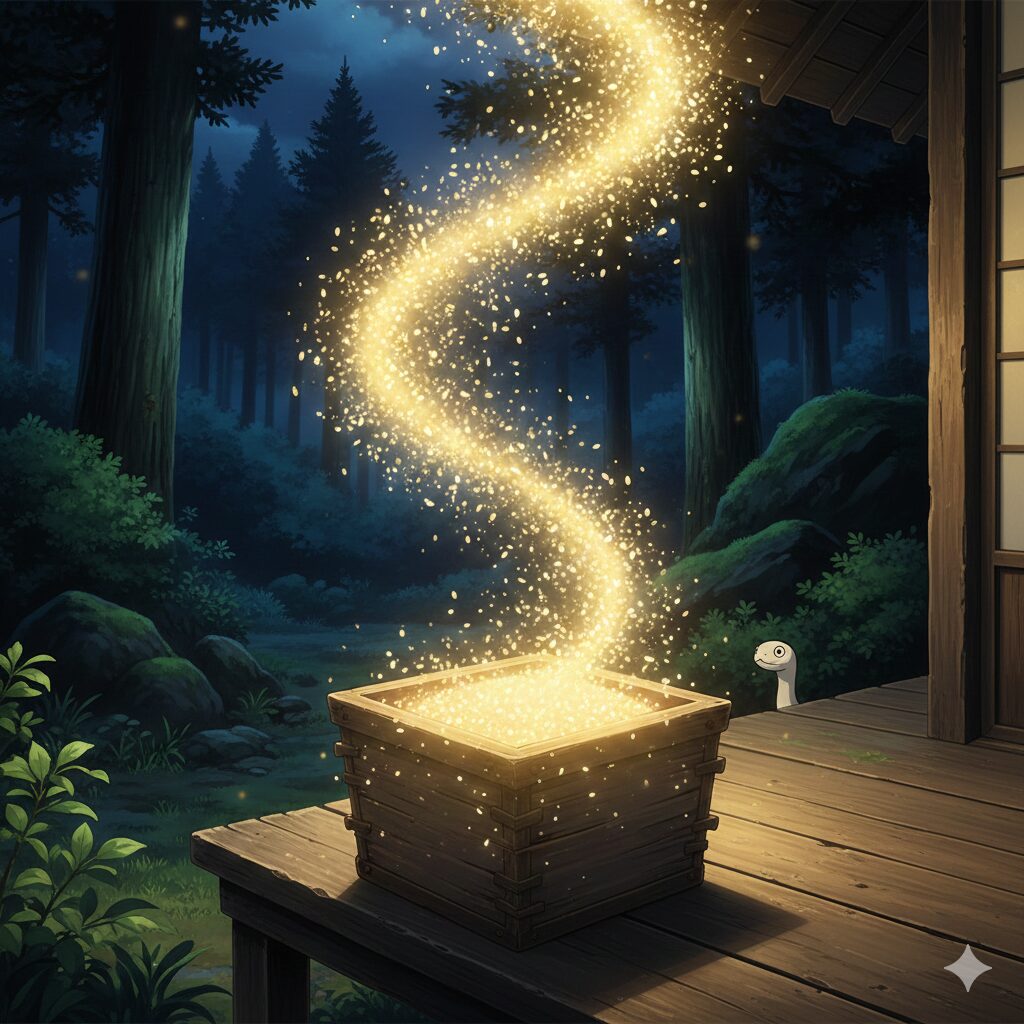

The Tale of “The Mysterious Masu”
Long, long ago, in a small village nestled deep in the mountains, lived an old man named Heisuke. He was very poor but honest and hardworking. His heart was as beautiful as fine brocade, and he always cherished the creatures of the forest.
One cold winter day, while Heisuke was gathering firewood in the mountains, he found a white snake caught in a trap, unable to move. “Oh my, you poor thing. I’ll help you right now.” With trembling hands, Heisuke released the trap and set the snake free.
That night, a beautiful woman appeared in Heisuke’s dream and said:
“I am the white snake you saved. As a token of my gratitude, I have left a gift in the shadow of the rock where I live. Please use it with care.”
The next morning, when Heisuke went to the spot she mentioned, he found a single, old, wooden “Masu” (measuring box) sitting there alone.
“Hmm, is this just an ordinary box?”
Heisuke decided to test it by placing the only grain of rice he had into the Masu. Suddenly, the grain of rice began to multiply with a rustling sound, and in the blink of an eye, the Masu was overflowing with polished white rice.
“This is a blessing!”
Thanks to the mysterious Masu, Heisuke no longer struggled for food. However, he never lived extravagantly. He took only what he needed and shared the surplus with the poor people of the village.
Now, a greedy man named Gonzo, who lived in the neighboring village, heard rumors of this.
“Heisuke seems to have obtained a strange treasure. I want a share of that luck.”
Gonzo forcibly borrowed the Masu from Heisuke. Promising to return it after just one night, Gonzo took the Masu home.
Gonzo had no interest in rice. “If I multiply something more valuable, I’ll become the richest man in the land!”
He placed a single gold coin into the Masu. Immediately, the gold coins multiplied, crunching and overflowing from the box. Gonzo danced with wild joy. Wanting to multiply them even faster, he foolishly peered deep into the Masu and tried to stir the contents with his hands.
At that moment, he lost his balance and tumbled headfirst into the Masu.
“Whoa! Help me!”
When Gonzo managed to crawl out, something unbelievable happened. Another Gonzo climbed out of the Masu after him.
“Who are you?” “I am Gonzo! Who are you?”
The two Gonzos began to argue about who was the real one. Then, another one, and yet another one—an endless stream of “angry Gonzos” crawled out of the box.
The house became filled with Gonzos, all fighting and grappling with each other, shouting, “I am the real one!” and “This gold is mine!” The situation spiraled out of control. The Gonzos punched and kicked each other until, finally, exhausted from the fighting, they all vanished like smoke.
All that remained was the empty, mysterious Masu. When Heisuke rushed over, there was no trace of the gold or Gonzo—only a quiet wind blowing through the empty house.
Analysis: What is Amplified—Matter or Mind?
This story is rich with suggestion. The mysterious Masu is depicted as a magical tool that physically multiplies objects, but on a deeper psychological level, it functions as a “device that amplifies the owner’s essence.”
- Heisuke’s Case: He was a man who “knew sufficiency.” He was satisfied with turning one grain of rice into a boxful and shared it with others. His “modesty” and “compassion” were amplified, enriching the entire village.
- Gonzo’s Case: His essence was “greed” and “narcissism.” By falling into the box, he multiplied himself. This is a powerful metaphor that greed has no limits and eventually consumes the self, leading to destruction (self-collapse).
The ending where “he multiplies himself and fights” is particularly surreal and philosophical among Japanese folktales. It reflects the image of modern people crushed by conflicts with their own inflated egos.
Unlocking Japanese Culture: The Role of the Masu
To understand this story more deeply, one must know the significance of the “Masu” in Japanese culture.
1. Symbol of Fairness
In historical Japan, the Masu was a crucial administrative tool for measuring rice for annual tax payments. The unit “Issho” (approx. 1.8 liters) was a standard for people’s lives. In other words, the Masu is a symbol of “fairness and justice.” When Gonzo abused this standard of fairness for “selfish greed,” he incurred Bachi (Divine Punishment).
2. A Sacred Vessel
Even in modern Japan, the Masu is used to drink Sake at weddings and celebrations. The scent of the wood enhances the flavor of the sake. It is also used as a container for beans during Setsubun (a festival to scatter beans to drive away evil). The Masu is a sacred vessel for offerings to the gods. It is not something to be handled with an impure heart.
Note: The word “Masu” has the same pronunciation as the Japanese verb for “increase” (増す). Therefore, it has long been treated as a lucky charm in Japan.
What Would You Put In It?
If you had this “Mysterious Masu” in your hands, what would you put in it?
Would it be money? Your favorite food? Or perhaps something intangible like time or knowledge?
But remember: that Masu might reflect and multiply your heart itself. If you have a heart that shares like Heisuke, happiness will come. If you try to monopolize it like Gonzo, chaos will surely follow.
Japanese folktales, while simple, sharply question us on “how we should live.”
Related Links
If you want to know more about Japanese traditional tools and folklore, please check the category below.
Internal Link: Japanese Folktale Series Category
日本の山深い村々には、不思議な力が宿る道具にまつわる伝説が数多く残されています。今回ご紹介するのは、ただの道具ではなく、人間の心のあり方を映し出す「枡(ます)」の物語です。この物語は、富とは何か、そして欲望の果てにあるものは何かを、ユーモアと少しの毒を含んで私たちに語りかけます。
昔話「ふしぎな枡」の物語
むかしむかし、ある山奥の小さな村に、とても正直で働き者の平助(へいすけ)というおじいさんが住んでいました。平助は貧しかったのですが、心は錦のように美しく、森の生き物たちをいつも大切にしていました。
ある寒い冬の日のことです。平助が山で薪を拾っていると、罠にかかって身動きが取れなくなっている一匹の白蛇を見つけました。「おやおや、可哀想に。今助けてやるからな」平助は震える手で罠を外し、蛇を逃がしてやりました。
その夜のことです。平助の夢枕に美しい女性が現れ、こう告げました。
「私はあなたが助けてくれた白蛇です。お礼に、私の住処である岩陰に贈り物を置いておきました。どうか大切に使ってください」
翌朝、平助が言われた場所へ行ってみると、そこには古びた小さな「枡(ます)」が一つ、ポツンと置かれていました。
「はて、ただの枡じゃろうか?」
平助が試しに、持っていたたった一粒の米をその枡に入れてみました。するとどうでしょう。枡の中の米粒がパラパラと音を立てて増え始め、あっという間に枡一杯の白米になったではありませんか。
「これはありがたい!」
平助はその不思議な枡のおかげで、食べるものに困らなくなりました。しかし、彼は決して贅沢をせず、必要な分だけを出し、余った分は村の貧しい人々に分け与えました。
さて、この噂を聞きつけたのが、隣村に住む強欲な権蔵(ごんぞう)という男です。
「平助のやつ、妙な宝物を手に入れたらしいな。俺もあやかってやろう」
権蔵は無理やり平助から枡を借り受けました。「一晩だけだぞ」と念を押され、権蔵は枡を家に持ち帰りました。
権蔵は米などには目もくれません。「もっと価値のあるものを増やせば、俺は長者になれる!」
彼は小判を一枚、枡に入れました。すると、ザクザクと小判が増え、枡から溢れ出しました。権蔵は狂喜乱舞し、もっと早く増やそうと、あろうことか枡の中を覗き込み、手でかき混ぜようとしました。
その時です。勢い余って、権蔵はバランスを崩し、枡の中に転がり落ちてしまいました。
「うわあ! 助けてくれ!」
権蔵が這い出してみると、なんということでしょう。枡の中から、もう一人の権蔵が出てきたのです。
「お前は誰だ!」「俺は権蔵だ! お前こそ誰だ!」
二人の権蔵は、どちらが本物かと言い争い始めました。そこへまた一人、さらに一人と、枡からは次々と「怒り狂った権蔵」が這い出してきます。
家の中は権蔵だらけになり、全員が「俺が本物だ」「この小判は俺のものだ」と取っ組み合いの喧嘩を始めました。収拾がつかなくなった権蔵たちは、互いに殴り合い、蹴り合い、最後には全員が疲れ果てて、煙のように消えてしまいました。
あとには、空っぽになった不思議な枡だけが残されていました。平助が駆けつけた時には、小判も権蔵も跡形もなく、ただ静かな風が吹き抜けているだけでした。
物語の考察:増幅されるのは「物質」か「心」か
この物語は非常に示唆に富んでいます。不思議な枡は、単に物を物理的に増やす魔法の道具として描かれていますが、深層心理的には「所有者の本質を増幅させる装置」として機能しています。
- 平助の場合:彼は「足るを知る」人物でした。一粒の米を枡一杯にするだけで満足し、それを他者と共有しました。彼の「慎ましさ」と「慈悲」が増幅され、村全体が豊かになりました。
- 権蔵の場合:彼の本質は「強欲」と「自己愛」です。彼が枡に落ちたことで、彼自身が増殖しました。これは、欲望には際限がなく、最終的には自分自身さえも飲み込み、破滅させる(自己崩壊する)という強烈なメタファーです。
特に「自分自身が増えて喧嘩をする」という結末は、日本の昔話の中でも特にシュールで哲学的です。エゴが肥大化した結果、自分自身との葛藤に押しつぶされる現代人の姿にも重なります。
日本文化を読み解く:枡(Masu)の役割
この物語をより深く理解するために、日本文化における「枡」の意味を知る必要があります。
1. 公正さの象徴
かつての日本において、枡は年貢(税金としての米)を計るための極めて重要な行政ツールでした。「一升(約1.8リットル)」という単位は、人々の生活の基準でした。つまり、枡は「公平・公正」の象徴なのです。権蔵がその公正な基準を「私利私欲」のために乱用した時、バチ(Divine Punishment)が当たったのです。
2. 神聖な器
現代の日本でも、結婚式やお祝いの席で日本酒を飲む際に「枡」が使われます。木の香りが移った酒は格別です。また、節分(豆まき)の際にも豆を入れる器として使われます。枡は、神様への供物を入れる神聖な器でもあります。不浄な心で扱ってはならないものなのです。
注釈:「増す(Masu)」という言葉は「増える(Increase)」と同じ発音であるため、日本では古くから縁起物として扱われてきました。
あなたなら、何を入れますか?
もし、あなたの手元にこの「ふしぎな枡」があったら、あなたは何を入れますか?
お金でしょうか? お気に入りの食べ物でしょうか? それとも、時間や知識のような形のないものでしょうか?
ただし、忘れないでください。その枡は、あなたの心そのものを映し出し、増やしてしまうかもしれません。平助のように分かち合う心を持っていれば幸福が、権蔵のように独り占めしようとすれば混乱が訪れるでしょう。
日本の昔話は、シンプルながらも私たちに「どう生きるべきか」を鋭く問いかけてきます。
関連リンク
日本の伝統的な道具や文化についてさらに詳しく知りたい方は、以下のカテゴリーもご覧ください。


コメント