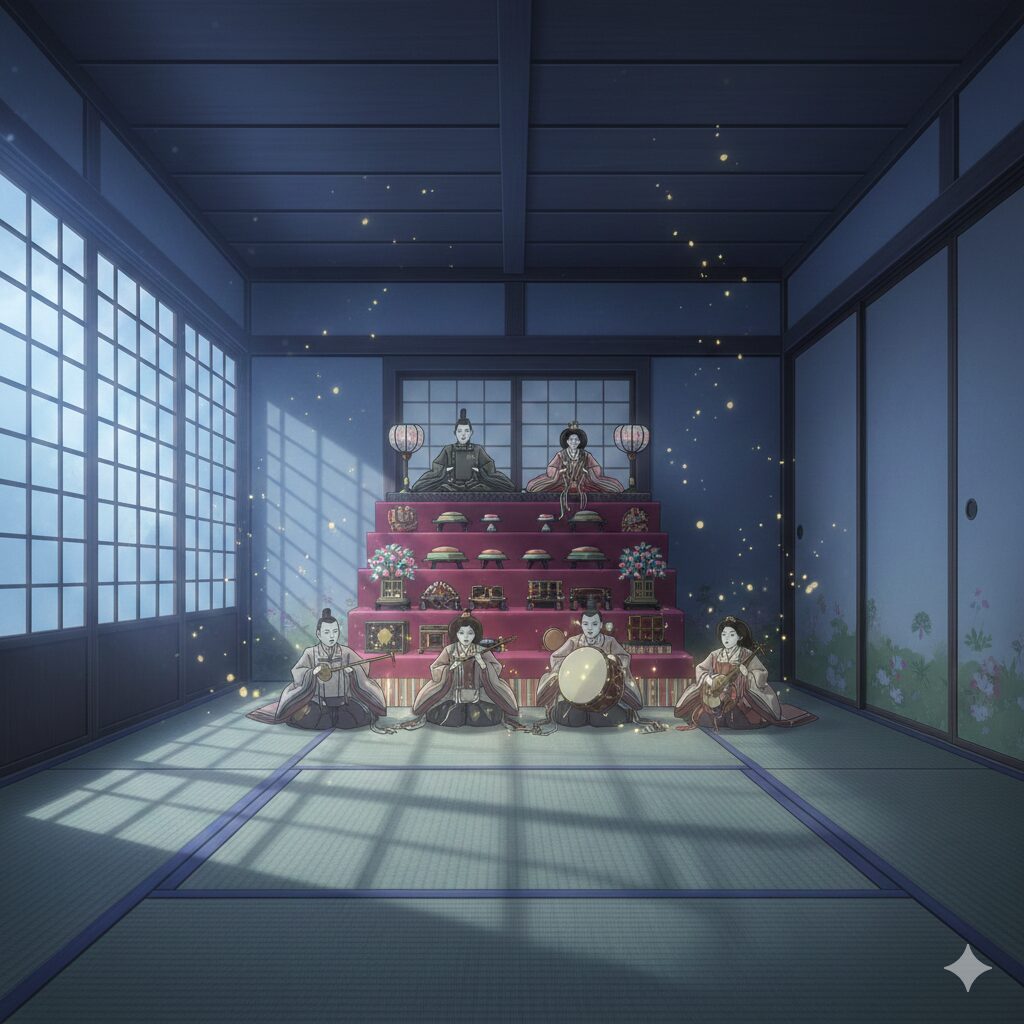
In Japanese folklore, there is an ancient belief that “objects and dolls that have been cherished for a long time acquire a soul.” Today, I would like to introduce a beautiful yet poignant story about a set of exquisite Hina dolls and a pure-hearted family living in poverty. This tale, known as “Hina no Yobayashi” (The Night Music of the Dolls), asks us the true meaning of “loving things.”

Folktale: Hina no Yobayashi (The Night Music of the Dolls)
The Poor Honest Man and the Treasured Dolls
Long ago, in a corner of a castle town, lived an honest and hardworking man with his wife and young daughter. Although the man worked diligently, the economy was bad, and they lived in such poverty that they struggled to find food for the day.
However, this humble house possessed a single, disproportionately magnificent family heirloom. It was a set of “Hina Dolls” passed down from their ancestors. The set included the Emperor and Empress (Odairi-sama and Ohina-sama), the Three Court Ladies, and the Five Musicians (Gonin-bayashi). These dolls had beautiful faces that looked almost alive, and their kimonos were vibrant, showcasing the master craftsmanship of a bygone era.
Every year, as the Peach Festival (Hina Matsuri on March 3rd) approached, the man would carefully take the dolls out of the closet, dust them off, and display them in the best spot in the house. The daughter loved looking at these dolls; it was her only joy amidst their poverty. Seeing their daughter smile and say, “We meet again this year,” was the greatest happiness for the couple as well.
A Heartbreaking Decision
One year, the man fell ill and could not work for many days. Their savings ran dry; they had no money for medicine, nor money for tomorrow’s rice. The wife sold her kimonos and sold off household items little by little to survive, but finally, there was nothing left to sell.
“…I suppose we have no choice but to let them go.”
The man’s gaze fell upon the Hina dolls displayed for the season. “They are such magnificent dolls. If we sell them to the antique dealer, we can live for a while, and I can buy medicine.” The wife and daughter wept and opposed the idea, but they could not exchange their dignity for survival. With a breaking heart, the man made a promise to hand the dolls over to the dealer the next morning.
The Miracle on the Night of Farewell
That night came. Knowing this was the end, the family spent the evening quietly in front of the dolls. By tomorrow morning, these beautiful figures would belong to someone else. The daughter, exhausted from crying, fell asleep beside the dolls. The couple, too, went to bed with heavy hearts.
It was the Hour of the Ox (around 2:00 AM), when even the grass and trees are asleep. Suddenly, the man woke up to a strange sound.
“…Do you hear that?” “Yes, is this… the sound of Ohayashi (festival music)?”
From the inner room where the dolls were displayed, faint but distinct music could be heard. *Pi-hyara, ton-ton. Pi-hyara, sutten-ton.* It was the sound of flutes and drums. However, it wasn’t lively like a festival; it was a beautiful tone, somewhat lonely yet crystal clear.
The couple looked at each other and gently slid open the Fusuma (sliding door).
The Performance of Souls
An unbelievable sight unfolded before them. In the room illuminated by moonlight, the dolls of the Five Musicians (Gonin-bayashi) had come to life; they were playing the flutes and beating the drums. The Three Court Ladies were dancing silently, and the Emperor and Empress stood still, looking tenderly at the sleeping daughter’s face.
“Ah, the dolls… they are reluctant to part with us.”
The man muttered with a trembling voice. The dolls were dedicating a performance on their last night for the family that had cherished them. The melody sounded as if they were saying, “Thank you, and goodbye.” The couple prostrated themselves on the floor, listening to the performance with tears streaming down their faces. The heartbreakingly gentle music continued until dawn.
The Conclusion
The next morning, the antique dealer arrived pulling his cart. However, the man bowed his head to the dealer and said: “I am terribly sorry. I cannot sell those dolls after all. They are not mere objects. They are family.”
Sensing the man’s extraordinary demeanor and a divine aura drifting from the dolls, the dealer left without saying a word. Strangely enough, from that day on, the man’s illness rapidly improved. Working harder than ever, he was blessed with more work, and the household gradually became prosperous.
The Hina dolls remained displayed in that house forever, quietly watching over the family and their descendants.
Analysis: “The Japanese Heart” in the Story
1. Tsukumogami and Animism
At the core of this story is the unique Japanese belief that “gods or spirits reside in tools that have passed through many years.” This is called “Tsukumogami.” In Western values, a doll is often just “material,” but in Japan, when disposing of dolls, it is common not to treat them as trash but to perform a ritual called “Ningyo Kuyo” at a shrine to appease their souls. This story beautifully depicts the existence of a “spiritual exchange” between matter and humans.
2. The Role of the “Gonin-bayashi”
In a Hina doll set, the Gonin-bayashi are the five boy musicians. They typically hold instruments used in Noh theater. In the story, what they play is not just sound, but words of gratitude and farewell to the family. The setting where voiceless dolls express emotions through music reflects the Japanese aesthetic of “Ishin-denshin” (communicating hearts without words).
Cultural Background and Message for Today
Hina Matsuri originally began as “Nagashibina,” where straw dolls were floated down a river to wash away bad luck. It was around the Edo period that it changed to the form of displaying luxurious dolls inside the house. In modern society, mass production and mass consumption have become the norm; if something breaks, it is immediately replaced. However, “Hina no Yobayashi” asks us: “Do you love your belongings enough that they would move at night to mourn your parting?”
This story is not mere fantasy; it contains a moral lesson reminding us of the “heart to cherish things” that we are losing. To cherish objects is synonymous with cherishing one’s own life and memories.
To Our Readers
How did you feel reading this story? Do you have any dolls or tools in your home that you have treasured since childhood? If you had to let them go, what kind of “music” would they play for you?
Please, take a moment today to direct a little gratitude toward the “things” around you. Perhaps tonight, in your dreams, they might speak to you.
Related Links
- Japanese Folktale Series Category
- Kyoto National Museum (Traditional Japanese Culture) – Exhibitions on traditional Japanese culture and dolls are often held here.
- JNTO – Konosu Hina Matsuri – Introduction to one of Japan’s largest Hina Matsuri events.
はじめに:人形に宿る魂の物語
日本の古い言い伝えには、「長く大切にされた道具や人形には魂が宿る」という考え方があります。今回ご紹介するのは、美しい雛人形と、貧しくとも心清らかな家族の間に起きた、ある春の夜の奇跡の物語です。『ひなの夜ばやし』と呼ばれるこのお話は、私たちに「ものを愛すること」の本当の意味を問いかけます。
昔話:ひなの夜ばやし
貧しき正直者と宝物の人形
むかしむかし、ある城下町の片隅に、正直で働き者の男が妻と幼い娘と一緒に暮らしていました。男は真面目に働いていましたが、不景気が続き、その日の食べ物にさえ困るほどの貧しい暮らしをしていました。
そんな家にも、たった一つだけ、不釣り合いなほど立派な家宝がありました。それは、先祖代々受け継がれてきた「雛人形(ひなにんぎょう)」の一式でした。お内裏様にお雛様、三人官女に五人囃子(ごにんばやし)。その人形たちは、まるで生きているかのような美しい顔立ちをしており、着ている着物も色あせることなく、当時の職人の技が光る見事なものでした。
毎年、桃の節句(3月3日)が近づくと、男は押入れから大切に人形を取り出し、埃を払い、一番良い場所に飾りました。娘はその人形を見るのが大好きで、貧しい暮らしの中で唯一の楽しみにしていました。「今年も会えたね」と語りかける娘の笑顔を見るのが、夫婦にとっても一番の幸せでした。
苦渋の決断
ある年のこと、男が病に倒れ、働けない日々が続きました。蓄えは底をつき、薬を買う金も、明日の米を買う金もありません。妻は自分の着物を売り、家にあるものを少しずつ売って食いつないできましたが、とうとう売るものがなくなってしまいました。
「……もはや、あれを手放すしかないか」
男の視線の先には、今年も飾られた雛人形がありました。 「あんなに立派な人形だ。道具屋に売れば、しばらくは暮らしていけるだろうし、薬も買える」 妻と娘は涙を流して反対しましたが、背に腹は代えられません。男は断腸の思いで、翌朝、道具屋に人形を引き渡す約束をしてしまいました。
別れの夜の奇跡
その夜のことです。 これが最後だと、家族は人形の前で静かに過ごしていました。明日の朝には、この美しい人形たちは他人の手に渡ってしまいます。娘は泣き疲れ、人形のそばで眠ってしまいました。夫婦もまた、重い心を抱えながら布団に入りました。
草木も眠る丑三つ時(午前2時頃)。 ふと、男は奇妙な音で目を覚ましました。
「……聞こえるか?」 「ええ、これは……お囃子(はやし)の音?」
家の奥の間、人形を飾ってある部屋から、微かですが、確かに音楽が聞こえてくるのです。 ピーヒャラ、トントン。ピーヒャラ、スッテントン。 それは笛や太鼓の音でした。しかし、祭りのような賑やかなものではなく、どこか寂しく、それでいて透き通るような美しい音色でした。
夫婦は顔を見合わせ、そっと襖(ふすま)を開けました。
魂の演奏
そこには信じられない光景が広がっていました。 月の光が差し込む部屋の中で、五人囃子の人形たちが動き出し、笛を吹き、太鼓を叩いていたのです。三人官女は静かに舞い、お内裏様とお雛様は、眠っている娘の顔を優しく見守るように佇んでいました。
「ああ、人形たちが……別れを惜しんでくれているのだ」
男は震える声で呟きました。人形たちは、自分たちを大切にしてくれた家族のために、最後の夜に演奏を捧げていたのです。その音色は、「ありがとう、さようなら」と言っているように聞こえました。 夫婦はその場にひれ伏し、涙を流しながらその演奏を聴き入りました。夜が明けるまで、その切なくも優しいお囃子は続きました。
結末
翌朝、道具屋が荷車を引いてやってきました。 しかし、男は道具屋に頭を下げて言いました。 「申し訳ない。やはり、あの人形たちは売ることができません。あれはただの物ではないのです。家族なのです」
道具屋は男の只ならぬ様子と、人形から漂う神々しい気配を感じ取り、何も言わずに帰っていきました。 不思議なことに、その日から男の病は急速に快方に向かいました。再び懸命に働き始めた男は、以前にも増して仕事に恵まれ、家は少しずつ豊かになっていきました。
雛人形たちはその後もずっとその家に飾られ、家族を、そしてその子孫たちを、静かに見守り続けたといいます。
考察:物語が示す「日本人の心」
1. 付喪神(Tsukumogami)とアニミズム
この物語の核となるのは、「長い年月を経た道具には神や霊魂が宿る」という日本独特の信仰です。これを「付喪神(つくもがみ)」と呼びます。西洋的な価値観では人形はあくまで「物質」ですが、日本では人形を捨てる際にゴミとして扱わず、神社で「人形供養(Ningyo Kuyo)」をして魂を鎮める儀式を行うのが一般的です。この物語は、物質と人間の間に「魂の交流」が存在することを美しく描いています。
2. 「五人囃子」の役割
雛人形の段飾りにおいて、五人囃子(Gonin-bayashi)は音楽を担当する少年たちの人形です。彼らは通常、能楽(Noh theater)の楽器を持っています。物語の中で彼らが演奏するのは、単なる音ではなく、家族への感謝と別れの言葉です。言葉を持たない人形が、音楽を通じて感情を表現するという設定は、日本文化における「以心伝心(言葉にしなくても心が通じ合うこと)」の美学を感じさせます。
文化的な背景と現代へのメッセージ
雛祭りは、本来、川へ人形を流して厄を払う「流し雛」から始まりました。それが江戸時代頃から、豪華な人形を家の中に飾る形式へと変化しました。 現代社会では、大量生産・大量消費が当たり前となり、物が壊れればすぐに買い替えることができます。しかし、『ひなの夜ばやし』は私たちに問いかけます。「あなたは、夜中に動き出して別れを惜しんでくれるほど、物を愛していますか?」と。
この物語は単なるファンタジーではなく、私たちが失いつつある「ものを慈しむ心」を思い出させてくれる、道徳的な教訓を含んでいます。物を大切にすることは、自分自身の生活や思い出を大切にすることと同義なのです。
読者の皆様へ
この物語を読んで、あなたはどのように感じましたか? あなたの家には、子供の頃からずっと大切にしている人形や道具はありますか?もし、それらを手放さなければならなくなったとき、それらはあなたにどんな「音」を奏でてくれるでしょうか。
ぜひ、あなたの周りにある「物」たちに、今日は少しだけ感謝の気持ちを向けてみてください。もしかすると今夜、あなたの夢の中で、彼らが話しかけてくれるかもしれません。
関連リンク
- Japanese Folktale Series Category
- Kyoto National Museum (Traditional Japanese Culture) – 日本の伝統文化や人形に関する展示が行われることがあります。
- JNTO – Konosu Hina Matsuri – 日本最大級のひな祭りイベントの紹介(英語)。


コメント