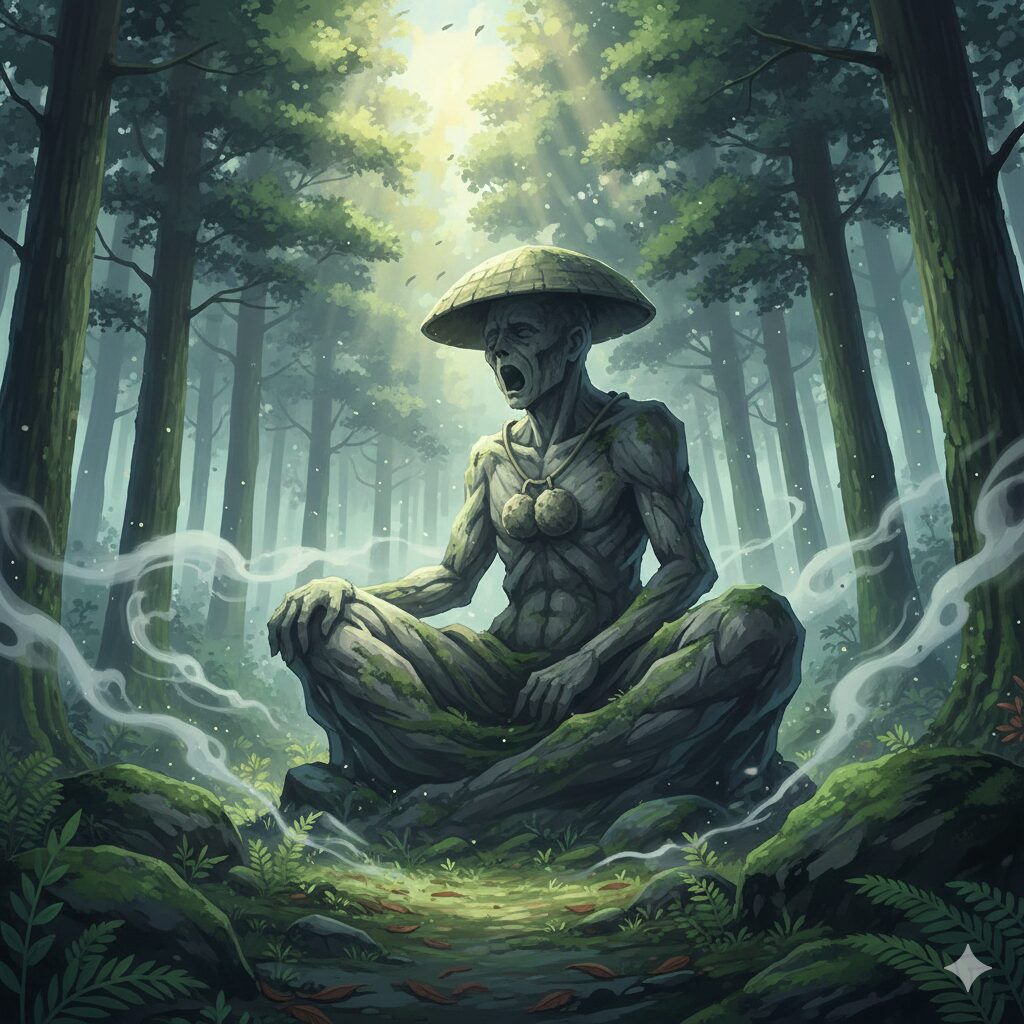
Deep within the mountains of Japan, there exist rocks and stones of such peculiar shapes that they seem far removed from mere geological formations. These stones are often cloaked in tragic legends and an awe of forces beyond human comprehension. The “Yamabushi Ishi” (Mountain Ascetic Stone) is one such legend.
Why did a disciplined ascetic turn into a stone that keeps an eternal silence in the misty mountains? This story contains a harrowing lesson about challenging supernatural forces and the peril of human hubris.

1. The Folktale: The Legend of Yamabushi Ishi
Long ago, in a remote and rugged mountain range, there arrived a single *Yamabushi* (mountain ascetic) who was exceptionally skilled in the use of *Horiki* (spiritual power).
A Yamabushi is a practitioner of *Shugendo*, an ancient Japanese faith where one undergoes rigorous training within nature. They blow conch shells, carry ringed staffs (*shakujo*), and train daily to gain supernatural abilities.
This particular Yamabushi, however, was overly confident in his own powers. “My spiritual power can manipulate the weather and repel demons,” he boasted to the villagers at the foot of the mountain. “There is nothing in this world that my spells cannot overcome.” The villagers feared him yet respected him, but the village elder alone frowned and offered a warning.
“Monk, a fierce god has lived at the peak of this mountain since ancient times. You must never defile the ‘God’s Garden’ at the summit. That is not a place for humans to tread.”
The Yamabushi scoffed. “A god, you say? With my powers, even a god will obey me. I will expose this god’s true form and make it submit to me.”
The next morning, the Yamabushi began his ascent with brimming confidence. On his way, the wind howled to reject him, and a sudden thunderstorm battered him. Yet, the Yamabushi chanted incantations, forcibly cutting through the storm. “Behold! Even nature bows before me!” Convinced of his victory, he finally stepped onto the forbidden summit.
The peak was wrapped in an eerie silence. There lay a beautiful, flat rock surface, drifting with a sacred atmosphere. There, the Yamabushi laughed loudly, blew his conch shell triumphantly, and began to drink the sake he had brought. “Come out, God! Let us see whose power is superior!”
It was in that moment.
The sky suddenly turned a bruised, dark purple. Soundless lightning flashed, and the ground began to tremble like an angry beast. The Yamabushi felt the cold sensation of stone creeping up from his feet.
“W-What is this?!”
From his toes to his knees, then to his waist, his body rapidly transformed into hard rock. He desperately tried to form hand seals and chant a spell, but his throat had already petrified, and no voice came out. All that remained were his eyes, wide open in terror. Then, even those eyes turned to gray stone, closing him into eternal darkness.
When the wind ceased and silence returned, only a rock shaped like a Yamabushi remained.
Even now, the “Yamabushi Ishi” stands on that mountain, looking as if it is trying to scream. It remains as an eternal warning from the gods to those who forget their awe of nature and become consumed by arrogance.
2. Analysis: Why Was He Turned to Stone?
This tragic ending is not merely a “bad ending.” It strongly reflects the concepts of “sin” and “punishment” in the Japanese psyche.
Punishment for Hubris
Much like in Greek mythology, humans infringing upon the domain of the divine (Hubris) is considered the ultimate sin. The Yamabushi’s fault was not a lack of training, but the delusion that he could “control nature (God).”
The Metaphor of “Petrification”
The punishment of “turning to stone” rather than death holds a special meaning.
- Eternal Shame: He is not allowed to die and return to the earth; instead, he must expose his foolish form for all eternity.
- Guardian of the Boundary: Ironically, the petrified monk now serves as a landmark, warning future generations that “beyond here lies danger.”
3. Cultural Depths: Shugendo and Nature Worship
To understand this story more deeply, we must touch upon Japanese cultural backgrounds, specifically “Shugendo” and the view of nature.
What is Shugendo?
Shugendo is a unique Japanese religious practice formed by the syncretism of ancient mountain worship, Buddhism (Esoteric), and Taoism. These “Yamabushi” secluded themselves in mountains, stood under waterfalls, and fasted to gain supernatural power.
However, the original purpose was to “become one with nature,” not to “dominate nature.” The Yamabushi in the story misunderstood this fundamental doctrine.
Nature to be Feared
In Western culture, nature is often depicted as something to be “pioneered and managed.” However, in Japan, nature *is* God itself. Mountains, rivers, and rocks are all believed to be inhabited by spirits (*Kami*).
This story expresses a sense of resignation and awe unique to Japan, a land of natural disasters: “No matter how much technology or knowledge (power) humans possess, they are powerless before the will of Great Nature.” It suggests that in modern society, too, just when we think we have conquered nature with technology, retribution will come.
4. Questions for You
After reading the story of “Yamabushi Ishi,” what did you feel?
Do we, in the modern age, also possess the “power” of science and technology and arrogantly believe we can control nature? Like that Yamabushi, have we crossed an “invisible boundary”?
If you were to climb that mountain and find the Yamabushi Stone, what words would you say to it? Would you laugh and call him foolish? Or would you quietly clasp your hands and offer a prayer to nature?
I would love to hear your thoughts.
Related Information & Links
- For more on Japanese mountain worship and history, please visit the following category:
Japanese Folktale Series – Kiri53.com - Reference Link (National Parks of Japan & Shugendo):
National Parks of Japan (Ministry of the Environment)
【日本昔話】山伏石:沈黙する石が語る、慢心と畏敬の物語
日本の山々には、単なる地質学的な形成物とは到底思えない、奇妙な形をした岩や石が存在します。それらは往々にして、悲劇的な伝説や、人知を超えた力への畏怖をまとっています。「山伏石(やまぶしいし)」もまた、その一つです。
霧深い山奥で、修行者がなぜ永遠の沈黙を守る石へと変わり果てたのか。この物語は、超自然的な力への挑戦と、人間の驕りに対する痛烈な教訓を含んでいます。
1. 昔話:山伏石の伝説
むかしむかし、ある深い山に、法力(不思議な術)を使うことに長けた一人の山伏(やまぶし)がやってきました。
山伏とは、山岳信仰に基づき、厳しい自然の中で修行を行う者のことです。彼らは法螺貝(ほらがい)を吹き、錫杖(しゃくじょう)を突き、超常的な力を得ようと日々鍛錬していました。
この山伏は、自らの力を過信していました。「私の法力は、天候をも操り、魔物を退ける。この世に私の術が通じぬものなどない」と、彼は麓の村人たちに豪語していました。村人たちは彼を恐れ、同時に敬いましたが、長老だけは眉をひそめて忠告しました。
「お坊様、この山の頂には、古くから荒ぶる神が住んでおられます。決して頂上の『神の庭』を汚してはなりませぬ。あそこは人が足を踏み入れてよい場所ではないのです」
しかし、山伏は鼻で笑いました。「神だと? 私の法力があれば、神もまた私に従うだろう。私がその神の正体を暴き、従わせてみせよう」
翌朝、山伏は自信満々に山を登り始めました。道中、風が唸りを上げて彼を拒もうとし、突然の雷雨が彼を打ち据えました。しかし、山伏は呪文を唱え、無理やりその嵐を切り裂いて進みました。「見よ、自然さえも私にひれ伏した!」彼は勝利を確信し、ついに禁断の頂上へと足を踏み入れたのです。
頂上は、奇妙なほど静寂に包まれていました。そこには美しい平らな岩場があり、神聖な空気が漂っていました。山伏はそこで高らかに笑い、あろうことか法螺貝を吹き鳴らし、持参した酒を飲み始めました。「神よ、出てこい! 私の力とどちらが上か、勝負だ!」
その瞬間でした。
空が突然、どす黒い紫色に染まりました。音のない稲妻が走り、地面が怒った獣のように震え始めました。山伏の足元から、冷たい石の感触が這い上がってくるのを彼は感じました。
「な、なんだこれは!?」
足先から膝、腰へと、彼の体は急速に硬い岩へと変わっていきました。彼は必死に印を結び、呪文を唱えようとしましたが、喉まで石化し、声が出ません。最後に残ったのは、恐怖に見開かれた彼の目だけでした。そして、その目さえも灰色の石となり、永遠の闇へと閉ざされました。
風が止み、再び静寂が戻ったとき、そこには一人の山伏の形をした岩だけが残されていました。
今でもその山には、何かを叫ぼうとしているかのような形をした「山伏石」が立ち尽くしています。それは、自然への畏敬を忘れ、驕り高ぶった者への、神からの永遠の戒めとして残されているのです。
2. 物語の考察:なぜ彼は石にされたのか
この悲劇的な結末は、単なる「バッドエンド」ではありません。ここには、日本人の精神構造における「罪」と「罰」の概念が色濃く反映されています。
ヒューブリス(傲慢)への罰
ギリシャ神話でも見られるように、人間が神の領域を侵すこと(ヒューブリス)は、最大の罪とされます。山伏の罪は、修行不足だったことではなく、「自分は自然(神)をコントロールできる」と錯覚した点にあります。
「石化」というメタファー
死ぬのではなく「石になる」という罰には特別な意味があります。
- 永遠の恥辱: 死んで土に還ることも許されず、その愚かな姿を未来永劫晒し続けることになります。
- 境界線の守護: 皮肉なことに、石になった彼は、後世の人々に対して「ここから先は危険だ」と知らせる道標(ランドマーク)の役割を果たすことになりました。
3. 日本文化の深層:修験道と自然崇拝
この物語をより深く理解するために、日本の文化的背景、特に「修験道(Shugendo)」と「自然観」について触れる必要があります。
修験道とは何か
修験道は、日本古来の山岳信仰に、仏教(密教)や道教などが習合して生まれた、日本独自の宗教的実践です。彼ら「山伏」は、山に籠もり、滝に打たれ、断食をすることで、超自然的な力を得ようとしました。
しかし、本来の目的は「自然と一体化すること」であり、「自然を支配すること」ではありません。物語の山伏は、この根本的な教義を履き違えていたのです。
畏怖すべき自然
欧米の文化において、自然はしばしば「開拓し、管理すべき対象」として描かれます。しかし、日本において自然は「神そのもの」です。山も川も岩も、すべてに神霊(Kami)が宿ると考えられています。
この物語は、「人間がいかに技術や知識(法力)を持とうとも、大自然の意志の前では無力である」という、災害大国日本ならではの諦念と畏敬の念を表しています。現代社会においても、我々がテクノロジーで自然を征服した気になった時にこそ、しっぺ返しが来ることを示唆しているようでもあります。
4. あなたへの問いかけ
この「山伏石」の物語を読んで、あなたは何を感じましたか?
現代の私たちもまた、科学や技術という「法力」を持って、自然をコントロールできると過信していないでしょうか? あの山伏のように、私たちは「見えない境界線」を越えてしまってはいないでしょうか。
もしあなたがその山に登り、山伏石を見つけたとしたら、その石にどのような言葉をかけますか? 「愚かだ」と笑うでしょうか。それとも、静かに手を合わせ、自然への祈りを捧げるでしょうか。
あなたの考えを聞かせてください。
関連情報・リンク
- 日本の山岳信仰と歴史についてさらに詳しく知りたい方は、以下のカテゴリーをご覧ください。
Japanese Folktale Series – Kiri53.com - 参考リンク(日本の国立公園と修験道):
National Parks of Japan (Ministry of the Environment)
コメント