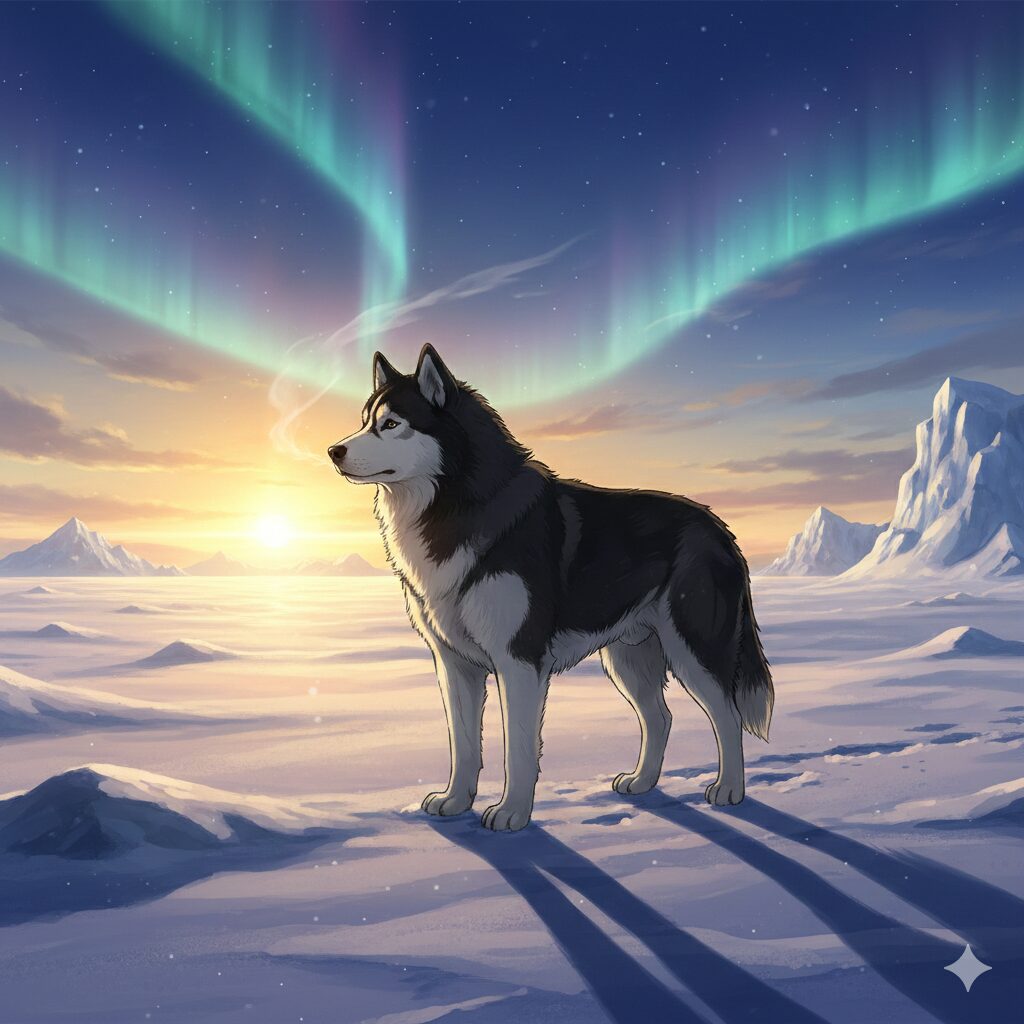
Why were two dogs honored with a commemorative day? Behind this lies a miraculous story of human agonizing decisions and the dogs’ triumph over the freezing Antarctic continent. In this article, we unravel this miraculous event that occurred in 1959 and explore the cultural background of why this story continues to move the Japanese people so deeply.

Parting in the Ice and Snow: The Tragedy of 1958
The story begins in 1956 when Japan’s first Antarctic Research Expedition departed. For Japan, which was still recovering from the devastation of war, Antarctic observation was a national project symbolizing its return to the international community. At that time, “Sakhalin Huskies” (Karafuto-ken), known for their resistance to cold, were chosen as the cornerstone of logistics in the polar region. Among them were the brothers, Taro and Jiro.
However, the fury of nature was beyond imagination. In February 1958, the icebreaker “Soya,” carrying the second wintering team, was blocked by thick ice and had to abandon docking at the base. Due to worsening weather, the first wintering team was rescued by helicopter, but the heavy 15 dogs had to be left behind at the unmanned Showa Station, still chained to their collars.
“We will definitely come back.”
The expedition members believed this, but due to bad weather and fuel shortages, the second wintering mission itself was cancelled. The dogs were abandoned in the polar region, where blizzards of minus tens of degrees Celsius raged, with only a scant amount of food. In Japan, fierce criticism arose against this decision, and the expedition members bore a heavy cross of guilt.
January 14, 1959: The Miraculous Reunion
One year later, on January 14, 1959. The helicopter of the Third Wintering Team reached the skies above Showa Station. “The dogs must have all perished.” Everyone was prepared for the worst. However, what jumped into the pilot’s field of vision was an unbelievable sight.
Two black shadows were running around the snowfield, wagging their tails at the helicopter.
They were Taro and Jiro. Out of the 15 dogs, only these two, who likely broke their chains to escape, had survived the extreme winter by eating penguin and seal droppings (or perhaps hunting). This news was telegraphed throughout Japan, and the archipelago was wrapped in a whirlpool of joy. “Thank you for living.” That sentiment transcended the guilt of abandonment and turned into a pure praise for the vitality of life.
“Loyalty” and “Resilience” in Japanese Culture
Why does the story of Taro and Jiro touch the heartstrings of the Japanese so deeply? This is deeply related to Japan’s unique spirituality.
1. Loyalty akin to “Hachiko”
Japan has the story of “Hachiko,” the faithful dog who waited at the station for his deceased master’s return. Taro and Jiro were also interpreted as having survived without leaving the vicinity of the base, believing that humans would return (although survival instincts played a large part). In the figure of “continuing to believe even after being betrayed,” the Japanese found the noble heart of “Makoto” (sincerity/truth).
2. “Hogan-biiki” (Sympathy for the Underdog) and Consciousness of Atonement
The Japanese have a strong emotion of “Hogan-biiki,” which is sympathy for the weak or those in tragic situations. The apology to the dogs abandoned for human convenience, and the awe for them surviving despite it. This aspect of “salvation from a perpetrator’s consciousness” sublimated this story into something more than just a survival story.
3. Fundamental Affirmation of “Living”
In the post-war reconstruction period, the Japanese considered “enduring and surviving” a virtue. The figures of Taro and Jiro, surviving for a year in extreme conditions, overlapped with the spiritual pillar of the Japanese people at that time.
Legacy Remaining in the Modern Era
Afterward, Taro returned to Japan and spent the rest of his life at the Hokkaido University Botanical Gardens, while Jiro passed away in Antarctica. Their story was visualized as the movie “Antarctica” (Nankyoku Monogatari), which became a massive hit, breaking box office records for Japanese films at the time.
Today, statues of the 15 dogs stand at the foot of Tokyo Tower, and statues of Taro and Jiro are installed at the Port of Nagoya along with the icebreaker “Fuji.” These are not mere monuments but reminders of the coexistence of humans and animals, and the precious sacrifices behind scientific progress.
A Question for You
The miracle of Taro and Jiro teaches us about the “unyielding heart” and the “possibility of life.” But at the same time, it confronts us with the reality that animals are sometimes sacrificed for human ego.
If you had to cut off “something” in an extreme situation, how would you decide? And how would you face the consequences of that decision?
January 14th may be a day to quietly think about your own “power to live” amidst the harsh cold of winter.
Related Information & Links
- National Institute of Polar Research (NIPR) – The official institution disseminating the history and latest information on Antarctic observation.
- What’s Today’s Special Day Series – Click here for more Japanese commemorative days.
1月14日。日本のカレンダーにおいて、この日は単なる冬の一日ではありません。日本中が涙し、生命の強さに驚嘆し、そして「希望」という言葉の意味を再確認した日です。今日は「タロとジロの日」、別名「愛と希望と勇気の日」として知られています。
なぜ、2匹の犬が記念日として制定されるに至ったのか。そこには、極寒の南極大陸を舞台にした、人間の苦渋の決断と、それに打ち勝った犬たちの奇跡の物語があります。この記事では、1959年に起きたこの奇跡的な出来事を紐解き、日本人がなぜこれほどまでにこの物語に心を動かされ続けるのか、その文化的背景を探ります。
氷雪の別れ:1958年の悲劇
物語は1956年、日本初の南極観測隊が出発したことに始まります。当時、敗戦から復興の途上にあった日本にとって、南極観測は国際社会への復帰を象徴する国家プロジェクトでした。その際、極地での物資輸送の要として、寒さに強い「樺太犬(カラフト犬)」たちが選ばれました。その中に、兄弟犬であるタロとジロもいました。
しかし、自然の猛威は想像を絶するものでした。1958年2月、第2次越冬隊を乗せた観測船「宗谷」は、分厚い氷に阻まれ基地への接岸を断念。天候の悪化により、第1次越冬隊員はヘリコプターで救出されましたが、体重の重い15頭の犬たちは、首輪に鎖をつながれたまま、無人の昭和基地に残されざるを得ませんでした。
「必ず戻ってくる」
隊員たちはそう信じていましたが、悪天候と燃料不足により、第2次越冬そのものが中止となります。犬たちは、氷点下数十度のブリザードが吹き荒れる極地に、わずかな食料と共に置き去りにされました。日本国内では、この決断に対して激しい非難の声が上がり、隊員たちは十字架を背負うことになります。
1959年1月14日:奇跡の再会
1年後の1959年1月14日。第3次越冬隊のヘリコプターが昭和基地上空に到達しました。「犬たちは全滅しているだろう」。誰もがそう覚悟していました。しかし、操縦士の視界に飛び込んできたのは、信じがたい光景でした。
2つの黒い影が、雪原を駆け回り、ヘリコプターに向かって尻尾を振っていたのです。
それが、タロとジロでした。15頭のうち、鎖をちぎって脱出したと思われる彼らだけが、ペンギンやアザラシの糞などを食料に(あるいは狩りをして)、極寒の冬を生き延びていたのです。このニュースは日本中に打電され、列島は歓喜の渦に包まれました。「生きていてくれてありがとう」。その思いは、置き去りにした罪悪感を超え、純粋な生命力への賛美へと変わりました。
日本文化における「忠誠」と「健気さ」
なぜ、タロとジロの物語はこれほど深く日本人の琴線に触れるのでしょうか。ここには、日本独自の精神性が深く関わっています。
1. 「忠犬ハチ公」に通じる忠誠心
日本には、亡き主人の帰りを駅で待ち続けた「ハチ公」の物語があります。タロとジロもまた、人間が戻ってくると信じ、基地周辺から離れずに生き抜いたと解釈されました(実際には生存本能による行動も大きかったはずですが)。「裏切られてもなお、信じ続ける」という姿に、日本人は尊い「誠」の心を見出したのです。
2. 「判官贔屓」と贖罪の意識
日本人は、弱者や悲劇的な状況にある者に同情を寄せる「判官贔屓(ほうがんびいき)」の感情を強く持っています。人間の都合で置き去りにされた犬たちへの申し訳なさ、そしてそれでも生き抜いた彼らへの畏敬の念。この「加害者意識からの救済」という側面が、この物語を単なるサバイバルストーリー以上のものに昇華させました。
3. 「生きる」ことへの根源的な肯定
戦後の復興期、日本人は「耐え忍び、生き抜く」ことを美徳としてきました。極限状態で1年間生き延びたタロとジロの姿は、当時の日本人の精神的支柱とも重なったのです。
現代に残るレガシー
その後、タロは日本に帰国し北海道大学植物園で余生を過ごし、ジロは南極でこの世を去りました。彼らの物語は映画『南極物語』として映像化され、当時の日本映画の興行記録を塗り替える大ヒットとなりました。
現在、東京タワーのふもとには15頭の犬たちの像があり、名古屋港には観測船「ふじ」と共にタロとジロの像が設置されています。これらは単なる記念碑ではなく、人間と動物の共生、そして科学の進歩の陰にある尊い犠牲を忘れないためのモニュメントです。
あなたへの問いかけ
タロとジロの奇跡は、私たちに「諦めない心」と「生命の可能性」を教えてくれます。しかし同時に、人間のエゴによって動物が犠牲になる現実も突きつけています。
もしあなたが、極限状態で「何か」を切り捨てなければならないとしたら、どう決断しますか?そして、その決断の結果とどう向き合いますか?
1月14日、今日という日は、厳しい冬の寒さの中で、自身の「生きる力」について静かに考える一日かもしれません。
関連情報・リンク
- 国立極地研究所 (National Institute of Polar Research) – 南極観測の歴史と最新情報を発信している公的機関です。
- What’s Today’s Special Day Series – その他の日本の記念日についてはこちらをご覧ください。
コメント