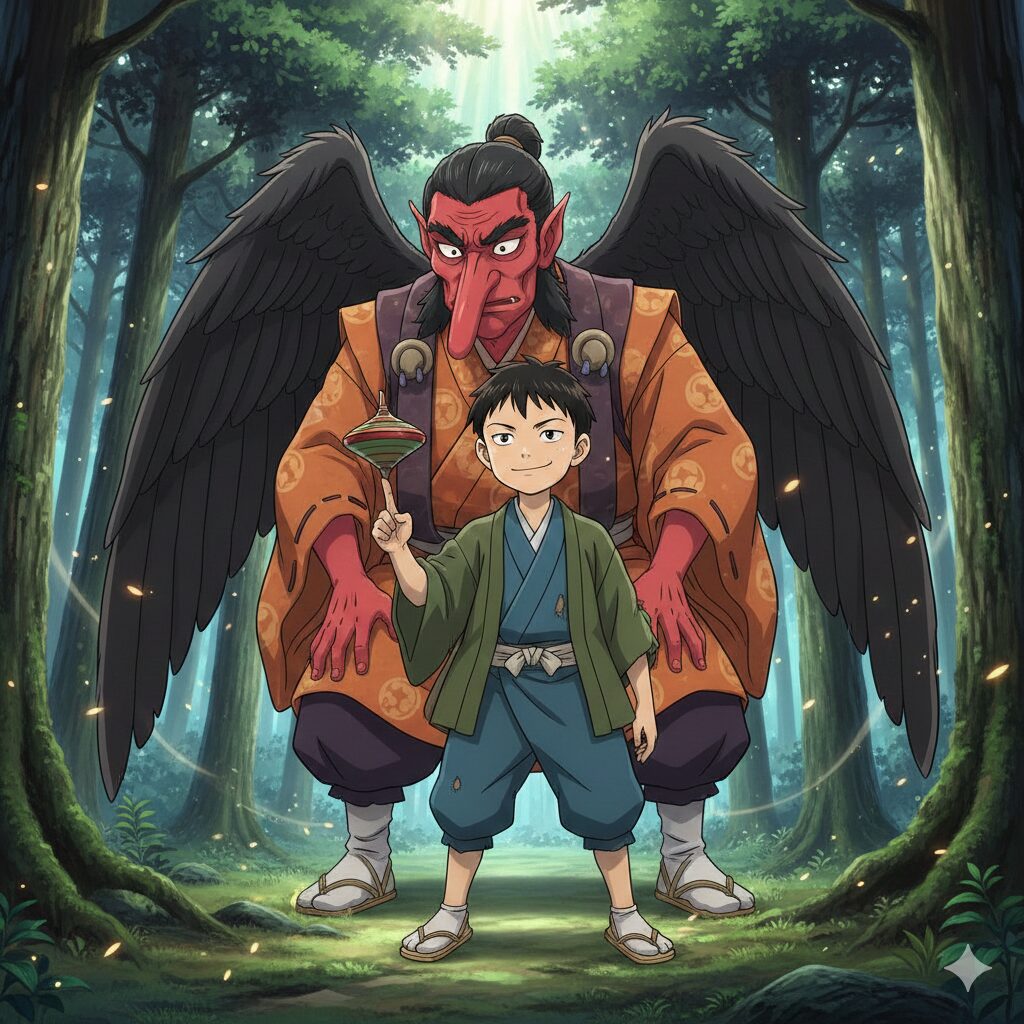
It is said that mysterious powers have dwelt in the forests of Japan since ancient times. The sound of the wind shaking the trees, laughter heard from nowhere… these might be the work of a “Tengu.” The story I will introduce today is a thrilling and instructive tale about a boy who uses a simple child’s toy, a “spinning top” (Koma), to trick a Great Tengu—a being revered as both a mountain god and a monster.

Story: The Battle of Wits Between a Boy and a Tengu
Long, long ago, in a mountain village, there lived a boy named Hikoichi. He was extremely quick-witted. Although he didn’t like studying very much, he was second to none when it came to cunning tricks that could surprise even adults.
One day, Hikoichi took his handmade bamboo spinning top and climbed the high mountain behind the village. It was a place the villagers feared, saying, “Don’t go near there, or the Tengu will get you.” However, for the curious Hikoichi, such legends meant nothing.
Under a large cedar tree near the top of the mountain, Hikoichi began to spin his top. “Vroom, vroom,” the bamboo top hummed with a unique low sound. The sound echoed through the quiet mountain.
Suddenly, with a gust of wind, a large shadow appeared. A red face, a long protruding nose, and black wings on his back. It was the “Tengu” rumored in the village.
“Hey, kid. What are you doing? What is that humming sound?” the Tengu asked in a deep voice.
An ordinary child would have been paralyzed with fear and run away, but Hikoichi replied calmly.
“Oh, Mr. Tengu. This is a tool called the ‘Kyoto and Osaka Sightseeing Top.'”
“Kyoto and Osaka Sightseeing Top? What is that?” The Tengu leaned forward with great interest.
Hikoichi smirked and told a lie.
“When you spin this and look through its hole, you can see the distant capital of Kyoto and the bustling streets of Osaka as if they were right in front of you. Look, I can see a beautiful princess crossing a bridge right now.”
For the Tengu living deep in the mountains, the sights of the capital were the most attractive entertainment. “What! Is that true? Let me see it too!”
“No, no. This is my treasure,” Hikoichi said, acting reluctant. The Tengu began to panic.
“Please, just once is enough. I know, I will trade you this ‘Invisibility Cloak’ (Kakure Mino) for it.”
What the Tengu offered was a cloak made of straw that looked tattered and old.
“I don’t need such a dirty cloak,” Hikoichi said. The Tengu replied proudly.
“This is not just a cloak. When you wear this, you become invisible.”
The Tengu put on the cloak, and suddenly his figure vanished. “See? Isn’t it amazing?” Only his voice could be heard.
Hikoichi thought to himself, “I got him!” but kept a straight face. “Hmm, well, if you insist, I’ll trade with you.”
Thus, Hikoichi exchanged a simple bamboo top for a magical cloak that could make him invisible. The Tengu, overjoyed, took the top and immediately spun it to look inside, but of course, he could see nothing. “Hey, I can’t see anything!” he shouted, but by then, Hikoichi had already put on the cloak, disappeared, and was running down the mountain.
Back in the village, taking advantage of his invisibility, Hikoichi did whatever he wanted—sneaking into a liquor store to drink sake and stealing buns from a confectionery shop.
However, getting drunk on the sake, Hikoichi fell asleep by the riverside, feeling good. While he slept, the cloak rolled up, and a passing villager spotted him. “Oh, it’s Hikoichi, drunk and sleeping.” Furthermore, because the cloak looked so dirty, someone threw it into the river, saying, “What is this old rag doing here?”
When Hikoichi woke up, he realized the cloak was gone and turned pale. Having lost his magical power, he was scolded severely by his parents as just a hungover child.
Analysis: Why the Boy Could Outsmart the Tengu
This story depicts a “reversal of power relationships” unique to Japanese folktales.
1. Curiosity as a Weakness
The Tengu possesses divine powers, can fly, and is far stronger than humans. However, he had a strong longing and complex towards the “Capital (Civilization).” Hikoichi cleverly exploited this psychology, clouding the Tengu’s reason with the lie that he could “see far away.” It beautifully portrays that no matter how strong a being is, they become fragile in the face of desire and curiosity.
2. The Symbolism of the “Koma” (Top)
A top is a toy that stabilizes by rotating around a central axis. This symbolizes “daily life” or “equilibrium.” On the other hand, the Tengu’s invisibility cloak represents “the extraordinary” or “chaos.” Hikoichi used an everyday tool to gain extraordinary power, but in the end, he failed because he couldn’t control it. This can be interpreted as a lesson against “possessing power beyond one’s capacity.”
Culture: The “Trickster” and “Boundaries” in Japan
From this story, we can decipher the depths of Japanese culture.
- Mountains as Boundaries: In Japan, mountains are sacred places and boundaries with the otherworld. Hikoichi’s act of going to the mountain signifies crossing from the ordinary to the otherworld. The “trade” that takes place there is a metaphor for cross-cultural exchange.
- Lies and Humor: Unlike Western chivalric tales of “fair fights,” Japanese folklore often favors stories where the weak use “wisdom (sometimes cunning lies)” to outsmart the strong. This may be an expression of the common people’s rebellious spirit against authority figures.
- Limits of Magic: Hikoichi fails in the end. This is not only a moral lesson that “evil deeds do not last” but also a punishment for using a sacred tool (the cloak) for selfish desires. Underlying this is the Japanese religious view that one must not forget awe for sacred things.
A Question for You
If you, like Hikoichi, obtained a “cloak that makes you invisible,” what would you do?
Would you play pranks, or would you use it to help someone?
And if you were the Tengu, would you believe the words of a strange child and hand over your precious treasure?
This story questions us about the responsibility of holding power and the importance of seeing the truth behind sweet words.
Read more from our Japanese Folktale Series here.
Japanese Folktale Series – Kiri53.com
【日本昔話】天狗のこまと隠れ蓑:子供の知恵が怪異を超えるとき
日本の森には、古来より不思議な力が宿ると言われています。風が木々を揺らす音、どこからともなく聞こえる笑い声。それはもしかすると、「天狗(てんぐ)」の仕業かもしれません。今回紹介するのは、ただの子供のおもちゃである「こま(独楽)」を使って、山の神とも妖怪とも呼ばれる大天狗を騙してしまう、痛快かつ教訓に満ちた物語です。
物語:天狗と少年の知恵比べ
むかしむかし、ある山里に、彦市(ひこいち)という、とても頓智(とんち)のきく男の子がいました。彦市は勉強はあまり好きではありませんでしたが、大人をあっと言わせるような悪知恵にかけては誰にも負けませんでした。
ある日のこと、彦市は竹で作ったお手製の「こま」を持って、村の裏手にある高い山へと登っていきました。そこは、村人たちが「天狗が出るから近づいてはいけない」と恐れている場所でした。しかし、好奇心旺盛な彦市には、そんな言い伝えなど関係ありません。
山の頂上近くにある大きな杉の木の下で、彦市はこまを回し始めました。「ブーン、ブーン」と、竹のこまは独特の低い音を立てて回ります。その音は静かな山の中に響き渡りました。
すると突然、突風とともに大きな影が現れました。真っ赤な顔に、突き出た長い鼻、背中には黒い翼。それは噂に聞く「天狗」でした。
「おい小僧、何をしておる。そのブーンという音は何だ?」天狗は太い声で尋ねました。
普通の子供なら腰を抜かして逃げ出すところですが、彦市は平然として答えました。
「ああ、天狗様。これは『京・大坂見物こま』という道具だよ」
「京・大坂見物こま? それは何だ?」天狗は興味津々に身を乗り出しました。
彦市はニヤリと笑って嘘をつきます。
「こいつを回してその穴から覗くとね、遠く離れた京の都や大坂の賑やかな街並みが、手に取るように見えるんだよ。ほら、今もちょうど綺麗な姫君が橋を渡っているのが見える」
山奥で暮らす天狗にとって、都の様子というのは何よりも魅力的な娯楽です。「なんと! それは本当か。ワシにも見せてくれ!」
「だめだめ。これは僕の宝物だからね」彦市が勿体ぶると、天狗は焦り始めました。
「頼む、一回だけでいい。そうだ、ワシのこの『隠れ蓑(かくれみの)』と交換してやろう」
天狗が差し出したのは、ボロボロの藁(わら)で作った蓑でした。
「そんな汚い蓑、いらないよ」と彦市が言うと、天狗は得意げに言いました。
「これはただの蓑ではない。これを着ると姿が見えなくなるのだ」
天狗が蓑を羽織ると、フッとその姿が消えました。「どうだ、すごいだろう?」声だけが聞こえます。
彦市は心の中で「しめた!」と思いましたが、顔には出しません。「うーん、まあ、そこまで言うなら交換してあげよう」
こうして彦市は、ただの竹ごまと引き換えに、姿を消せる魔法の蓑を手に入れました。天狗は大喜びでこまを受け取り、早速回して覗き込みましたが、当然何も見えません。「おい、何も見えんぞ!」と叫びましたが、その時すでに彦市は蓑を着て姿を消し、山を駆け下りていました。
村に戻った彦市は、姿が見えないのをいいことに、酒屋に入って酒を盗み飲みしたり、菓子屋で饅頭をつまみ食いしたりと、やりたい放題の悪さをしました。
しかし、酒に酔った彦市は、川辺で気持ちよくなってそのまま眠り込んでしまいました。寝ている間に蓑がめくれ上がり、通りがかった村人に「なんだ、彦市が酔っ払って寝ているぞ」と見つかってしまいました。さらに、あまりに汚い蓑だったので、誰かが「こんなボロ切れ」と川へ投げ捨ててしまったのです。
目を覚ました彦市は、蓑がないことに気づき、青ざめました。魔法の力を失った彼は、ただの二日酔いの子供として、親にこっぴどく叱られたのでした。
考察:なぜ少年は天狗に勝てたのか
この物語には、日本の昔話特有の「力関係の逆転」が描かれています。
1. 未知への憧れという弱点
天狗は神通力を持ち、空を飛び、人間よりも遥かに強大な力を持っています。しかし、彼には「都(文明)」への強い憧れとコンプレックスがありました。彦市はその心理を巧みに突き、「遠くが見える」という嘘で天狗の理性を曇らせました。どんなに強い存在でも、欲望や好奇心の前では脆くなるという心理描写が見事です。
2. 「こま」という道具の象徴性
こまは、中心軸を持って回転することで安定するおもちゃです。これは「日常」や「均衡」を象徴します。一方で、天狗の隠れ蓑は「非日常」や「混沌」をもたらすアイテムです。彦市は日常的な道具を使って非日常的な力を手に入れましたが、結局それを制御しきれずに失敗しました。これは「身の丈に合わない力を持つことへの戒め」とも読み取れます。
文化:日本における「トリックスター」と「境界」
この物語から、日本文化の深層を読み解くことができます。
- 境界としての山: 日本において、山は神聖な場所であり、異界との境界線です。彦市が山へ行くという行為は、日常から異界への越境を意味します。そこで行われる「交換(トレード)」は、異文化交流のメタファーでもあります。
- 嘘とユーモア: 西洋の騎士道物語のような「正々堂々とした戦い」とは異なり、日本の民話では「知恵(時には狡猾な嘘)」を使って強者をやり込める話が好まれます。これは、庶民が権力者に対して抱いていた反骨精神の表れかもしれません。
- 魔法の限界: 彦市は最終的に失敗します。これは「悪事は長続きしない」という道徳的な意味に加え、神聖な道具(隠れ蓑)を私利私欲のために使ったことへの罰とも言えます。神聖なものへの畏敬の念を忘れてはならない、という日本的な宗教観が根底にあります。
あなたならどうしますか?
もし、あなたが彦市のように「姿を消せる蓑」を手に入れたら、何をしますか?
悪戯をするでしょうか、それとも誰かを助けるために使うでしょうか?
そして、もしあなたが天狗だったら、見知らぬ子供の言葉を信じて大切な宝物を渡してしまうでしょうか?
この物語は、力を持つことの責任と、甘い言葉の裏にある真実を見抜くことの大切さを、私たちに問いかけています。
日本の妖怪や天狗についてさらに詳しく知りたい方は、以下のリソースも参考にしてください。
天狗 – Wikipedia
その他の日本の昔話シリーズはこちらからお読みいただけます。
Japanese Folktale Series – Kiri53.com

コメント