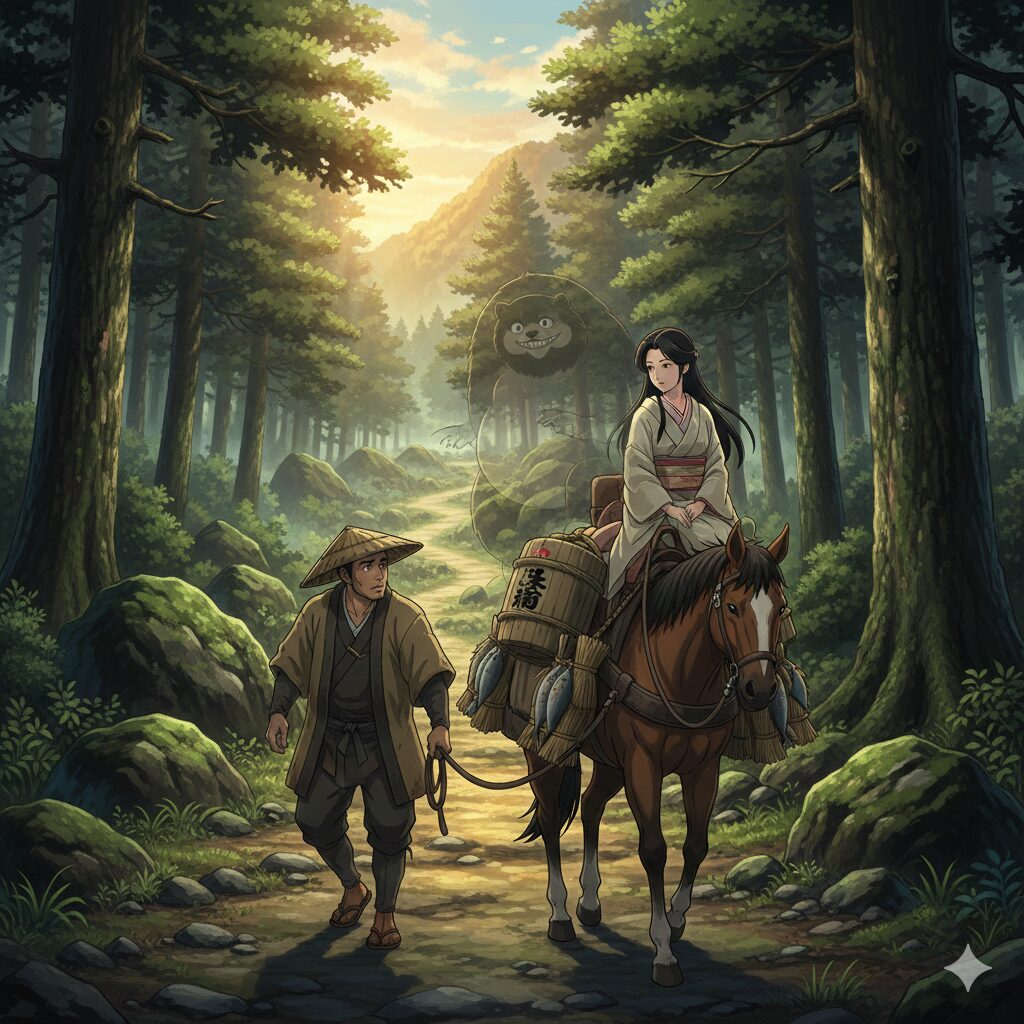
In Japan, mountains have long been believed to harbor mysterious powers. Mountain passes, in particular, serve as boundaries between the human world and the spirit world, where events defying common sense often occur. Today, I introduce a story that unfolds on such a lonely road: a battle of wits between a hardworking “Umakata” (Packhorse Driver) and a “Tanuki” (Raccoon Dog) who loves to trick humans.
This is not merely a fairy tale about animals. It is a narrative skillfully woven with awe for nature, the vulnerability of the human heart, and a unique sense of humor.

1. The Story: The Packhorse Driver and the Tanuki
Long ago, on a pass deep within the mountains, lived a hardworking packhorse driver.
Every day, the Umakata transported goods from the seaside town to the village on the other side of the mountain. His horse carried a heavy load of delicious, salted fish. The scent of the fatty fish drifted on the wind, reaching deep into the forest.
“Today is going to be a profitable day,” the driver thought.
As he approached the pass, humming a tune, he saw a beautiful young woman collapsed in the middle of the road. Her kimono was dirty, and she was breathing with difficulty.
“Oh my, what happened in such a remote place?”
The kind-hearted driver couldn’t leave her there. The woman pleaded with tears in her eyes, “I twisted my ankle and cannot walk. Please, could you give me a ride to the village?” The driver agreed and helped her sit on top of the load of fish.
As the horse started walking, a strange sound came from behind: “Munch, munch, crunch.”
“What is that noise?” the driver asked.
When he looked back, the woman hid her face with her kimono sleeve and said shyly, “I am so hungry that my stomach is making embarrassing noises.” The driver laughed, saying, “Don’t worry about it,” and continued walking.
However, as they neared the top of the pass, the horse’s load suddenly felt much lighter. Suspicious, the driver turned around quickly and saw an unbelievable sight.
The beautiful woman was nowhere to be seen. Instead, an old Tanuki with a huge, distended belly was stuffing the very last fish into its mouth. The Tanuki shouted, “Thanks for the meal!” then drummed on its belly—Pon, Pon!—wagged its tail, and disappeared into the bushes.
“You rascal! That old Tanuki tricked me!”
The driver was furious, but not a single fish remained. However, the story does not end here. The driver vowed revenge. A few days later, he prepared a new load of fish, but this time, he smeared them generously with spicy wasabi and red chili peppers before heading back to the pass.
The Tanuki appeared again, disguised as the woman, and asked for a ride. Thinking he had fooled the driver again, the Tanuki bit into a fish. At that moment—
“GYAAHH! It burns! Hot, hot!”
The Tanuki writhed in agony from the fire in its mouth and fell off the horse. Revealing its true form, the Tanuki cried and ran away, while the driver laughed loudly, victorious in his revenge.
2. Analysis: The Psychology of Deception
This story perfectly illustrates the uniqueness of the “Tanuki” in Japanese folklore. If the fox represents “cunning” in Western fables, the Japanese Tanuki is a “lovable trickster.”
Why does the Tanuki shape-shift?
The motivation for a Tanuki to trick humans is usually “appetite” or “playfulness.” They rarely harbor malice to kill. In this story, the Tanuki’s goal was simply the fish. This reflects the Japanese consciousness of coexistence with nature; animals are not enemies, but mischievous neighbors.
The Meaning of the Driver’s Counterattack
In many folktales, the tricked human simply cries and gives up, but the driver in this story uses his wits to fight back. This symbolizes the resilience of the common people living in harsh natural environments. The strength to “give as good as you get” was likely an essential skill for survival in those days.
3. Cultural Connection: Tanuki as Yokai
Even in modern Japan, the Tanuki holds a special status.
- Shigaraki Ware Tanuki: Have you ever seen statues of Tanuki wearing straw hats and holding sake bottles in front of Japanese shops or homes? They are lucky charms for business prosperity, symbolizing “surpassing others” (Ta-nuki).
- The Art of “Henge” (Shape-shifting): In Japanese lore, foxes and Tanuki are the two masters of transformation. However, while foxes transform mysteriously and coolly, Tanuki transformations are often comical—sometimes leaving their tail visible or failing in the details. This “imperfection” is why they are loved by the Japanese people.
- The Boundary of the Mountain God: The pass the driver crosses has historically been considered an “entrance to the other world.” Twilight is the time when humans and monsters cross paths. This story contains a lesson: one must never let their guard down when entering the mountains.
4. A Question for You
After reading this story, how do you feel?
Do you find the Tanuki, who used its wits to disguise itself just to fill its empty stomach, somewhat “cute”? Or do you sympathize with the driver who lost the goods he worked hard to carry, and applaud his spicy revenge?
If you were the driver, would you forgive the Tanuki after punishing it? Or would you ensure it never comes near you again?
Japanese folktales often lack a clear line between “good and evil.” The Tanuki is trying to survive, and so is the driver. That ambiguous worldview is the essence of the Japanese spirit.
Related Links
- Japanese Folktale Series (Internal)
- Bake-danuki – Wikipedia (Reference)
- Arts & Culture – JNTO (Official Travel Guide)
霧深い峠の怪異:馬方とタヌキの知恵比べ
日本の山々には、古くから不思議な力が宿ると信じられてきました。特に人里離れた峠道は、人間界と異界の境界線であり、そこでは常識では説明できない出来事が起こります。今回ご紹介するのは、そんな山道で繰り広げられる、真面目な働き者の「馬方(Umakata)」と、人を化かすのが大好きな「タヌキ(Tanuki)」の物語です。
単なる動物のおとぎ話ではありません。ここには、自然への畏怖、人間の心の隙間、そしてユーモアが巧みに織り交ぜられています。
1. 物語:馬方とタヌキ
むかしむかし、ある深い山の峠道でのことです。
毎日、海辺の町から山向こうの村へ荷物を運ぶ馬方がいました。彼の馬の背中には、塩漬けにされた美味しそうな魚がたくさん積まれています。脂の乗った魚の匂いは、風に乗って山奥まで漂っていました。
「今日は良い稼ぎになりそうだ」
馬方が鼻歌交じりで峠に差し掛かった時のことです。道の真ん中に、一人の美しい娘が倒れていました。着物は汚れ、苦しそうに息をしています。
「おや、こんな山奥でどうしたんだ?」
心優しい馬方は、娘を放っておけません。娘は涙ながらに「足を挫いて歩けません。どうか村まで乗せていってください」と懇願しました。馬方は快く承諾し、魚の荷物の上に娘を乗せてやりました。
馬が歩き出すと、背後から「ムシャ、ムシャ」という奇妙な音が聞こえてきます。
「はて、なんの音だ?」
馬方が振り返ると、娘は着物の袖で顔を隠し、「お腹が空きすぎて、お恥ずかしい音をさせてしまいました」と恥じらいます。馬方は「気にすることはない」と笑って歩き続けました。
しかし、峠の頂上に近づいた頃、馬の荷が急に軽くなったのです。不審に思った馬方が勢いよく振り返ると、そこには信じられない光景がありました。
美しい娘の姿はどこにもありません。代わりに、大きな腹を膨らませた一匹の古タヌキが、最後の魚を口に放り込んでいるところでした。タヌキは「ごちそうさん!」と叫ぶと、自分のお腹をポンと叩き、尻尾を振って藪の中へ消えていきました。
「おのれ、あの古ダヌキめ!騙したな!」
馬方は悔しがりましたが、魚は一匹も残っていません。しかし、物語はここでは終わりません。馬方は復讐を誓い、数日後、今度は荷物に「わさび」や「唐辛子」をたっぷり塗り込んだ魚を混ぜて、再び峠へ向かったのです。
再び現れたタヌキは、またしても娘に化けて馬に乗せてもらいます。そして、しめしめと魚にかぶりつきました。その瞬間です。
「ギャーッ!辛い!熱い!」
タヌキは口から火が出るような辛さに悶絶し、馬から転げ落ちました。正体を現して泣き叫ぶタヌキを尻目に、馬方は高らかに笑い声を上げながら去っていきました。
2. 物語の考察:化かし合いの心理学
この物語は、日本の民話における「タヌキ」という存在の特異性をよく表しています。西洋の寓話におけるキツネが「狡猾」の象徴であるなら、日本のタヌキは「愛嬌のあるトリックスター」です。
なぜタヌキは化けるのか?
タヌキが人間を化かす動機は、多くの場合「食欲」か「遊び心」です。悪意を持って人間を殺傷することは稀です。この物語でも、タヌキの目的はあくまで「魚」でした。ここに、日本人が自然界の動物に対して抱く「共存の意識」が見て取れます。彼らは敵ではなく、隣人なのです。
馬方の逆襲が意味するもの
多くの昔話では、騙された人間は泣き寝入りすることが多いですが、この物語の馬方は知恵を使って反撃します。これは、厳しい自然環境(峠道)で生きる庶民の逞しさを象徴しています。「やられたらやり返す」という強さは、当時の過酷な労働環境を生き抜くための必須スキルだったのでしょう。
3. 日本文化との関連性:妖怪としてのタヌキ
現代の日本でも、タヌキは特別な地位を確立しています。
- 信楽焼のタヌキ: 日本の商店や家の玄関で、笠を被り、徳利を持ったタヌキの置物を見たことはありませんか?あれは「他を抜く(他より優れる)」という商売繁盛の縁起物です。
- 変化(Henge)の能力: 日本の伝承では、キツネとタヌキは変身能力を持つ二大巨頭です。しかし、キツネが神秘的でクールな変身をするのに対し、タヌキの変身はどこか間が抜けていて、尻尾が出たままであったり、詰めが甘かったりします。この「不完全さ」こそが、日本人に愛される理由です。
- 山の神との境界: 馬方が通る峠は、古来より「異界への入り口」とされてきました。夕暮れ時(黄昏時)は「誰そ彼(彼は誰だ?)」という言葉が語源であるように、人と魔物が交差する時間です。この物語は、山に入るときは決して油断してはならないという教訓も含んでいるのです。
4. あなたへの問いかけ
この物語を読んで、あなたはどう感じましたか?
空腹を満たすために知恵を絞って人間に化けたタヌキを、少し「可愛い」と感じましたか?それとも、汗水流して運んだ商品を盗まれた馬方に同情し、唐辛子での復讐に拍手を送りますか?
もしあなたが馬方だったら、タヌキを懲らしめた後、許してあげますか?それとも二度と近づけないようにしますか?
日本の昔話には、明確な「善と悪」の境界線がないことがよくあります。タヌキも必死に生きており、馬方もまた必死です。その曖昧な世界観こそが、日本の精神性なのです。
コメント