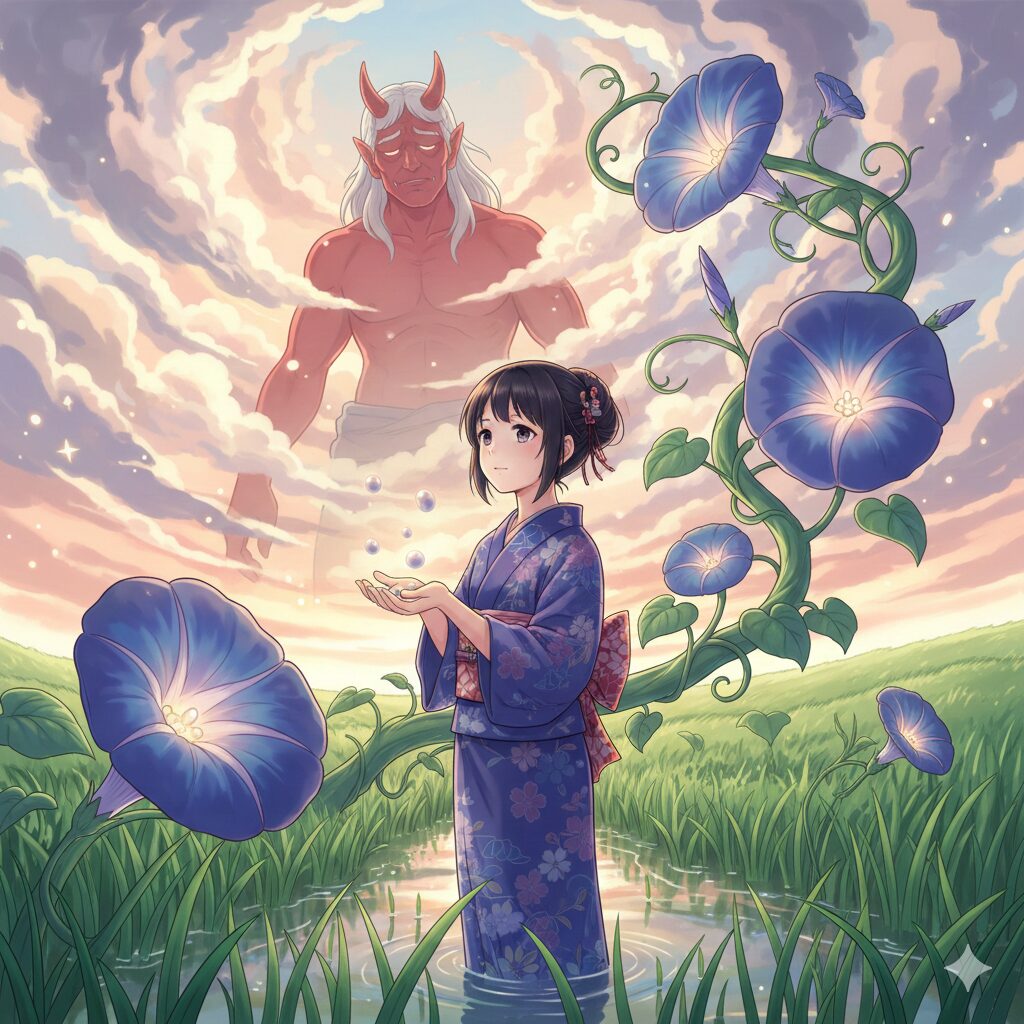
Once upon a time, in a certain village in Japan, there lived a farmer who was honest but prone to speaking without thinking. That year, not a drop of rain had fallen since spring. By the time summer arrived, the sun beat down mercilessly. The water in the rice paddies had dried up, the rice plants were withering, and the ground was cracked like the shell of a tortoise.
The farmer had three daughters. He loved them all dearly, but faced with the reality that they might not have food for tomorrow, he sat on the ridge of his paddy and lamented to the heavens.
“Oh, Gods, oh Buddha! If you would only make it rain, I would give any one of my three daughters as a bride! Please, save us!”
It was a careless remark, born of utter despair. However, in that instant, the sky turned pitch black, and dark clouds began to swirl. Thunder roared, and rain began to pour down as if buckets were being overturned from the sky. The withering rice plants came back to life, and the village was saved.

The Ogre Comes for His Promise
The next day, someone banged violently on the farmer’s door. When he opened it, a gigantic Oni (Ogre/Demon), tall enough to pierce the heavens, stood there. His skin was red, his eyes shone like fire, and he had two horns on his head.
“I made it rain as promised. I have come to receive my bride,” the Oni boomed.
The farmer was terrified. He never imagined that an Oni (specifically, the Thunder God) had heard his muttering yesterday. But a promise is a promise. Trembling, the farmer called his eldest daughter.
“My daughter, in return for yesterday’s rain, would you go to be this Oni’s bride?”
The eldest daughter turned pale and screamed, “Absolutely not! I would rather die than go to such a terrifying monster!”
Next, he called the second daughter, but she too cried and refused. The farmer held his head in his hands. His careless words were about to bring misery to his family. Just then, the youngest daughter stepped forward.
“Father, I will go. If my sacrifice has saved the village, then I am willing.”
Fighting back tears, the youngest daughter took the Oni’s hand and was whisked away on a black cloud up to the heavens.
Life in the Sky and the Legend of the Morning Glory
When they arrived at the Oni’s mansion above the clouds, something unexpected awaited her. Contrary to his terrifying appearance on earth, the Oni treated the youngest daughter with great kindness. He prepared delicious food, dressed her in beautiful kimonos, and constantly asked, “Do you need anything?”
However, despite the comfortable life, her longing for home only grew. One day, she begged the Oni, “Please, let me visit my home just once.”
The Oni looked sad but acceded to his beloved wife’s request. “Very well. But you must not return empty-handed. I will give you a souvenir.”
The Oni gave her the seeds of a beautiful flower and lowered a ladder of clouds for her.
Returning to earth, the daughter reunited with her family, weeping tears of joy. Legends vary on the ending of this tale. Some say she lived happily on earth, while others say the flow of time was different between the Oni’s world and the human world.
In the most beautiful version of the legend, the seeds she brought back were those of the “Asagao” (Morning Glory). It is said that she planted them so the vines would climb up to the sky, allowing her to return to her husband, the Oni. Or perhaps, she could never return, and every time she saw the Morning Glories blooming toward the sky, she thought of him.
Analysis: Reverence for Nature and Responsibility
The story of “The Ogre’s Wife” (Oni no Yomesan) is not merely a tragedy or a horror story. deeply etched within it are the Japanese views on nature and ethics.
1. The Weight of “Kotodama” (Spirit of Words)
Since ancient times, Japanese people have believed that words possess spiritual power (Kotodama). The fact that the farmer’s casual remark about giving away his daughter affected reality teaches the heavy responsibility of words. Even if it was a monologue, a promise once spoken must be kept, even if the other party is not human. This reflects a distinctly Japanese sense of integrity.
2. The Oni as a Wild God
The Oni in this story symbolizes nature gods governing thunder and rain. Nature brings blessings (rain) to humans but also demands cruel sacrifices (the daughter). This shows that the Japanese, who have lived alongside typhoons and earthquakes, recognized nature as “something uncontrollable and to be feared.”
Reading Japanese Culture Through Folklore
From a modern perspective, this might look like a cruel story of human sacrifice. However, in a cultural context, the theme of “salvation of the community through self-sacrifice” emerges.
The youngest daughter’s decision reflects the spiritual structure once considered a virtue in Japan: prioritizing the survival of the “ie” (household) or village over individual happiness. Furthermore, the fact that the Oni is often portrayed as a “surprisingly good husband” may represent the duality of Japanese society: fear of the “outsider” (foreigners or strangers) versus the understanding of their humanity that comes after interaction.
When Japanese people see Morning Glories blooming toward the sky in summer, they sense the emotion of a tragic love connecting heaven and earth, or the longing for someone far away.
Question for Readers
If you were in the farmer’s shoes, what would you have done? Would you watch the village perish in the drought, or would you pray with the resolve to sacrifice your precious family?
Also, what do you think of the youngest daughter’s decision to go with the Oni? Do you think she was brave, or do you think she should have run away?
Please let us know your thoughts and if there are similar stories in your country.
References & Links
灼熱の太陽と農民の悲痛な叫び
むかしむかし、ある村に、正直ですが少しおっちょこちょいな農民が住んでいました。その年は、春から一度も雨が降らず、夏になると太陽は容赦なく照りつけました。田んぼの水は干上がり、稲は枯れかけ、地面は亀の甲羅のようにひび割れていました。
農民には三人の娘がいました。どの娘も大切でしたが、明日の食べ物さえ危うい状況に、農民は田んぼの畔(あぜ)に座り込み、天に向かって嘆きました。
「ああ、神様、仏様。雨さえ降らせてくれるなら、三人の娘のうち誰でも嫁にやりますから、どうかお救いください!」
それは、絶望のあまり口をついて出た、軽はずみな言葉でした。しかし、その瞬間、空が急に真っ暗になり、黒雲が渦を巻き始めました。ゴロゴロと雷鳴が轟き、バケツをひっくり返したような大雨が降り出したのです。枯れかけた稲は息を吹き返し、村は救われました。
約束を迫る鬼の来訪
翌日、農民の家の戸を激しく叩く者がいました。戸を開けると、そこには天を突くような巨体の鬼が立っていました。肌は赤く、目は燃えるように輝き、頭には二本の角が生えています。
「約束通り、雨を降らせてやったぞ。娘を嫁にもらいに来た」
農民は腰を抜かしました。まさか昨日の独り言を、鬼(雷神)が聞いていたとは。しかし、約束は約束です。農民は震えながら長女を呼びました。
「お前、昨日の雨のお礼に、この鬼の嫁に行ってくれないか」
長女は真っ青になって叫びました。「とんでもない! あんな恐ろしい鬼のところへ行くくらいなら、死んだほうがマシです!」
次に次女を呼びましたが、次女も泣き叫んで拒絶しました。農民は頭を抱えました。自分の軽口のせいで、家族が不幸になる。そう思った時、一番末の娘が進み出て言いました。
「お父さん、私が参ります。私の犠牲で村が救われたのなら、本望です」
末娘は涙をこらえ、鬼の手を取ると、黒雲に乗って天へと連れ去られていきました。
天上の生活と朝顔の伝説
雲の上の鬼の屋敷に着くと、意外なことが待っていました。鬼は地上で見せた恐ろしい形相とは裏腹に、末娘をとても大切に扱ったのです。美味しい食事を用意し、美しい着物を着せ、「不自由はないか」と気遣いました。
しかし、快適な生活でも、故郷への想いは募るばかりです。ある日、末娘は鬼に頼みました。「一度でいいから、里帰りさせてください」
鬼は寂しそうな顔をしましたが、愛する妻の頼みを聞き入れました。「わかった。ただし、決して手ぶらで帰ってはいけない。土産を持たせよう」
鬼は、美しい花の種を娘に持たせ、雲の梯子(はしご)を下ろしてくれました。
地上に戻った娘は、家族と再会し、涙を流して喜びました。しかし、物語にはいくつかの結末があります。娘が地上で幸せに暮らしたという説もあれば、鬼の世界と人間界の時間の流れが違いすぎたという説もあります。
最も美しい言い伝えでは、娘が持ち帰った種が「朝顔」であり、娘は朝顔のツルを伝って、再び鬼の待つ空へ戻ったとも、あるいは二度と戻れず、空に向かって咲く朝顔を見るたびに夫である鬼を想ったとも言われています。
【考察】異類婚姻譚が示す「自然への畏敬」と「責任」
「鬼の嫁さん」の物語は、単なる悲劇や恐怖譚ではありません。ここには、日本人の自然観と倫理観が深く刻まれています。
1. 言霊(ことだま)の重み
日本では古来より、言葉には霊力が宿ると信じられてきました(言霊信仰)。農民が何気なく発した「娘をやる」という言葉が現実に作用したことは、言葉に対する責任の重さを説いています。たとえ独り言であっても、一度口にした約束は、相手が人間でなくとも守らねばならないという、日本的な律義さが表れています。
2. 荒ぶる神としての「鬼」
この物語の鬼は、雷や雨を司る自然神の象徴です。自然は人間に恵み(雨)をもたらす一方で、残酷な犠牲(娘)を要求します。これは、台風や地震などの災害と共生してきた日本人が、「自然はコントロールできない、畏れるべき存在」として認識していたことを示しています。
この物語から読み解く日本文化
現代の視点で見ると、人身御供(ひとみごくう)のような残酷な話に見えるかもしれません。しかし、文化的な文脈では「自己犠牲による集団の救済」というテーマが浮かび上がります。
末娘の決断は、個人の幸福よりも「家」や「村」の存続を優先する、かつての日本の美徳とされた精神構造を映し出しています。また、鬼が意外にも「良き夫」として描かれるパターンが多いのは、「異質なもの(外国人や他所者)」への恐怖と、交流した後にわかる人間性への理解という、日本社会の二面性を表しているとも言えます。
朝顔が夏に空に向かって咲く姿を見る時、日本人はそこに、天と地を結ぶ悲恋や、遠く離れた人を想う情緒を感じ取るのです。
読者の皆様へ
あなたがもし、この農民の立場だったらどうしましたか? 干ばつで村が滅びるのをただ見ているか、それとも大切な家族を犠牲にする覚悟で、祈りを捧げますか?
また、鬼の元へ行った末娘の決断をどう思いますか? 勇敢だと思いますか、それとも逃げるべきだったと思いますか?
ぜひ、あなたの考えや、あなたの国の似たような物語について教えてください。
コメント