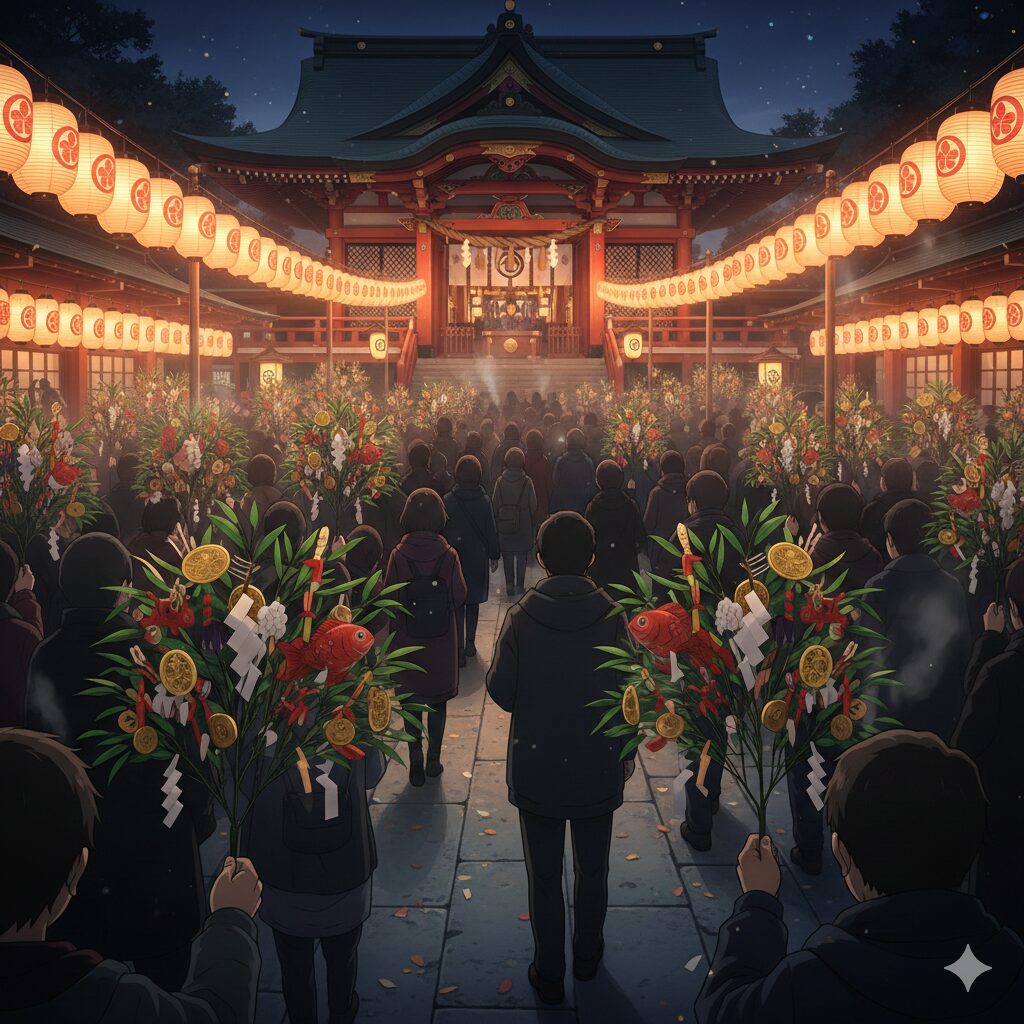
Just as the quiet of the Japanese New Year begins to settle, a season of feverish festivals suddenly arrives, primarily in the Kansai region. January 9th is not just a date on the calendar. For Japanese business people, merchants, and anyone seeking fortune, it marks the opening of the most critical three days of the year: “Yoi-Ebisu” (Eve of Ebisu).

What is Yoi-Ebisu?
January 9th is known as “Yoi-Ebisu.” It serves as the eve of the “Toka Ebisu” festival held on January 10th. Toka Ebisu is a festival dedicated to “Ebisu,” one of the Seven Lucky Gods, praying for business prosperity, safety of the family, and traffic safety.
The festival consists of the following three days:
- January 9th: Yoi-Ebisu (Eve) – The opening of the festival. It reaches its climax from evening to night.
- January 10th: Hon-Ebisu (Main Festival) – The day of the grand festival.
- January 11th: Nokori-Fuku (Remaining Luck) – The conclusion. Based on the proverb “There is luck in the leftovers.”
Especially on Yoi-Ebisu (Jan 9th), office workers and business owners flock to the shrines after work. The shrine grounds bustle all night long, filled with an energy that rivals, or even exceeds, the main festival day.
Ebisu: Japan’s Unique God of Fortune
“Ebisu” is the only indigenous Japanese god among the Seven Lucky Gods (others originate from India or China). He is depicted wearing a hunting robe (Kariginu), holding a fishing rod in his right hand and a large sea bream under his left arm, with a broad smile on his face.
Originally, he was a god of fishing, bringing “large catches and happiness.” Over time, he became the guardian deity of markets and is now widely worshipped as the “God of Business Prosperity.” In Kansai, he is affectionately called “Ebessan.”
Historical Background and Mythology
There are various theories about the true identity of Ebisu, but two are predominant:
- Kotoshironushi-no-Kami Theory: The son of Okuninushi (a major god in Shinto mythology). In the myth of the transfer of the land, he was fishing, which linked him to being a god of fishery.
- Hiruko Theory: The first child born to Izanagi and Izanami, but because he was born deformed, he was set adrift in a reed boat. The theory goes that he washed ashore and was worshipped as a god. This is the basis of the faith at Nishinomiya Shrine (the head shrine of all Ebisu shrines).
The Chant: “Shobai Hanjo de Sasa Mottekoi!”
Stepping into the Yoi-Ebisu venue, you will hear a rhythmic chant accompanied by bells and drums:
“Shobai Hanjo de Sasa Mottekoi!”
(Bring the bamboo grass for business prosperity!)
This phrase is said to have a double meaning: “If you bring bamboo, we will make your business prosper,” and “If your business prospers, bring the bamboo back as a thanksgiving offering.”
Fuku-Zasa (Lucky Bamboo) and Charms
Worshippers receive “Fuku-Zasa” (Lucky Bamboo branches) at the shrine. Bamboo is evergreen, resilient, and grows straight, making it a symbol of vitality and prosperity.
Various decorations called “Kitcho” (lucky omens) are then attached to this bamboo. These include:
- Zeni-Kamasu: Straw bags containing money. Increases financial luck.
- Money Bags: Symbol of wealth.
- Suehiro (Fan): Spreading prosperity.
- Koban: Gold coins (assets).
- Chogin: Silver bars (business capital).
- Eboshi: Success in life/career.
- Mallet & Mortar: Creating treasure.
These are attached by chosen women known as “Fuku-Musume” (Lucky Maidens), creating a personalized, powerful lucky charm.
Deep Dive into Japanese Culture: Fusion of Sacred and Secular
Yoi-Ebisu and Toka Ebisu represent a magnificent fusion of Japanese religious views and economic activity. Japanese people typically value humility, but on this day, they do not hide their desire for “making money.”
Within the sacred precincts of the shrine, people openly pray for worldly benefits (financial success), drink sake at street stalls, and laugh together. This chaos, where the boundary between the “Sacred” (rituals) and the “Secular” (economy/desire) blurs and blends, represents the robustness and intrigue of Japanese culture.
The excitement is particularly intense at Imamiya Ebisu Shrine in Osaka and Nishinomiya Shrine in Hyogo, attracting millions of visitors. Here lies an energetic, humanistic Japan, the complete opposite of the quiet “Zen” image often portrayed abroad.
A Question for You
Yoi-Ebisu is not just a day for praying to gods. It is a day to flip the switch, renewing one’s determination to “work hard at business this year” and setting sail into the rough seas of society.
What do you wish to make “prosper” in your work or life? And what kind of “Bamboo” (symbol) will you hold up to achieve it?
Please use this intense Japanese energy as inspiration to reaffirm your own goals for this year.
Related Links
- Reference (External): Nishinomiya Shrine Official Site (Headquarters)
- Reference (External): Imamiya Ebisu Shrine Official Site
- Category: What’s Today’s Special Day Series
1月9日:商売繁盛の熱狂的な前夜祭「宵戎(よいえびす)」
日本の正月気分が少し落ち着き始めた頃、関西地方を中心に突如として熱狂的な祭りの季節がやってきます。1月9日、それは単なる日付ではありません。日本のビジネスマン、商売人、そして幸運を求めるすべての人々にとって、一年で最も重要な3日間の幕開け、「宵戎(よいえびす)」の日です。
宵戎(よいえびす)とは何か?
1月9日は「宵戎(よいえびす)」と呼ばれます。これは、1月10日に行われる「十日戎(とおかえびす)」の前夜祭(イブ)にあたります。十日戎は、七福神の一柱である「えびす様」を祀り、商売繁盛、家内安全、交通安全を願う祭事です。
祭りは以下の3日間で構成されています:
- 1月9日:宵戎(よいえびす) – 祭りの幕開け。夕方から夜にかけて最高潮に達します。
- 1月10日:本戎(ほんえびす) – 大祭当日。
- 1月11日:残り福(のこりふく) – 祭りの締めくくり。「残り物には福がある」とされます。
特に1月9日の宵戎は、仕事終わりの会社員や経営者が殺到し、夜通し賑わうことから、本祭に負けないほどのエネルギーに満ち溢れています。
えびす様:日本独自の福の神
「えびす様(恵比寿)」は、七福神の中で唯一、日本古来の神様です(他の神様はインドや中国由来)。狩衣を着て、右手に釣り竿、左手に大きな鯛を抱え、満面の笑みを浮かべた姿で描かれます。
もともとは漁業の神様として「大漁追福」をもたらす存在でしたが、時代とともに市場の守護神となり、現在では広く「商売繁盛の神様」として信仰されています。関西では親しみを込めて「えべっさん」と呼ばれています。
歴史的背景と神話
えびす様の正体については諸説ありますが、主に二つの説が有力です。
- 事代主神(コトシロヌシノカミ)説: 日本神話に登場する大国主命(オオクニヌシノミコト)の子。国譲りの神話において、釣りをしていたことから漁業の神と結びついたとされます。
- ヒルコ神説: イザナギとイザナミの間に生まれた最初の子ですが、不具であったため葦船に乗せて流されました。漂着した先で神として祀られたという説です。これは西宮神社(えびす宮総本社)の信仰に基づいています。
「商売繁盛で笹持ってこい!」の掛け声
宵戎の会場に足を踏み入れると、鐘や太鼓の音とともに、リズミカルな掛け声が絶え間なく聞こえてきます。
「商売繁盛で笹持ってこい!」
このフレーズには、「笹を持ってくれば商売繁盛させますよ」という意味と、「商売が繁盛したら、お礼参りとしてまた笹を持ってきなさい」という二重の意味が含まれていると言われています。
福笹(ふくざさ)と縁起物
参拝者は神社で「福笹」と呼ばれる笹を受け取ります。笹は常緑で、生命力が強く、真っ直ぐ伸びることから、繁栄の象徴とされています。
そして、この笹に「吉兆(きっちょう)」と呼ばれる飾りをつけていきます。吉兆には以下のようなものがあります:
- 銭叺(ぜにかます): お金の入った袋。金運上昇。
- 銭袋: 富の象徴。
- 末広(扇): 末広がりの繁栄。
- 小判: 財産。
- 丁銀: 商売の資本。
- 烏帽子: 立身出世。
- 臼・小槌: 宝を生み出す。
これらを福娘(ふくむすめ)と呼ばれる選び抜かれた女性たちにつけてもらい、自分だけの最強の縁起物を作り上げるのです。
日本文化の深層:聖と俗の融合
宵戎、そして十日戎は、日本人の宗教観と経済活動が見事に融合したイベントです。日本人は普段、謙虚さを美徳としますが、この日ばかりは「金儲け」への欲望を隠しません。
神聖な神社の境内で、現世利益(金銭的な成功)をあからさまに願い、露店で酒を飲み、笑い合う。この「聖(神事)」と「俗(経済・欲望)」の境界線が曖昧になり、渾然一体となるカオスこそが、日本文化のたくましさであり、面白さです。
特に大阪の今宮戎神社や、兵庫の西宮神社での盛り上がりは凄まじく、数百万人の参拝者が訪れます。静謐な禅(Zen)のイメージとは真逆の、エネルギッシュで人間臭い日本がここにあります。
あなたへの問いかけ
宵戎は、単に神頼みをする日ではありません。「今年も商売に励むぞ」という決意を新たにし、社会という荒波へ漕ぎ出すためのスイッチを入れる日です。
あなたは、自分の仕事や人生において、何を「繁盛」させたいですか?そして、そのためにどんな「笹(象徴)」を掲げますか?
ぜひ、この日本の熱気を想像しながら、あなた自身の今年の目標を再確認してみてください。
関連リンク
- 参考サイト(外部): えびす宮総本社 西宮神社 公式サイト
- 参考サイト(外部): 今宮戎神社 公式サイト
- カテゴリー: 今日は何の日シリーズ一覧
コメント