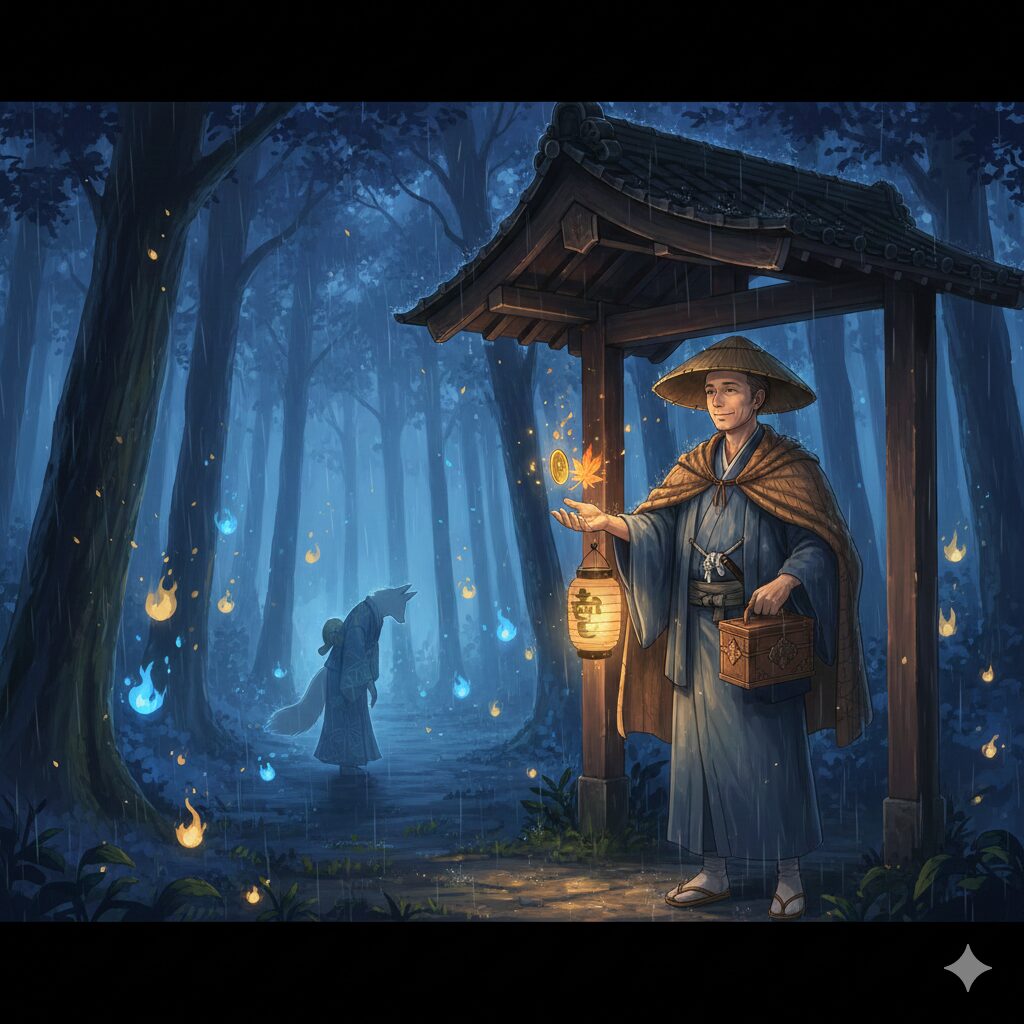
In Japanese folklore, no animal is as closely tied to people’s lives—and as deeply feared and revered—as the Kitsune (Fox). They are messengers of the gods, and at times, mischievous spirits that bewitch humans. Today, we introduce “The Fox’s Childbirth” (Kitsune no Osan), a mysterious tale depicting a strange interaction between a fox and a human.
What happened deep in the foggy mountains on a rainy night? This story is not merely a fantasy; it embodies the respect and kindness Japanese people have long held toward nature and the “unseen.”

Chapter 1: The Visitor on a Stormy Night
Long ago, in a certain village, there lived a skilled doctor named Genshuku. He was deeply respected by the villagers because he never charged the poor for his services and treated everyone with sincerity.
One summer night, a severe thunderstorm struck. The wind pounded ominously against the doors. Just as Genshuku thought, “I hope no one falls ill on a night like this,” and was about to go to bed, there was a loud banging on his door.
“Doctor, Doctor, please open up!”
When Genshuku opened the door, a stranger stood there. The man wore a straw raincoat pulled low, hiding his face in the shadows. However, his voice was filled with desperation.
“My wife is suffering in childbirth. Please, you must save her. I will pay you any amount.”
Seeing the man’s desperation, Genshuku agreed immediately. “A life is at stake. Money can wait. Let us go at once.”
Chapter 2: The Procession in the Dark and the Grand Mansion
Genshuku followed the man to the edge of the forest outside the village, where a magnificent palanquin awaited. Several servants holding lanterns bowed silently. As soon as Genshuku boarded the palanquin, they sped up the mountain path as if flying.
After being rocked for about an hour, the palanquin stopped. When Genshuku stepped out, he saw a grand mansion unlike anything he had ever seen before. The gate was imposing, and he could sense many maids moving busily inside.
“This way, please.”
He was led to a room where a young lady lay on beautiful silk futons, writhing in pain. Genshuku immediately set to work. He wiped her sweat, encouraged her, and used all his medical skills to assist with the difficult birth.
Then, just before dawn, a healthy cry echoed through the mansion. A healthy baby boy was born safely.
“Thank you, Doctor! We are so relieved.”
The husband wept with joy and invited Genshuku to another room. There, a feast of delicacies from the mountains and seas was laid out. Genshuku was served sake and, feeling a pleasant exhaustion, became intoxicated.
Chapter 3: The Fox’s Gratitude
“This is a token of my appreciation.”
As he was leaving, the man handed Genshuku a heavy bundle. “Inside is your reward. Please accept it.”
Genshuku was placed back in the palanquin. As he dozed off, he suddenly found himself standing in front of his own house. The sky was beginning to brighten, and the rain had completely stopped.
“Was it all a dream…?”
But in his hands, he certainly held the heavy bundle. When Genshuku opened it, he found it packed with glittering gold coins. “To think such a wealthy man lived deep in those mountains.” Genshuku carefully put the money away and went back to sleep.
The next morning, when Genshuku woke up and checked the bundle, something astonishing had happened. The coins that were gold yesterday had all turned into “dry leaves.”
“I see, I was bewitched by a fox after all.”
Genshuku smiled wryly but did not get angry. “Well, it matters not. A new life was born safely. Whether it is a fox’s child or a human’s child, I simply did my duty as a doctor.”
That night, at Genshuku’s doorstep, someone had left muddy wild yams and a freshly caught pheasant. It was the best “real” gratitude the mountain dwellers, who possessed no human money, could offer.
- Chapter 1: The Visitor on a Stormy Night
- Chapter 2: The Procession in the Dark and the Grand Mansion
- Chapter 3: The Fox’s Gratitude
- Analysis: Experiences on the Boundary and Views on Life and Death
- Deciphering Japanese Culture: Inari Faith and Coexistence
- To Our Readers
- 神秘のベールに包まれた命の物語:キツネのお産
- 考察:境界線上の体験と日本人の死生観
- 日本文化を読み解く:稲荷信仰と共存
- 読者の皆様へ
Analysis: Experiences on the Boundary and Views on Life and Death
The story of “The Fox’s Childbirth” cannot be dismissed simply as a tale of being tricked. It contains several important elements unique to Japanese culture.
Visiting the Otherworld
In the story, the doctor is taken deep into the mountains in a palanquin. This is a typical structure of “visits to the otherworld” in folklore. The conditions of night, rain, and deep mountains symbolize the moment when the boundary between the human world and the spirit world becomes blurred. The doctor temporarily stepped into a sacred realm.
Why Did the Fox Invite a Human?
Normally, wild animals give birth on their own. However, in this story, the fox specifically relies on a human doctor. This indicates that in Japanese folk beliefs, foxes were recognized as special beings with intelligence and social structures close to humans. Furthermore, the desperate plea for help during a difficult birth appeals to the universal truth that the weight of life is the same for both humans and animals.
The Meaning of Leaves and Yams
The ending where gold coins turn into leaves is generally interpreted as a “fox’s prank.” However, the wild yams and pheasant delivered later are the essence of the story. Foxes cannot create human money (they can only show it through illusion). However, the prey they catch themselves is “real.” This depicts an essential value: that sincere gratitude (food) is more precious than illusory wealth.
Deciphering Japanese Culture: Inari Faith and Coexistence
From this folktale, we can understand the concept of “coexistence with nature” that lies at the root of Japanese culture.
Inari Kami and Foxes
There are about 30,000 “Inari Shrines” across Japan. Fushimi Inari Taisha in Kyoto, with its tunnel of red torii gates, is the head shrine. Foxes are considered messengers of Inari (the god of harvest) and have been worshipped as bringers of good harvests. For farmers, foxes that hunted mice were truly divine messengers.
Tolerance for Being “Bewitched”
Unlike in many Western fairy tales where wolves are often depicted as “evil” to be defeated, Japanese foxes are often portrayed as “neighbors who trick us but cannot be hated.” Just as Genshuku did not rage upon seeing the dry leaves, Japanese people have accepted mysterious natural phenomena with humor, thinking, “If it’s a fox’s doing, it can’t be helped,” and have coexisted with them.
This story teaches us the beauty of “tolerance toward others (different species)” and “goodwill without expecting a reward,” virtues that modern society often loses sight of.
To Our Readers
How did you enjoy the story of “The Fox’s Childbirth”?
If you were in Genshuku’s shoes, how would you have felt when the gold coins turned into leaves? would you be angry, thinking you were tricked? Or could you laugh and forgive, thinking you had a unique experience?
Does your country have folktales where animals transform into humans or help people? Please think about the differences in how animals are treated across cultures.
When you visit Japan, please be sure to visit an Inari Shrine. There, a fox disguised as a human might just be watching you.
Related Links
- Fushimi Inari Taisha Official Website – The most famous shrine in Japan dedicated to foxes.
- Japanese Folktale Series – Read more Japanese folktales here.
神秘のベールに包まれた命の物語:キツネのお産
日本の民間伝承において、キツネ(狐)ほど人々の生活に密着し、かつ畏怖されてきた動物はいません。彼らは神の使いであり、時には人を化かす妖怪でもあります。今回ご紹介するのは、そんなキツネと人間の不思議な交流を描いた物語「キツネのお産」です。
雨の夜、霧深い山奥で何が起きたのか。この物語は単なるファンタジーではなく、日本人が自然や「目に見えないもの」に対して抱いてきた敬意と優しさが込められています。
第一章:嵐の夜の来訪者
昔々、ある村に玄叔(げんしゅく)という腕の良い医者が住んでいました。彼は貧しい人々からはお金を取らず、誰に対しても誠実に治療を行うため、村人たちから深く尊敬されていました。
ある夏の夜のことです。激しい夕立が降り続き、風が戸を叩く音が不気味に響いていました。「こんな夜に病人が出なければよいが」と玄叔が床に就こうとしたその時、ドンドンドンと激しく扉を叩く音がしました。
「先生、先生、どうか開けてください!」
玄叔が扉を開けると、そこには見知らぬ男が立っていました。男は蓑(みの)を深くかぶり、顔は闇に隠れてよく見えません。しかし、その声は焦りに満ちていました。
「実は、妻がお産で苦しんでいるのです。どうか、妻を助けてやってください。お礼はいくらでもいたします」
男の必死な様子に、玄叔は二つ返事で引き受けました。「人の命にかかわることだ。金など後で良い。すぐに行こう」
第二章:闇夜の行列と大屋敷
玄叔が男の後についていくと、村外れの森の入り口に、立派な駕籠(かご)が用意されていました。提灯を持った数人の従者たちが無言で頭を下げます。玄叔が駕籠に乗り込むと、彼らは飛ぶような速さで山道を登っていきました。
揺られること小一時間。駕籠が止まり、玄叔が外に出ると、そこには今まで見たこともないような壮大な屋敷が建っていました。門構えは立派で、奥からは多くの女中たちが忙しなく動く気配がします。
「さあ、こちらです」
案内された部屋には、美しい絹の布団に横たわり、苦しむ若き夫人の姿がありました。玄叔はすぐに準備に取り掛かりました。汗を拭き、励まし、医術の限りを尽くして難産に挑みました。
そして、夜明け前。「オギャー、オギャー」という元気な産声が屋敷に響き渡りました。無事に元気な男の子が生まれたのです。
「ありがとうございます、先生!これで一安心です」
夫である男は涙を流して喜び、玄叔を別室へ招きました。そこには見たこともないような山海の珍味が並べられた膳が用意されていました。玄叔は酒を振る舞われ、心地よい疲れと共に酔いしれました。
第三章:狐の恩返し
「これはほんの気持ちです」
男は帰り際に、重厚な包みを玄叔に手渡しました。「中には謝礼が入っております。どうかお納めください」
再び駕籠に乗せられ、玄叔がうつらうつらとしていると、いつの間にか自宅の前に立っていました。空は白み始め、雨はすっかり上がっています。
「夢だったのだろうか…」
しかし、手元には確かにあの重い包みがあります。玄叔が包みを開けると、中には黄金色に輝く小判がぎっしりと詰まっていました。「なんと、あのような山奥にこれほどの長者がいたとは」。玄叔はその金を大切にしまい、再び眠りにつきました。
翌朝、玄叔が目を覚まして包みを確認すると、驚くべきことが起きていました。昨日まで黄金だった小判が、すべて「枯れ葉」に変わっていたのです。
「やはり、あれはキツネに化かされたのか」
玄叔は苦笑いしましたが、腹を立てることはありませんでした。「まあよい。新しい命が無事に生まれたのだ。それがキツネの子であろうと、人の子であろうと、医者としてやるべきことをやっただけだ」
その夜、玄叔の家の玄関先に、誰が置いたのか、泥のついた山芋と、仕留められたばかりの雉(キジ)が置かれていました。それは、お金を持たない山の住人たちができる、精一杯の「本物の」お礼だったのです。
考察:境界線上の体験と日本人の死生観
この「キツネのお産」の物語は、単なる「化かされた話」として片付けることはできません。ここには日本文化特有のいくつかの重要な要素が含まれています。
異界への訪問
物語の中で、医者は駕籠に乗って山奥へ連れて行かれます。これは「異界訪問譚」の典型的な構造です。夜、雨、山奥という条件は、人間界と異界(神や妖怪の住む世界)の境界が曖昧になる瞬間を象徴しています。医者は、一時的に神聖な領域へ足を踏み入れたのです。
なぜキツネは人を招いたのか?
本来、動物であるキツネは自力で出産します。しかし、この物語ではわざわざ人間の医者を頼ります。これは、日本の民間信仰において、キツネが人間に近い知能や社会性を持つ特別な存在として認識されていたことを示しています。また、「難産」という命の危機において、種族を超えて助けを求める切実さは、命の重さに人間も動物も変わりがないことを訴えかけています。
枯れ葉と山芋の意味
小判が枯れ葉に変わる結末は、一般的には「キツネのいたずら」と解釈されます。しかし、後日届けられた山芋や雉こそが、物語の真髄です。キツネたちは人間のお金(小判)を作り出すことはできません(幻術でしか見せられない)。しかし、自分たちが狩りで得た獲物は「真実」です。幻の富よりも、実質的な感謝の気持ち(食料)こそが尊いという、本質的な価値観がここに描かれています。
日本文化を読み解く:稲荷信仰と共存
この昔話から、私たちは日本文化の根底にある「自然との共存」を読み解くことができます。
稲荷神とキツネ
日本全国には約3万社の「稲荷神社」が存在します。赤い鳥居がトンネルのように続く京都の伏見稲荷大社がその総本宮です。キツネは稲荷神(穀物の神)の使いとされ、豊作をもたらす存在として崇められてきました。農民にとって、ネズミを駆除してくれるキツネは、まさに神の使いだったのです。
「化かす」ことへの許容
西洋の童話におけるオオカミなどが「悪」として退治される対象であるのに対し、日本のキツネは「人を化かすが、どこか憎めない隣人」として描かれることが多いです。玄叔が枯れ葉を見ても激怒しなかったように、日本人は自然界の不可思議な現象を「キツネのせいなら仕方ない」と受け入れ、ユーモアを持って共存してきました。
この物語は、現代社会が見失いがちな「他者(異種)への寛容さ」と「見返りを求めない善意」の美しさを教えてくれます。
読者の皆様へ
「キツネのお産」の物語はいかがでしたか?
もしあなたが玄叔の立場だったら、小判が枯れ葉に変わったとき、どう感じたでしょうか?「騙された!」と怒りますか?それとも、「良い経験をした」と笑って許せますか?
また、あなたの国には、動物が人間に化けたり、人間を助けたりするような昔話はありますか?文化による動物の扱いの違いについて、ぜひ考えてみてください。
日本を訪れる際は、ぜひ稲荷神社に足を運んでみてください。そこには、もしかすると人間の姿に化けたキツネが、あなたを観察しているかもしれません。
関連リンク
- 伏見稲荷大社 (Fushimi Inari Taisha Official Website) – 日本で最も有名な、キツネを祀る神社。
- Japanese Folktale Series – その他の日本昔話はこちらからお読みいただけます。

コメント