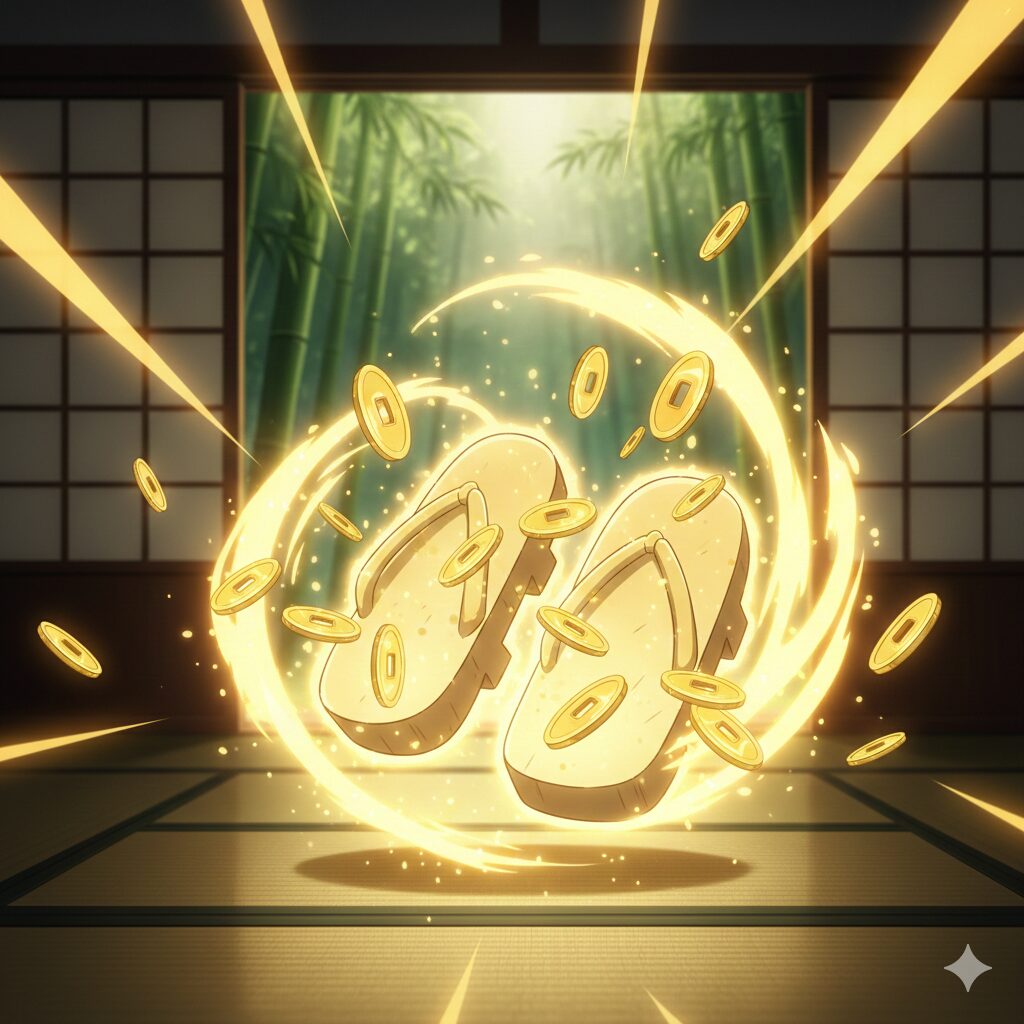

Japanese folktales are more than just simple moral stories; they often peer into the abyss of the human heart. Today, I am introducing the story of “Takara no Geta” (The Treasure Clogs). If you could make your wishes come true simply by stomping your feet while wearing a specific pair of wooden sandals, what would you do? This story poses sharp questions about wealth, happiness, and insatiable human desire.
Chapter 1: The Story of the Treasure Clogs
Long, long ago, in a certain village, lived two men. One was “Gonpachi,” who was honest and hardworking. The other was “Jiro,” who was greedy and selfish.
One day, when Gonpachi went to the mountains to gather firewood, he found a mouse in trouble near a deep hole. When Gonpachi kindly saved it, the mouse, in return, guided him to a mysterious world at the bottom of the hole. It was a place known as “The Pure Land of Mice.”
The mice welcomed Gonpachi warmly, serving him delicious rice cakes and feasts. Upon his departure, the elder mouse presented him with an old pair of wooden clogs (geta).
“These are the ‘Treasure Clogs.’ If you wear them and walk, money will appear with every step. However, you must never overuse them.”
Gonpachi thanked them and returned to the surface. Skeptical, he put on the clogs and stomped his foot—Karank!—and to his surprise, a glittering gold coin flew out. With every Karank, Karank step he took, more gold coins appeared. Gonpachi produced only as much money as he needed, rebuilt his house, shared his wealth with the villagers, and lived happily.
Hearing rumors of this, his neighbor Jiro became envious. “I want those clogs too!” he shouted, rushing to Gonpachi’s house and forcibly borrowing the clogs.
As soon as Jiro got home, he put on the clogs and began stomping furiously. Karank, Clink! Karank, Clink!
Gold coins poured out, piling up until the floor could no longer be seen. But Jiro’s greed knew no bounds. “More! Come out more!”
Jiro continued to stomp violently like a madman. Suddenly, the sound of the clogs changed. Thud, Thud…
Instead of gold coins, mud and rocks began to spew out. Still, Jiro did not stop. As he stomped even harder, his body began to shrink rapidly.
In the end, Jiro vanished completely, turning into a small insect. This was the fate of a man blinded by greed, who sought wealth beyond his stature.
Chapter 2: Analyzing the Story ~ The Distance from Wealth ~
The story of “The Treasure Clogs” is not merely a tale of good triumphing over evil. It depicts the “qualities of the human being who uses the tool (technology or wealth).”
The Heart that Knows Sufficiency
Gonpachi found happiness not just because he obtained the clogs, but because he “was satisfied with what was necessary.” He did not monopolize the wealth he gained but circulated it. On the other hand, Jiro became obsessed with the tool itself—the clogs—and lost sight of the purpose.
What the Geta Symbolize
Originally, Geta are tools to protect feet and aid in walking. However, in this story, they function as a “device that generates wealth.” This can be likened to modern investments, business, or powerful tools like AI. The story contains a warning: used correctly, they enrich life, but if abused, they can destroy the user (in this story, losing one’s humanity and becoming an insect).
Chapter 3: Japanese Culture and the Spirituality of “Geta”
Let’s decode the background of Japanese culture found in this story.
1. “Mottainai” and “Knowing Sufficiency”
In Japanese Buddhist values, there is a concept called “Shoyoku Chisoku” (Little Desire, Knowing Satisfaction). It is the spirit of keeping desires minimal and being satisfied with what one has. Gonpachi’s attitude embodies this perfectly and is considered a traditional Japanese virtue.
2. The Footwear Known as Geta
Geta are traditional Japanese sandals made of wood. Notable is their “sound.” The Karan-Koron sound of geta on stone is part of the emotional scenery of Japan. The depiction in the story where this sound changes from “the sound of gold” to “the sound of ruin” reflects the Japanese sensitivity to auditory experiences.
3. Entrance to the Otherworld
The opening sequence of falling into a hole and visiting the world of mice is a variation of the Japanese mythological visit to “Ne-no-Kuni” (The Land of Roots/Underworld). Underlying this is an animistic worldview where supernatural powers reside underground or deep in the mountains, beyond human understanding.
To Our Readers
If you obtained the “Treasure Clogs,” what would you do?
Do you have the confidence to stop at just what you need, like Gonpachi? Or would you, like Jiro, stomp until you reached the limit?
In modern society, we constantly hold “magic tools” like smartphones and the internet in our hands. Perhaps the sound of these old wooden clogs is teaching us the importance of not being swayed by them, but walking firmly on the ground with our own feet.
Related Links
宝の下駄:欲と運命が交差する不思議な物語
宝の下駄:欲と運命が交差する不思議な物語
日本の昔話には、ただの教訓話にとどまらず、人間の心の深淵を覗き込むような不思議な物語数多く存在します。今回ご紹介するのは「宝の下駄(たからのげた)」というお話です。履物を履いて足を踏み鳴らすだけで願いが叶うとしたら、あなたならどうしますか?この物語は、富と幸福、そして人間の尽きない欲望について、私たちに鋭い問いを投げかけます。
第1章:宝の下駄の物語
むかしむかし、ある村に二人の男が住んでいました。ひとりは正直で働き者の「権八(ごんぱち)」、もうひとりは欲張りで自分勝手な「次郎(じろう)」です。
ある日、権八が山へ薪を拾いに行くと、深い穴のそばで一匹のネズミが困っていました。権八が優しく助けてやると、ネズミはお礼にと彼を穴の底にある不思議な世界へと案内しました。そこは「ネズミの浄土」と呼ばれる場所でした。
ネズミたちは権八をもてなし、美味しいお餅やご馳走を振る舞いました。そして、帰る際に長老ネズミが古びた一足の下駄を差し出しました。
「これは『宝の下駄』です。これを履いて歩けば一歩ごとにお金が出ますが、決して使いすぎてはいけませんよ」
権八は礼を言い、地上へ戻りました。半信半疑でその下駄を履き、「コロン」と足を踏み鳴らすと、なんとキラキラと輝く小判が一枚飛び出したのです。「コロン、コロン」と歩くたびに、小判がザクザクと出てきます。権八は必要な分だけお金を出し、家を建て直し、村の人々にも富を分け与え、幸せに暮らしました。
この噂を聞きつけたのが、隣の次郎です。「俺もその下駄が欲しい!」と権八の家に押しかけ、無理やり下駄を借りてしまいました。
次郎は家に帰るなり、下駄を履いて足踏みを始めました。「コロン、チャリン! コロン、チャリン!」
小判が出るわ出るわ、床が見えなくなるほどの金貨が積もりました。しかし、次郎の欲は止まりません。「もっとだ、もっと出ろ!」
次郎は狂ったように激しく足を踏み鳴らし続けました。すると突然、下駄の音が変わりました。「ドロン、ドロン…」
小判ではなく、泥や石ころが出てき始めたのです。それでも次郎は止まりません。さらに強く踏み鳴らすと、彼の体はみるみる縮んでいきました。
最後には、次郎の姿は消え失せ、一匹の小さな虫になってしまいました。欲に目がくらみ、身の丈以上の富を求めた男の末路でした。
第2章:物語の考察 ~富との距離感~
この「宝の下駄」という物語は、単なる勧善懲悪の物語ではありません。ここには「道具(テクノロジーや富)を使う人間の資質」が描かれています。
足るを知る心
権八が幸せになれたのは、下駄を手に入れたからではありません。「必要な分だけで満足した」からです。彼は得た富を独占せず、循環させました。一方、次郎は下駄というツールそのものに執着し、目的を見失いました。
下駄が象徴するもの
「下駄」は本来、足を保護し、歩行を助ける道具です。しかし、この物語では「富を生む装置」として機能します。これは現代における投資やビジネス、あるいはAIのような強力なツールに置き換えることができます。正しく使えば生活を豊かにしますが、乱用すれば使い手自身を破滅させる(この物語では人間性を失い、虫になる)という警告を含んでいるのです。
第3章:日本文化と「下駄」の精神性
この物語から読み解ける日本文化の背景について解説します。
1. 「もったいない」と「足るを知る」
日本の仏教的価値観には「少欲知足(しょうよくちそく)」という言葉があります。欲を少なくし、今あるもので満足するという精神です。権八の態度はまさにこれを体現しており、日本の伝統的な美徳とされています。
2. 下駄という履物
下駄(Geta)は、木で作られた日本の伝統的なサンダルです。特筆すべきは、その「音」です。「カランコロン」という下駄の音は、日本の情緒的な風景の一部です。物語の中で、この音が「小判の音」や「破滅の音」に変化する描写は、聴覚を大切にする日本人の感性を反映しています。
3. 異界への入り口
物語の冒頭、穴に落ちてネズミの世界へ行く展開は、日本神話の「根の国(黄泉の国)」訪問の変奏曲です。地下や山奥には人知を超えた力が宿っているという、アニミズム的な世界観が根底に流れています。
読者の皆様へ
もし、あなたが「宝の下駄」を手に入れたらどうしますか?
権八のように必要な分だけで止める自信がありますか? それとも、次郎のように限界まで踏み鳴らしてしまうでしょうか?
現代社会において、私たちはスマートフォンやインターネットという「魔法の道具」を常に手にしています。それらに振り回されず、自分の足でしっかりと地面を踏みしめて歩くことの大切さを、この古い下駄の音が教えてくれているのかもしれません。


コメント