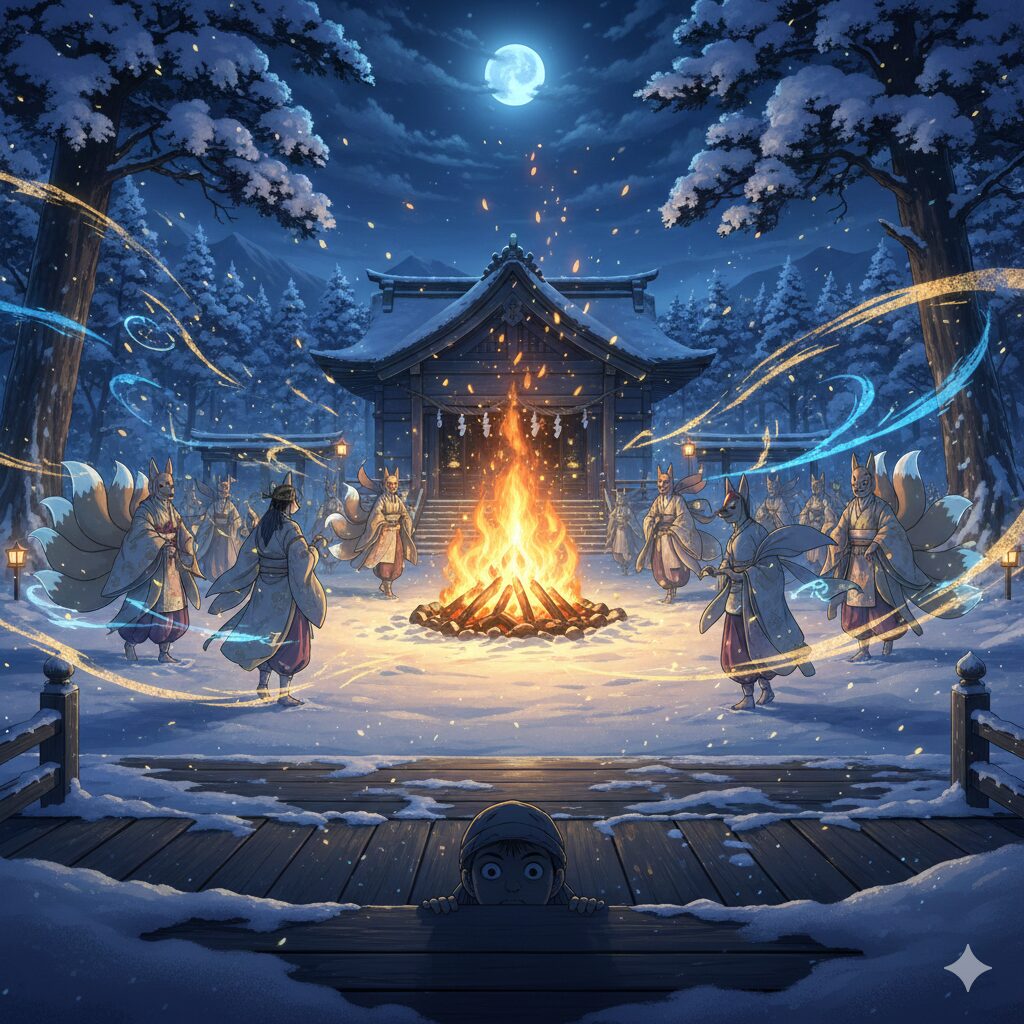
In the Japanese winter, especially on New Year’s Eve (Omisoka), it is believed that invisible sacred forces are at work. The story I am introducing today, “The Fire of the Great Year,” is a beautiful and solemn tale depicting how the Gods of the New Year bestow fortune or trials upon people. It is not just a mysterious story; hidden within it are the Japanese people’s awe of nature and their attitude toward the future.
1. The Story: Ōtoshi no Hi (The Fire of the Great Year)
Long ago, in a small village deep in the mountains, lived an honest and hardworking man. However, that year had suffered from a drought, and the entire village was gasping in poverty. Finally, New Year’s Eve arrived, but the man had no rice cakes to eat, nor even sacred sake to offer to the gods.
“At the very least, I will visit the guardian shrine (Ujigami) and pray for a bountiful harvest next year.”
Carrying no lantern, the man walked along the dark, snow-covered mountain path toward the old shrine on the outskirts of the village. Upon arriving, he quietly clasped his hands in prayer, but due to the bitter cold and exhaustion, he drifted into a slumber right there beneath the floorboards of the shrine.
In the dead of night, with a roaring sound like the wind, the area suddenly became as bright as midday. The man woke up with a start, peeked through the gaps in the floorboards, and saw an unbelievable sight.
The divine “Toshigami-sama” (The Great God of the Year), mounted on a white horse, along with many attendant gods and messenger foxes, had gathered. They were circling a large bonfire, discussing something.
“Now, let us decide the crop yields for each village for the coming year.”
As Toshigami-sama solemnly announced this, the attendants began lighting torches one by one. The way the fire burned would determine the fortune of each village.
“How about the neighboring village, the Northern Hamlet?”
“Yes, it shall be a bountiful harvest!”
The torch held up by the attendant burned fiercely and vigorously.
“Then, what of the Southern Valley?”
“An average harvest.”
The fire burned calmly, yet without fading.
The man waited for his own village’s name to be called, his heart pounding so hard he thought it might burst. Eventually, Toshigami-sama’s voice resonated.
“And how is the village where this man lives?”
An attendant held up a torch, but its flame was so small and weak it looked as if it might go out at any moment.
“I report: Next year will be a poor harvest. The villagers will continue to suffer.”
The man nearly cried out in despair but desperately covered his mouth. Then, Toshigami-sama spoke quietly.
“It is a pity. However, even if the fire is small, as long as it does not burn out, there is hope. If someone protects that fire and uses wisdom, the village can survive.”
Eventually, with the break of dawn, the gods vanished, leaving only silence. The man hurried back to the village and gathered the villagers. “If I tell them exactly what I saw, they might panic,” he thought. So, he told them this:
“I received an oracle from the guardian god. Next year will also be a difficult year. Therefore, do not waste a single grain of seed rice, cherish your reserves, and let us all help each other and live frugally.”
The villagers believed the serious look in the man’s eyes. And the following year, although the weather was rough as predicted, because the villagers were prepared and resolute, no one starved, and they were able to overcome the harsh winter.
The small fire had become the fire in the villagers’ hearts, protecting the village to the end.
2. Analysis: Can Destiny be Changed?
This story is not merely a tale of “prophecy.” It skillfully depicts the balance between “fatalism” and “human will.”
The Terror and Blessing of Peeking into the Unknown
The protagonist witnesses the meeting of the gods by hiding “under the floor,” a boundary area where people usually do not enter. This is an act of violating a taboo—knowing a “fate” that humans are not supposed to know—but at the same time, it becomes the key to saving the village. In Japanese folktales, there is a common pattern where those who learn the secrets of the otherworld are ruined if they use them for selfish greed, but blessed if they use them for others.
Metaphor of Fire
The “fire” appearing here is a symbol of vitality and the energy of the sun. The weakness of the fire implies a lack of the sun’s blessings (bad weather). However, the god did not say “extinguish the fire.” The fact that it continues to burn, however small, suggests that survival is possible depending on human effort.
3. Cultural Insight: New Year’s Eve and Toshigami
The core of Japanese culture deciphered from this story involves the faith in “Toshigami” and the spirit of “preparedness” (Sonae).
- Who is Toshigami?
The Japanese New Year is not just a holiday, but a religious ritual to welcome this “Toshigami” into the home. Toshigami is an ancestral spirit god who brings abundance and health for the year. Decorations like Kadomatsu (pine decoration) and Kagami Mochi (mirror rice cake) are vessels (Yorishiro) to welcome this god. - Connection to “Okera Mairi”:
At Yasaka Shrine in Kyoto and other places, a ritual called “Okera Mairi” is held on New Year’s Eve. People transfer sacred fire to a rope and bring it home to cook the first soup of the year (Ozoni). This is a ritual of taking “God’s fire (vital force)” into the body, which can be seen as a real-life ritualization of the “distribution of fire” depicted in the story. - Awe and Coexistence with Nature:
In the story, the villagers did not despair upon hearing the bad prophecy, but survived the fury of nature by “living frugally.” This symbolizes the traditional Japanese view of nature: “Kyosei” (Coexistence), where one lives in rhythm with nature rather than conquering it.
4. Conclusion: The New Year’s Fire in Your Country
“The Fire of the Great Year” teaches us that the future is never fixed and can be changed by our mindset and actions. Even if the prophesied flame is small, we can protect it through wisdom and cooperation.
Does your country have special rituals using “fire” or “light” on New Year’s Eve or New Year’s Day? And if you knew a harsh prophecy for the future, would you be able to act for the community like this man?
Please imagine your own story.
Reference & More Stories
【日本昔話】運命を照らす大晦日の奇跡「大歳の火」:神々が決める来年の運勢
日本の冬、特に大晦日(おおみそか)には、目に見えない神聖な力が働いていると信じられてきました。今日ご紹介する物語「大歳の火」は、新年の神様がどのようにして人々に幸福や試練を与えるのかを描いた、美しくも厳かな物語です。ただの不思議な話ではなく、そこには日本人の自然に対する畏敬の念と、未来への向き合い方が隠されています。
1. 昔話:大歳の火(The Fire of the Great Year)
むかしむかし、ある山奥の小さな村に、正直で働き者の男が住んでいました。しかし、その年は日照りが続き、村全体が貧困に喘いでいました。いよいよ大晦日の夜が訪れましたが、男の家には食べる餅はおろか、神様に供えるお神酒さえありません。
「せめて、氏神様(村の守り神)にお参りをして、来年の豊作を祈ろう」
男は提灯も持たず、雪の積もる暗い山道を歩き、村外れにある古びたお堂へと向かいました。お堂に着くと、男は静かに手を合わせましたが、あまりの寒さと疲労で、そのままお堂の縁の下でうとうとと眠り込んでしまいました。
真夜中、ゴオオオッという風の音と共に、あたりが真昼のように明るくなりました。男がふと目を覚まし、床板の隙間から外を覗くと、信じられない光景が広がっていました。
白馬に跨った神々しい姿の「大歳神(おおとしがみ)」様と、その従者である多くの神々やお使いの狐たちが集まっていたのです。彼らは大きな焚き火を囲み、何やら相談をしています。
「さあ、来年の各村々の作柄を決めるとしよう」
大歳神様が厳かに告げると、従者たちが次々と松明(たいまつ)に火を灯し始めました。その火の燃え方で、それぞれの村の吉凶が決まるのです。
「隣村、北の里は?」
「はい、豊作でございます!」
従者が掲げた松明は、ごうごうと勢いよく燃え上がりました。
「では、南の谷は?」
「中作でございます」
火は穏やかに、しかし消えることなく燃えています。
男は心臓が飛び出るほど緊張しながら、自分の村の名前が呼ばれるのを待ちました。やがて、大歳神様の声が響きました。
「して、この男が住む村はどうじゃ?」
従者が松明を掲げましたが、その火は今にも消えそうなほど小さく、頼りないものでした。
「申し上げます。来年も凶作、村人には苦難が続くでしょう」
男は絶望のあまり声を上げそうになりましたが、必死に口を押さえました。すると、大歳神様が静かに言いました。
「不憫なことよ。だが、火が小さくとも、燃え尽きなければ希望はある。誰かがその火を守り、知恵を絞れば、村は生き延びられよう」
やがて夜明けと共に神々は消え去り、静寂だけが残りました。男は急いで村へ戻り、村人たちを集めました。「見たことをそのまま話せば混乱するかもしれない」。そう考えた男は、こう告げました。
「氏神様のお告げがあった。来年も厳しい年になる。だから、種籾(たねもみ)を一粒たりとも無駄にせず、蓄えを大切にし、皆で助け合って慎ましく暮らそう」
村人たちは男の真剣な眼差しを信じました。そして翌年、予言通り天候は荒れましたが、村人たちは事前の覚悟と備えがあったため、誰一人飢えることなく、厳しい冬を乗り越えることができました。
小さな火は、村人たちの心の火となって、村を守り抜いたのです。
2. 物語の考察:運命は変えられるのか
この物語は、単なる「予言」の話ではありません。「運命論」と「人間の意志」のバランスを巧みに描いています。
不可知の領域を覗き見る恐怖と恩恵
主人公は「縁の下」という、普段は人が立ち入らない境界領域に隠れることで、神々の会議を目撃します。これは、人間が本来知る由もない「運命」を知ってしまったというタブーを犯す行為ですが、同時にそれが村を救う鍵となりました。日本の昔話では、異界の秘密を知った者が、それを私利私欲に使えば破滅し、他者のために使えば祝福されるというパターンが多く見られます。
火のメタファー
ここで登場する「火」は、生命力や太陽のエネルギーの象徴です。火の勢いが弱いことは、太陽の恵みが少ないことを意味します。しかし、神様は「火を消す」とは言いませんでした。小さくても燃え続けているということは、人間の努力次第で生存が可能であることを示唆しています。
3. 日本文化への視座:大晦日と大歳神
この物語から読み解ける日本文化の核心は、「大歳神(Toshigami)」への信仰と「備え」の精神です。
- 大歳神(Toshigami)とは:
日本のお正月は、単なる祝日ではなく、この「大歳神」を家に迎え入れるための宗教的儀式です。大歳神は、その年の豊穣と健康をもたらす祖霊神です。門松や鏡餅は、この神様を歓迎するための依代(よりしろ)なのです。 - 「おけら参り」との関連:
京都の八坂神社などでは、大晦日に「おけら参り」という神事が行われます。神聖な火を吉兆縄(きっちょうなわ)に移して家に持ち帰り、その火でお雑煮を作る風習があります。これは、「神の火(生命力)」を体内に取り込む儀式であり、物語の中で描かれた「火の分配」が現実に儀礼化されたものと言えます。 - 自然への畏敬と共生:
物語の中で、村人たちは悪い予言を聞いて絶望するのではなく、「慎ましく生きる」ことで自然の猛威をやり過ごしました。これは、自然を征服するのではなく、自然のリズムに合わせて生きる日本人の伝統的な自然観「共生(Kyosei)」を象徴しています。
4. 終わりに:あなたの国の新年の火
「大歳の火」は、未来が決して固定されたものではなく、私たちの心構えと行動によって変えられることを教えてくれます。たとえ予言された炎が小さくても、知恵と協力でそれを守り抜くことができるのです。
あなたの国では、大晦日や新年に「火」や「光」を使った特別な儀式はありますか?また、もしあなたが未来の厳しい予言を知ってしまったら、この男のようにコミュニティのために行動できるでしょうか?
ぜひ、あなた自身の物語を想像してみてください。
コメント