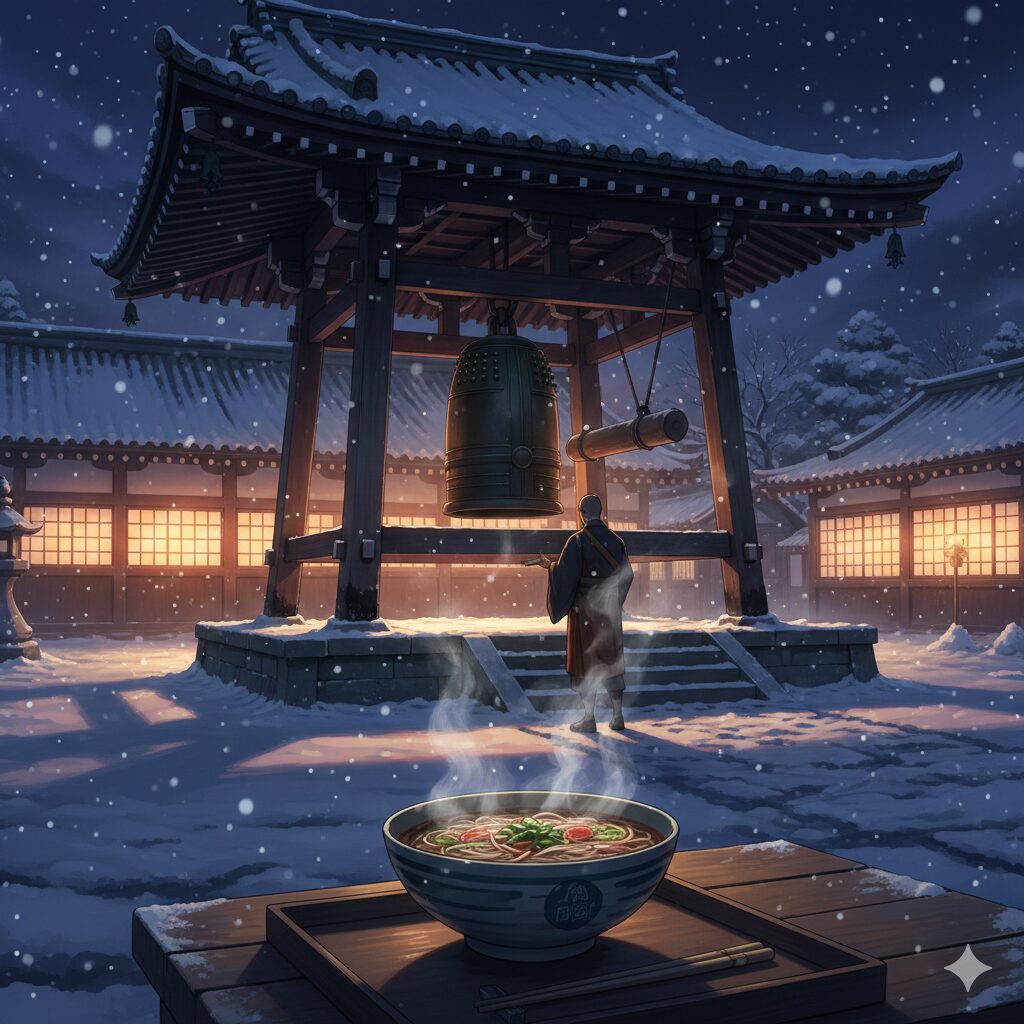
In many parts of the world, December 31st is a day for popping champagne, setting off fireworks, and welcoming the New Year with wild festivities. However, here in Japan, the scenery is starkly different. December 31st is called “Omisoka,” and it is not merely a marker to end the year, but a sacred day for spiritual “settlement” and “rebirth.”
Why do Japanese people eat buckwheat noodles (Soba) on this day and listen to the sound of bells at midnight? Behind these actions lies a deep philosophy and faith inherited over hundreds of years.

- The Origin of Omisoka and the Meaning of “Misoka”
- “Sweeping and Purifying” to Welcome Toshigami-sama
- Joya no Kane: The Sound that Erases 108 Worldly Desires
- Toshikoshi Soba: Thin, Long, and Severing Ties
- “Ending” is a Blank Space for “Beginning”
- A Question for You
- 大晦日の起源と「晦日」の意味
- 歳神様を迎えるための「掃き清め」
- 除夜の鐘:108の煩悩を消し去る音
- 年越し蕎麦:細く長く、そして断ち切る
- 「終わり」は「始まり」のための空白
- あなたへの問いかけ
The Origin of Omisoka and the Meaning of “Misoka”
First, let’s unravel the word “Omisoka.” Originally, “Misoka” meant the 30th day, or the day the moon hides, based on the phases of the moon in the lunisolar calendar. In short, it refers to the last day of every month. Since December is the final month of the year, the character for “Great” (O) was added to create “Omisoka” (The Great Last Day).
Historically, it was believed that the new day began at nightfall. Therefore, the night of Omisoka was already considered the beginning of the New Year, a sacred time to welcome the gods.
“Sweeping and Purifying” to Welcome Toshigami-sama
The protagonist of Omisoka is not us humans, but “Toshigami-sama,” the God of the New Year. It is believed that Toshigami-sama descends from the high mountains to each household to bring a bountiful harvest and good health to the family for the coming year.
The “Osouji” (Big Cleaning) that Japanese people frantically perform at the end of the year is not just housework to tidy up rooms. It is a Shinto ritual to welcome the god, an act of “Harai” (purification) to brush away the soot and dust of the year, thereby removing bad luck. Finishing the cleaning and decorating with Kadomatsu (pine decorations) or Shime-nawa (sacred ropes) by the night of Omisoka creates a sacred boundary, ensuring the god can enter the home without losing their way.
Joya no Kane: The Sound that Erases 108 Worldly Desires
On the night of Omisoka, what breaks the silence of Japan is not the explosion of fireworks, but the solemn sound of bells. In a Buddhist event called “Joya no Kane” (Bells on New Year’s Eve), temple bells are rung 108 times, straddling midnight.
Why 108 times? In Buddhist teaching, it is said that humans have 108 “Bonno” (worldly desires/passions). Bonno refers to movements of the heart that torment and confuse us, such as desire, anger, obsession, and jealousy.
- Eyes, Ears, Nose, Tongue, Body, Mind (The 6 Senses)
- Good, Bad, Neutral (3 states for each sense)
- Pure, Impure (2 states)
- Past, Present, Future (3 timelines)
Multiplying these factors (6 × 3 × 2 × 3) results in 108. With each strike of the bell, we release one desire, preparing to welcome the New Year with a pure heart. The sound of the bell echoing in the freezing winter night sky is also a signal to bid farewell to one’s past self.
Toshikoshi Soba: Thin, Long, and Severing Ties
In Japanese households, “Toshikoshi Soba” (Year-crossing Noodles) is eaten on the night of Omisoka. This tradition holds two contradictory yet important wishes:
- A Wish for Longevity: Because soba noodles stretch thin and long, they symbolize the wish to “live a long, slender life” and for the family’s fortune to continue for a long time.
- Severing Bad Luck: Compared to other noodles, soba breaks easily. This symbolizes “cleanly severing the hardships and disasters of the past year.”
It is considered bad luck to eat the soba after crossing into the New Year; the rule is to finish eating it before the New Year arrives.
“Ending” is a Blank Space for “Beginning”
What we can interpret from Omisoka in Japanese culture is the aesthetic of “emptiness” and the philosophy of “circulation.”
If the Western sense of time is linear and cumulative, the Japanese sense of time is cyclical. Omisoka is a day to reset what has been built up. Scrubbing away dirt during the Big Cleaning, washing away spiritual grime with the sound of bells, and severing bad connections with soba. All these acts are processes to return to “zero.”
Only when the vessel (the house or the heart) is empty can the luck of the New Year (Toshigami-sama) enter. This decisiveness to “completely end once” might be ancient wisdom for Japanese people to maintain their mental health.
In modern times, there is a custom of watching the national music program “NHK Kohaku Uta Gassen” with the family, which also holds a ritualistic aspect of “sharing the same time and confirming unity.” While old and new blend, the essence of Omisoka—spending time with family and quietly reflecting—remains unchanged.
A Question for You
How did you spend your time this past year?
And as you welcome the New Year, are there any “burdens of the heart” or “obsessions” you wish to let go of?
If possible, this December 31st, try stepping away from the noise of lively parties and listen for the sound of the bell echoing within your own heart in a quiet place. Even if you don’t physically eat soba, why not take a few minutes to mentally “sever” the hardships of the year and return to a state of zero?
Endings are not sad. They are the preparation of a blank page to begin writing a new story.
References & Related Information
12月31日:大晦日(Omisoka)― 静寂と再生の儀式
世界中の多くの地域で、12月31日はシャンパンを開け、花火を打ち上げ、狂騒の中で新年を迎えるパーティーの日かもしれません。しかし、ここ日本において、その風景は全く異なります。12月31日は「大晦日(Omisoka)」と呼ばれ、一年の終わりを告げる単なる区切りではなく、精神的な「清算」と「再生」のための神聖な一日です。
なぜ日本人はこの日に蕎麦を食べ、深夜に鐘の音を聞くのか。その背景には、何百年もの間受け継がれてきた深い哲学と信仰が存在します。
大晦日の起源と「晦日」の意味
まず、「大晦日(Omisoka)」という言葉を紐解きましょう。もともと「晦日(Misoka)」とは、太陰太陽暦において月の満ち欠けに基づき、月が隠れる「三十日(Miso-ka)」を意味していました。つまり、毎月の最終日を指す言葉です。一年の最後の月である12月、その最終日であるため「大(O)」をつけて「大晦日」となりました。
かつて、一日の始まりは夜にあると考えられていました。そのため、大晦日の夜はすでに新しい年の始まり、あるいは神様を迎えるための神聖な時間とされていたのです。
歳神様を迎えるための「掃き清め」
大晦日の主役は人間ではありません。「歳神様(Toshigami-sama)」と呼ばれる、新年の神様です。歳神様は、その年の豊作や家族の健康をもたらすために、高い山から各家庭へと降りてくると信じられています。
日本人が年末に必死になって行う「大掃除(Osouji)」は、単に部屋を綺麗にする家事ではありません。それは神様を迎えるための神事であり、一年間の煤(すす)や埃を払うことで、厄を落とす「祓い(Harai)」の儀式なのです。大晦日の夜までに掃除を終え、門松やしめ縄を飾るのは、神様が迷わずに家に入ってこられるようにするための結界作りと言えます。
除夜の鐘:108の煩悩を消し去る音
大晦日の夜、日本の静寂を破るのは花火の爆発音ではなく、重厚な鐘の音です。深夜0時を跨いで行われる仏教行事「除夜の鐘(Joya no Kane)」では、寺院の梵鐘が108回突かれます。
なぜ108回なのか。仏教の教えでは、人間には108つの「煩悩(Bonno)」があると言われています。煩悩とは、欲望、怒り、執着、妬みなど、人の心を苦しめ、迷わせる心の動きのことです。
- 眼、耳、鼻、舌、身、意(6つの感覚)
- 好、悪、平(それぞれの感覚に対する3つの状態)
- 浄、染(きれいか、汚れているか2つの状態)
- 過去、現在、未来(3つの時間軸)
これらを掛け合わせる(6×3×2×3)と108になります。鐘を一つ突くたびに、私たちは一つの煩悩を手放し、清らかな心で新年を迎える準備をするのです。凍てつく冬の夜空に響く鐘の音は、過去の自分への別れの合図でもあります。
年越し蕎麦:細く長く、そして断ち切る
日本の家庭では、大晦日の夜に「年越し蕎麦(Toshikoshi Soba)」を食べます。これには二つの相反する、しかし重要な願いが込められています。
- 長寿への願い:蕎麦は細く長く伸びることから、「細く長く生きられますように」「家運が長く続きますように」という縁起を担いでいます。
- 厄災を断ち切る:蕎麦は他の麺類に比べて切れやすい性質を持っています。これにより、「一年の苦労や災厄を綺麗に断ち切る」という意味が込められています。
年を越してから蕎麦を食べることは縁起が悪いとされ、必ず新年を迎える前に食べ終えるのがルールです。
「終わり」は「始まり」のための空白
日本文化における大晦日から読み解けるのは、「空白」の美学と「循環」の思想です。
西洋的な時間の感覚が直線的で、積み上げていくものであるとすれば、日本の時間の感覚は円環的です。大晦日は、積み上げたものを一度リセットする日です。大掃除で汚れを落とし、鐘の音で心の垢を落とし、蕎麦で悪縁を断ち切る。これらすべての行為は「ゼロ」に戻るためのプロセスです。
空っぽになった器(家や心)があって初めて、新しい年の運気(歳神様)が入ってくることができます。この「一度完全に終わらせる」という潔さこそが、日本人の精神衛生を保つための古代からの知恵なのかもしれません。
また、現代では「NHK紅白歌合戦」という国民的音楽番組を家族で見る習慣がありますが、これもまた「同じ時間を共有し、一体感を確認する」という儀式的な側面を持っています。古いものと新しいものが融合しながらも、「家族で過ごす」「静かに振り返る」という大晦日の本質は変わっていません。
あなたへの問いかけ
あなたは今年一年、どのような時間を過ごしましたか?
そして、新しい年を迎えるにあたり、手放したいと思っている「心の重荷」や「執着」はありますか?
もし可能であれば、今年の12月31日は、賑やかなパーティーの喧騒から少し離れ、静かな場所で自分の心の中に響く鐘の音に耳を傾けてみてください。物理的に蕎麦を食べなくとも、今年一年の苦労を精神的に「断ち切り」、ゼロの状態に戻る時間を数分でも持ってみてはいかがでしょうか。
終わりは悲しいものではありません。それは、新しい物語を書き始めるための、白紙のページを用意することなのです。
コメント