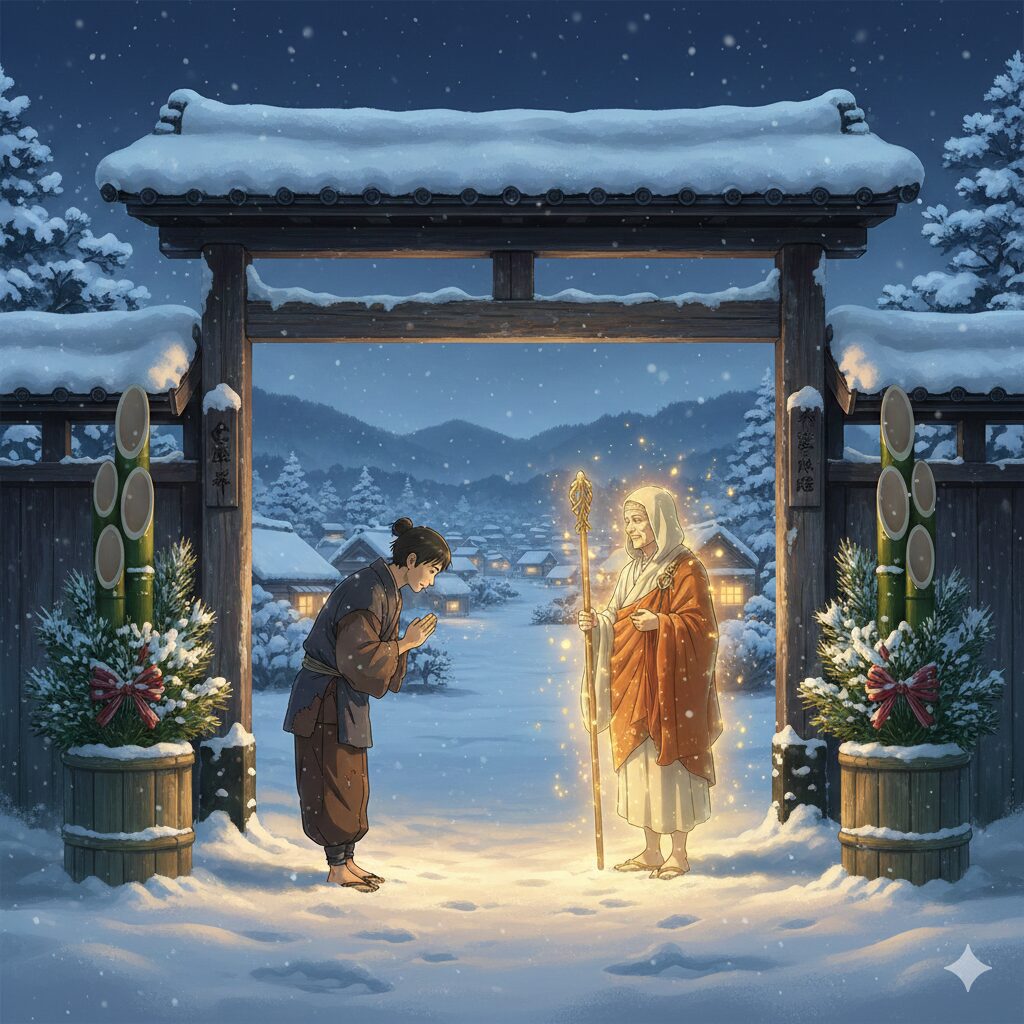
In Japan, as the winter deepens and the end of December approaches, the entire country buzzes with a unique energy. This is not merely preparation for a holiday; it is the beginning of a sacred ritual to welcome a very special deity. His name is “Toshigami-sama” (The God of the Year). He is one of the most important figures in Japanese folklore, bringing happiness, health, and a bountiful harvest for the coming year.
Why do Japanese people clean their houses thoroughly and place pine decorations at their gates? The answer lies in this ancient, heartwarming, and slightly mysterious story.

Chapter 1: The Visitor on a Snowy Night
Long, long ago, in a small village nestled in the mountains, lived two brothers.
The older brother was the wealthiest man in the village. He owned many storehouses and lived in luxury every day. However, his heart was cold as ice, and he hated parting with even a single gold coin for others.
The younger brother, on the other hand, was very poor. He often struggled to find enough rice for the next day, but his heart was pure, kind, and deeply faithful.
It happened on New Year’s Eve, the night known as Omisoka.
A fierce blizzard was raging outside, burying the houses in snow. As the villagers huddled by their hearths, a lone traveling monk appeared at the village entrance. His robes were tattered, his straw sandals were worn through, and he was trembling from the bitter cold.
The monk first knocked on the magnificent gate of the older brother’s house.
“I am a humble traveler,” the monk called out. “I have lost my way in this blizzard. Could you please lend me just the eaves of your roof for the night?”
The older brother poked only his head out from his warm room and sneered.
“Hmph, you look filthy! We are busy preparing to welcome the New Year. We have no space for a beggar like you. Get lost immediately!”
With that, the older brother slammed the door shut, forcing the monk back into the freezing storm.
Chapter 2: The Light in the Poor House
Stumbling through the snow, the monk made his way to the edge of the village, where the younger brother lived.
The sound of the wind whistling through the cracks of the dilapidated hut was audible. When the monk called out, the younger brother and his wife emerged.
“Oh my, what a terrible state you are in! Come in, please, come in! We have nothing to offer, but at least it is shelter from the wind.”
The couple invited the monk inside. They took the warmest kimonos they had intended to wear for themselves and draped them over the shivering guest. Then, they took the small amount of millet they had saved for their New Year’s meal, cooked a warm porridge, and offered it to him.
“Monk, we have no feast for the New Year, but please, warm yourself with this.”
The monk ate the porridge with delight and bowed deeply.
“I shall never forget your warm hospitality. Tomorrow morning, when I leave, decorate your gate with pine branches. If you do so, misfortune will leave, and fortune will dance in.”
Chapter 3: The Miracle of the New Year
The next morning, as the first light of New Year’s Day broke, the monk was nowhere to be found.
Following his instructions, the couple went to the mountain behind their house, cut some pine branches, and decorated their gate.
Then, a miracle happened.
The moment the morning sun hit the pine branches, a golden light filled their humble home. The empty rice straw bags were suddenly bursting with rice, and piles of gold coins appeared on the floor.
Even more surprisingly, within that light, the majestic figure of a god briefly appeared. The monk from the night before was actually “Toshigami-sama” in disguise, testing the hearts of humans before bestowing the blessings of the New Year.
Meanwhile, the mean-spirited older brother faced a series of misfortunes, and his house eventually fell into ruin.
The younger brother did not hoard his newfound wealth. He shared it with the villagers and taught them the importance of decorating with pine to welcome the god.
Since then, people have put up Kadomatsu (pine decorations), offered Kagami Mochi (mirror rice cakes), and purified their bodies and minds to sincerely welcome Toshigami-sama every New Year.
Analysis: The Test of “Heart” and “Hospitality”
This story is more than a simple moral tale of “good triumphs over evil.” It deeply reflects the concept of “Marebito Faith” which lies at the root of Japanese spirituality.
“Marebito” refers to a spirit or god who visits from another world. They often appear in our daily lives disguised as shabby travelers. This conveys two powerful messages: “Gods look at the essence, not the appearance,” and “Unconditional kindness (hospitality) to strangers” will eventually save you.
The older brother symbolizes “material wealth but spiritual poverty,” while the younger brother represents “material poverty but spiritual abundance.” Toshigami-sama did not test them on their wealth, but on whether they had the “emotional capacity to care for others.” This is a poignant question that resonates even in our modern society.
Decoding Japanese Culture: Traces of Toshigami in Modern Japan
Understanding this folktale changes how you see the scenery of the Japanese New Year.
1. The True Meaning of Kadomatsu (Pine Decoration)
The pine branches the younger brother used are the origin of today’s “Kadomatsu.” Pine is an evergreen tree, symbolizing vitality. But more importantly, the Kadomatsu acts as an “antenna or landmark for Toshigami-sama to descend from the sky.” In an age without GPS, it guides the god to your home without getting lost.
2. Kagami Mochi (Mirror Rice Cake)
The round rice cakes displayed during New Year serve as a “Yorishiro”—a vessel or temporary lodging for the god. It is like a cushion for Toshigami-sama to rest on. Eating this mochi later (a ritual called Kagami Biraki) means ingesting the power of the god to gain energy for the coming year.
3. Otoshidama (New Year’s Gift)
Today, this is an event where children receive cash in envelopes. However, the characters originally meant “The Spirit of the Year.” It began with the head of the household breaking the Kagami Mochi (which housed Toshigami’s spirit) and sharing it with the family. It was a sacred ritual of sharing “God’s soul” (the vitality for the year).
What Would You Do?
If a dirty stranger knocked on your door on a blizzardy night, what would you do?
Considering modern security, closing the door like the older brother might be the “correct” answer. However, I believe we should all keep a small space in our hearts for the “unconditional kindness” of the younger brother.
When you welcome a new year, what do you prioritize?
Is it the material preparations, or the preparation of your heart?
The Japanese New Year is not just a holiday. It is a quiet, beautiful time to reset one’s soul and express gratitude to the unseen.
Links for Further Discovery
【日本昔話】年神様(としがみさま):福をもたらす来訪神の物語
日本の冬、特に12月の終わりになると、街全体がそわそわとした活気に包まれます。それは単なる祝日の準備ではありません。ある特別な「神様」を迎えるための神聖な儀式の始まりなのです。その神様の名は「年神様(としがみさま)」。新しい年の幸福と実りを持ってくる、日本で最も重要な神様の一柱です。
なぜ日本人は年末に大掃除をし、門松を立てるのでしょうか?その答えは、古くから伝わるこの物語の中にあります。
第一章:雪夜の訪問者
むかしむかし、ある村に二人の兄弟が住んでいました。
兄は村一番の長者で、大きな蔵をいくつも持ち、毎日贅沢な暮らしをしていました。しかし、その心は冷たく、金貨一枚すら他人に恵むことを嫌っていました。
一方、弟はとても貧しく、明日の米にも困る暮らしでしたが、心は清く、信心深い男でした。
ある大晦日の夜のことです。
外は猛吹雪で、家々が雪に埋もれそうなほどでした。村人たちが暖炉の前で暖を取っていると、村の入り口に一人の旅の僧侶が現れました。僧侶の衣はボロボロで、わらじは破れ、寒さで震えています。
僧侶はまず、立派な門構えの兄の家を訪ねました。
「旅の者ですが、この吹雪で道に迷ってしまいました。どうか一晩、軒先だけでも貸していただけないでしょうか」
兄は暖かい部屋から顔だけ出し、ふんぞり返って言いました。
「ふん、汚らしい。うちは正月を迎える準備で忙しいんだ。お前のような乞食を入れる場所などない。とっとと失せろ!」
兄はピシャリと戸を閉め、僧侶を吹雪の中へ追い返してしまいました。
第二章:貧しい家の灯り
僧侶はよろめきながら、村外れにある弟の家へと向かいました。
あばら家からは隙間風の音が聞こえます。僧侶が声をかけると、弟とその妻が出てきました。
「まあ、なんとひどい格好だ。さあさあ、何もありませんが、中へお入りください」
弟夫婦は僧侶を招き入れると、自分たちが着るはずだった一番暖かい着物を僧侶に着せました。そして、正月のためにとっておいたわずかな粟(あわ)を炊き、温かいお粥を作って差し出しました。
「お坊様、正月のご馳走はありませんが、せめてこれで温まってください」
僧侶はそのお粥を美味しそうに食べ、感謝の言葉を述べました。
「あなた方の温かい心遣い、決して忘れはしません。明日の朝、私が発つ時に、門口に松の枝を飾っておきなさい。そうすれば、災いは去り、福が舞い込むでしょう」
第三章:正月の奇跡
翌朝、元旦の光が差し込むと、僧侶の姿はどこにもありませんでした。
弟夫婦は言われた通り、裏山から松の枝を切ってきて、門口に飾りました。
すると、不思議なことが起こりました。
朝日が松の枝を照らした瞬間、家の中に黄金色の光が満ち溢れたのです。空っぽだった米俵は米で満たされ、床には小判が山のように積まれていました。
さらに驚くべきことに、その光の中から、ふくよかで威厳のある神様の姿が一瞬浮かび上がりました。昨晩の僧侶は、新しい年の幸福をもたらす「年神様」の仮の姿だったのです。
一方、意地悪な兄の家には不幸が重なり、やがて家は傾いてしまいました。
弟は授かった富を独り占めすることなく村人たちにも分け与え、松を飾って神様を迎えることの大切さを伝えました。
それ以来、人々は正月に門松を立て、鏡餅を供え、心身を清めて年神様を心から歓迎するようになったのです。
物語の考察:試される「心」と「もてなし」
この物語は、単なる勧善懲悪の話ではありません。ここには日本人の宗教観の根底にある「マレビト信仰」が色濃く反映されています。
「マレビト(稀人)」とは、異界から訪れる霊的な存在や神を指します。彼らはしばしば、みすぼらしい旅人の姿をして私たちの日常に現れます。これは、「神は見た目ではなく、本質を見ている」というメッセージであると同時に、「見知らぬ者への無償の優しさ(ホスピタリティ)」が、巡り巡って自分自身を救うという教訓を含んでいます。
兄が象徴するのは「物質的な豊かさと精神的な貧困」、弟が象徴するのは「物質的な貧困と精神的な豊かさ」です。年神様は、富の有無ではなく、「他者を思いやる余裕があるか」を試したのです。これは現代社会においても、非常に鋭い問いかけとして響きます。
日本文化を読み解く:現代に残る「年神様」の痕跡
この昔話を理解すると、現代の日本のお正月の風景がまったく違って見えてくるはずです。
1. 門松(Kadomatsu)の本当の意味
物語の中で弟が飾った「松」。これは現在の「門松」の起源です。松は常緑樹であり、生命力の象徴です。しかし、それ以上に重要なのは、門松が「年神様が空から降りてくるためのアンテナ(目印)」の役割を果たしているということです。GPSのない時代、神様が迷わず家にたどり着くためのガイドなのです。
2. 鏡餅(Kagami Mochi)
正月に飾る丸い餅は、年神様の「依り代(よりしろ)」、つまり神様が滞在するための座布団のようなものです。鏡開きでその餅を食べることは、神様の力を体内に取り込み、新しい一年を生き抜くエネルギーを得ることを意味します。
3. お年玉(Otoshidama)
今では子供たちが現金を貰うイベントですが、本来は「御歳魂(おとしだま)」と書きました。家長が鏡餅(年神様の魂が宿ったもの)を砕き、家族に分け与えたのが始まりです。「神様の魂(=一年分の生きる力)」を分け与える神聖な儀式だったのです。
あなたならどうしますか?
もし、吹雪の夜、あなたの家のドアを見知らぬ汚れた旅人がノックしたら、あなたはどうしますか?
現代のセキュリティ事情を考えれば、兄のようにドアを閉ざすのが「正解」かもしれません。しかし、心のどこかに、弟のような「見返りを求めない優しさ」を持つスペースを残しておきたいものです。
あなたは、新しい年を迎える時、何を大切にしますか?
物質的な準備でしょうか、それとも心の準備でしょうか?
日本のお正月は、ただの休暇ではありません。自分の心をリセットし、見えない存在に感謝する、静かで美しい時間なのです。
コメント