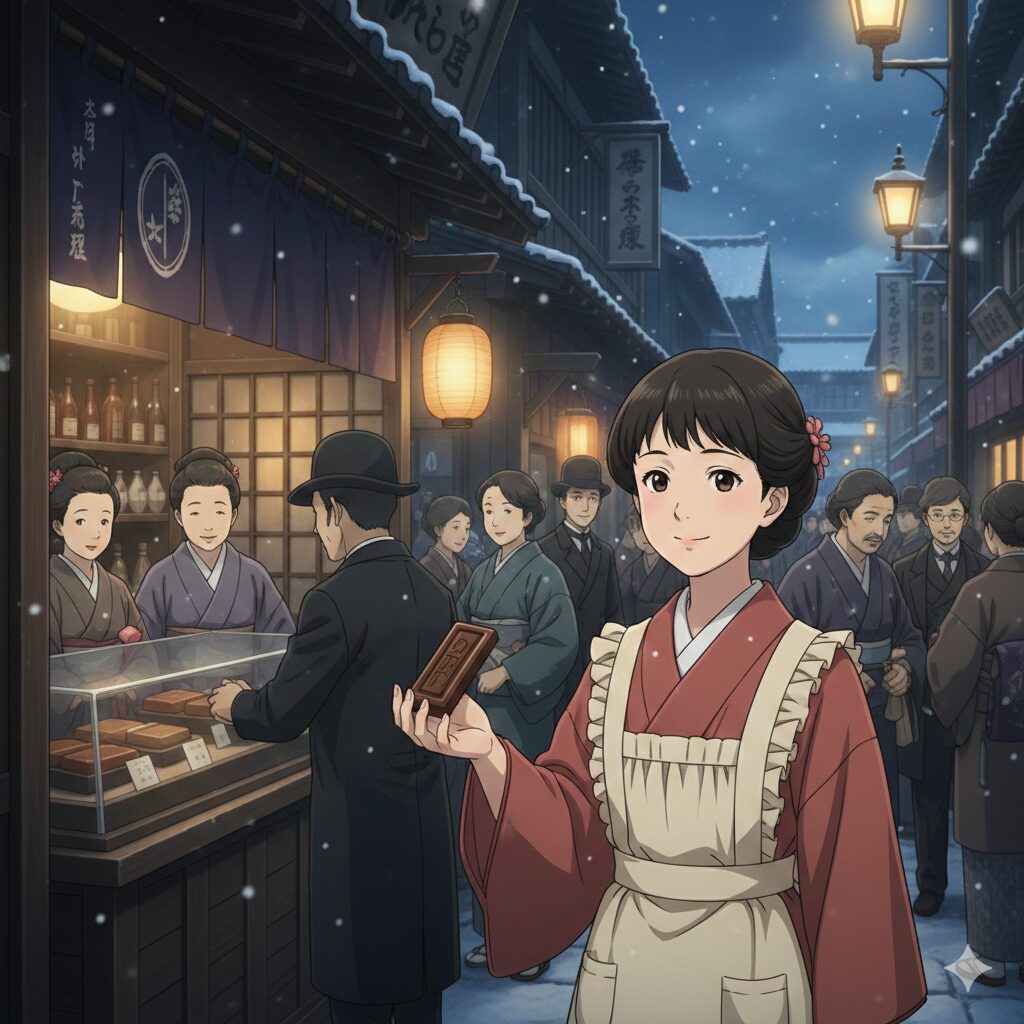
When you think of December 25th, Christmas is likely the first thing that comes to mind. However, if we unravel the threads of Japanese history, this date marks another significant milestone—a “sweet revolution” that changed the nation’s palate forever.
The year was 1878 (Meiji 11). On this day, Yonezu Fugetsudo, a confectionery shop in Ryogoku, Tokyo, placed a newspaper advertisement announcing the sale of the first domestically processed chocolate in Japan. Today, we travel back to the turbulent Meiji era, a time when samurai topknots were being replaced by Western haircuts, to explore the history and cultural background of how Japanese people first encountered this mysterious dark confection.

Deep Dive into History: The Scent of Cacao in the Meiji Sky
The Shock of “In-cho-koryo-to”
While chocolate is a ubiquitous treat today, for the Japanese people of the late 19th century, it was an encounter with the unknown. The advertisement placed by Yonezu Fugetsudo in the “Kanayomi” newspaper did not use the Katakana script we see today. Instead, it used a complex set of Kanji characters chosen for their phonetic sound and auspicious meaning.
“貯古齢糖” (Cho-Ko-Rei-To)
The characters chosen were powerful: “Cho” (to store/save), “Ko” (ancient), “Rei” (age), and “To” (sugar). Implicit in this name was the nuance that this was a medicinal sweet that could preserve one’s youth and longevity.
Whether viewed as a medicine or a treat, the use of such elaborate characters reveals just how luxurious and special this Western import appeared to the people of that era.
The Price of Modernity
So, how much did this “Cho-Ko-Rei-To” cost? Records suggest that a single piece or bar would cost the equivalent of several thousand to nearly ten thousand yen in today’s currency (approx. $30-$70 USD). Compared to the price of rice at the time, it was astronomically expensive and certainly not something the common people could easily afford.
Furthermore, the chocolate of 1878 was likely not the smooth milk chocolate we know today. It was probably high in cacao, grainy, and bitter—closer to a “medicinal block.” Yet, for the “Edokko” (locals of Tokyo) who loved new trends, and for intellectuals eager to absorb Western culture, this dark block was the very taste of “Bunmei Kaika” (Civilization and Enlightenment).
Cultural Fusion: The Aesthetics of Acceptance and Transformation
The Power to Digest Culture through “Kanji”
This event highlights a key characteristic of Japanese culture: the ability to “translate” foreign cultures.
Since ancient times, Japanese people have adapted foreign concepts by assigning Kanji characters to them (known as Ateji), thereby embedding them into their own cultural context. “Coffee” became 珈琲, “Beer” became 麦酒, and “Chocolate” became 貯古齢糖. By giving meaning to the sounds, they redefined foreign culture as something of their own.
Yonezu Fugetsudo’s decision to sell chocolate was likely driven not just by novelty, but by the spirit of Japanese craftsmanship—a desire to prove that Japanese confectioners could match Western techniques during a period of rapid Westernization.
Lineage to the Present: The Unique Evolution of Japanese Chocolate
The seeds sown in the Meiji era have since blossomed into a unique evolutionary tree. Today, the Japanese chocolate market boasts a diversity rarely seen elsewhere in the world.
- Matcha Chocolate: A perfect fusion of Japanese tradition and Western confectionery.
- Seasonal Flavors: A reflection of the Japanese love for the four seasons (e.g., Sakura flavor in spring, Chestnut in autumn).
- Valentine’s Day: The development of a unique culture where women give chocolate to men as a confession of love.
Without that first step taken by Yonezu Fugetsudo on December 25, 1878, Japan’s rich modern sweets culture might not exist today. It was more than just a product launch; it was the moment Japan opened the door to the world of Western confectionery.
A Question for You
If you could take a time machine back to Tokyo in 1878, would you want to try that first “Cho-Ko-Rei-To” amidst the crowd of people in kimonos? Would it taste like bitter medicine to you, or would it taste like the hope of the future?
Does your country have a specific history or memory associated with the arrival of chocolate? Please enjoy a piece of chocolate today while thinking about your own story.
Related Links
For more detailed information on the history of chocolate in Japan, please visit the following association website:
Chocolate & Cocoa Association of Japan
Check out other posts in our special day series here:
What’s Today’s Special Day Series
文明開化の味がする?12月25日は日本のチョコレート誕生の日
12月25日といえば、世界中がクリスマス一色に染まる日です。しかし、日本の歴史を紐解くと、この日はもう一つの「甘い革命」が起きた記念すべき日でもあります。
時は明治11年(1878年)。東京・両国にあった和菓子店「米津風月堂(よねづふうげつどう)」が、日本で初めて国産チョコレートの販売広告を新聞に掲載した日なのです。今回は、ちょんまげから散切り頭へと変わりゆく激動の明治時代に思いを馳せ、日本人がいかにして「チョコレート」という未知の黒い菓子と出会ったのか、その歴史と文化的背景を紐解いていきます。
歴史の深層:明治の空に香るカカオの香り
「貯古齢糖」という名の衝撃
現在、私たちが当たり前のように口にしているチョコレートですが、当時の日本人にとっては、まさに未知との遭遇でした。米津風月堂が新聞「かなよみ」に掲載した広告には、チョコレートというカタカナではなく、漢字の当て字が使われていました。
「貯古齢糖」
読み方は「チョコレート」。なんと力強く、縁起の良さそうな漢字でしょうか。「貯(たくわ)える」「古(いにしえ)」「齢(よわい)」。つまり、これを食べれば長生きができる、滋養強壮に良い薬菓子であるというニュアンスが含まれていました。
また、別の表記として「猪口令糖(しょくらあと)」という文字が使われた記録もありますが、いずれにせよ、当時の人々がこの西洋の菓子をいかに高級で、特別なものとして捉えていたかが文字から伝わってきます。
当時の価格と価値
では、当時の「貯古齢糖」はいくらだったのでしょうか?記録によると、現在の価値に換算して1枚(またはひとかけら)が数千円から1万円近くしたと言われています。当時の米の価格と比較しても、庶民が気軽に手を出せる代物ではありませんでした。
当時のチョコレートは、現在のような滑らかな口溶けのミルクチョコレートではなく、カカオの含有率が高く、少しざらつきのある、苦味の強い「食べる薬」に近いものであったと推測されます。それでも、新しいもの好きの「江戸っ子」たちや、西洋文化を貪欲に取り入れようとする知識人たちにとって、この黒い塊は「文明開化の味」そのものだったのです。
日本文化との融合:受容と変容の美学
異文化を「漢字」で飲み込む力
この出来事から読み解ける日本文化の最大の特徴は、「外来文化の翻訳能力」です。
日本人は古来より、海外から入ってきた概念に漢字を当て(当て字)、自分たちの文脈の中に落とし込んできました。「珈琲(コーヒー)」「麦酒(ビール)」そして「貯古齢糖」。単に音を真似るだけでなく、そこに意味を持たせることで、異国の文化を「自分たちのもの」として再定義するのです。
米津風月堂が販売に踏み切った背景には、単なる物珍しさだけでなく、急速な西洋化の中で「日本の菓子職人の技術も西洋に負けていない」ことを証明したいという気概があったのかもしれません。
現代への系譜:独自の進化を遂げた日本のチョコ
明治時代に蒔かれた種は、その後、独自の進化を遂げました。現在、日本のチョコレート市場は世界でも稀に見る多様性を誇っています。
- 抹茶チョコレート:和と洋の完全な融合。
- 季節限定フレーバー:四季を愛でる日本文化の反映。
- バレンタインデー:女性から男性へ贈るという、日本独自の「告白文化」への発展。
1878年の12月25日、米津風月堂が踏み出したその一歩がなければ、今の日本の豊かなスイーツ文化は存在しなかったかもしれません。それは単なる商品の発売ではなく、日本人が「洋菓子」という新しい世界への扉を開けた瞬間だったのです。
あなたへの問いかけ
もしあなたがタイムマシンで1878年の東京に行けるとしたら、着物姿の人々が行き交う中で、初めて発売された「貯古齢糖」を試してみたいと思いますか?それは苦い薬の味がするでしょうか、それとも未来への希望の味がするでしょうか。
そして、あなたの国では、チョコレートにはどのような歴史や思い出がありますか?ぜひ、あなたのストーリーを思い浮かべながら、今日のチョコレートを味わってみてください。
関連リンク
日本のチョコレートの歴史についてさらに詳しく知りたい方は、以下の公的な協会のサイトが参考になります。
日本チョコレート・ココア協会 (Chocolate & Cocoa Association of Japan)
当ブログの他の記念日シリーズはこちらからご覧いただけます:
What’s Today’s Special Day Series

コメント