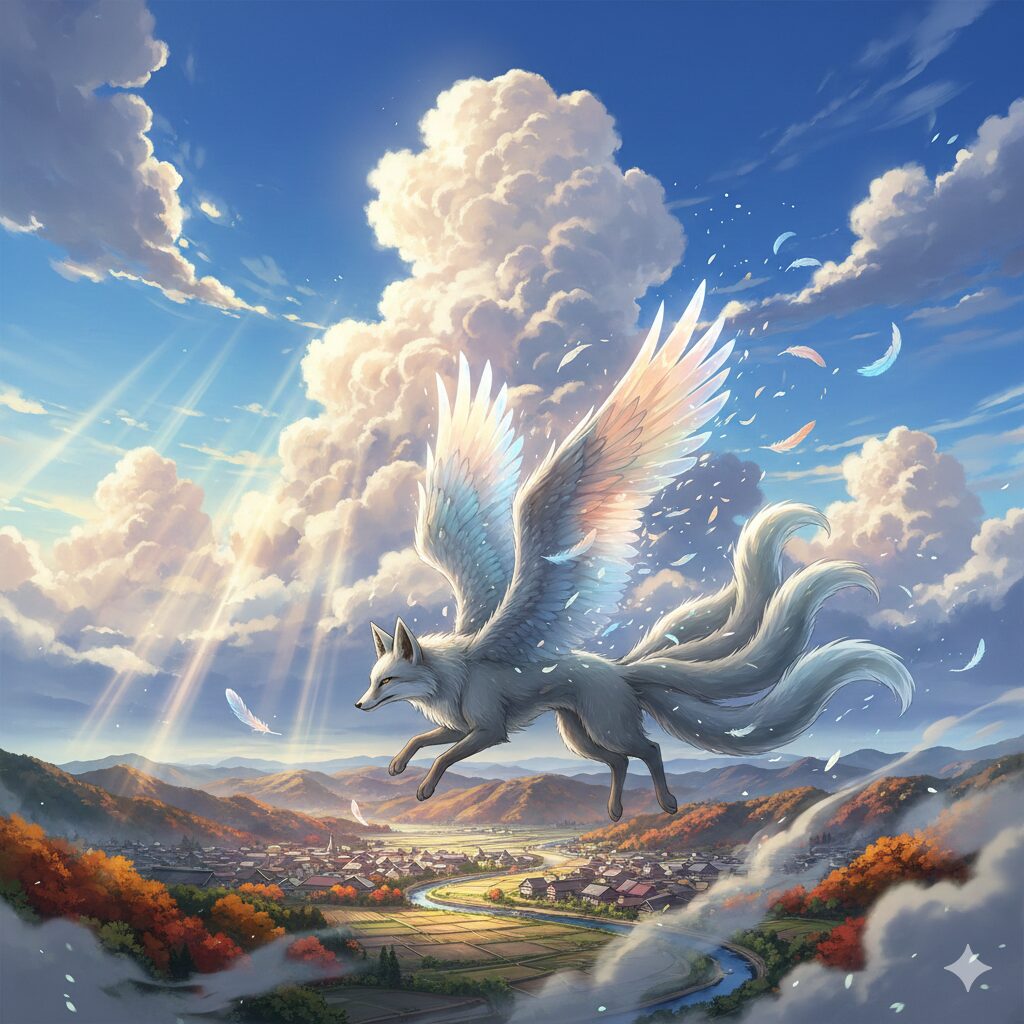
In Japanese folklore, the Fox (Kitsune) is far more than a simple wild animal. They are messengers of the gods, tricksters who deceive humans, and sometimes, beings with emotions deeper than our own. The story I am introducing today is about a unique fox who was not satisfied with merely running through the fields and mountains. He challenged the forbidden realm: the Sky.
This story encapsulates the Japanese view of nature, the aesthetics of knowing one’s place, and the insatiable quest for the unknown.

Folktale: The Fox Who Flew (Sora wo Tonda Kitsune)
Long, long ago, deep in the mountains of Japan, lived a young fox named “Gin” (Silver). His fur was so beautiful that it shimmered like silver under the moonlight, and he was the cleverest fox in the village.
While other foxes competed to see who could steal fried tofu (Abura-age) from villagers or lead travelers astray, Gin would always sit atop a high rock, gazing up at the sky.
“Life crawling on the ground is boring,” he thought. “Surely, above those clouds, there is a magnificent world I have never seen.”
Gin’s admiration was directed at the hawks and kites that danced elegantly in the air. They spread their wings and looked down upon the mountains, riding the wind. To Gin, having his four paws bound to the ground felt unbearably restricting.
Days of Training
One day, Gin made a decision. “I will fly, too.” Ancient fox magic includes the art of transformation (Henge), usually using leaves to turn into humans. However, Gin decided to apply this art to transform into a bird.
Day after day, Gin trained under the great Ginkgo tree behind the old shrine. He placed yellow ginkgo leaves on his head and focused his mind. At first, it didn’t go well. When he tried to become a sparrow, he turned into a hairy brown lump. When he tried to become a crow, he looked like a black raccoon dog (Tanuki), and the other foxes laughed at him.
But Gin did not give up. “My heart belongs to the sky. My body will surely follow.”
The First Flight
As autumn deepened and a cold wind blew through the mountains, one morning Gin chose a particularly large, golden leaf and placed it on his head. He closed his eyes and wished strongly. He imagined becoming the wind itself.
“Doron!” (The sound of magical transformation)
With a puff of smoke, Gin’s body felt light. When he opened his eyes, his perspective was high. He had successfully transformed into a magnificent black kite (bird). Flapping his wings, his body floated effortlessly. Gin let out a cry of joy—which echoed as the sharp screech of a bird—and soared high into the sky.
Below him, the forest he lived in looked as small as a miniature garden. Humans looked like beans, and the river shone like a silver ribbon. “So this is the world of the sky! I have finally obtained freedom!”
Hubris and the Fall
For several days, Gin enjoyed his aerial journey. He saw the ocean beyond the neighboring mountains and pierced through the clouds. However, familiarity breeds carelessness. Gin gradually forgot that he was truly a fox and began to behave as if he were the king of the sky.
At one point, Gin spotted a real hawk hunting for prey. “Hmph, I can fly higher and faster than him,” Gin thought. He began to tease the hawk, diving rapidly and crossing right in front of its beak.
The enraged hawk extended its sharp talons and attacked Gin. Startled, Gin tried to flee, but he did not know how to fight in the air. In his terror, Gin instinctively tried to run using “fox movements”—kicking the air as if it were the ground.
In that instant, his concentration broke. With a “Pon!” sound, the transformation was undone.
Returning to his original form in mid-air, Gin was just a fox. He had no wings. Obeying gravity, he fell headfirst. “Help me!” he screamed, crashing through the branches of the forest trees, finally landing with a heavy thud into a deep pile of fallen leaves.
Fortunately, the thick leaves and branches acted as a cushion, and Gin survived. However, his body was covered in bruises. Dragging his painful legs, Gin smelled the scent of the soil.
“Ah, the smell of the earth. What a comforting scent.”
Gin realized a profound truth. The sky is a beautiful place, but he belonged to the earth. He remembered the joy of feeling the ground firmly beneath his own feet.
From then on, Gin no longer looked up at the sky with envy. Instead, he became respected by his peers as the fox who could run through the mountains faster than anyone else.
Analysis: The Limits of Transformation and Identity
The story of “The Fox Who Flew” holds deep meaning beyond a simple tale of failure.
1. Innovation and Risk
Gin was an innovator who wasn’t satisfied with the traditional “way of the fox” and tried to pioneer a new realm (the sky). His effort and success are worthy of praise. However, the cause of his failure was not a lack of skill, but “forgetting his essence” and “hubris.”
2. The False Self vs. The True Self
While transformed into a bird, Gin was free, but it was a freedom based on a “false form.” The scene where he instinctively moved like a fox when attacked suggests that no matter how much we disguise ourselves, our true nature reveals itself in critical situations.
Cultural Perspective: Knowing One’s Place and Harmony
From this story, we can interpret unique aspects of Japanese spirituality.
Knowing Your “Bun” (Role)
In Japan, there is a concept called Bun-sou-ou (behaving according to one’s status or capacity). This virtue emphasizes knowing one’s abilities and place. The story can be seen as a warning against a fox trespassing into the bird’s domain. However, it is also a distinctly Japanese story of “return”—rediscovering the value of one’s original world (the earth) after experiencing the outside world (the sky).
Longing for the Other Realm
In Japanese folktales, the sky, the sea, and lands beyond the mountains are often depicted as “other worlds.” It is possible to visit them, but one cannot stay for long. Gin’s survival suggests that he still belonged to this world.
References
If you want to learn more about Japanese Yokai and Fox legends, please check out the category below:
Japanese Folktale Series
Also, for general information on fox folklore, the following site is helpful:
Wikipedia – Kitsune
A Question for You
Gin’s adventure resonates with us in the modern world.
Are you satisfied with your current environment? Or, like Gin, do you wish to fly into a new world (the sky) even if it means taking risks?
If you were Gin, how would you have reacted when attacked by the hawk? would you have fought as a bird, or decided to return to the ground sooner?
I invite you to think about what the “sky” represents in your own life.
はじめに:日本の空に憧れた、ある狐の物語
日本の伝説において、狐(キツネ)は単なる野生動物ではありません。彼らは神の使いであり、人を化かすトリックスターであり、時には人間以上の情動を持つ存在として描かれます。今回ご紹介するのは、野山を駆けるだけでは満足できず、禁断の領域である「空」に挑んだ一匹の狐の物語です。
この物語には、日本人の自然観、身の程を知ることの美学、そして未知への飽くなき探求心が凝縮されています。
昔話:空を飛んだ狐(そらをとんだきつね)
むかしむかし、ある深い山奥に、「ギン」という名の若い狐が住んでいました。ギンの毛並みは、月の光を浴びると銀色に輝くほど美しく、村一番の知恵者でもありました。
他の狐たちが、いかにして村人から油揚げを盗むか、いかにして旅人を迷わせるかを競い合っている中、ギンだけはいつも高い岩の上に座り、空を見上げていました。
「地を這うだけの生活は退屈だ。あの雲の上には、きっと見たこともない素晴らしい世界があるに違いない」
ギンの憧れは、空を優雅に舞うトンビや鷹に向けられていました。彼らは翼を広げ、風に乗って山々を見下ろしています。ギンは、自分の四本の足が地面に縛り付けられていることが、たまらなく不自由に思えたのです。
修行の日々
ある日、ギンは決意しました。「俺も空を飛んでやる」と。古くから伝わる狐の妖術の中に、木の葉を使って姿を変える術があります。通常、それは人間に化けるために使われますが、ギンはその術を応用し、鳥に化けようと考えたのです。
ギンは来る日も来る日も、神社の裏手にある大イチョウの木の下で修行に励みました。頭に黄色く色づいたイチョウの葉を乗せ、意識を集中させます。しかし、最初はうまくいきません。スズメになろうとすれば毛むくじゃらの茶色い塊になり、カラスになろうとすれば黒い狸のような姿になってしまい、仲間の狐たちからは笑い者にされました。
それでもギンは諦めませんでした。「俺の心は空にある。体は後からついてくるはずだ」と信じ続けました。
初めての飛翔
秋が深まり、冷たい風が山を吹き抜けるある朝のこと。ギンはひときわ大きな黄金色の葉を選び、頭に乗せました。そして、目を閉じて強く念じました。自分が風そのものになるイメージを。
「ドロン!」
煙と共に、ギンの体は軽くなりました。目を開けると、視線が高いのです。彼は見事、一羽の大きなトンビに姿を変えていました。翼を羽ばたかせると、体がふわりと浮き上がります。ギンは歓喜の声を上げ(それはトンビの鋭い鳴き声となって響きました)、空高く舞い上がりました。
眼下には、いつも住んでいる森が箱庭のように小さく見えます。人間たちは豆粒のようで、川は銀色のリボンのように輝いていました。 「これが空の世界か! 俺はついに自由を手に入れたんだ!」
慢心と墜落
数日間、ギンは空の旅を楽しみました。隣の山の向こう側にある海を見たり、雲の中を突き抜けたりしました。しかし、慣れとは恐ろしいものです。ギンは次第に、自分が本当は狐であることを忘れ、空の王者であるかのように振る舞い始めました。
ある時、ギンは本物の鷹が獲物を探して飛んでいるのを見つけました。 「ふん、俺の方がもっと高く、もっと速く飛べるさ」 ギンはその鷹をからかうように、急降下したり、目の前を横切ったりしました。
怒った鷹は、鋭い爪を立ててギンに襲いかかりました。驚いたギンは逃げようとしましたが、空での戦い方は知りません。恐怖のあまり、ギンはとっさに「狐の走り方」で空を蹴って逃げようとしました。
その瞬間、集中が途切れました。 「ポン!」という音と共に、変化(へんげ)が解けてしまったのです。
空中で元の姿に戻ったギンは、ただの狐です。翼はありません。重力に従い、真っ逆さまに落ちていきました。 「助けてくれ!」と叫びながら、ギンは森の木々の枝にバサバサとぶつかり、最後は深い落ち葉の山にズドンと埋まりました。
地にある幸せ
幸いなことに、厚い落ち葉と枝がクッションとなり、ギンは命拾いしました。しかし、体中はあざだらけ。痛む足を引きずりながら、ギンは地面の土の匂いを嗅ぎました。
「ああ、土の匂いだ。なんて安心する匂いなんだろう」
ギンは悟りました。空は美しい場所だが、自分には帰るべき大地があるのだと。そして、自分の足で大地をしっかりと踏みしめて走ることの喜びを思い出したのです。
それ以来、ギンは空を見上げても、羨むことはなくなりました。代わりに、彼は誰よりも速く山を駆け抜ける狐として、仲間たちから尊敬されるようになったといいます。
物語の考察:変化(へんげ)の限界とアイデンティティ
この「空を飛んだ狐」の物語は、単なる失敗談以上の深い意味を持っています。
1. イノベーションとリスク
ギンは、従来の「狐の生き方(人を化かす、盗む)」に満足せず、新しい領域(空)を開拓しようとしたイノベーターでした。彼の努力と成功は称賛に値します。しかし、彼の失敗の原因は技術不足ではなく、「本質の忘却」と「慢心」でした。
2. 偽りの自分と本当の自分
鳥に化けている間、ギンは自由でしたが、それは「偽りの姿」による自由でした。鷹に襲われたとき、とっさに狐の動きが出てしまったシーンは、どんなに取り繕っても、危機的状況では「本性」が現れることを示唆しています。
日本文化の視点:分相応と自然との調和
この物語から、日本独自の精神性を読み解くことができます。
「分(ぶん)」を知る
日本には「分相応(ぶんそうおう)」という言葉があります。これは、自分の能力や立場をわきまえ、それにふさわしい振る舞いをすることを美徳とする考え方です。物語は、狐が鳥の領分を侵したことへの戒めとも取れますが、同時に、一度外の世界(空)を知ったことで、元の世界(大地)の良さを再発見するという、日本的な「回帰」の物語でもあります。
異界への憧れ
日本の民話では、空や海、山の向こう側はしばしば「異界」として描かれます。そこへ行くことは可能ですが、長居はできません(浦島太郎などが良い例です)。ギンが生還できたのは、彼がまだこちらの世界に属していたからでしょう。
参考リンク
日本の妖怪や狐の伝説についてさらに詳しく知りたい方は、以下のカテゴリーもご覧ください。
Japanese Folktale Series – 日本の昔話カテゴリー
また、一般的な狐の伝承については、以下のサイトも参考になります。
Wikipedia – キツネ (妖怪)
読者への問いかけ
ギンの冒険は、私たち現代人にも通じるものがあります。
あなたは、今の自分の環境に満足していますか? それとも、ギンのようにリスクを冒してでも、新しい世界(空)へ飛び出してみたいと思いますか?
もしあなたがギンなら、鷹に襲われたとき、どう対処したでしょうか。そのまま鳥として戦い抜いたでしょうか、それとももっと早く地上へ戻る決断をしたでしょうか。
あなたの人生における「空」とは何なのか、ぜひ考えてみてください。


コメント