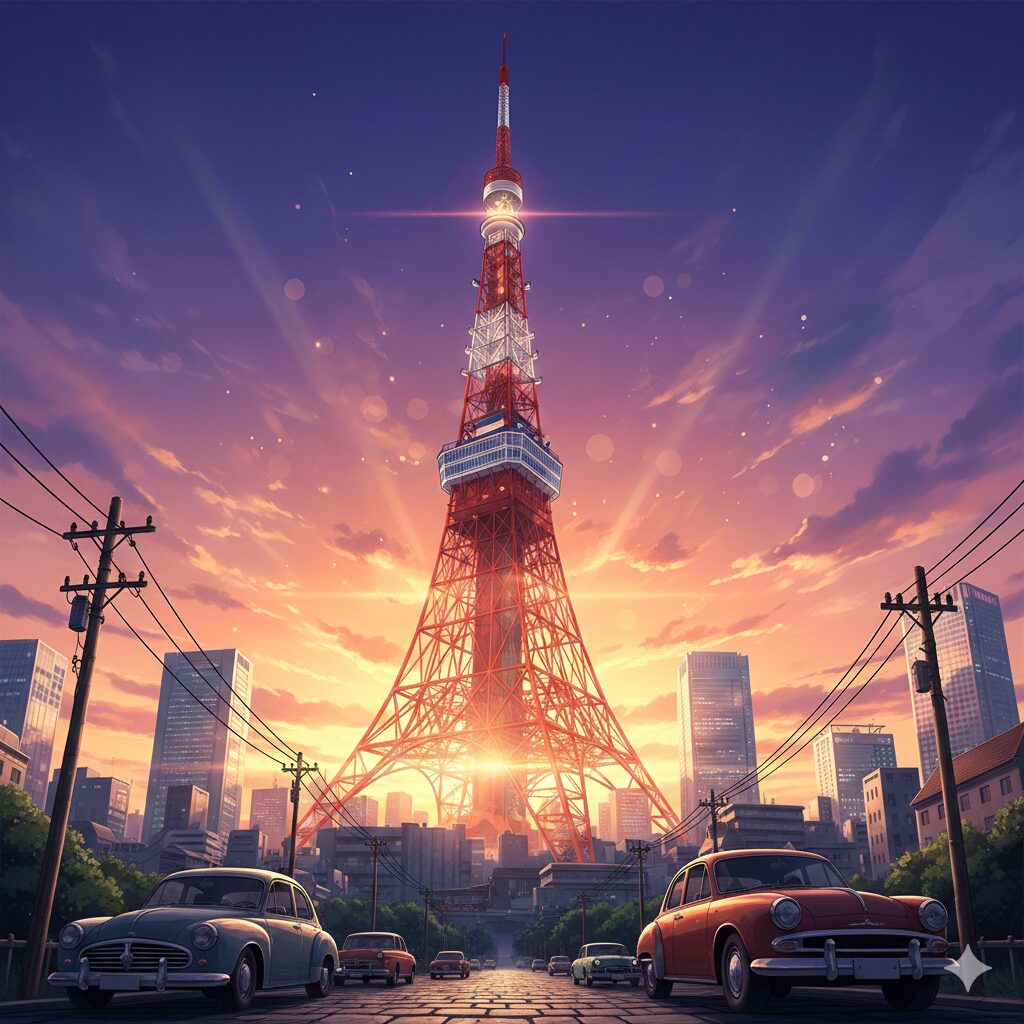
In this article, we will go beyond the guidebooks. We will explore the human drama behind its construction, the intense energy of the “Showa” era ingrained in the Japanese psyche, and why, even in the age of modern skyscrapers, this retro tower remains the beloved heart of the city.

1. December 23, 1958: The Day Tokyo’s Sky Changed
Rising from the Ashes to the Clouds
Only 13 years had passed since the end of World War II. Tokyo, once a burnt-out ruin, was recovering at a furious pace. However, as television broadcasting expanded, the city faced a problem: individual broadcasting stations were building their own towers, creating a chaotic skyline and posing risks to aviation safety. The solution was a master plan to build a single “Comprehensive Radio Tower” to handle signals for the entire region.
“Build the world’s tallest tower.” This ambition ignited the souls of Japanese engineers. The height of 333 meters—surpassing the Eiffel Tower’s 312 meters at the time—was not chosen merely to break a record. It was a precise calculation necessary to transmit radio waves across the entire Kanto region.
The Legend of the “Tobi” Workers
This was an era before computer-controlled heavy machinery. The construction of Tokyo Tower was a masterpiece of human craftsmanship. The steelworkers, known as “Tobi,” became legends. They walked on narrow steel beams hundreds of meters in the air without safety harnesses. They would heat rivets until they were red-hot, toss them through the air, and catch them with ladles to hammer them into place. It was a death-defying circus act performed high above the city.
The construction took only a year and a half. A total of 220,000 workers were involved, completing the project at a miraculous speed. This velocity was a testament to the momentum of Japan during that era.
2. The Secret of “International Orange”
When you think of Tokyo Tower, you envision its striking red and white two-tone color. Technically, the red is “International Orange.” This color scheme wasn’t a design choice but a legal requirement under the Civil Aeronautics Act to serve as an obstacle mark for aircraft.
Originally, the bands of color were narrower, but following legal revisions, the tower now features the iconic seven-section design (Orange-White-Orange-White-Orange-White-Orange). This color ensures that even against Japan’s often cloudy winter skies, the tower asserts its presence, serving as a “color of life” that guides pilots safely.
3. Why We Still Love Tokyo Tower in the Age of Skytree
In 2012, the Tokyo Skytree (634 meters) was completed, taking over the role of the primary broadcasting tower. Logically, Tokyo Tower should have become a relic of the past. Yet, the reality is quite the opposite. Its retro-futuristic beauty and warm orange illumination continue to captivate hearts more than ever.
Nostalgia for “Sunset on Third Street”
As depicted in the famous Japanese movie ALWAYS: Sunset on Third Street, the Tokyo Tower under construction was a symbol of “hope for tomorrow” for the Japanese people of that time. It was the era when the song “Sukiyaki” (Ue o Muite Arukou) topped the charts; people looked up, and there was always the Tower.
If Skytree represents a sophisticated “Future,” Tokyo Tower symbolizes “Warmth” and “Home.” Especially on cold winter nights, seeing the tower glowing in warm colors gives many Japanese people an indescribable sense of comfort.
The Legend of the Lights Down
There is a famous urban legend among lovers in Tokyo: “Couples who watch the moment the Tokyo Tower’s lights are turned off at midnight together will be happy forever.” Because of this myth, parks and restaurants with a view of the tower are filled with couples just before 12:00 AM. Finding romance in a giant steel structure is perhaps a unique aspect of modern Japanese culture.
4. Conclusion: What the Steel Tower Teaches Us
December 23rd, the Completion of Tokyo Tower Day. This is not just the birthday of a structure. It is a day to honor the “indomitable spirit” of a people who rose from the scars of war to reach for the sky. Packed into this 333-meter mass of steel are the sweat of 220,000 artisans and the dreams of millions who looked up at it.
In a modern world where digitalization is accelerating and virtual spaces like the Metaverse are expanding, the physical, overwhelming presence of Tokyo Tower teaches us the “weight of reality” and the continuity of history.
A Question for You
After reading this, have you thought about the landmarks in your own country and the history or stories they hold? And if you were to visit Tokyo, which would you want to climb first: the cutting-edge Skytree or the historic Tokyo Tower?
Please share your thoughts or your country’s iconic buildings on social media. Knowing the history makes the view from the top even more vivid.
References & Related Links
12月23日。日本中がクリスマスムードに包まれるこの時期、東京のシンボルにとっても特別な一日であることをご存知でしょうか。1958年(昭和33年)のこの日、東京タワーが完工し、正式に開業しました。高さ333メートル。自立式鉄塔としては当時世界一の高さを誇り、戦後日本の復興と経済成長の象徴として、その赤い鉄骨は東京の空に突き刺さりました。
この記事では、単なる観光地としての東京タワーではなく、その建設背景にあるドラマ、日本人の心に刻まれた「昭和」という時代の熱量、そして現代においても色褪せないその文化的意義について、深く掘り下げていきます。
1. 1958年12月23日:東京の空が変わった日
廃墟からの復興、そして空へ
第二次世界大戦の終結からわずか13年。焼け野原だった東京は、猛烈な勢いで復興を遂げていました。しかし、当時の東京は放送事業の拡大に伴い、各放送局が独自に建設した電波塔が乱立し、都市景観や航空安全上の問題が発生していました。これを解決するために計画されたのが、各局の電波を一手に引き受ける「総合電波塔」の建設です。
「世界一の塔を作る」。その野望は、技術者たちの魂に火をつけました。エッフェル塔(312メートル・当時)を超える333メートルという数字は、単なる記録更新のためではありません。関東一円に電波を送るために計算され尽くした必然の高さだったのです。
333メートルに込められた職人魂「鳶(とび)」の伝説
現代のようなコンピューター制御の建設重機がなかった時代です。東京タワーの建設は、まさに「職人の技」の結晶でした。特に、高所で鉄骨を組む「鳶(とび)」職人たちの活躍は伝説となっています。命綱なしで細い鉄骨の上を歩き、真っ赤に焼けたリベット(接合用の鋲)を空中で放り投げ、空中でキャッチして打ち込む。まるでサーカスのような光景が、地上数百メートルの高さで繰り広げられたのです。
工期はわずか1年半。のべ22万人の職人が携わり、奇跡的なスピードで完成に至りました。このスピード感こそが、当時の日本が持っていた「勢い」そのものでした。
2. インターナショナルオレンジと航空法の秘密
東京タワーといえば、あの鮮やかな赤と白のツートンカラーを思い浮かべるでしょう。正確には「インターナショナルオレンジ」と「白」です。これはデザイン上の理由ではなく、航空法によって定められた「昼間障害標識」としての役割を果たしています。
当初はもっと細かい間隔で塗り分けられていましたが、法律の改正に伴い、現在のような7等分(赤・白・赤・白・赤・白・赤)のデザインになりました。この色は、曇り空の多い日本の冬空でも、はっきりとその存在を主張し、飛行機のパイロットに位置を知らせるための「命の色」なのです。
3. スカイツリーができても、なぜ私たちは東京タワーを愛するのか
2012年に東京スカイツリー(634メートル)が完成し、主要な電波塔としての役割は譲渡されました。論理的に考えれば、東京タワーは「過去の遺産」になるはずです。しかし、現実は違います。むしろ、そのレトロフューチャーな美しさと、温かみのあるオレンジ色のライトアップは、今なお多くの人々を惹きつけてやみません。
「ALWAYS 三丁目の夕日」に見る原風景
映画『ALWAYS 三丁目の夕日』で描かれたように、建設中の東京タワーは、当時の日本人にとって「明日への希望」そのものでした。「上を向いて歩こう」という歌が流行した時代、見上げる先には常に東京タワーがありました。
スカイツリーが洗練された「未来」の象徴だとすれば、東京タワーは私たちの「体温」や「帰る場所」を象徴しています。特に冬の夜、寒空の下で暖色に輝くタワーを見ると、多くの日本人が言いようのない安らぎを感じるのです。
ライトダウン伝説
恋人たちの間では有名な都市伝説があります。「深夜0時、東京タワーのライトアップが消える瞬間を一緒に見たカップルは永遠に幸せになれる」。この伝説のおかげで、深夜0時前になるとタワーの見える公園やレストランには多くのカップルが集まります。巨大な鉄塔にロマンスを見出す感性もまた、日本独自のものかもしれません。
4. 結論:鉄の塔が教えてくれること
12月23日、東京タワー完工の日。この日は単なる建築物の誕生日ではありません。戦争の傷跡から立ち上がり、空を目指した人々の「不屈の精神」を称える日です。333メートルの鉄の塊には、22万人の職人の汗と、それを見上げて夢を描いた数千万人の日本人の想いが詰まっています。
デジタル化が進み、メタバースなどの仮想空間が広がる現代において、圧倒的な質量を持ってそこに在り続ける東京タワーの存在感は、私たちに「現実の重み」と「歴史の連続性」を教えてくれます。
あなたへの問いかけ
この記事を読んで、あなたは自身の国のランドマークにどのような歴史や物語があるか、思いを馳せたことはありますか?また、あなたが東京を訪れるなら、最新のスカイツリーと、歴史ある東京タワー、どちらに先に登ってみたいと思いましたか?
ぜひ、あなたの国の象徴的な建物や、この記事の感想をSNSでシェアしてください。歴史を知ることで、旅の景色はもっと鮮やかになるはずです。
コメント