
1. The Story of “Nise Honzon” (The Counterfeit Buddha)
Once upon a time, in a dilapidated temple deep in the mountains, there lived a mischievous Tanuki (raccoon dog). This was no ordinary animal; it was an old Tanuki skilled in the art of shape-shifting.
One day, a hunter from the village entered the mountain with his gun. “Today is the day I catch that old Tanuki and make Tanuki soup,” he declared. The Tanuki ran for his life, but eventually, he was cornered and fled into the main hall of the ruined temple where he lived.
“If I stay here, I’ll be shot!”
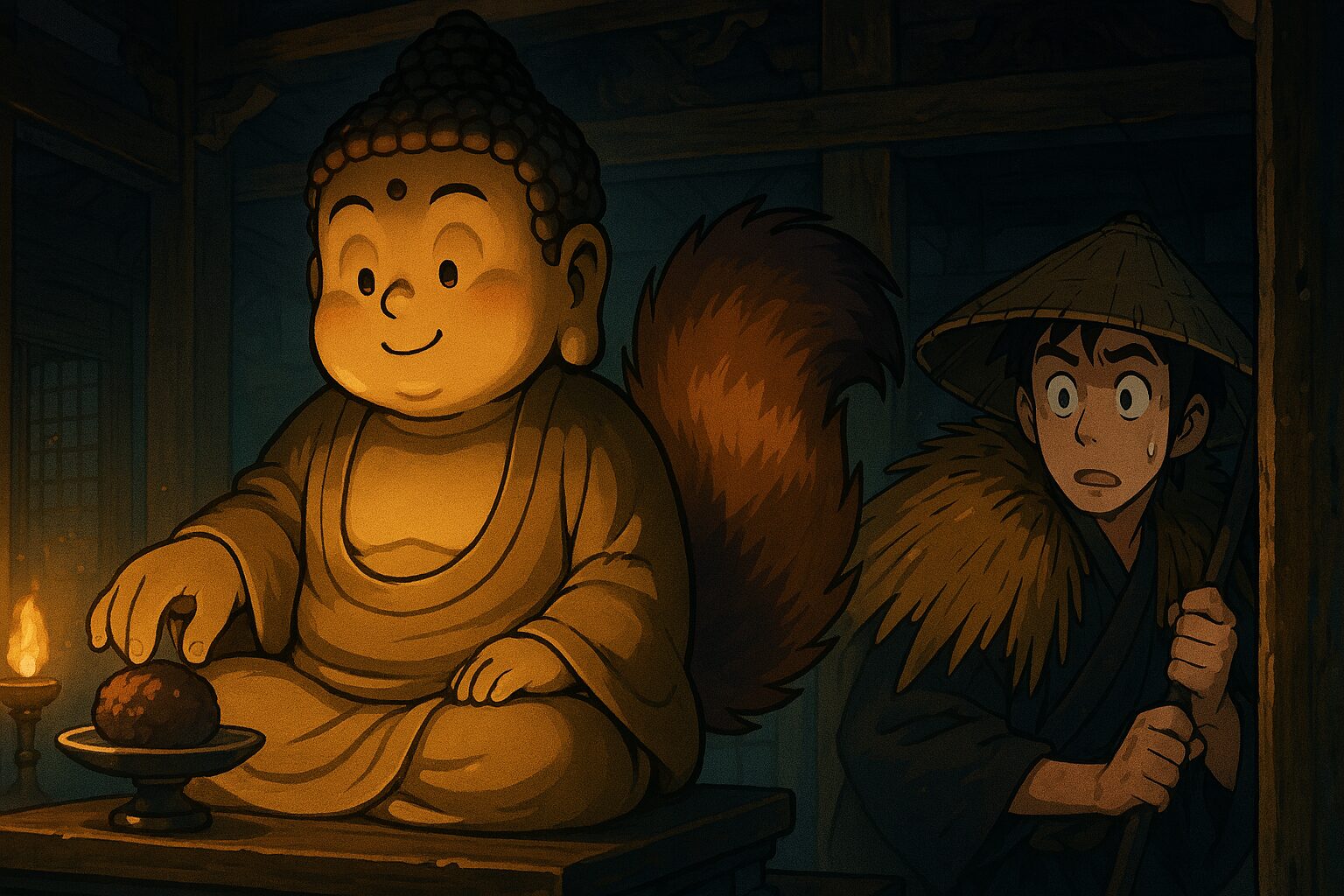
The Tanuki racked his brains. In this temple, there was a pedestal where the main image of Buddha (Honzon) usually sat, but it was currently away for repairs. In a split second, the Tanuki jumped onto the pedestal and, amidst a puff of smoke, transformed himself into the figure of “Amida Nyorai” (Amitābha Tathāgata).
The hunter, entering moments later, was astonished to see the golden Buddha statue sitting in the main hall. “Oh? The main image that was supposed to be out for repairs has returned. How grateful I am.” The hunter was a pious man. He put down his gun, prostrated himself on the spot, and pressed his hands together in prayer.
“Namu Amida Butsu, Namu Amida Butsu…” (I take refuge in Amitābha Buddha…)
As the hunter chanted fervently, the Tanuki felt a sense of relief and let his guard down. Moreover, the hunter took out a “Botamochi” (sweet rice cake with red bean paste) meant for his lunch and placed it as an offering right in front of the statue. The sweet scent tickled the Tanuki’s nose.
While the hunter bowed his head with his eyes closed, the Buddha (Tanuki) reached out one hand, grabbed a Botamochi, and threw it into his mouth. However, when the hunter looked up, there was red bean paste on the Buddha’s mouth. “Huh? Does the Buddha eat bean paste…?”
Suspicious, the hunter pretended to fall asleep (playing possum). Thinking the coast was clear, the Buddha reached for the remaining rice cakes and, unable to contain his excitement, accidentally let his large bushy tail pop out.
“You ungrateful Tanuki!”
The hunter jumped up. Startled, the Tanuki reverted to his original form and scrambled back into the depths of the mountains. The hunter smiled wryly, “To survive by borrowing the form of the Buddha… I can’t bring myself to hate him.” He lowered his gun and returned to the village.
2. Analysis: Why Could the Tanuki Become a Buddha?
At first glance, this story is a slapstick comedy, but a deeper look reveals the spirituality of the Japanese people.
The Boundary Between the Sacred and the Profane
In Western religious views, demons or animals taking the form of a holy deity is often strictly condemned as “blasphemy.” However, in Japanese folktales, there are many stories of Tanuki and Kitsune (foxes) shape-shifting into Buddhas or monks, and these are often accepted with a sense of charm.
This reflects a mixture of Animism—the belief that “gods dwell in all things” (Yaoyorozu no Kami)—and the tolerance of Buddhism. The ending, where the hunter realizes it is a Tanuki but lets it go, suggests that his respect for “something in the form of Buddha” and admiration for the creature’s survival wisdom outweighed his anger at being tricked.
Desire as a Weakness
The reason the Tanuki revealed his true identity was his “appetite.” The lesson is that no matter how noble a form one assumes (Buddha), one cannot hide their inner instincts (appetite). This is also a satire on human society. Even those who wear impressive titles or clothes reveal their true nature in unguarded moments. This story preaches the difficulty and importance of seeing through appearances to the essence.
3. Decoding Japanese Culture: The Relationship Between Tanuki and Humans
The keyword to understanding Japanese culture from “Nise Honzon” is the humor of the Tanuki.
Tanuki as a Trickster
The Japanese Tanuki (Raccoon Dog) is a real animal but also holds a place as a Yokai (spirit/monster). While foxes are depicted as “wise and slightly scary,” Tanuki are “clumsy and somewhat lovable.” The reason there are so many ceramic Tanuki statues in front of Japanese restaurants is a pun on “Ta-nuki” (surpassing others/prospering in business), but also a symbol of humor to put customers at ease.
Familiarity with the Honzon (Buddha Image)
Japanese people feel a sense of familiarity, not just awe, towards Buddha statues. The title “Nise Honzon” (Fake Main Image) itself contains a sophisticated playfulness that makes the object of worship a subject of a joke. In traditional performing arts like Rakugo and Kyogen, plays satirizing monks and Buddhist rituals are popular. This is not a lack of faith, but proof of a “mature culture” where faith is so integrated into daily life that it can be the subject of laughter.
4. What Would You Do?
If you were praying in a quiet temple and the Buddha statue in front of you started moving and eating the offerings, what would you do?
- Would you run away in fear?
- Would you think it was a miracle and pray even deeper?
- Or, like this hunter, would you see through the disguise and laugh it off?
In modern society, we are surrounded by many “Nise Honzon”—fake news, edited images, and pretentious authority. This Tanuki’s story might be teaching us the importance of having eyes to discern the truth of information, and perhaps, the leeway to laugh and enjoy even the lies.
Does your country have folktales where animals transform into gods or holy beings? Please reflect on what you felt after reading this story.
Related Links
- Japanese Raccoon Dog (Tanuki) – Wikipedia (Cultural background of the Tanuki)
- Japanese Folktale Series – Kiri53.com (Read more Japanese folktales)
日本の田舎の静寂の中に、ユーモアと信仰が交差する不思議な物語が隠されています。今回ご紹介するのは、「にせ本尊(Nise Honzon)」というお話です。これは単なる笑い話ではありません。日本人が持つ「信仰の形」と、自然界への親しみが融合した、非常に日本的な寓話です。
1. 昔話「にせ本尊」のあらすじ
むかしむかし、ある山奥の荒れ寺に、一匹のいたずら好きなタヌキが住んでいました。このタヌキはただの動物ではなく、人や物に化けるのが得意な古狸でした。
ある日、村の猟師が鉄砲を持って山に入ってきました。「今日こそあの古狸を仕留めて、狸汁にしてやる」と息巻いています。タヌキは必死に逃げ回りましたが、ついに追い詰められ、自分の住処である荒れ寺の本堂へと逃げ込みました。
「このままでは撃たれてしまう!」
タヌキは知恵を絞りました。この寺には、修理に出されていて本尊(仏像)が不在の台座がありました。タヌキはとっさにその台座の上に飛び乗ると、煙とともに「阿弥陀如来(あみだにょらい)」の姿に化けたのです。
遅れて入ってきた猟師は、本堂に鎮座する金色の仏像を見て驚きました。「おや? 修理に出したはずのご本尊様が戻っておられる。なんとありがたいことだ」。猟師は信心深い男でもありました。彼は鉄砲を置き、その場に平伏して手を合わせました。
「南無阿弥陀仏、南無阿弥陀仏…」
猟師が熱心にお経を唱えていると、タヌキは少し安心して気が緩んでしまいました。しかも、猟師が懐からお昼ご飯用の「牡丹餅(ぼたもち)」を取り出し、お供えとして目の前に置いたのです。甘い匂いがタヌキの鼻をくすぐります。
猟師が頭を下げて目を閉じている隙に、仏像(タヌキ)は片手を伸ばして牡丹餅を一つ掴み、口に放り込みました。しかし、猟師がふと顔を上げると、仏像の口元にあんこがついています。「はて? 仏様があんこを召し上がるとは…」
不審に思った猟師は、わざと狸寝入り(眠ったふり)をしました。すると、仏像は「しめしめ」とばかりに、残りの牡丹餅に手を伸ばし、さらには我慢できずに大きなしっぽを出してしまいました。
「この罰当たりなタヌキめ!」
猟師が飛び起きると、タヌキは驚いて元の姿に戻り、あわてて山奥へと逃げていきました。猟師は苦笑いしながら、「仏の姿を借りて命拾いするとは、憎めないやつだ」と鉄砲を収め、村へ帰っていったといいます。
2. 考察:なぜタヌキは仏になれたのか?
この物語は、一見すると単なるドタバタ喜劇ですが、深く考察すると日本人の精神性が見えてきます。
聖なるものと俗なるものの境界線
西洋の宗教観において、悪魔や動物が神聖な神の姿をとることは「冒涜」として厳しく断罪される傾向があります。しかし、日本の昔話では、タヌキやキツネが仏や僧侶に化ける話が数多く存在し、それらはどこか愛嬌をもって受け入れられています。
ここには、「万物に神が宿る(八百万の神)」というアニミズム的な下地と、仏教の寛容さが混ざり合っています。猟師がタヌキだと気づいても殺さずに見逃した結末は、化かされたことへの怒りよりも、「仏の姿をしたもの」に対する敬意や、生きるための知恵に対する称賛が勝ったことを示唆しています。
欲望という弱点
タヌキが正体を現してしまった原因は「食欲」でした。どれほど崇高な姿(仏)を装っても、内面にある本能(食欲)は隠せないという教訓です。これは人間社会への風刺でもあります。立派な肩書きや衣服をまとっていても、ふとした瞬間にその人の本性が現れる。この物語は、外見に惑わされず、本質を見抜くことの難しさと重要性を説いています。
3. 日本文化を読み解く:タヌキと日本人の関係
「にせ本尊」から読み取れる日本文化のキーワードは「他力本願」ならぬ「狸(他)力」のユーモアです。
タヌキ(Tanuki)というトリックスター
日本のタヌキ(Raccoon Dog)は、実在する動物でありながら、妖怪としての側面も持ちます。キツネが「知恵があり、少し怖い」存在として描かれるのに対し、タヌキは「間が抜けていて、どこか憎めない」存在です。日本の飲食店の前に信楽焼のタヌキの置物が多いのは、「他を抜く(商売繁盛)」という語呂合わせとともに、客を和ませるユーモアの象徴だからです。
仏像(Honzon)への親しみ
日本人は仏像に対して、畏怖だけでなく親しみを持ちます。「にせ本尊」というタイトル自体が、信仰対象をネタにするという高度な遊び心を含んでいます。落語や狂言などの伝統芸能でも、僧侶や仏教儀式を風刺する演目は人気があります。これは信仰心がないのではなく、信仰が生活の一部として完全に溶け込んでいるからこそ、笑いの対象にできるという「成熟した文化」の証左と言えるでしょう。
4. あなたならどうしますか?
もし、あなたが静かな寺院で祈りを捧げているとき、目の前の仏像が動き出し、お供え物を食べ始めたらどうしますか?
- 恐怖を感じて逃げ出しますか?
- 奇跡だと思って、さらに深く祈りますか?
- それとも、この猟師のように、その正体を見破って笑って許しますか?
現代社会においても、私たちは多くの「にせ本尊」―つまり、フェイクニュースや加工された画像、見せかけの権威―に囲まれています。このタヌキの物語は、情報の真偽を見抜く目を持つこと、そして時にはその嘘さえも笑って楽しむ余裕を持つことの大切さを教えてくれているのかもしれません。
あなたの国の民話にも、神様や聖なるものに化ける動物の話はありますか?ぜひ、この物語を読んで感じたことを心の中で反芻してみてください。
関連リンク
- Japanese Raccoon Dog (Tanuki) – Wikipedia (英語:タヌキの文化的背景について)
- Japanese Folktale Series – Kiri53.com (もっと日本の昔話を読む)

コメント