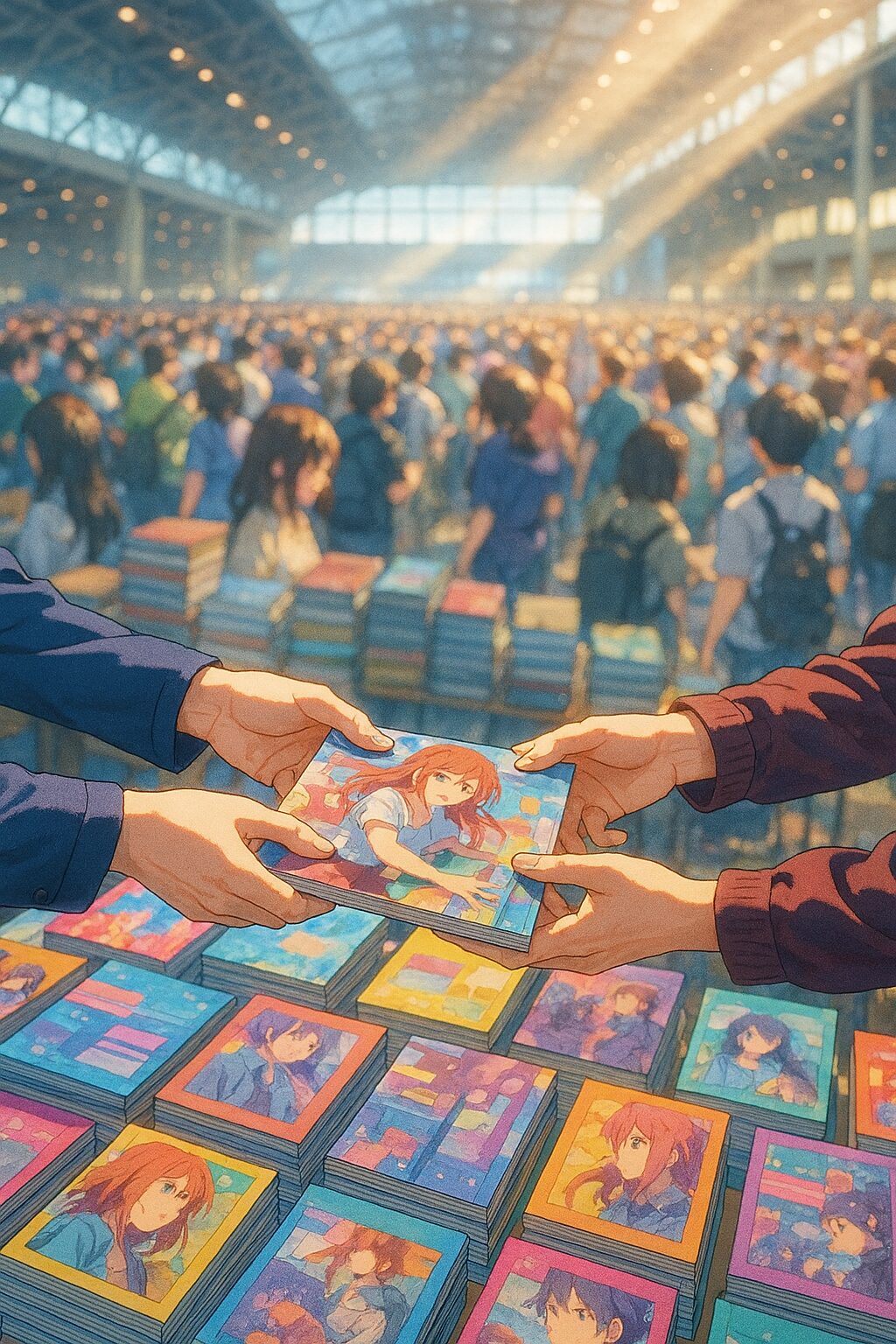
December 21, 1975. It is no exaggeration to say that there is no more significant date in the history of Japanese subculture. In a small conference room at the “Japan Fire Industry Hall” in Toranomon, Tokyo, an event opened quietly but with intense fervor.
This was the First Comic Market (Comiket).
Today, Comiket is known as the world’s largest Doujinshi (fan-made publication) fair, mobilizing hundreds of thousands of people. However, its beginning was humble, with only 32 participating circles and about 700 attendees in total. Yet, this very day marks the singularity where Japanese “Otaku culture” shifted from passive consumption to active creation.

Part 1: December 21, 1975 – A Detailed Record
Why Did Comiket Start?
In the mid-1970s, the Japanese anime and manga industry was undergoing a major transformation. With the boom of Space Battleship Yamato, anime, previously considered only for children, began to be recognized as a medium worthy of appreciation by “young adults.”
At that time, members centered around the late Yoshihiro Yonezawa, representative of the manga critique group “Meikyu” (Labyrinth), sought a place for free expression unbound by the constraints of the existing manga market or commercial magazines. They wanted to create a space to publish experimental works that wouldn’t fit a commercial base, fan parodies (secondary creations), and critiques, and to interact directly with readers. This was the founding purpose of Comiket.
The Atmosphere of the First Event
The first Comiket was not held in a massive exhibition center like the current Tokyo Big Sight, but in a small conference room. According to testimonies from participants at the time, the venue was filled with an enthusiasm akin to a “secret society of those who love manga.”
What is noteworthy is the philosophy behind it. “Manga fans are not just consumers. Anyone can be a creator.” This ideology was clearly present even in the trial-and-error phase of its dawn.
Part 2: Decoding Japan’s Unique “Co-Creation” Culture Through Comiket
There Are No “Customers”
Comiket has an iron rule that does not exist in other Japanese service industries. That is the principle that “all participants are equal.”
Circles (sellers), general attendees (buyers), and staff (organizers/volunteers). All are referred to as “participants.” The Japanese business custom that “the customer is god” does not apply here. Buyers are required to have a high level of “participation awareness” and manners, such as patience in queuing under extreme heat or cold, cooperation for smooth alignment, and preparing small change. This unique sense of solidarity sublimates Comiket from a mere flea market into a “festival” (Hare-no-hi).
The Disappearance of the Boundary Between Pro and Amateur
The movement that began on December 21 has had an immeasurable impact on Japan’s content industry.
- Cradle of Talent: Many creators who later gained worldwide fame, such as Yoichi Takahashi of Captain Tsubasa and the creative group CLAMP, grew from the soil of Comiket.
- The Paradox of Secondary Creation: While legally in a gray zone regarding copyright, original authors and publishers often tacitly approve (or coexist with) this massive fan activity. This has formed Japan’s unique “ecosystem” where content longevity is extended, and the market expands through synergistic effects.
As a Physical “Battlefield”
Comiket is often described as a “battlefield.” Taking the first train to the venue, walking around the vast exhibition halls, and acquiring the desired thin books (Doujinshi). This process involves physicality similar to sports. Even in the modern era where digital distribution is widespread, hundreds of thousands persist in gathering at the “site” because there is a “sharing of passion” that cannot be obtained online.
Part 3: A Question for You
Did the 700 people who gathered in that small conference room on that day in 1975 imagine that their activities would become a cultural phenomenon attracting attention from around the world 50 years later?
Comic Market is a place symbolizing freedom of expression, arguably the most chaotic yet most orderly event in the world. Here, your emotion of “liking” something is never denied.
How much risk and effort are you willing to shoulder to express your “passion”? And does your country have a creative space where professionals and amateurs mix this chaotically?
Please reflect on this in comparison to your own creative activities or your local convention culture.
Related Links
- External Official Site: Comic Market Official Website
- Category: What’s Today’s Special Day Series
12月21日:伝説の始まり。コミックマーケット(コミケ)が産声を上げた日
1975年12月21日。日本のサブカルチャー史において、これほど重要な日付は他にないと言っても過言ではありません。東京・虎ノ門にある小さな会場「日本消防会館」の会議室で、あるイベントがひっそりと、しかし熱狂的に幕を開けました。
それが第1回コミックマーケット(コミケ)です。
現在では数十万人を動員し、世界最大規模の同人誌即売会として知られるコミケですが、その始まりは参加サークルわずか32、一般参加者を含めても約700人という規模でした。しかし、この日こそが、日本の「オタク文化」が単なる受動的な消費から、能動的な創造へと転換した特異点なのです。
第1部:1975年12月21日、その詳細な記録
なぜコミケは始まったのか?
1970年代半ば、日本のアニメ・マンガ界は大きな変革期にありました。『宇宙戦艦ヤマト』のブームにより、子供向けとされていたアニメが「若者(ヤングアダルト)」の鑑賞に堪えうるメディアとして認識され始めた時期です。
当時、マンガ評論集団「迷宮」の代表であった故・米澤嘉博氏を中心とするメンバーは、既存のマンガ市場や商業誌の制約に縛られない、自由な表現の場を求めていました。商業ベースに乗らない実験的な作品や、ファンによるパロディ(二次創作)、そして評論。これらを発表し、読者と直接交流できる空間を作ること。それがコミケの設立趣旨でした。
第1回の様子
第1回コミックマーケットは、現在の東京ビッグサイトのような巨大な展示場ではなく、小さな会議室で行われました。当時の参加者の証言によれば、そこは「マンガを愛する者たちだけの秘密結社」のような熱気に包まれていたといいます。
注目すべきは、入場料です。当時はパンフレット代などの概念もまだ薄く、黎明期の試行錯誤の中にありました。しかし、そこには明確な理念がありました。「マンガファンは、単なる消費者ではない。誰もが表現者になり得る」という思想です。
第2部:コミケから読み解く日本独自の「共創」文化
「お客様」は存在しない
コミックマーケットには、日本の他のサービス業にはない鉄の掟があります。それは「参加者は全員対等である」という原則です。
サークル(売り手)、一般参加者(買い手)、スタッフ(運営)。これら全てが「参加者」と呼ばれます。「お客様は神様」という日本の商習慣は、ここでは通用しません。猛暑や極寒の中で列に並ぶ忍耐力、スムーズな整列への協力、小銭の用意など、買い手側にも高いレベルの「参加意識」とマナーが求められます。この独特の連帯感が、コミケを単なるフリーマーケットとは異なる「祝祭(ハレの日)」へと昇華させています。
プロとアマチュアの境界線の消失
12月21日に始まったこの運動は、日本のコンテンツ産業に計り知れない影響を与えました。
- 才能の揺りかご:『キャプテン翼』の高橋陽一氏や、創作集団CLAMPなど、後に世界的な名声を得る多くのクリエイターが、コミケという土壌から育ちました。
- 二次創作のパラドックス:著作権法的にはグレーゾーンにありながら、原作者や出版社がこの巨大なファン活動を黙認(あるいは共存)することで、コンテンツの寿命が延び、相乗効果で市場が拡大するという、日本独自の「エコシステム」が形成されました。
物理的な「戦場」としての側面
コミケはしばしば「戦場」と形容されます。始発列車で会場に向かい、広大な会場を歩き回り、目当ての薄い本(同人誌)を手に入れる。このプロセスはスポーツにも似た身体性を伴います。デジタル配信が普及した現代においても、数十万人が「現地」に集まることに固執するのは、そこにネットでは得られない「情熱の共有」があるからです。
第3部:あなたへの問いかけ
1975年のあの日、小さな会議室に集まった700人は、自分たちの活動が50年後に世界中から注目される文化現象になると想像していたでしょうか。
コミックマーケットは、表現の自由を象徴する場所であり、世界で最もカオスで、かつ最も秩序あるイベントです。ここでは、あなたの「好き」という感情が否定されることはありません。
あなたは、自分の「情熱」を表現するために、どれだけのリスクと労力を背負うことができますか?そして、あなたの国には、プロとアマチュアがこれほど混沌と混ざり合うクリエイティブな空間は存在しますか?
ぜひ、あなた自身の創作活動や、地元のコンベンション文化と比較して、思いを巡らせてみてください。
コメント