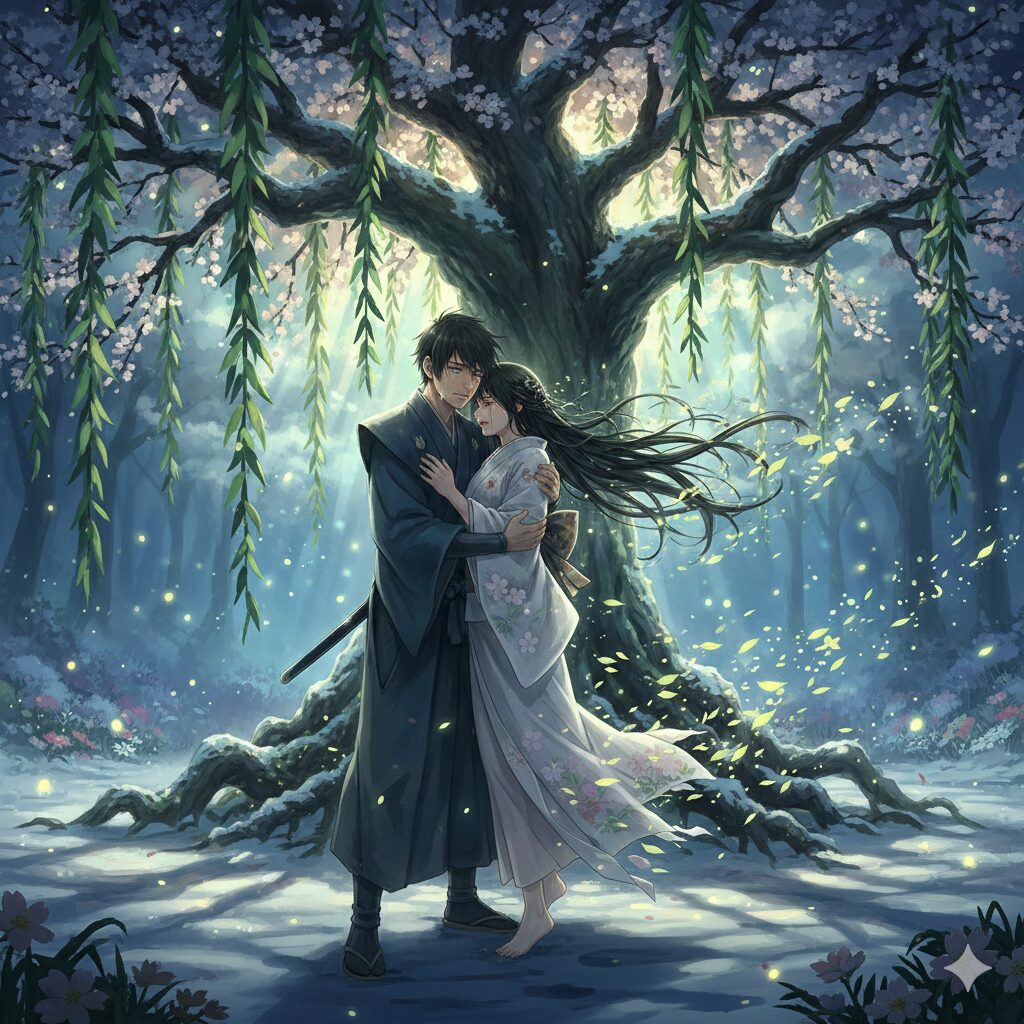
Japanese folklore is filled with stories where nature and humanity intertwine deeply. The story I am introducing today, “Oryu Willow” (often known as “The Story of Green Willow” or “Aoyagi”), is a masterpiece of the “Irui Konin Tan” (tales of marriage between humans and non-humans). Through this story, you will experience the Japanese belief that souls reside in trees and flowers.

Chapter 1: The Blizzard and the Encounter
It was near the end of the Heian period. A young samurai named Tomotada was traveling from the capital, Kyoto, to Noto (present-day Ishikawa Prefecture) on a mission for his lord. Tomotada was skilled in martial arts and courteous, but he had yet to know true love.
During his journey, while passing through the province of Echizen (present-day Fukui Prefecture), a fierce blizzard struck him. His horse could not move, and his vision was painted white. Just as he thought, “I will freeze to death,” he spotted a thatched cottage through a break in the wind. Desperate, Tomotada knocked on the door.
“Who is there?”
An elderly couple and a young maiden appeared. Though poor, they warmly welcomed Tomotada and stoked the fire in the hearth. Tomotada’s eyes were fixed on the maiden. Her name was “Oryu” (Green Willow). Her figure was as graceful as a willow swaying in the wind, and her skin was as white as snow. Her speech and demeanor were so elegant that she seemed out of place in such a lonely mountain dwelling.
The blizzard raged for three days and three nights. During this time, Tomotada and Oryu recited old poetry together and fell deeply in love. Tomotada made a decision: “I would rather live with her than fulfill my duty.”
Chapter 2: The Forbidden Journey and Blissful Days
On the morning the storm cleared, Tomotada bowed to the elderly couple. “Please give me Oryu as my wife. I promise to make her happy.” The old couple looked sad but strangely did not object. “If Oryu’s heart desires it, we will not stop you. However, young lord, please cherish her.”
The two left the house. Because Tomotada had abandoned his mission and failed his duty to his lord, he could not return to the capital. They traveled in hiding until they reached a village by the sea with beautiful scenery, where they began their life together.
The next five years were like a dream for Tomotada. Oryu was gentle and always close to his heart. Though they lived a humble life, there was true love between them. Tomotada believed without a doubt, “This happiness will last forever.”
Chapter 3: The Sudden Farewell
One quiet night, as they were gazing at the moon and talking, Oryu suddenly let out a piercing scream. Her face turned pale, and she began to sweat in agony.
“Oryu! What is wrong?” Tomotada embraced her, and she spoke in a faint voice.
“My husband, please forgive me. My life ends here.”
“What are you saying! Where does it hurt? I will call a doctor!”
“No, a doctor cannot cure this.” Oryu’s body began to fade, becoming translucent.
“The truth is, I am not a human being. I am the spirit of a willow tree that stood in those mountains. Right now, someone is cutting down my physical form, the tree. Every time the axe bites into the trunk, my body is torn apart.”
Tomotada was speechless. Yet, the reality was that the life of the wife in his arms was fading.
“Ah, the first blow has struck… my roots are shaking…” Oryu wept, using her last bit of strength to touch Tomotada’s cheek.
“The five years I spent with you were the brightest in my long life. Thank you for loving me as a human.”
With those words, a loud sound echoed in the air, and Oryu’s form dissolved into the wind and vanished. All that remained was Tomotada, weeping as he embraced the empty air.
Later, when Tomotada visited the site of the cottage in the mountains, there was no house. There was only a giant willow tree stump that had just been cut down, and two old stumps beside it.
- Chapter 1: The Blizzard and the Encounter
- Chapter 2: The Forbidden Journey and Blissful Days
- Chapter 3: The Sudden Farewell
- Analysis: Why a “Willow”?
- The Essence of Japanese Culture: Animism and the Soul of Nature
- To Our Readers: What Would You Do?
- 儚くも美しい愛の物語:おりゅう柳
- 考察:なぜ「柳」だったのか?
- 日本文化の真髄:アニミズムと「草木国土悉皆成仏」
- 読者の皆様へ:あなたならどうしますか?
Analysis: Why a “Willow”?
This story is not merely a tragic romance. Why was Oryu a spirit of a “Willow”? There is deep meaning here.
- Symbol of Feminine Beauty: In Japanese literature, the Willow (Yanagi) symbolizes female grace and flexibility. Its ability to sway with the wind without breaking represents strength in yielding.
- Boundary to the Otherworld: Willows often grow near water and are considered trees that stand on the boundary between “this world” and “the spirit world” in Japanese folklore. The willow motif implies that Oryu is not an inhabitant of the human world.
- Regeneration and Vitality: Willows have strong vitality. Although Oryu disappears at the end, the story subtly suggests that her love and soul return to nature, living on eternally.
The Essence of Japanese Culture: Animism and the Soul of Nature
The most important cultural element to decipher from “Oryu Willow” is **Animism (Shinto nature worship)**.
Since ancient times, Japanese people have believed that mountains, rivers, stones, and trees possess “Kami” (gods) or souls. Just as there is a word for tree spirits, “Kodama,” giant trees are thought to have personalities. This blends with the Buddhist concept that “Grass, trees, and the land all attain Buddhahood” — meaning even nature can become enlightened.
Tomotada’s love for Oryu reflects the history of Japanese people viewing nature not merely as a “resource” but as a “partner” or “object of reverence.” The point that cutting down a tree is depicted not as simple labor but as the pain of taking a life represents the origin of the Japanese view of nature.
To Our Readers: What Would You Do?
After reading this story, what did you feel?
If your beloved partner was actually a spirit of nature, and their life was being taken by human convenience (development or logging), how would you face that reality?
In modern society, we live at the expense of much of nature. The next time you look up at the trees, imagine that a soul like Oryu might be dwelling there. The world might look a little different to you.
Related Links:
儚くも美しい愛の物語:おりゅう柳
日本の昔話には、自然と人間が深く交わる物語が数多く存在します。今回紹介する「おりゅう柳(The Story of Green Willow)」は、その中でも最も美しく、そして悲しい「異類婚姻譚(いるいこんいんたん)」の傑作です。木や花に魂が宿ると信じる日本の心を、この物語を通して体験してください。
第一章:運命の吹雪と出会い
時は平安の世の終わり頃。若き武士、友忠(ともただ)は、主君の命を受け、京の都から能登(現在の石川県)へと旅をしていました。友忠は武芸に秀で、礼儀正しい若者でしたが、まだ本当の恋を知りませんでした。
旅の途中、越前の国(現在の福井県)に差し掛かった時、猛烈な吹雪が友忠を襲いました。馬は進めず、視界は白一色に染まります。「このままでは凍え死んでしまう」と覚悟したその時、風の合間に一軒のあばら家が見えました。友忠は必死の思いで扉を叩きました。
「どなたですか」
中から現れたのは、老夫婦と一人の若い娘でした。彼らは貧しいながらも温かく友忠を招き入れ、囲炉裏の火を強めました。友忠の目は、その娘に釘付けになりました。娘の名は「おりゅう(柳)」。その姿は、風になびく柳のようにしなやかで、雪のように白い肌をしていました。彼女の言葉遣いや所作は、とてもこの寂しい山奥に住む者とは思えないほど優雅でした。
吹雪は三日三晩続きました。その間、友忠とおりゅうは、古い和歌を語り合い、互いの心に深く惹かれ合いました。友忠は決意しました。「任務を捨ててでも、彼女と共に生きたい」と。
第二章:許されざる旅立ちと幸福な日々
嵐が去った朝、友忠は老夫婦に頭を下げました。「おりゅう殿を私にください。必ず幸せにします」。老夫婦は悲しげな顔を見せましたが、不思議なことに反対はしませんでした。「おりゅうの心がそれを望むなら、私たちは止めません。しかし、若殿、どうか彼女を大切にしてください」
二人は家を出ました。友忠は、主君への義理を果たさず旅を放棄したため、都へ戻ることはできません。彼らは身を隠すように、美しい景色が広がる海辺の村にたどり着き、そこで暮らし始めました。
それからの五年間は、友忠にとって夢のような日々でした。おりゅうは優しく、常に友忠の心に寄り添いました。貧しい暮らしでしたが、二人の間には真実の愛がありました。友忠は「この幸せが永遠に続く」と信じて疑いませんでした。
第三章:突然の別れ
ある静かな夜のことです。二人が月を眺めながら語らっていると、突然、おりゅうが激しく叫び声を上げました。顔面は蒼白になり、脂汗を流して苦しみ始めました。
「おりゅう! どうしたのだ!」友忠が抱きしめると、おりゅうはか細い声で言いました。
「あなた、許してください。私の命はここまでです」
「何を言っているんだ! どこが痛むのだ、医者を呼んでくる!」
「いいえ、医者には治せません」おりゅうの体は、次第に透き通るように儚くなっていきました。
「実は、私は人間ではありません。あの山奥にあった、一本の柳の木の精なのです。今、誰かが私の本体である木を切り倒そうとしています。斧が幹に食い込むたびに、私の体は引き裂かれるのです」
友忠は言葉を失いました。しかし、腕の中の妻の命が消えようとしている現実は変わりません。
「ああ、最初の一撃が入りました… 根が揺れています…」おりゅうは涙を流しながら、最期の力を振り絞って友忠の頬に触れました。
「あなたと過ごした五年間は、私の長い命の中で最も輝いていました。人間として愛してくれて、ありがとう」
その言葉と共に、大きな音が響いたかと思うと、おりゅうの姿は風に溶けるように消え失せました。後には、友忠が一人、虚空を抱きしめて泣き崩れるだけでした。
後日、友忠があの山奥のあばら家を訪ねると、家などはなく、そこには切り倒されたばかりの巨大な柳の切り株と、二本の古い木の切り株があるだけでした。
考察:なぜ「柳」だったのか?
この物語は、単なる悲恋物語ではありません。なぜ、おりゅうは「柳」の精だったのでしょうか。これには深い意味があります。
- 女性的な美の象徴: 日本文学において、柳(Yanagi)は女性の優美さやしなやかさの象徴です。風に逆らわず揺れる姿は、困難を受け流す強さと美しさを表しています。
- 異界との境界: 柳は水辺に多く生え、日本の伝承では「この世」と「あの世」の境界にある木とされています。おりゅうが人間界の住人ではないことを、柳というモチーフが暗示しています。
- 再生と生命力: 柳は生命力が強く、挿し木でも育ちます。物語の最後でおりゅうは消えますが、その愛の記憶や魂は、自然の中に還り、永遠に生き続けるという救いが隠されているとも読み取れます。
日本文化の真髄:アニミズムと「草木国土悉皆成仏」
「おりゅう柳」から読み解ける最も重要な日本文化の要素は、**アニミズム(精霊信仰)**です。
日本では古来より、山、川、石、そして木々にも「神」や「魂」が宿ると信じられてきました。「こだま(木霊)」という言葉があるように、巨木には人格があると考えられています。これは仏教の「草木国土悉皆成仏(そうもくこくどしっかいじょうぶつ)」―草木や国土さえも仏になれるという思想とも融合しています。
友忠がおりゅうを愛したことは、日本人が自然を単なる「資源」としてではなく、「パートナー」や「敬愛の対象」として見てきた歴史そのものです。木を伐採することが、単なる作業ではなく、一つの命を奪う痛みとして描かれている点に、日本人の自然観の原点があります。
読者の皆様へ:あなたならどうしますか?
この物語を読んで、あなたは何を感じましたか?
もし、あなたの愛するパートナーが、実は自然の精霊で、人間の都合(開発や伐採)によって命を落とすとしたら、あなたはその現実にどう向き合いますか?
現代社会において、私たちは多くの自然を犠牲にして生きています。次に木々を見上げた時、そこにおりゅうのような魂が宿っているかもしれないと想像してみてください。世界が少し違って見えるはずです。
関連リンク:

コメント