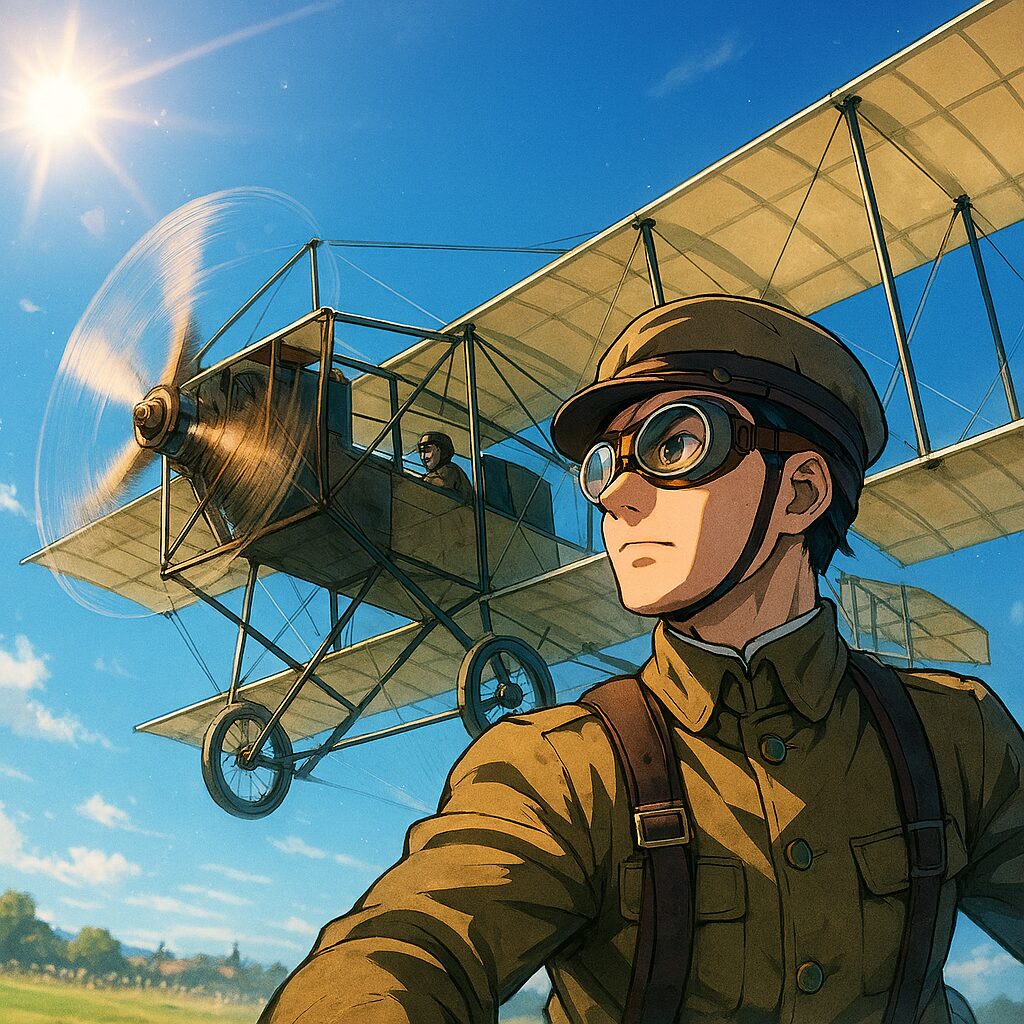
In the grand tapestry of Japanese history, December 19th is not just another winter day. It marks a monumental milestone: Japan’s First Flight Day. It was the day when the descendants of samurai, who once relied on swords, defied gravity and claimed the skies. Taking place in 1910 at the Yoyogi Parade Ground (now Yoyogi Park) in Tokyo, this event was a dramatic symbol of Japan’s rapid modernization.

December 19, 1910: The Moment History Shifted
The era was the late Meiji period. Japan was riding a wave of rapid Westernization, desperate to stand shoulder-to-shoulder with the great powers of the world. Just seven years after the Wright brothers succeeded in their first flight, the Japanese Army was ready to challenge the skies.
The protagonists were two military officers: Captain Yoshitoshi Tokugawa and Captain Kumazo Hino. Captain Tokugawa piloted a French-made “Henri Farman” biplane, while Captain Hino flew a German-made “Grade” monoplane.
On the morning of December 19th, a large crowd gathered at the Yoyogi Parade Ground. Captain Hino was the first to lift off, but his flight covered a short distance and was arguably considered more of a “jump.” However, Captain Tokugawa followed with a decisive performance. Skillfully maneuvering the Henri Farman, he set a magnificent record: an altitude of 70 meters, a flight distance of 3,000 meters, and a flight time of 4 minutes.
This was officially recognized as “Japan’s first powered flight.” Less than half a century after cutting off their topknots (Chonmage), the Japanese people had acquired wings.
The Fusion of Culture and Technology: Why Was Japan So Fast?
What we should decode from this historical event is the Japanese capacity for “adaptation” and their “obsession with technology.”
It is astounding that a country isolated from the world until the mid-19th century could introduce and master cutting-edge aviation technology so quickly after opening its borders. Here, we see the unique Japanese spirit of “Wakon Yosai” (Japanese spirit, Western talent). This was the slogan of the Meiji era, meaning to maintain the Japanese spirit while utilizing superior Western learning and technology.
Captains Tokugawa and Hino didn’t just buy planes and fly them. They went to Europe, learned the technology with their own bodies, understood the mechanics, and brought that knowledge back to Japan. This led to domestic maintenance and improvement. This process of “learning from the outside and refining it the Japanese way (Kaizen)” is the origin of the later success of Japan’s automotive and electronics industries.
Furthermore, few travelers know that the peaceful Yoyogi Park of today was once a military parade ground and the site of this first flight. Beneath the lawns where people now picnic, sleeps the passionate spirit of the Meiji people who longed for the sky.
A Question for You
Over 100 years ago, taking off into the unknown sky required life-threatening courage. Yet, that courage birthed the convenient transportation and global connections we enjoy today.
While we can connect with the world instantly via smartphones, have we forgotten the kind of courage Captain Tokugawa had—the courage to physically step into an unknown world?
What is the “unknown flight” (new challenge) you want to take this year? If this story stimulated your sense of adventure even a little, please let me know in the comments. I’d love to hear how you would navigate your own uncharted skies.
References & Links
- What’s Today’s Special Day Series (Category)
- National Museum of Nature and Science, Tokyo (Exhibits related to Japanese Technology)
サムライの国が空を飛んだ日:12月19日、日本初飛行の物語
日本の歴史において、12月19日は単なる冬の一日ではありません。かつて刀を差していた侍の子孫たちが、初めて重力を振り切り、日本の空を支配した記念すべき日、「日本初飛行の日」です。1910年(明治43年)、東京・代々木練兵場(現在の代々木公園)で起きたこの出来事は、日本の近代化を象徴する劇的な瞬間でした。
1910年12月19日:歴史が動いた瞬間
時は明治の終わり。日本は急速な西洋化の波に乗り、列強と肩を並べようと必死でした。ライト兄弟が初飛行を成功させてからわずか7年後、日本陸軍もまた、空への挑戦権を手にしていました。
主役は二人の軍人、徳川好敏(とくがわ よしとし)大尉と日野熊蔵(ひの くまぞう)大尉です。徳川大尉は、フランス製の複葉機「アンリ・ファルマン式」を、日野大尉はドイツ製の単葉機「グラーデ式」を操りました。
12月19日の朝、代々木練兵場には多くの観衆が集まりました。まず空へ舞い上がったのは日野大尉でしたが、飛行距離は短く、あくまで「ジャンプ」と見なされることもありました。しかし、その後に続いた徳川大尉は違いました。彼はアンリ・ファルマン機を巧みに操り、高度70メートル、飛行距離3,000メートル、滞空時間4分という堂々たる記録を打ち立てたのです。
これが公式に「日本初の動力飛行」として認定された瞬間でした。髷(まげ)を切り落としてからわずか半世紀足らずで、日本人は翼を手に入れたのです。
日本文化とテクノロジーの融合:なぜ日本は早かったのか?
この歴史的出来事から読み解くべきは、日本人の「適応力」と「技術への執着」です。
江戸時代まで鎖国をしていた国が、開国からわずかな期間で最先端の航空技術を導入し、それを乗りこなした事実は驚異的です。ここには、日本独自の精神「和魂洋才(わこんようさい)」が見て取れます。これは「日本人の精神(大和魂)を持ちつつ、西洋の優れた学問・技術を活用する」という明治時代のスローガンです。
徳川大尉も日野大尉も、単に飛行機を買ってきて乗ったわけではありません。彼らは欧州へ渡り、自らの体で技術を習得し、機体の構造を理解し、日本へ持ち帰りました。そして日本国内での整備・改良へと繋げていったのです。この「外部から学び、自国流に洗練させる(改善・カイゼン)」というプロセスは、後の日本の自動車産業やエレクトロニクス産業の成功に通じる原点と言えるでしょう。
また、現在の代々木公園がかつて「練兵場」であり、初飛行の地であったことを知る旅行者は多くありません。平和な公園の芝生の下には、空への憧れを抱いた明治人の熱い魂が眠っているのです。
あなたへの問いかけ
100年以上前、未知の空へ飛び立つことには命がけの勇気が必要でした。しかし、その勇気が現在の私たちの便利な移動手段や、グローバルな繋がりを生み出しました。
現代の私たちは、スマートフォン一つで世界中と繋がることができますが、徳川大尉たちが持っていたような「未知の世界へ物理的に踏み出す勇気」を忘れてはいないでしょうか?
あなたにとって、今年挑戦したい「未知のフライト(新しい挑戦)」は何ですか?この記事を読んで、少しでも冒険心が刺激されたなら、ぜひコメントで教えてください。


コメント