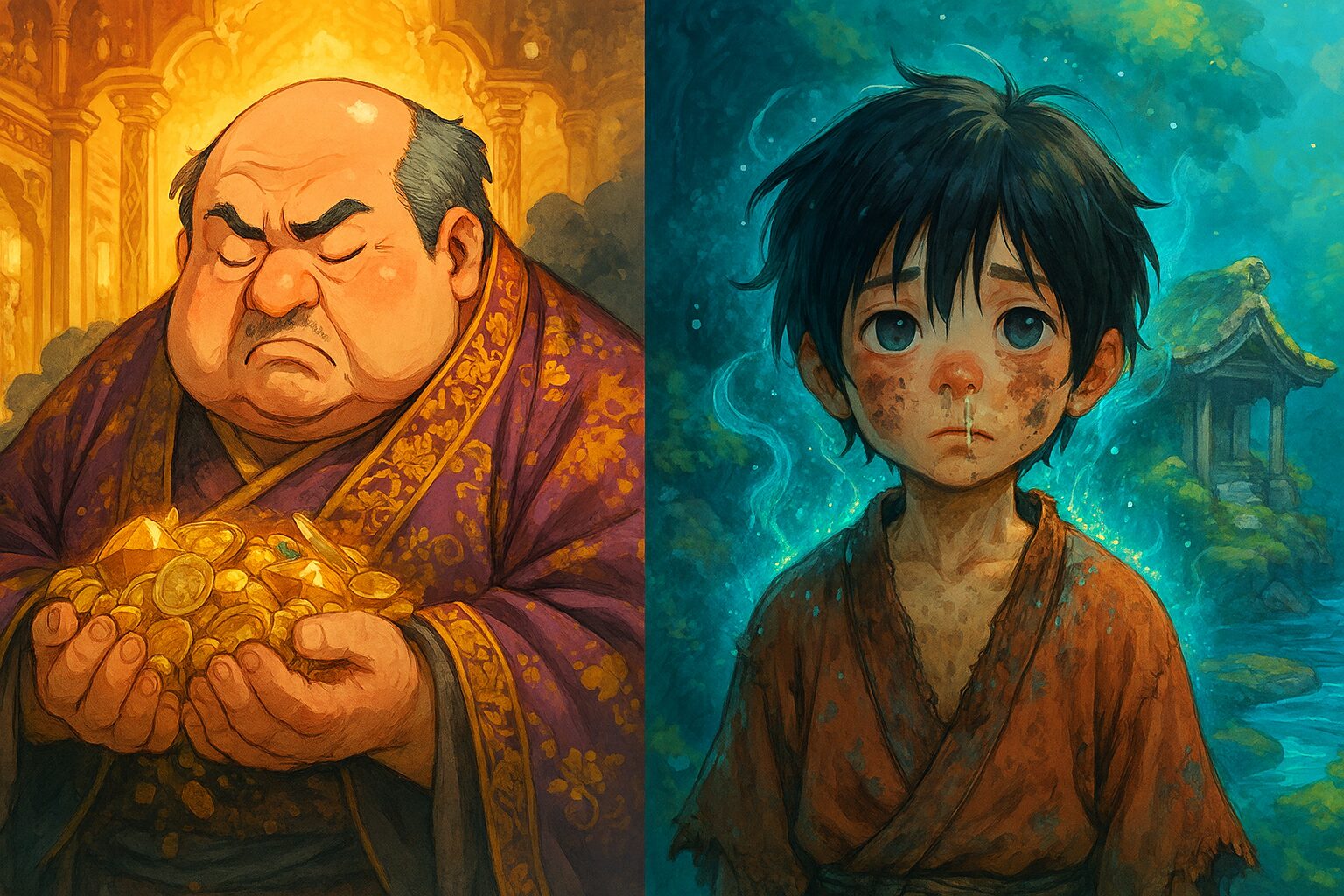
In Japan, there are countless Mukashi Banashi (Japanese Folktales) that serve not merely as children’s stories, but as mirrors reflecting the deep-seated ethics and views of nature held by the Japanese people. Today, we introduce a tale that touches on the very core of Japanese belief: that a seemingly absurd, sometimes even unhygienic, character can be a being of immense power.
That story is “Hanatare Kozō-sama” (The Little Snot-Nosed God). It is a powerful narrative that harshly questions how often we are misled by superficial things like “appearance” and “efficiency,” causing us to overlook what is truly valuable.

- The Story of the Folktale: “Hanatare Kozō-sama”
- Folktale Analysis: Appearance, Essence, and the Price of Gratitude
- Connection to Japanese Culture: Shinto’s ‘Mitate’ and the Idea of ‘Humble Gods’
- A Question for the Reader: Have You Forgotten the Source of Your Wealth?
- Related Links and Category
- 📖 昔話のストーリー:「はなたれ小僧さま」
- 🧐 昔話の考察:外見と本質、そして「感謝」という対価
- 🌸 日本文化との関連:神道の「見立て」と「貧しい神」の思想
- 💡 読者への問いかけ:富の源泉を忘れていませんか?
- 🔗 参考リンクとカテゴリー
The Story of the Folktale: “Hanatare Kozō-sama”
Once upon a time, there was a poor old man. Every day, he went to the mountains to gather firewood to sell in town, but one day, he could not sell a single piece. Exhausted, he carried the heavy load back home.
Walking sadly down the road, the old man stopped by a river in front of a small shrine dedicated to the great water deity, the Dragon God (Ryūjin-sama).
Out of fatigue and despair, the old man took all the precious firewood he could not sell and tossed it into the river current, saying, “Dragon God, please, take this and use it.” This was the greatest offering a poor man could give to the divine.
Suddenly, a beautiful woman emerged from the river. She introduced herself as the Dragon God’s messenger and said, “Your offering has deeply moved us. As a reward, I shall grant you a Little God who can grant any wish you desire.”
The woman then presented a small child. However, the child was dirty, covered in grime, and perpetually had snot (hana) running from his nose—a truly miserable sight. The old man frowned at the child’s appearance, wondering, “What good can such a dirty boy be?”
But the woman warned him sternly: “This Little God is the Dragon God’s child. You must never treat him poorly.” She then made the old man promise to feed the Little God a special meal called “**Ebinamasu**” three times a day on the day he brought him home, before she vanished.
Skeptical but willing to try, the old man wished for a magnificent home.
And behold! When he opened his eyes, the old, dilapidated shack had transformed into a glorious Mansion (Goten) with a glittering gate!
Convinced that the boy was truly a child of the gods, the old man began to make one extravagant wish after another: treasures, delicious foods, lavish clothes. Hanatare Kozō-sama quietly nodded each time, fulfilling all the old man’s desires.
The old man became immensely wealthy and lived a life of leisure.
However, as his wealth grew, the old man’s heart became arrogant and lazy. Surrounded by luxurious meals, the chore of caring for the snot-nosed boy—especially preparing and serving the special “Ebinamasu” three times a day as promised—became an unbearable burden.
“I have everything I want now. I don’t need this dirty boy anymore,” he thought.
On the morning of the appointed day, the old man spoke to the Little God in a cold, ungrateful tone.
“Little God. I have enough now. Please return to the Dragon God’s realm.”
Hanatare Kozō-sama said nothing, simply nodded silently, and walked out the door of the mansion.
The moment the Little God’s small back disappeared beyond the gate, there was a deafening sound. The walls of the mansion crumbled, the luxurious furnishings turned to dust, and the gold and silver treasures became mere stones. The silk robes the old man wore turned back into rags, and the old man himself reverted to the **poor, exhausted state** he was in when he offered the firewood.
Hanatare Kozō-sama was a God who granted everything, yet also the **Yorishiro (vessel for a spirit)** that sustained the old man’s true fortune and happiness. The old man realized he had discarded his own treasure, but it was far too late.
Folktale Analysis: Appearance, Essence, and the Price of Gratitude
The core of the “Hanatare Kozō-sama” story is the universal lesson that **”judging by appearance leads one to misjudge true value.”**
The Little God is dirty, snot-nosed, and appears to be a ‘Kegare’ (unclean/polluted) presence of no use. Yet, he was the messenger, or even the incarnation, of the most revered Dragon God. This tale profoundly reflects the Japanese belief found in Shinto and Buddhism: **”Gods do not always appear in majestic forms.”**
* The Disregard for the Source of Wealth
As the old man became accustomed to luxury, the presence of the Little God, the source of his wealth, became an annoyance. Crucially, the old man desired only the **material outcome** the Little God provided, not the **relationship** with the Little God himself.
* The Symbolism of “Ebinamasu”
The Dragon God’s messenger woman emphasized the three servings of “Ebinamasu” because it was more than just a meal; it was an act of **offering, gratitude, and a ritual to maintain the divine contract.** The old man found this “ritual” inconvenient, he broke the sacred covenant and completely lost his **Respect** and **Gratitude** for the source of his fortune.
* The Reversible Nature of Giving and Taking
The Little God continued to “give” wealth only as long as the old man maintained gratitude and respect. The moment that connection was severed, the wealth he had given was instantly “taken back.” This reflects an ancient Japanese idea: Fortune and success are not something to be “owned permanently,” but something that is “temporarily bestowed” through a proper relationship with the Gods and Nature.
Connection to Japanese Culture: Shinto’s ‘Mitate’ and the Idea of ‘Humble Gods’
The tale of “Hanatare Kozō-sama” highlights vital aspects of Japanese culture and faith.
1. The Culture of ‘Yorishiro’ and ‘Mitate’
In Shinto, it is believed that the gods dwell in specific places or objects. This is known as **Yorishiro** (vessels). The Little God was a Yorishiro, temporarily housing the Dragon God’s power, hence his sacred essence.
Furthermore, Japanese aesthetics include the concept of **Mitate** (seeing things metaphorically). This is the philosophical idea of finding intrinsic beauty or value in something that is not perfect, or seeing one thing as a representation of another. Just as a slightly imperfect tea bowl is appreciated as a “scenery” in Tea Ceremony, the old man was expected to **’Mitate’** the dirty boy as a “venerable child of the Gods” and respect his true essence. He failed, distracted by the surface grime.
2. Faith in the ‘Humble God’ (Raihōshin/Marebito)
The Little God is strongly connected to the ancient Japanese folk belief in **Raihōshin** (Visiting Gods) or **Marebito** (Rare/Foreign People).
Raihōshin are deities who visit villages from beyond the mountains or the sea, often appearing in tattered or strange guises. They frequently take the form of poor travelers or strangers. The household that treats them with utmost hospitality is blessed with fortune, while the household that treats them poorly is met with disaster.
- Example: The famous ‘Namahage’ figures, who visit villages during the New Year. They look frightening or comical, but their true identity is that of a fertility god. People fear them but welcome them with respect.
“Hanatare Kozō-sama” strictly adheres to this tradition. He appeared before the old man as a Marebito, bringing both fortune and a test. The old man’s story conveys a severe moral code that the Japanese have cherished since ancient times: **one must treat even strangers and those of humble appearance with respect and sincerity.**
A Question for the Reader: Have You Forgotten the Source of Your Wealth?
At the lowest point of his life, the old man’s offering of firewood—an act of **humility**—earned him the ultimate gift: Hanatare Kozō-sama. Yet, he succumbed to luxury and abandoned the most crucial payment: gratitude and respect.
If you were granted a wish by Hanatare Kozō-sama, would you become obsessed only with the **”result”** of the wealth or success, neglecting its **”Source”**?
What is the “Hanatare Kozō-sama” in your own life? It might be your family supporting you, the boss who gave you a chance, or even your own talent and health.
This story speaks to us powerfully: “When you achieve success, you must cherish the invisible things that sustain it—the tedious, mundane habits, and the connections with people who might not look impressive—more than anything else.”
Could you, even after becoming wealthy, continue to offer the three daily servings of “Ebinamasu” to the Little God with a grateful heart? And what actions would you take to ensure you do not lose that fortune?
We invite you to share your thoughts.
Related Links and Category
Here is some related information to deepen your enjoyment of this story.
| Type | Title / Description | Link |
|---|---|---|
| Internal Link | 【Category】Japanese Folktale Series | /category/japanese-folktale-series/ |
| External Link | About Ryūjin (Dragon God) Worship (Agency for Cultural Affairs, Japan) | https://www.bunka.go.jp/ |
| External Link | Japanese Folktales and Legends (National Diet Library Digital Collection) | https://www.ndl.go.jp/ |
🗻 日本昔話シリーズ:はなたれ小僧さまが教える真の神と富
日本には、単なる童話としてではなく、人々の心の奥底にある倫理観や自然観を映し出す「昔話(Mukashi Banashi)」が数多く存在します。今日ご紹介するのは、一見すると滑稽で、時には不潔にさえ見える登場人物が、実は絶大な力を秘めた存在であるという、日本の信仰の根幹に触れる物語です。
その物語こそが、「はなたれ小僧さま(The Little Snot-Nosed God)」です。この物語は、私たちが普段、いかに「外見」や「効率」といった表面的なものに惑わされ、真に大切なものを見失いがちであるかを厳しく問いかけてきます。
📖 昔話のストーリー:「はなたれ小僧さま」
昔々、ある貧しいお爺さんがいました。お爺さんは毎日山に入り、薪を担いで町へ売りに行っていましたが、その日は一本も売れず、重い薪を背負って疲れ果てていました。
トボトボと歩く帰り道、お爺さんは一つの祠の前の川辺に立ち止まりました。そこは、水を司る偉大な神様である「竜神さま」を祀る場所です。
お爺さんは疲れと絶望から、「竜神さま、どうか使ってください」と、今日売れなかった大切な薪を、すべて川の流れに投げ入れました。これは、貧しい者が神に差し出せる最大限の供物でした。
すると、川の中から美しい女が現れました。女は竜神さまの使いだと名乗り、「あなたの捧げものに心打たれました。そのお礼に、どんな願いでも叶えてくれる小僧さまを授けましょう」と言いました。
そして女が連れてきたのは、小さな子どもでした。しかし、その小僧は顔中が汚れており、常に鼻水(はな:snot/mucus)を垂らしている、とても見窄らしい姿をしていました。
お爺さんは一瞬、その汚い姿に眉をひそめ、「こんな小僧が何の役に立つのか」と邪険に扱おうとしましたが、女は「この小僧さまは、竜神さまの子です。決して粗末にしてはいけません」と厳しく諭し、また、小僧さまを連れてきた日には、三度「エビナマス」という特別な食事を小僧さまに与えるという約束をさせ、姿を消しました。
半信半疑のお爺さんは、試しに「立派な家が欲しい」と小僧さまに願ってみました。
するとどうでしょう。目を閉じ、再び開けると、先ほどまでのお爺さんの粗末なあばら屋が、煌びやかな門構えの御殿(Palace/Mansion)に変わっていたのです!
驚いたお爺さんは、これは本物の神の子だと確信し、次々と贅沢な願いを口にし始めました。財宝、美味しい食べ物、豪華な着物…。はなたれ小僧さまは、その都度静かに頷き、お爺さんの望みをすべて叶えていきました。
お爺さんはすっかり大金持ちとなり、毎日を悠々自適に過ごしました。
しかし、裕福になりすぎたお爺さんの心は、傲慢で怠惰になっていきました。毎日豪華な食事に囲まれているお爺さんにとって、鼻水を垂らした小僧の世話をすること、特に女と約束した「エビナマス」という特別な食事を三度用意し、与えることが、いつしか面倒でたまらない重荷となってしまったのです。
「もう欲しいものは全て手に入れた。この汚い小僧も必要ない」
約束の日の朝、お爺さんは小僧さまに優しさのかけらもない冷たい口調で頼みました。
「小僧さま。もうわしは十分じゃ。お前さんは竜神さまの元へ帰ってくれ」
はなたれ小僧さまは、何も言わず、ただ静かに頷き、御殿の戸口から出ていきました。
小僧さまの小さな背中が、門の向こうに見えなくなった、その途端でした。
轟音と共に、御殿の壁が剥がれ落ち、豪華な調度品は塵となり、金銀財宝は石ころに変わりました。そしてお爺さんが着ていた絹の着物は、ボロボロの襤褸(ぼろ)に戻り、お爺さん自身も、薪を背負って疲れ果てていた、あの元の貧しいお爺さんの姿に戻ってしまったのです。
はなたれ小僧さまは、全てを与えてくれる神であったと同時に、お爺さんの真の富と幸せを維持していた「依代(Yorishiro:神霊が宿るもの)」だったのです。お爺さんは、自らその宝を手放したことを悟りましたが、全てはもう後の祭りでした。
🧐 昔話の考察:外見と本質、そして「感謝」という対価
この「はなたれ小僧さま」の物語の核心は、「見た目の判断が、真の価値を見誤らせる」という普遍的な教訓です。
小僧さまは、汚く、鼻水を垂らし、一見何の役にも立たない「穢れた(Kegare:unclean/polluted)」存在に見えます。しかし、彼は最も尊い存在である竜神さまの使者、あるいはその化身でした。この物語は、「神は必ずしも荘厳な姿で現れるわけではない」という、日本の神道や仏教に見られる信仰観を深く反映しています。
* 富の源泉の軽視
お爺さんが贅沢に慣れるにつれて、富の源泉である「小僧さま」の姿がますます煩わしくなりました。ここで重要なのは、お爺さんが求めていたのは**小僧さまとの繋がり**ではなく、小僧さまがもたらす**物質的な結果**だけであったという点です。
* 「エビナマス」の象徴
竜神の使いの女が、小僧さまとの約束の日に三度の「エビナマス」を強調したのは、これが単なる食事ではなく、**神への供養、感謝、そして契約維持の儀式**であったことを示唆しています。お爺さんがこの「儀式」を面倒だと感じた瞬間、彼は神聖な契約を破り、富の源泉に対する**敬意(Respect)**と**感謝(Gratitude)**を完全に失ったのです。
* 「与える」と「奪われる」の表裏一体
小僧さまは、お爺さんが感謝と敬意を払い続けている間だけ、その富を「与え」続けました。その繋がりが断たれた瞬間、彼が与えた富もまた、彼によって一瞬にして「奪い返され」ました。これは、富や幸運は「永遠に所有できるもの」ではなく、神や自然との関係性によって「一時的に授けられているもの」であるという、日本古来の考え方を示しています。
🌸 日本文化との関連:神道の「見立て」と「貧しい神」の思想
「はなたれ小僧さま」の物語は、日本文化と信仰の重要な側面を浮き彫りにします。
1. 神の「依代(Yorishiro)」と「見立て」の文化
神道において、神様は特定の場所や物に宿るとされます。これを依代と呼びます。この小僧さまは、竜神さまの力を一時的に宿した依代であり、その本質は神聖です。
さらに、日本の美意識には「見立て(Mitate)」という概念があります。これは、あるものを別のものに見立てる、あるいは、完璧ではないものの中に本質的な美や価値を見出すという思想です。茶の湯の茶碗が多少歪んでいてもそれを「景色」として愛でるように、汚い小僧を「尊い神の子」と見立て、その本質を敬うことが、お爺さんに求められていた姿勢でした。お爺さんは外見の汚さに気を取られ、真の価値を見立てることができませんでした。
2. 「貧しい神」としての信仰(来訪神・稀人信仰)
この物語の小僧さまは、日本の民間信仰に古くから存在する「来訪神(Raihōshin)」や「稀人(Marebito)」の概念と強く結びついています。
来訪神は、山の向こうや海の彼方から、ボロボロの姿や、異様な格好で村に訪れる神々です。これらは、貧しい旅人や異邦人の姿をとることが多いですが、丁重にもてなした家には富と幸運をもたらし、邪険に扱った家には災いをもたらします。
- **例:** 有名な「なまはげ」や、正月などに村を訪れる神事。彼らは恐ろしい、または滑稽な外見をしていますが、その正体は豊穣をもたらす神であり、人々は彼らを恐れながらも歓迎し、もてなします。
「はなたれ小僧さま」は、まさにこの伝統に則っています。彼は、富と試練をもたらす稀人としてお爺さんの前に現れました。お爺さんの物語は、日本人が古来より大切にしてきた、**見知らぬ人や、見窄らしい外見の人に対しても敬意と真心をもって接するべきである**という、厳しい道徳律を今に伝える教訓なのです。
💡 読者への問いかけ:富の源泉を忘れていませんか?
お爺さんは、人生のどん底で薪を捧げた「謙虚さ」という心の富のおかげで、はなたれ小僧さまという最高の贈り物を得ました。しかし、彼は贅沢に溺れ、最も大切な「感謝と敬意」という対価を支払うことを放棄しました。
もしあなたがはなたれ小僧さまに願いを叶えてもらったとしたら、あなたは富や成功の「結果」だけに執着し、その「源泉(Source)」を疎かにしてしまうでしょうか?
あなたの人生における「はなたれ小僧さま」とは何でしょうか?それは、あなたを支える家族かもしれません。仕事を与えてくれる上司かもしれません。あるいは、あなた自身の才能や健康かもしれません。
この物語は私たちに、「成功したときこそ、その成功を支えている目に見えないもの、面倒で地味な習慣、そして外見に惑わされがちな人との繋がりこそ、大切にしなければならない」と力強く語りかけています。
あなたなら、裕福になった後も、毎日三度の「エビナマス」を、感謝の心をもって小僧さまに捧げ続けることができますか?そして、その富を失わないために、どのような行動をとりますか?
あなたの考えをぜひ教えてください。
🔗 参考リンクとカテゴリー
この物語をさらに深く楽しむための関連情報をご紹介します。
| 種類 | タイトル / 説明 | リンク先 |
|---|---|---|
| 内部リンク | 【カテゴリー】日本昔話シリーズ | /category/japanese-folktale-series/ |
| 外部リンク | 竜神信仰について(文化庁) | https://www.bunka.go.jp/ |
| 外部リンク | 日本の民話と伝承(国立国会図書館デジタルコレクション) | https://www.ndl.go.jp/ |

コメント