Category: Japanese Folktale Series

- 🦊The Raccoon Dog’s Spinning Wheel: Where the Sound of Weaving Echoes in the Satoyama
- 🧐A Deep Dive into “The Raccoon Dog’s Spinning Wheel”: The Hidden Message
- 💡Decoding Japanese Culture: “Mottainai” and “Yaoyorozu no Kami”
- 🙋♀️A Question for the Reader: What Would You Do?
- 🔗References and Blog Category
- 🦊たぬきの糸車:不思議な機織りの音が響く里山で
- 🧐「たぬきの糸車」の深い考察:隠されたメッセージ
- 💡昔話から読み解く日本文化:「もったいない」と「八百万の神」
- 🙋♀️読者への問いかけ:あなたならどうしますか?
🦊The Raccoon Dog’s Spinning Wheel: Where the Sound of Weaving Echoes in the Satoyama
This is a tale from long ago, set in a tranquil *Satoyama* (traditional countryside) surrounded by the rich nature of Japan.
The main characters of the story are **Omitsu**, a kind and hardworking young woman, and a **Raccoon Dog (Tanuki)** who lives near her village—a creature who is a little clumsy but ultimately endearing.
Omitsu’s family was poor, and life was a struggle. The task of spinning thread for clothing was particularly heavy work, often continuing late into the night. One cold winter evening, as Omitsu turned her old spinning wheel, it let out a lonely, creaking sound—*Kee, Kee*—perhaps due to the cold.
Hearing this sound was the **Tanuki** living on the back mountain. The Tanuki was intensely curious about human activities, and the daily sound of the spinning wheel particularly captivated it.
One day, Omitsu had to leave the house for an errand. Seizing the opportunity, the Tanuki quietly slipped into her home. There, it found the mysterious tool she spun every day: the **Spinning Wheel**.
The Tanuki tried to operate the spinning wheel, imitating what it had seen humans do. Soon, a slightly different, more cheerful yet diligent sound—***Kee, Kee, Gar, Gar***—than when a human spun it, filled the quiet house. The Tanuki continued to spin, lost in the activity.
When Omitsu returned home, she was astonished. The spinning wheel was turning, and **beautiful thread had been spun**, even though no one should have been there! Moreover, it was not just any thread; it was lustrous, fluffy, and of a much higher quality than what Omitsu usually spun. Yet, there was no one in sight.
The next day, and the day after, whenever Omitsu left the house, the spinning wheel would turn, and fine thread would appear. Though mystified, Omitsu put this strange gift to good use, and her life gradually became more prosperous.
However, Omitsu felt a strong desire to **thank this kind “someone.”**
So, Omitsu pretended to be out but hid to watch. After a while, the *shoji* (sliding door) quietly opened, and who walked in but **a Raccoon Dog!** The Tanuki looked around, then skillfully began to turn the spinning wheel with its front paws.
“It was you after all!”
Omitsu was surprised but gently revealed herself. The Tanuki was startled and tried to scramble away.
“Wait! Don’t run. Thank you for everything. You were spinning the thread for me, weren’t you?”
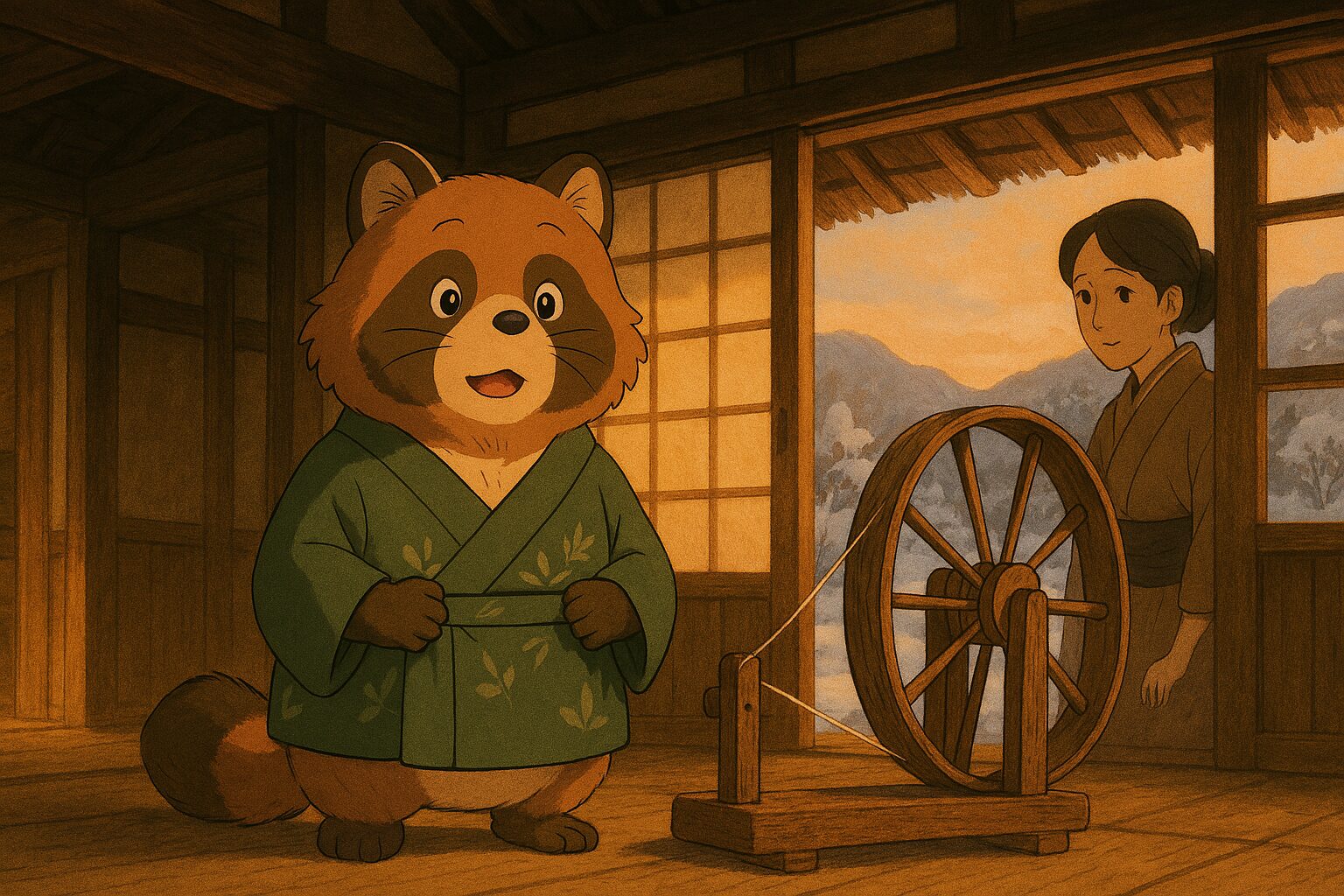
Omitsu spoke kindly and slowly approached the fleeing Tanuki. Then, she presented the Raccoon Dog with a **small, adorable garment made of cloth**, sewn with all her heart. It was a tiny kimono, made from some of the very thread it had spun, perfectly sized for the Tanuki’s body.
The Tanuki stopped fleeing and stared at the garment in surprise. Sensing Omitsu’s kindness, it quietly accepted the kimono and, with evident joy, put it on.
From that day on, the Tanuki never came to Omitsu’s house again. However, the villagers often saw the **cute, garment-wearing Tanuki** playing happily in the *Satoyama* on snowy and cold days.
This is a heartwarming tale demonstrating that a connection of the heart transcends humans and extends to all living things, a beautiful lesson in compassion.
🧐A Deep Dive into “The Raccoon Dog’s Spinning Wheel”: The Hidden Message
While “The Raccoon Dog’s Spinning Wheel” may seem like a charming fantasy where an animal helps a human, its narrative is deeply rooted in Japanese culture and the national spirit.
1. The Spirit of Reciprocity (Gifts and Reciprocity)
The core of the story is the **Spirit of Reciprocity**. The Tanuki spins the thread for Omitsu without asking for anything in return. This illustrates a Japanese virtue: **quietly extending a helping hand** after sensing another’s hardship.
Omitsu, in turn, does not take this kindness for granted but feels a strong desire to thank the “someone.” She offers a perfect, thoughtful gift: **a small kimono for the Tanuki**.
This beautiful chain of **”Action”** and **”Grateful Return”** is fundamental to social relations in Japan and is still clearly visible today in customs like *Ochūgen* and *Oseibo* (mid-year and year-end gifts).
2. The Animistic View of Nature
Japanese culture is profoundly influenced by **Animism** (the belief that all natural things possess a spiritual essence). Animals of the mountains and forests, especially Raccoon Dogs (Tanuki) and Foxes (Kitsune), often appear in folktales as **beings that connect humans and nature**.
The Tanuki spinning the wheel can be interpreted as a symbol of the **reverence for nature**, suggesting that the *Satoyama* itself is aiding Omitsu’s life. They are not merely animals but parts of nature’s law, bringing blessings to humans.
3. The Aesthetic of “Invisible Kindness”
Until Omitsu directly met the Tanuki, the kindness continued in an “invisible form.” Japanese aesthetics include a modest aspect of **”not claiming credit for a favor”** and **”helping without being noticed.”** The Tanuki’s attempt to flee might stem from a sense of embarrassment at being discovered, or a desire to maintain a respectful distance from humans.
Omitsu’s quiet acceptance of the Tanuki’s kindness, followed by her quiet reward with the kimono, highlights this **”silent exchange,”** which adds great depth to the narrative.
💡Decoding Japanese Culture: “Mottainai” and “Yaoyorozu no Kami”
This folktale, “The Raccoon Dog’s Spinning Wheel,” is deeply connected to two major values that the Japanese people have cherished.
1. “Mottainai”: The Heart of Cherishing Things
The spirit of **”Mottainai”** is subtly visible in the Tanuki’s act of spinning the thread for Omitsu.
“Mottainai” is a word with a deeper meaning than merely “Waste Not.” It carries the sentiment that **”everything—material goods, resources, time—has value, and treating them carelessly is sacrilege to the divine.”**
The Tanuki transforms the spinning wheel—which Omitsu painstakingly turns—from **”just spinning”** into a valuable product: **”fine thread.”** This speaks to the Japanese respect for maximizing the utility of tools, technology, and nature’s blessings.
Even today, as environmental awareness grows, “Mottainai” is being re-evaluated as a **global keyword** for sustainability.
2. “Yaoyorozu no Kami”: The Myriad Gods Are Near
In Japanese Shintoism, it is believed that **”Yaoyorozu no Kami”** (Eight Million Gods, or Myriad Gods) reside everywhere: in the mountains, rivers, and even in **everyday tools (*Tsukumogami*—Tool Spirits)**.
The portrayal of the Tanuki as a being that brings blessings to humans is precisely based on this “Yaoyorozu no Kami” belief:
- Spinning Wheel (Tool): Daily-used tools possess a soul and the power to aid humans.
- Tanuki (Animal): Living in the human *Satoyama*, they are messengers of the divine, or beings that embody the power of nature itself.
This folktale conveys the fundamental Japanese cultural message: **humans should live in harmony with nature and their tools**, and that harmony is what brings prosperity. This is the root of the Japanese tendency today to cherish old objects and natural landscapes.
🙋♀️A Question for the Reader: What Would You Do?
Thank you for reading “The Raccoon Dog’s Spinning Wheel” to the end.
Just as Omitsu did not take the invisible kindness for granted and expressed her gratitude with a heartfelt gift, **how often in our daily lives do we notice “invisible kindness” and express our thanks?**
If you were to discover “something” that was secretly helping you in your life without anyone knowing, **how would you convey your gratitude to that “something”?**
Though an ancient story, it asks us a contemporary question about the **”heart of gratitude”** and **”the kindness of caring for one another,”** which are values we risk losing in modern society. Please share your thoughts with us.
🔗References and Blog Category
- Category: Japanese Folktale Series
🇯🇵日本の昔話シリーズ:知恵と優しさの物語「たぬきの糸車」
カテゴリー: 日本昔話シリーズ
🦊たぬきの糸車:不思議な機織りの音が響く里山で
これは、遥か昔、日本の豊かな自然に囲まれた静かな里山での物語です。
物語の主人公は、心優しく働き者の「おみつ」という娘と、彼女の暮らす村の近くに住む、ちょっとおっちょこちょいだけれども憎めない「たぬき」です。
おみつの家は貧しく、生活は楽ではありませんでした。特に、着物を作るための糸を紡ぐ仕事は、夜遅くまでかかる大変な重労働でした。ある寒い冬の夜、おみつが古い糸車を回していると、寒さのせいか、糸車がキー、キーと寂しそうな音を立てていました。
その音を聞きつけたのが、村の裏山に住む一匹のたぬきでした。たぬきは好奇心旺盛で、人間がしていることに興味津々でした。特に、毎日聞こえてくる糸車の音に、たぬきは心惹かれていました。
ある日、おみつが用事で家を空けることになりました。その隙を狙って、たぬきはこっそりとおみつの家に入り込みます。そして、彼女が毎日回していたあの不思議な道具、「糸車」を見つけました。
たぬきは、人間がやっているのを見よう見まねで、糸車に触れてみました。すると、キー、キー、ガー、ガーと、人間が回すのとは少し違う、どこか愉快で、それでいて一生懸命な音が、静かな家の中に響き渡りました。たぬきは夢中になって糸車を回し続けます。
おみつが家に帰ってくると、驚きました。誰もいないはずなのに、糸車が回り、美しい糸が紡がれていたのです! しかも、ただの糸ではありません。光沢があり、ふんわりとしていて、おみつが紡ぐよりもずっと上質な糸でした。しかし、あたりには誰の姿もありません。
次の日も、その次の日も、おみつが家を空けると、糸車は回り、上質な糸ができていました。おみつは不思議に思いながらも、この不思議な贈り物を活かし、生活は少しずつ豊かになっていきました。
しかし、おみつは、この親切な「誰か」にどうしてもお礼がしたいと思いました。
そこで、おみつは家にいるふりをして、隠れて様子を伺うことにしました。しばらくすると、静かに障子が開き、中に入ってきたのは、まさかの一匹のたぬきでした。たぬきは、辺りを見回してから、器用に前足で糸車を回し始めました。
「やっぱり、あなただったのね!」
おみつは驚きましたが、そっと姿を現しました。たぬきはギョッとして、慌てて逃げ出そうとします。
「待って!逃げないで。いつもありがとう。あなたが私のために糸を紡いでくれていたのね」
おみつは優しく声をかけ、逃げようとするたぬきにそっと近づきました。そして、心を込めて縫った、可愛らしい布で作った着物をたぬきに差し出しました。それは、おみつが紡がれた糸の一部を使って作った、たぬきの体にぴったりな小さな着物でした。
たぬきは、怖がるのをやめ、驚きの表情でその着物を見つめました。そして、おみつの優しさが伝わったのでしょう、そっと着物を受け取り、嬉しそうにそれを羽織りました。
それ以来、たぬきはおみつの家に来ることはなくなりました。しかし、村の皆は、雪の日や寒い日に、可愛らしい着物を着たたぬきが、里山で楽しそうに遊んでいる姿を見かけるようになったということです。
これは、心と心の触れ合いが、人間に限らず、生き物すべてに通じるという、温かい教訓の物語です。
🧐「たぬきの糸車」の深い考察:隠されたメッセージ
この「たぬきの糸車」の物語は、一見すると動物が人間に手を貸すという可愛らしいファンタジーのように見えますが、その背景には、日本の文化や人々の精神性が深く根付いています。
1. 互恵の精神(Gifts and Reciprocity)
物語の核心は、互恵の精神(Reciprocity)です。たぬきは、特に見返りを求めずに、おみつのために糸を紡ぎます。これは、他者の苦労を察し、そっと助けの手を差し伸べるという日本人の美徳を表しています。
一方、おみつもまた、その親切を当たり前とは考えず、「誰か」にお礼をしたいという強い思いを持ちます。そして、最高の形で、たぬきのために小さな着物を贈ります。
この「行為」と「感謝の返礼」の美しい連鎖は、日本社会における人間関係の基本であり、現代でも「お中元やお歳暮」といった習慣に色濃く残っています。
2. アニミズム的な自然観(Animistic View of Nature)
日本文化には、古来よりアニミズム(Animism:自然界のあらゆるものに霊魂が宿るという考え方)が深く根付いています。山や森に住む動物たち、特にたぬきやきつねなどは、人間と自然を繋ぐ存在として、昔話に多く登場します。
たぬきが糸車を回すという行為は、里山そのものがおみつの生活を助けている、という自然への畏敬の念の象徴とも読み取れます。彼らは、単なる動物ではなく、自然の摂理の一部として、人間に恵みをもたらす存在なのです。
3. 「見えない親切」の美学
おみつが、たぬきに直接会うまでは、この親切は「見えない形」で続いていました。日本の美意識には、「恩を売らない」、「気づかれないように助ける」という奥ゆかしい側面があります。たぬきが逃げようとしたのは、親切が露見したことへの恥ずかしさや、人間との一定の距離感を保ちたいという思いの表れかもしれません。
おみつが、たぬきの親切を静かに受け入れ、そして、静かに着物で報いる。この「静かなやり取り」こそが、この物語に深みを与えています。
💡昔話から読み解く日本文化:「もったいない」と「八百万の神」
この昔話「たぬきの糸車」は、日本人が大切にしてきた二つの大きな価値観と深く結びついています。
1. 「もったいない」(Mottainai):物を大切にする心
たぬきがおみつのために糸車を回した背景には、「もったいない」の精神が垣間見えます。
「もったいない」は、単なる「Waste Not(無駄にするな)」以上の深い意味を持つ言葉で、「物や資源、時間など、あらゆるものに価値があり、それを粗末に扱うのは神への冒涜である」という感覚を含んでいます。
おみつが手間をかけて紡ぐ糸車を、たぬきが「ただ回っている」のではなく、「上質な糸」という価値あるものに変えてくれる。これは、日本人にとって、道具や技術、そして自然の恵みを最大限に生かすことの尊さを物語っています。
現代においても、「もったいない」は、環境問題への意識が高まる中で、地球規模のキーワードとして再評価されています。
2. 「八百万の神」(Yaoyorozu no Kami):神様は身近にいる
日本の神道では、「八百万の神」、つまり数多くの神々が、山や川、そして、日常の道具(付喪神/つくもがみ)にさえ宿ると考えられています。
たぬきという生き物が、人間に恵みをもたらす存在として描かれているのは、まさにこの「八百万の神」の思想に基づいています。
- 糸車(道具): 毎日使う道具には、魂が宿り、人間を助けてくれる力がある。
- たぬき(動物): 人間の住む里山に生きる彼らも、神の使い、あるいはそれ自身が自然の力を体現する存在。
この昔話は、人間は自然や道具と調和して生きるべきであり、その調和こそが、豊かさをもたらす、という日本文化の根幹にあるメッセージを伝えているのです。現代の日本人が、古いものや自然の風景を大切にする心のルーツが、ここにあります。
🙋♀️読者への問いかけ:あなたならどうしますか?
「たぬきの糸車」の物語を最後までお読みいただき、ありがとうございます。
おみつが、見えない親切を当たり前に受け取らず、心を込めた贈り物で感謝を伝えたように、私たちは日々の生活の中で、どれだけ「見えない親切」に気づき、感謝の気持ちを表現できているでしょうか?
もし、あなたの生活の中で、誰にも知られずに、あなたの助けになっている「何か」を発見したとしたら、あなたなら、どのようにその「何か」にお礼を伝えますか?
これは、遠い昔の物語ですが、現代社会で失われつつある「感謝の心」と「互いを思いやる優しさ」を私たちに問いかけています。ぜひ、あなたの考えを聞かせてください。


コメント