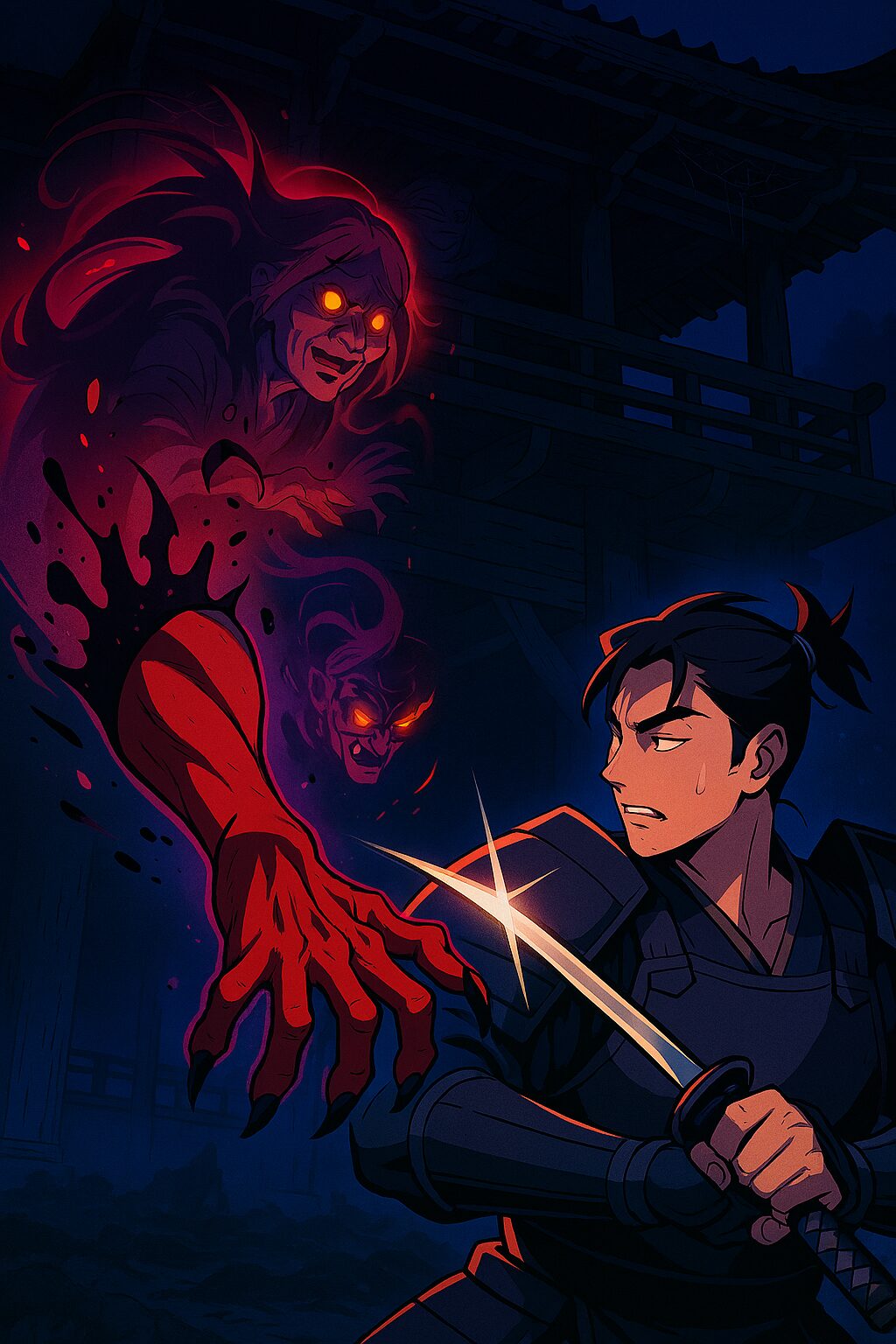
The term “Rashomon Demon” is famous as the subject of Ryunosuke Akutagawa’s short story, but it is originally based on an anecdote found in the Konjaku Monogatarishu (Anthology of Tales from the Past), a collection of Japanese setsuwa (tales) compiled during the Heian period.
This is a story that depicts human karma and the supernatural, set at the massive **Rashomon Gate**, the southern entrance to the ancient capital of Heian-kyo (Kyoto).

- 📌 The Beginning of the Tale: Heian-kyo’s Decline and Rashomon
- 📌 The Encounter with the Demon
- 📌 Slicing Off the Demon’s Arm
- 📌 The Demon Appears Again
- 🧐 A Deep Analysis of the Story: What is True Terror?
- 🇯🇵 Connection to Japanese Culture: Reading the Culture Through the Tale
- 💬 A Question to Our Readers
- 🔗 Related Information and External Links
- 📌 物語の始まり:平安京の衰退と羅生門
- 📌 鬼との遭遇
- 📌 鬼の腕を切り落とす
- 📌 再び現れた鬼
- 🧐 物語の深い考察:真の恐怖とは何か?
- 🇯🇵 日本文化との関連性:物語から読み解くもの
- 💬 読者への問いかけ (A Question to Our Readers)
- 🔗 関連情報と外部リンク
📌 The Beginning of the Tale: Heian-kyo’s Decline and Rashomon
Heian-kyo was once a magnificent capital, but as time passed, successive plagues and natural disasters caused the city to fall into ruin. The Rashomon Gate, in particular, despite being the southern gateway, was so vast that it fell into disrepair and became a desolate place that people avoided.
Discarded corpses were abandoned beneath the gate, and it became a hideout for thieves and villains. The Rashomon was an eerie place where life and death ambiguously mingled.
📌 The Encounter with the Demon
One late night, **Watanabe no Tsuna**, a samurai official of the capital known for his skill with the bow, passed near the Rashomon. His lord, Minamoto no Yorimitsu, had heard rumors that a demon had taken up residence in the gate and was attacking people, and he had ordered Tsuna to investigate the truth.
Tsuna was unfazed by the sight of the corpses beneath the gate. He climbed the stairs to the tower (rokaku) of the gate. What Tsuna saw there was a terrifying **Demon** of great stature, with hair standing on end, horns, and eyes glowing like fire.
The Demon preyed on humans, sustaining itself on their fear.
📌 Slicing Off the Demon’s Arm
Without hesitation, Tsuna drew his beloved sword, the **”Higekiri” (Beard Cutter)**, and with a flash, the blade severed the demon’s arm. The Demon shrieked in pain and fled into the darkness with a terrifying earth-shattering sound.
Tsuna brought the demon’s arm back as proof and reported to Minamoto no Yorimitsu. Yorimitsu strictly sealed the arm and ordered Tsuna to observe *monomi* (seven days of spiritual abstinence, refraining from going out and purifying the mind and body).
📌 The Demon Appears Again
On the seventh night, an old woman claiming to be Tsuna’s wet nurse (menoto) visited his mansion. Weeping, the old woman pleaded, “I have cared for you for a long time. Please let me see the demon’s arm one last time. I wish to pray with it in my hands and report your safety to the gods and Buddha.”
Despite being in the middle of his *monomi*, Tsuna, wishing to repay his long-standing debt of gratitude, decided to unseal the arm and show it to her.
The moment Tsuna handed the arm to the old woman, she transformed into the Demon.
“That is my arm!”
Screaming this, the Demon snatched its severed arm and flew high into the sky, disappearing.
Watanabe no Tsuna’s heroic tale ultimately ends in defeat against the demon’s clever scheme.
🧐 A Deep Analysis of the Story: What is True Terror?
This tale is too profound to be dismissed as merely a ghost story or a heroic legend. It continues to be recounted today because it depicts a universal truth inherent in the human psyche.
1. Rashomon: The Ambiguity of Boundaries
The Rashomon Gate is the “boundary” separating the capital (civilization/life) from the outside (nature/death). However, in the era of the story, that boundary is collapsing. Famine and corpses overflow even within the gate, and the capital is desolate. This place symbolizes the **chaos where the human and spirit worlds, “good” and “evil,” “life” and “death” dissolve together**. The demon can be interpreted as an entity born from this chaos, a physical manifestation of human fear and ego.
2. Watanabe no Tsuna’s “Gullibility” and “Compassion”
Watanabe no Tsuna is a hero known for his strength. Initially, he possessed the “military might” and “courage” to defeat the demon. However, his defeat in the second encounter was not due to a lack of power, but due to **”jo” (compassion/human emotion)** and gullibility.
In the face of the demon disguised as his wet nurse—the most trusted relationship—he broke his lord’s command and his promise of *monomi* for the virtue of “filial piety.” In this moment, **his “human emotions” took precedence over his “samurai code of conduct.”** This story drives home the truth that even heroes are fragile in the face of human weakness such as compassion and carelessness.
3. The True Identity of the Demon: Human Egoism
Ryunosuke Akutagawa’s novel *Rashomon* focuses not on the demon’s arm, but on a story of an old woman pulling hair from corpses at the gate and a servant (genin) who decides to become a thief after seeing her. The old woman says, “It cannot be helped if I am to live,” and the servant, also “to live,” shoves the old woman aside and strips her of her clothing.
In other words, the core theme that emerges is that the **”egoism” of humans, who sacrifice others to survive or fulfill their desires in extreme situations, is the true “demon,”** rather than a physical monster. The tale of Watanabe no Tsuna in the *Konjaku Monogatarishu* also depicts the underlying human weakness and vulnerability, as his compassionate impulse, bordering on self-satisfaction to repay a debt, ultimately falls into the demon’s trap.
🇯🇵 Connection to Japanese Culture: Reading the Culture Through the Tale
The tale of “The Rashomon Demon” contains elements that are key to understanding the deeper layers of Japanese culture.
1. Belief and Animism: “Eight Million Gods” and the “Supernatural”
Japan has a belief in **Animism**, the idea that gods reside in all things in nature. Therefore, the existence of supernatural beings (evil) such as *oni* (demons) and *yokai* (monsters), which possess powers beyond human understanding, is strongly recognized as the antithesis to the gods (good).
The Rashomon Demon is not just a monster; it is portrayed as an entity that is born from and gains strength through societal anxiety—**”the capital falling into ruin”**—and people’s “wicked deeds” (karma). This reflects the Japanese ethical view that human actions directly influence the order of the world (the realm of the gods) and its chaos (the realm of the demons).
2. “Mono no Aware” and “Mujo-kan”: The Heian Aesthetic
While the Heian period saw the flowering of courtly culture, it was also dominated by a pessimistic Buddhist view known as *Mappo Shiso* (the Latter Day of the Law), the belief that the world was in decline.
- **Mujo-kan (Sense of Impermanence):** The idea that all things change and are not eternal.
- **Mono no Aware:** A deep sense of pathos and aesthetic appreciation for things that are fleeting and transient.
The desolation of the Rashomon Gate symbolizes the decline of past glory and the coming of a mutable world. The structure of the story, where a demon runs rampant in this desolation, reflects the unique Japanese aesthetic and *Mujo-kan*, where **beauty and sorrow, life and death, exist side by side.**
3. The Prototype of “Bushido”: The Conflict Between Code and Emotion
The era in which this story was established was when the samurai class began to rise to power. Tsuna embodies the samurai ideal: “strength” and “loyalty.” Yet, he was defeated because he broke the samurai code (strict adherence to *monomi*, placing the lord’s command first) and was swayed by “emotion.”
This indicates that the concept of **”suppressing private emotion for the greater good,”** which would later become central to *Bushido* (the Way of the Warrior), was already causing intense conflict with human nature during this time. The tale teaches us about the difficulty of balancing “public duty” (**ōyake**) and “private feelings” (**watakushi**), a struggle that the Japanese people have valued since ancient times, and reveals the source of human weakness.
💬 A Question to Our Readers
What emotions did the tale of “The Rashomon Demon” evoke in you?
- What are your thoughts on the hero, Watanabe no Tsuna, who defeated the demon but then fell into the demon’s trap again because he was swayed by human compassion?
- How would you answer the question of human egoism lurking beneath the story: “Is everything permissible if it is done to survive?”
- If you were in Watanabe no Tsuna’s position, facing a plea from your cherished wet nurse, which would you choose: the samurai **”Code”** or the human **”Emotion”**?
We invite you to share your thoughts in the comments below.
🔗 Related Information and External Links
Category
External Links
- Agency for Cultural Affairs: Konjaku Monogatarishu – Information regarding the Japanese collection of tales that is the source of the story.
https://www.bunka.go.jp/ - Kyoto City Official Travel Guide: The History of Kyoto – Information for international readers on the history and decline of Heian-kyo.
https://kyoto.travel/en/
👹 羅生門の鬼:日本文化に潜む「生」と「死」、そして「エゴ」の物語
「羅生門の鬼」という言葉は、芥川龍之介の短編小説の題材としても有名ですが、もともとは平安時代に成立した説話集『今昔物語集』に収められている逸話が元になっています。
これは、平安京の入り口、巨大な**羅生門(らしょうもん)**を舞台にした、人間の業(ごう)と怪異を描く物語です。
📌 物語の始まり:平安京の衰退と羅生門
平安京はかつて華やかな都でしたが、時代が下るにつれて疫病や天災が相次ぎ、都は荒廃し始めます。特に羅生門は、都の南の玄関口でありながら、あまりの巨大さゆえに管理が行き届かず、いつしか人々の寄り付かない寂しい場所となっていました。
門の下には、捨てられた死体が運ばれてきて野ざらしにされ、盗人や悪党の隠れ家となっていました。生と死が曖昧に混ざり合う、不気味な場所、それが羅生門だったのです。
📌 鬼との遭遇
ある晩のこと、都の役人で、強弓の使い手として知られる**渡辺綱(わたなべのつな)**という武士が、夜遅く羅生門の近くを通りました。彼の主君である源頼光は、最近都で羅生門に鬼が住み着き、人々を襲っているという噂を聞きつけ、綱にその真相を確かめるよう命じていたのです。
綱は、門の下で死体を見ても動じません。彼は階段を登り、門の楼閣(ろうかく)へと上がりました。そこで綱が見たものは、身の丈高く、髪は逆立ち、角を持ち、火のように眼を光らせる恐ろしい姿の**鬼**でした。
鬼は人間を喰らい、その恐怖を糧に生きていました。
📌 鬼の腕を切り落とす
綱は臆することなく、愛刀である**「髭切(ひげきり)」**を抜き放ち、一閃。その刃は鬼の腕を切り落としました。鬼は激痛に叫び声をあげ、恐ろしい地響きとともに闇の中へと逃げ去りました。
綱は、鬼の腕を証拠として持ち帰り、源頼光に報告しました。頼光はその腕を厳重に封印し、綱に七日間の物忌み(外出を控え、心身を清めること)を命じます。
📌 再び現れた鬼
七日目の夜、綱の乳母(めのと)と名乗る老婆が、綱の屋敷を訪ねてきました。老婆は、「長い間、お前の世話をしてきたが、最後にその鬼の腕を見せてくれないか。この手で拝んで、お前の無事を神仏に報告したい」と涙ながらに懇願しました。
物忌みの最中であるにもかかわらず、綱は長年の恩に報いようと、封印を解いて腕を見せることにしました。
綱が腕を取り出し、老婆の手に渡したその瞬間、老婆は鬼の姿へと変わりました。
「これは、わたしの腕だ!」
鬼はそう叫ぶや否や、切り取られた自分の腕を掴み取り、空高く飛び去ってしまいました。
渡辺綱の武勇伝は、結局のところ、鬼の巧妙な計略に敗れたという結末を迎えるのです。
🧐 物語の深い考察:真の恐怖とは何か?
この物語は単なる怪談や武勇伝として終わらせるにはあまりに深遠です。この物語が現代に至るまで語り継がれるのは、人間の内面にある普遍的な真実を描き出しているからです。
1. 羅生門:境界線の曖昧さ
羅生門は、都(文明・生)と都の外(自然・死)を隔てる「境界」です。しかし、物語の時代において、その境界は崩壊しています。門の内側にも、飢えや死体が溢れ、都は荒廃している。この場所は、人間界と異界、**「善」と「悪」、「生」と「死」が溶け合うカオス**を象徴しています。鬼は、そのカオスから生まれた、人間の恐怖やエゴが具現化した存在と解釈できます。
2. 渡辺綱の「油断」と「情」
渡辺綱は、強弓で知られる英雄です。彼は初め、鬼を打ち破る「武力」と「勇気」を持っていました。しかし、二度目の遭遇で彼が敗北したのは、武力ではなく、**「情(じょう)」**、すなわち人間的な感情と油断によるものです。
乳母という最も信頼すべき関係を装った鬼に対し、彼は「孝行」という美徳のために、主君の命令や物忌みの約束を破りました。この瞬間、**彼の「武士としての規範」よりも、「人間的な感情」が優位に立ってしまった**。この物語は、英雄ですら、情や油断という人間の弱さの前には脆い、という真実を突きつけます。
3. 真の鬼の正体:人間のエゴイズム
芥川龍之介の小説『羅生門』では、鬼の腕ではなく、羅生門で死体の髪を抜く老婆と、それを見て泥棒になる下人(げにん)の物語が描かれます。老婆は「生きるためには仕方がない」と語り、下人もまた「生きるために」老婆を突き飛ばして着物を剥ぎ取る。
つまり、形ある「鬼」よりも、**極限状態に陥った人間が、生きるため、あるいは自分の欲望を満たすために他者を犠牲にする「エゴイズム」こそが、真の「鬼」**であるというテーマが浮かび上がります。『今昔物語集』の渡辺綱の逸話も、綱の「恩義を果たしたい」という自己満足に近い情けが、結果として鬼の策略に乗ってしまうという点で、人間の内面に潜む隙や弱さを描いているのです。
🇯🇵 日本文化との関連性:物語から読み解くもの
「羅生門の鬼」の物語は、日本文化の深層を理解するための鍵となる要素を含んでいます。
1. 信仰とアニミズム:「八百万の神」と「怪異」
日本には、森羅万象に神が宿るという**アニミズム**の思想があります。そのため、神(善)の対極として、人知を超えた力を持つ「鬼」や「妖怪」といった怪異(悪)の存在も強く意識されてきました。
羅生門の鬼は、ただの怪物ではなく、**「都が荒れる」**という社会不安や人々の「悪行」によって生み出され、力を増す存在として描かれます。これは、人間の行い(業)が、そのまま世界の秩序(神の領域)と混乱(鬼の領域)に影響を与えるという、日本的な倫理観を反映しています。
2. 「もののあわれ」と「無常観」:平安時代の美意識
平安時代は、雅な文化が花開いた一方で、仏教の「末法思想」が広がり、世界が衰退していくという悲観的な考えも支配的でした。
- **無常観(むじょうかん):** すべてのものは移り変わり、永遠ではないという考え方です。
- **もののあわれ:** 移りゆくもの、儚いものに対する、深い情感と美意識です。
羅生門の荒廃は、かつての栄華が衰え、無常の世になったことの象徴です。その荒廃の中で、鬼が跋扈(ばっこ)するという構図は、**美と哀愁、生と死が隣り合わせである**という、日本人が持つ独特な美意識と無常観を映し出しています。
3. 「武士道」の原型:規範と情の対立
この物語が成立した時代は、武士が台頭し始めた頃です。綱は武士の理想像、すなわち「強さ」と「忠誠心」を体現しています。しかし、その彼が敗れたのは、武士の規範(物忌みの厳守、主君の命令第一)を破り、「情」に流されたからです。
これは、後の「武士道」で重視される**「大義のための私情の抑制」**という考え方が、既にこの頃から、人間性との間で激しい葛藤を生んでいたことを示しています。この物語は、日本人が古来より大切にしてきた「**公(おおやけ)**」と「**私(わたくし)**」のバランスの難しさ、そして人間的弱さの根源を教えてくれるのです。
💬 読者への問いかけ (A Question to Our Readers)
「羅生門の鬼」の物語は、あなたにどのような感情を抱かせたでしょうか?
- 鬼を打ち破った英雄・渡辺綱が、情に流されて再び鬼の策略に嵌ってしまったことについて、あなたはどう考えますか?
- 「生きるためなら、何をしても許されるのか?」という、物語の裏に潜む人間のエゴイズムの問いに、あなたならどう答えますか?
- もしあなたが渡辺綱の立場なら、大切な乳母の頼みを前に、武士としての**「規範」**と人間としての**「情」**、どちらを選びますか?
あなたの考えを、ぜひコメントで聞かせてください。
🔗 関連情報と外部リンク
カテゴリー
外部リンク
- 文化庁:今昔物語集 – 物語の元となった日本の説話集に関する情報です。
https://www.bunka.go.jp/ - Kyoto City Official Travel Guide: The History of Kyoto – 平安京の歴史と衰退について、海外読者向けの情報が掲載されています。
https://kyoto.travel/en/

コメント