
- Introduction: December 12th, the Weight of One Character Echoing in the Ancient Capital
- ① What is Kanji Day? A Question for Culture, History, and the Future
- ② Cultural Connections: The Spirit of Japan Residing in Kanji
- ③ Conclusion: What is Your Single Character?
- External Links and Category
- 序章:12月12日、古都に響く一文字の重み
- ① 漢字の日とは:文化、歴史、そして未来への問いかけ
- ② 文化との関連性:漢字に宿る日本の精神
- ③ 結び:あなたにとっての一文字は何ですか?
- 外部リンクとカテゴリー
Introduction: December 12th, the Weight of One Character Echoing in the Ancient Capital
Japan boasts numerous unique commemorative days throughout the year. Among them, December 12th is a special day when the eyes of the entire Japanese nation turn to the ancient capital of Kyoto. This is “Kanji Day,” established by the Japan Kanji Aptitude Testing Foundation (Kan-ken). The main focus of this day is the announcement of “The Kanji of the Year,” a single character that symbolizes the social trends of the preceding 12 months.
This event is far more than a mere end-of-year spectacle. It functions as a “Mirror Reflecting the Era,” condensing everything that occurred in Japanese society during the year—the emotional highs and lows of the people, economic shifts, political turmoil, and cultural currents. For our international readers, this special Japanese holiday and the single character it produces serve as a crucial key to understanding not only the beauty and depth of the Japanese language but also how we collectively reflect on the year and share common experiences.
① What is Kanji Day? A Question for Culture, History, and the Future
The Origin: A Wish Contained in “A Good Character”
The reason “Kanji Day” is set on December 12th is due to a Japanese wordplay (Goroawase) based on the date:
- December 12th (12/12) → “ii(1) ji(2) ichi(1) ji(2)“
- Which translates to “ii ji ichi ji” (A Good Character).
This wordplay holds the profound wish of the Kan-ken Foundation: “that each person reflect on the year, contemplate the meaning embedded in a single Kanji character, and continue to use Kanji with care.” Kanji, which originated in China, forms the core of Japan’s linguistic culture. Kanji Day embodies the cultural mission of carefully preserving and passing on these complex and profound ideograms to the next generation.
The Stage for “The Kanji of the Year”: The “Kigō” Calligraphy at Kiyomizu-dera Temple
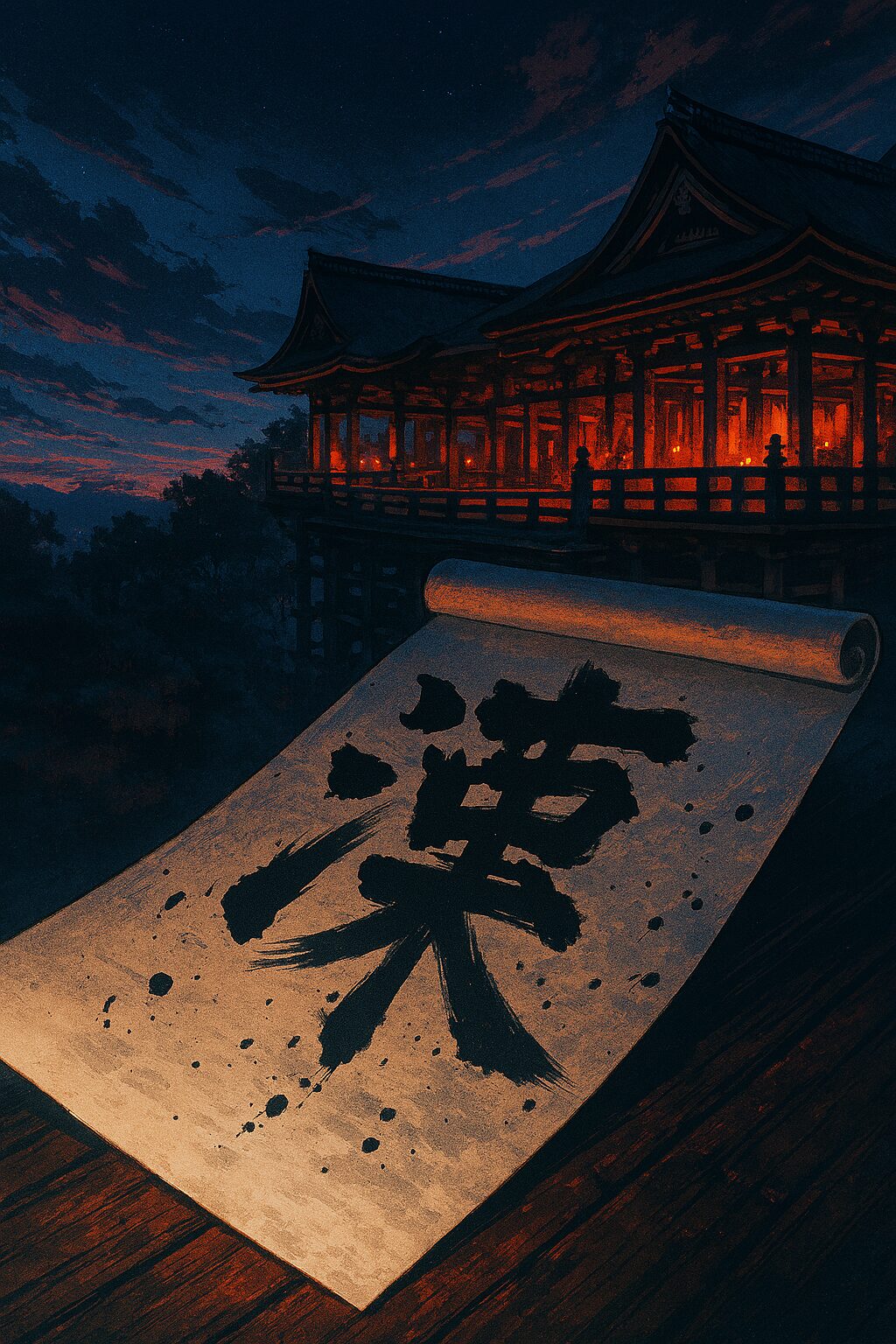
The announcement of “The Kanji of the Year” always takes place at the World Heritage site, Kiyomizu-dera Temple in Kyoto. The ceremony, known as **Kigō** (揮毫: the act of writing or painting with a brush), where the Chief Priest (Kansu) of Kiyomizu-dera boldly writes the chosen character on a massive sheet of Japanese paper, is a major event broadcast live across the country.
The choice of Kiyomizu-dera for this ritual carries deep cultural significance. Located on Higashiyama in Kyoto, the temple has been a center of worship for centuries. For the year’s symbolic Kanji to be written there with a giant brush and ink is not merely a performance. It is a form of **modern Shintō ritual**, solemnly “certifying” the events of the year before the gods and Buddhas, engraving them deeply into the national consciousness. The sheer power of the ink bursting from the large brush strongly reminds us of the power inherent in the characters and the spirituality of “Shodō” (Japanese calligraphy) in Japanese culture.
Japan’s History Narrated by Past Characters
“The Kanji of the Year” began in 1995 (Heisei 7). A look at some of the characters chosen reveals the social conditions of the time:
- “震” (Shaking/Trembling – 1995): Symbolized the year the Great Hanshin-Awaji Earthquake occurred, shaking the nation with profound grief and shock.
- “金” (Gold/Money – 2000, 2012, 2016, 2021, 2024*Most recent example): Chosen during Olympic years (Sydney, London, Rio, Tokyo) for the “Gold” medal rush, or for scandals related to “Money” (finance, corruption). This character represents both bright and dark topics.
- “災” (Disaster – 2004, 2018): The years when Japan was struck by the fury of nature—massive typhoons and earthquakes—resulting in loss of life and property. The character “災” reflects the fate of the Japanese archipelago, which must coexist with nature.
- “密” (Crowded/Dense – 2020): The year the global COVID-19 pandemic began. The term “San-Mitsu” (Three C’s: Closed spaces, Crowded places, Close-contact settings) fundamentally altered our lives.
Thus, “The Kanji of the Year,” based on a national poll, is a “Crystal of Public Opinion” that most purely reflects the collective consciousness, emotions, and social events of that year.
② Cultural Connections: The Spirit of Japan Residing in Kanji
The custom of “The Kanji of the Year” might appear to international readers as a mere “year-in-review” event, but it reveals a deep connection between the Japanese people, the Kanji characters, and Japanese culture.
1. “Kotodama” (Word Spirit) and the Power of Kanji
An ancient Japanese belief is “Kotodama” (言霊: Word Spirit), the idea that “spiritual power resides in words, and what is spoken will come true.” This Kotodama concept is deeply ingrained not just in words but in each individual Kanji character.
Kanji are logograms, each carrying its own meaning. Characters like “Love (愛),” “Bond (絆),” “Peace (安),” or “War (戦)” all evoke a wide range of strong images. By condensing the events and emotions of the year into a single character, it creates a more potent Kotodama, embedding itself deeply in people’s memory. The act of the nation collectively choosing and sharing this single character **strengthens the “Kotodama”** and becomes a **cultural mass action** of wishing for a better future (or serving as a caution against negative events).
2. The Aesthetic of “Abstraction” that Resonates with “Wabi-Sabi”
Underpinning Japanese culture is an aesthetic, exemplified by “Wabi-Sabi,” which finds **profound beauty in simplicity**. Just as a Haiku expresses the subtle essence of nature and life in only seventeen syllables (5-7-5), “The Kanji of the Year” abstracts the complex events of a whole year into a single character, leaving the **Negative Space (Yo-in/Afterglow)** for the reader to interpret.
For instance, when “金” (Gold/Money) is chosen, it encompasses not only the joy of “Olympic medals” but also negative aspects like “economic uncertainty” or “political corruption.” It is precisely the high level of “abstraction” in this single character that allows recipients to deeply reflect on the year from their own perspectives. This technique of **conveying maximum emotion and information with minimum expression** is strongly tied to Japan’s traditional aesthetic sense.
3. The End-of-Year “Misogi” (Purification) and the Culture of Reset
In Japan, the end of the year involves strong cultural practices such as Ōsōji (large-scale cleaning) and Bōnenkai (forget-the-year parties), emphasizing “cleansing away the impurities and fatigue of the year to welcome the new one with a reset.” This is closely related to the Shintō concept of **Misogi** (禊: ritual purification).
The announcement of “The Kanji of the Year” serves as a part of this “end-of-year reset” ritual. By collectively sharing the chosen character (even a negative one like “War” or “Disaster”), we organize the emotional baggage of the past year. Encapsulating the year’s symbol on the massive paper at the ancient Kyoto temple, Kiyomizu-dera, marks an important boundary, allowing us to **”conclude” the year’s essence** and turn our minds toward the New Year.
③ Conclusion: What is Your Single Character?
Now, dear international readers, through the “Kanji Day” and the announcement of “The Kanji of the Year”—a crossroads of Japanese culture, history, and modern social trends—we have touched upon something deeper than a mere annual review: the profound spirituality of the Japanese people.
Many of us cherish the power inherent in Kanji, the aesthetic of condensing everything into a single character, and above all, the cultural practice of “**sharing a single emotion or event across the entire society.**”
Having read this blog, when you reflect on your own country, your region, or your personal year, what single Kanji character would you choose?
Perhaps it is “Change (変),” reflecting global events, or maybe “Progress (進),” signifying personal growth. What character resonated most strongly in your heart? And what wish for your future do you entrust to that single character?
Please share your single character in the comments below and continue this “journey of the single character” with us.
External Links and Category
📚 Related Category
What’s Today’s Special Day Series
🔗 Valid External Links
- Japan Kanji Aptitude Testing Foundation – Kanji of the Year
- Otawa-san Kiyomizu-dera Temple
🎌【深掘り】12月12日:日本の「漢字の日」に秘められた、世相を映す鏡「今年の漢字」
序章:12月12日、古都に響く一文字の重み
日本には、一年を通して数多くのユニークな記念日が存在します。その中でも、毎年12月12日になると、日本国民の視線が一斉に古都・京都へと集まる特別な日があります。それが、公益財団法人 日本漢字能力検定協会(略称:漢検)によって制定された「漢字の日」です。そしてこの日、最も注目を集めるのが、その年の世相をたった一文字の漢字で表す「今年の漢字」の発表です。
このイベントは、単なる年末の風物詩として消費されるものではありません。それは、その一年間に日本社会で起こった出来事、人々の感情の起伏、経済の動向、政治の混乱、そして文化の潮流といった、すべてを凝縮した「時代を映す鏡」として機能しています。海外の読者の皆さんにとって、日本のこの特別な記念日とそこから生まれる一文字は、日本語の美しさや奥深さだけでなく、私たちがどのようにして一年を振り返り、共通の体験を共有するのかを理解するための、極めて重要な鍵となるでしょう。
① 漢字の日とは:文化、歴史、そして未来への問いかけ
制定の由来:「いい字一字」に込められた願い
「漢字の日」が12月12日に制定された理由は、その日付の語呂合わせにあります。
- 12月12日 → 「いい(1)じ(2)いち(1)じ(2)」
- つまり、「いい字一字」(良い字一字)
この語呂合わせには、「一人ひとりが一年を振り返り、漢字一文字に込められた意味をかみしめて、大切に漢字を使ってほしい」という、漢検協会の切なる願いが込められています。漢字は、中国から伝来し、日本の言語文化の中核を形成してきました。その複雑で奥深い象形文字を大切に継承し、次の世代へ伝えていく。この「漢字の日」は、そのような文化的な使命を背負っているのです。
「今年の漢字」発表の舞台:清水寺での「揮毫(きごう)」
「今年の漢字」の発表は、いつも京都にある世界遺産、清水寺(きよみずでら)で行われます。中でも、清水寺の貫主(かんす)が、巨大な和紙に向かい、選ばれた一文字を豪快に書き上げる揮毫(きごう:筆で文字や絵をかくこと)の儀式は、テレビを通じて全国に生中継される一大イベントです。
この儀式が清水寺で執り行われることには、深い文化的意義があります。清水寺は、京都市内の東山に位置し、古来より人々の信仰を集めてきた寺院です。その荘厳な舞台で、一年の世相を象徴する漢字が、巨大な筆と墨によって書き記される。これは、単なるパフォーマンスではなく、その年の出来事を神仏の前で厳かに「公証」し、人々の心に深く刻み込む、一種の現代的な神事とも言えるでしょう。巨大な筆からほとばしる墨の勢いは、文字の持つ力、そして日本文化における「書」の精神性を、私たちに改めて強く感じさせます。
過去の「一文字」が物語る日本の歴史
「今年の漢字」は1995年(平成7年)に始まりました。過去に選ばれた漢字をいくつか紐解くと、当時の日本の社会状況が手に取るようにわかります。
- 「震」(1995年):阪神・淡路大震災が発生した年。日本中が深い悲しみと衝撃に震えた一年を象徴します。
- 「金」(2000年、2012年、2016年、2021年、2024年※直近の例):シドニー、ロンドン、リオ、東京と、オリンピック開催年や、それに伴う「金」メダルラッシュ、あるいは「金」融や汚職といった「お金」にまつわるスキャンダルなど、明るい話題と暗い話題の両方で、この漢字が選ばれています。
- 「災」(2004年、2018年):巨大台風や地震など、自然の猛威が日本を襲い、多くの人命や財産が失われた年。「災」という一文字は、自然と共存せざるを得ない日本列島の宿命を反映しています。
- 「密」(2020年):新型コロナウイルスの世界的なパンデミックが始まった年。人との接触を避ける「三密」(密閉・密集・密接)という言葉が、私たちの生活を一変させました。
このように、「今年の漢字」は、国民のアンケートに基づき、その年の集合的な意識、感情、そして社会的な出来事を最も純粋に反映する「世論の結晶」なのです。
② 文化との関連性:漢字に宿る日本の精神
「今年の漢字」の風習は、海外の読者には単なる「一年のまとめ」イベントと映るかもしれませんが、ここには、日本人と漢字、そして日本文化との深い関連性を見て取ることができます。
1. 「言霊(ことだま)」と漢字の力
日本の古来の信仰に「言霊(ことだま)」という考え方があります。これは、「言葉には霊的な力が宿っており、発した言葉どおりの事象が実現する」という思想です。この言霊の思想は、単語だけでなく、一つ一つの漢字にも深く浸透しています。
漢字は、一つで意味を持つ表意文字です。「愛」「絆」「安」「戦」といった一文字は、それぞれが持つ意味の範囲が広く、強いイメージを喚起します。一文字に集約することで、その年の出来事や感情を抽象化し、より強力な言霊として、人々の記憶に刻みつける効果があります。国民が自ら選んだ一文字を共有することで、その「言霊」の力を強め、良い未来を願う(あるいは悪い出来事を戒める)という、文化的な集団行動になっているのです。
2. 「わび・さび」に通じる「抽象化」の美学
日本文化の根底には、「わび・さび」に代表されるような、シンプルさの中に見出す深遠な美しさという美学があります。俳句が五・七・五のたった十七音で大自然や人生の機微を表現するように、「今年の漢字」もまた、複雑な一年間の出来事をたった一文字に抽象化し、その裏にある**余白(余韻)**を読み手に委ねるという構造を持っています。
例えば、「金」という一文字が選ばれたとき、それは「オリンピックのメダル」という喜びだけでなく、「経済の不安」「政治家の不正な資金」といったネガティブな側面をも同時に内包します。この一文字の「抽象度」が高いからこそ、受け手はそれぞれの立場で一年を深く振り返ることができるのです。この最小限の表現で最大限の感情や情報を伝えるという手法は、まさに日本の伝統的な美意識と強く結びついています。
3. 年末の「禊(みそぎ)」とリセット文化
日本では、年末に大掃除や忘年会(Bōnenkai: 一年を忘れる会)を行うなど、「**一年の穢(けが)れや疲れを払い、リセットして新しい年を迎える**」という強い文化があります。神道における「**禊(みそぎ)**」の概念に近いものです。
「今年の漢字」の発表は、この「年末のリセット」の儀式の一部として機能しています。私たちは、選ばれた一文字(たとえそれが「戦」や「災」のようなネガティブな文字であっても)を皆で共有し、過去一年間の感情的な荷物を整理します。そして、その一文字を京の古刹、清水寺の巨大な和紙に封じ込めることで、**その年の象徴を一旦「収め」、気持ちを新たに新年へと向かう**ための、重要な区切りとしているのです。
③ 結び:あなたにとっての一文字は何ですか?
さて、海外の読者の皆さん。私たちは、日本の文化と歴史、そして現代の世相が交差するこの「漢字の日」と「今年の漢字」の発表を通じて、単に一年を振り返る以上の、日本人の深い精神性に触れることができました。
私たちの多くは、漢字の持つ力、一文字に全てを凝縮する美学、そして何よりも「**社会全体で一つの感情や出来事を共有する**」という文化的な営みを大切にしています。
このブログを読まれたあなたは、ご自身の国、地域、あるいはご自身の個人的な一年を振り返ったとき、どのような漢字一文字を選ぶでしょうか?
それは、世界的な出来事を反映した「**変**」かもしれませんし、あるいは個人的な成長を意味する「**進**」かもしれません。あなたの心に強く響いた一文字は何ですか?そして、その一文字から、あなたはご自身の未来にどのような願いを託しますか?
ぜひ、コメント欄であなたの一文字を共有し、私たちと一緒にこの「一文字の旅」を続けていきましょう。
外部リンクとカテゴリー
📚 関連カテゴリー
What’s Today’s Special Day Series
🔗 有効な外部リンク
- 公益財団法人 日本漢字能力検定協会 – 今年の漢字
- 音羽山 清水寺 (Otawa-san Kiyomizu-dera Temple)


コメント