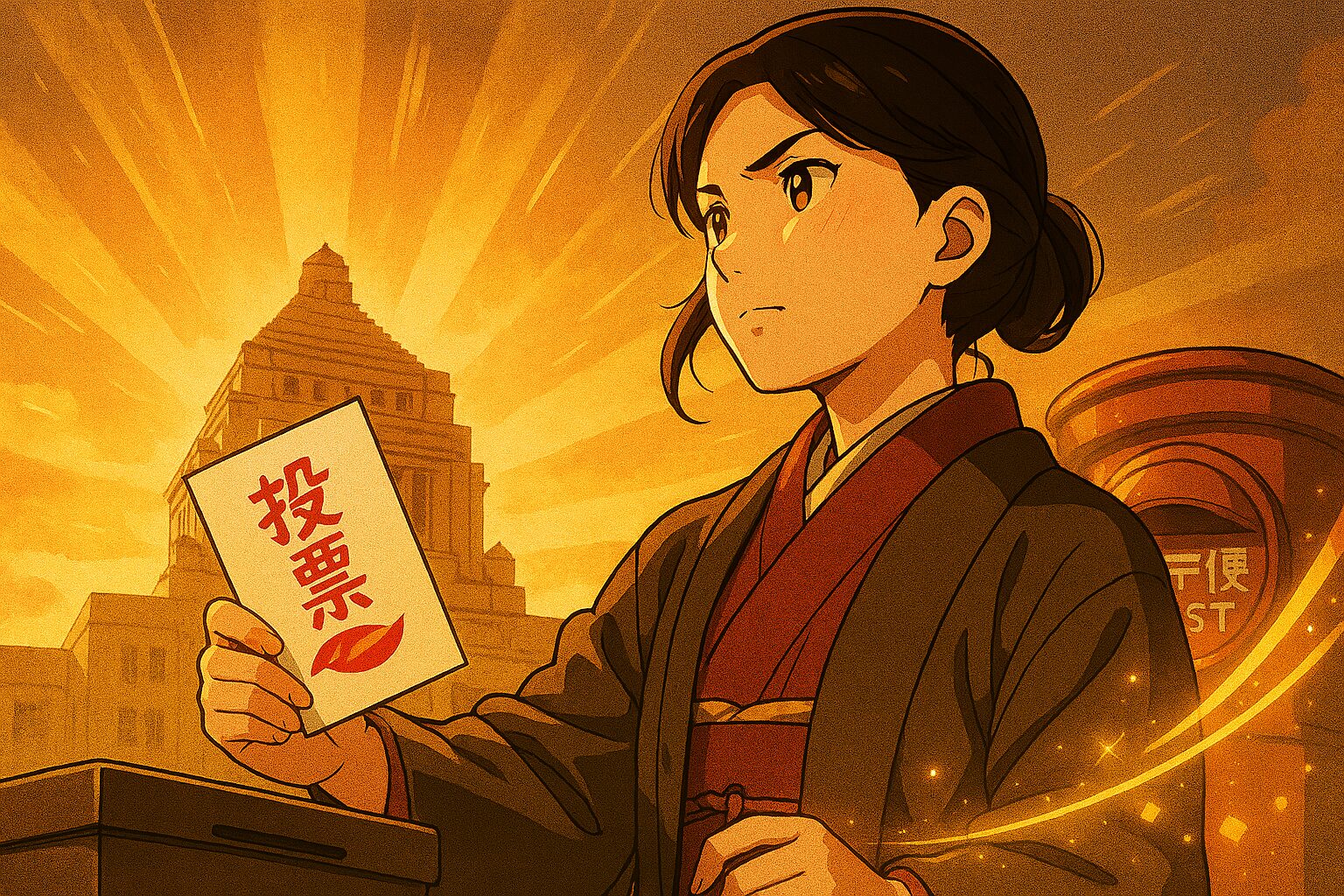

**Introduction: A Day That Changed History**
Hello, dear international readers! Join me, a blogger and programmer dedicated to delving into Japan’s profound history and culture, as we explore the special meaning held by this day. Today, **December 17th**, symbolizes one of the most crucial democratic developments in Japan: the historic day when **women’s suffrage** was legally recognized.
This landmark legal amendment occurred on December 17, 1945 (Showa 20), immediately following the end of World War II. Amidst an unprecedented national crisis, Japan’s social structure was fundamentally reassessed, and a wave of democratization swept the nation. As a significant part of this movement, the long-standing issue of women’s right to political participation was finally realized.
**① December 17th: The Revision of the House of Representatives Election Law and Women’s Suffrage**
On December 17, 1945, the **Bill for the Revision of the House of Representatives Election Law** was passed and enacted in the 89th Imperial Diet. This revision abolished restrictions based on property, tax payments, and crucially, sex, proclaiming that **”suffrage shall be granted to all Japanese citizens aged 20 and over.”** This marked the establishment of **universal suffrage** in Japan, and for women in particular, it signified a decisive victory after a long struggle for a place on the political stage.
**Historical Context: The Path to Women’s Rights**
The demand for women’s suffrage existed long before the war. With the introduction of the national assembly system during the Meiji era, women were severely restricted from participating in political associations and assemblies by laws like the “Regulations on Political Meetings and Associations” and the “Public Order and Police Law.” Against these discriminatory laws, female activists such as **Raichō Hiratsuka** and **Fusae Ichikawa** persistently and bravely raised their voices.
The **New Women’s Association (Shin Fujin Kyokai)**, founded primarily by Fusae Ichikawa, and the later **League for the Attainment of Women’s Suffrage**, conducted educational campaigns aimed at improving women’s status and gaining the right to vote. However, the rigid conservative ideology rooted in Japan’s pre-war social structure, particularly the patriarchal system, did not easily permit women’s political participation.
The tide turned after World War II. The democratization policies enforced by the Supreme Commander for the Allied Powers (GHQ) strongly demanded the overhaul of Japan’s outdated systems. The GHQ positioned the expansion of women’s rights as a key pillar of democratization and forcefully urged the Japanese government to implement women’s suffrage. This external pressure, combined with the domestic momentum for change post-war, led to the legal revision on December 17, 1945.
**Impact on Culture and Society: The First Election**
The realization of women’s suffrage was not merely about gaining the right to cast a vote. It promoted a fundamental change in the societal recognition that women, **as individuals and members of the state, held equal rights to men.**
The first general election after this revision, in which women participated, was held on April 10, 1946 (Showa 21). In this election, **39 female Diet members** were elected for the first time, marking a new page in the history of Japanese politics. This event accelerated women’s social advancement and became a catalyst for profoundly changing awareness regarding women’s roles in education, labor, and domestic life.
December 17th is not just a date of legal amendment; it is a day that should be deeply remembered as the **day Japan’s democracy began to fulfill its true value**, and the **day women gained the right to carve out their future with their own voices.**
**② Connection to Japanese Culture: The Transformation of Women’s “Power”**
What we can decipher from the events of December 17th is the **transformation of the concept of women’s “power” (*chikara*) in Japanese culture.** Japanese culture has deep roots in the belief that women possess spiritual or authoritative power.
**Ancient “Power”: Miko and Female Rulers**
In ancient Japan, especially in the mythological realm, the Sun Goddess, **Amaterasu Ōmikami**, was female. Similarly, as exemplified by Queen Himiko, there were eras when **Miko (shrine maidens)** and female rulers held political authority. Women served an essential role in society as spiritual intermediaries between the gods and people. However, through the Nara and Heian periods and with the formation of the samurai society, public authority gradually shifted to a male-centric system, and women’s scope of activity became largely confined to the domestic sphere.
**From “Invisible Power” to “Visible Power”**
The women’s suffrage movement after the Meiji era was a process of **re-visualizing the women’s “power”** that had been long sidelined from the public stage, **as public “political power.”** Pre-war women’s power was exercised as **”invisible, indirect power”**—in the home, education, and certain arts and literature. The acquisition of suffrage transformed this into **”visible, direct power,”** incorporated into the democratic system as **”the right to vote and stand for election.”**
This is not contradictory to the Japanese cultural value of **”Wa o motte tōtoshi to nasu” (valuing harmony)**; rather, it reflects the recognition that women’s perspectives are indispensable for harmonizing diverse opinions and interests in the political arena. December 17th can be called the **moment Japanese democracy reconstructed the spirit of “harmony” based on the principle of “universal equality.”**
This event serves as the **legal and spiritual origin** of Japan’s ongoing commitment to gender equality—specifically, efforts to increase the ratio of female parliamentarians and promote women’s participation in decision-making across all sectors of society.
**③ A Question for Our Readers**
Dear readers, the event of December 17th teaches us one of the most fundamental principles of democracy: that power is not limited to a select few or a specific gender, but **inherently resides equally in all human beings.**
In your country, when and through what process was women’s suffrage granted? What are your thoughts on the perseverance and passion demonstrated by Japanese women who won their rights during Japan’s tumultuous post-war period?
If you were a modern citizen of Japan, benefiting from this historic progress, **what would you strive for next?** I, for one, would focus on overcoming political apathy, especially among the younger generation, to ensure this hard-won right is not wasted, and on exploring forms of political participation that are more open through digital technology. History demands that we constantly move forward without standing still. Please share your thoughts with us.
**🏷️ Internal Link**
- Category: Whats Today’s Special Day Series
- **Introduction: A Day That Changed History**
- **① December 17th: The Revision of the House of Representatives Election Law and Women’s Suffrage**
- **② Connection to Japanese Culture: The Transformation of Women’s “Power”**
- **③ A Question for Our Readers**
- 🇯🇵 What Day is it Today? December 17th: The Dawn of Women’s Suffrage in Japan
🇯🇵 What Day is it Today? December 17th: The Dawn of Women’s Suffrage in Japan
**はじめに:歴史を動かした一日**
親愛なる海外の読者の皆さん、こんにちは。日本の奥深い歴史と文化を掘り下げ、皆さんに紹介するブロガー兼プログラマーの私と一緒に、今日という日が持つ特別な意味を探ってみましょう。本日、12月17日は、日本において最も重要な民主主義の発展の一つを象徴する日です。それは、女性参政権が法的に認められた記念すべき日だからです。
この法律改正は、第二次世界大戦終結直後の1945年(昭和20年)12月17日に行われました。敗戦という未曾有の国難の中で、日本の社会構造は根本から見直され、民主化の波が一気に押し寄せました。その大きな流れの一つとして、長年の課題であった女性の政治参加の権利が、ついに実現したのです。
**① 12月17日:衆議院議員選挙法改正と女性参政権**
1945年12月17日、第89回帝国議会において、衆議院議員選挙法改正案が可決・成立しました。この改正により、従来の財産や納税額に基づく制限、そして性別による制限が撤廃され、「満20歳以上の日本国民すべてに選挙権が与えられる」ことになったのです。これは、日本における普通選挙の確立であり、特に女性にとっては、政治の舞台へ上がるための長きにわたる闘いの末の、決定的な勝利を意味しました。
**歴史的背景:女性の権利獲得への道**
女性参政権の要求は、戦前から存在していました。明治時代に導入された国会制度において、女性は「集会及政社に関する取締法」や「治安警察法」などによって、政治的な結社や集会への参加を厳しく制限されていました。こうした差別的な法律に対し、平塚らいてうや市川房枝といった女性運動家たちは、粘り強く、そして果敢に異議を唱え続けました。
市川房枝が中心となって結成された新婦人協会や後の婦人参政権獲得期成同盟などは、女性の地位向上と参政権獲得を目指して啓蒙活動を展開しました。しかし、戦前の日本の社会構造、特に家父長制度に基づく強固な保守的な考え方は、女性の政治参加を容易には認めませんでした。
潮目が変わったのは、第二次世界大戦後です。連合国軍総司令部(GHQ)による民主化政策は、日本の旧態依然とした制度の刷新を強く要求しました。GHQは、女性の権利拡大を民主化の重要な柱と位置づけ、日本政府に対して女性参政権の導入を強く促しました。この外圧と、戦時中から続く国内の変革への機運が相まって、1945年12月17日の法改正へと繋がったのです。
**文化と社会への影響:最初の選挙**
女性参政権の実現は、ただ単に選挙で票を投じる権利を得たということに留まりません。それは、女性が一人の人間として、国家の構成員として、男性と等しい権利を持つという、社会の根本的な認識の変化を促すものでした。
この改正後、初めて女性が参加した総選挙は、翌1946年(昭和21年)4月10日に実施されました。この選挙では、初めて39人の女性議員が誕生し、日本の政治の歴史に新たな一ページを刻みました。この出来事は、女性の社会進出を加速させ、教育、労働、家庭生活における女性の役割に対する意識を大きく変えていくきっかけとなったのです。
12月17日は、単なる法改正の日ではなく、日本の民主主義がその真価を発揮し始めた日、そして女性たちが自らの声で未来を切り開く権利を手にした日として、深く記憶されるべき日なのです。
**② 日本文化との関連:女性の「力」の変遷**
12月17日の出来事から読み解けるのは、日本文化における女性の「力(ちから)」の概念の変遷です。日本の文化には、古来より女性が霊的、あるいは権威的な力を有するという側面が根強く存在します。
**古来の「力」:巫女と女性の支配者**
古代の日本、特に神話の世界では、太陽神である天照大御神(アマテラスオオミカミ)が女性であり、卑弥呼に代表されるように、巫女(みこ)や女性の支配者が政治的な権威を持っていた時代がありました。女性は、神と人との間を繋ぐ霊的な存在として、社会において重要な役割を果たしていたのです。しかし、奈良・平安時代を経て、武家社会が形成されるにつれて、公的な権威は徐々に男性中心へと移行し、女性の活動範囲は家庭内に限定されるようになっていきました。
**「見えない力」から「可視化された力」へ**
明治以降の女性参政権運動は、この長きにわたって社会の表舞台から遠ざけられていた女性の「力」を、再び公的な「政治力」として可視化するプロセスでした。戦前の女性の力は、家庭や教育、そして一部の芸術や文学といった「見えない、間接的な力」として発揮されていましたが、参政権の獲得は、それを「選挙権・被選挙権」という民主的なシステムに組み込まれた「可視化された、直接的な力」へと変貌させました。
これは、日本の文化が持つ「和をもって尊しとなす(調和を重んじる)」という価値観と矛盾するものではなく、むしろ、多様な意見と利害を政治の場で調和させるために、女性の視点が必要不可欠であるという認識の表れでもあります。12月17日は、日本の民主主義が、「調和」の精神を「普遍的な平等」の原理に基づいて再構築した瞬間と言えるでしょう。
この出来事は、現代に至るまで続く、日本のジェンダー平等への取り組み、特に国会における女性議員比率の向上や、社会のあらゆる分野での意思決定への女性の参画を促す動きの法的かつ精神的な原点となっています。
**③ 読者の皆さんへの問いかけ**
親愛なる読者の皆さん、12月17日の出来事は、権力は一部の人間や性別に限定されるものではなく、すべての人間に平等に宿るという、民主主義の最も大切な原則を私たちに教えてくれます。
皆さんの国では、女性参政権はいつ、どのような経緯で認められましたか?日本の戦後の混乱期に、女性たちが自らの権利を勝ち取った粘り強さと情熱について、どう思われますか?
もしあなたが現代の日本で、一人の市民として、この歴史的な進歩の恩恵を受けているとしたら、次に何を求めて行動しますか? 私ならば、この参政権を無駄にしないためにも、政治への無関心を脱し、特に若い世代の投票率向上と、デジタル技術を活用した、より開かれた政治参加の形を模索することに注力するでしょう。歴史は、立ち止まらずに常に前進し続けることを私たちに要求します。皆さんのご意見をぜひ聞かせてください。


コメント