Japan has countless folktales, but some stand out for their deep humanity and ability to make us chuckle. One such story is “The Myoga Inn” (Myoga no Yado). This isn’t just a moral lesson; it’s a humorous tale, much like a Rakugo comedy performance, depicting human greed and failure.
Why did Japanese people believe that eating “Myoga” (Japanese ginger) makes you forget things? And what message does this story hold for us today?
In this article, we will thoroughly introduce this lovable, funny Japanese story and dive deep into the cultural background behind it.

1. The Story: The Myoga Inn
Once upon a time, along a certain highway, there stood a small, unpopular inn.
The innkeeper was not a bad person at heart, but he was a bit greedy and always thought, “I want to get rich without working too hard.”
One evening, a well-dressed traveler visited the inn.
“I’d like to stay for the night,” the traveler said, lowering a large bundle from his shoulder. As he did, a heavy “THUD” echoed through the room.
(Oh? That heavy sound… It must be filled with gold coins!)
The innkeeper’s intuition kicked in. The traveler seemed to be a wealthy merchant. His purse strings looked tight, but the contents seemed plentiful.
The innkeeper went to the back and whispered to his wife.
“Hey, did you see that guest? He’s carrying a lot of money. Isn’t there a way we can make that money ours…”
“Dear, are you planning to rob him? If you get caught, it’s over.”
“No, no. I won’t use force. It would be best if he just left it behind on his own.”
Then, the innkeeper remembered an old saying:
“If you eat a lot of Myoga, you will become forgetful.”
“This is it! For dinner tonight, we’ll use all the Myoga in the garden and treat him to a feast. If we do that, surely he’ll forget that massive amount of money and leave!”
The couple rushed to the garden and harvested every last bit of Myoga growing there.
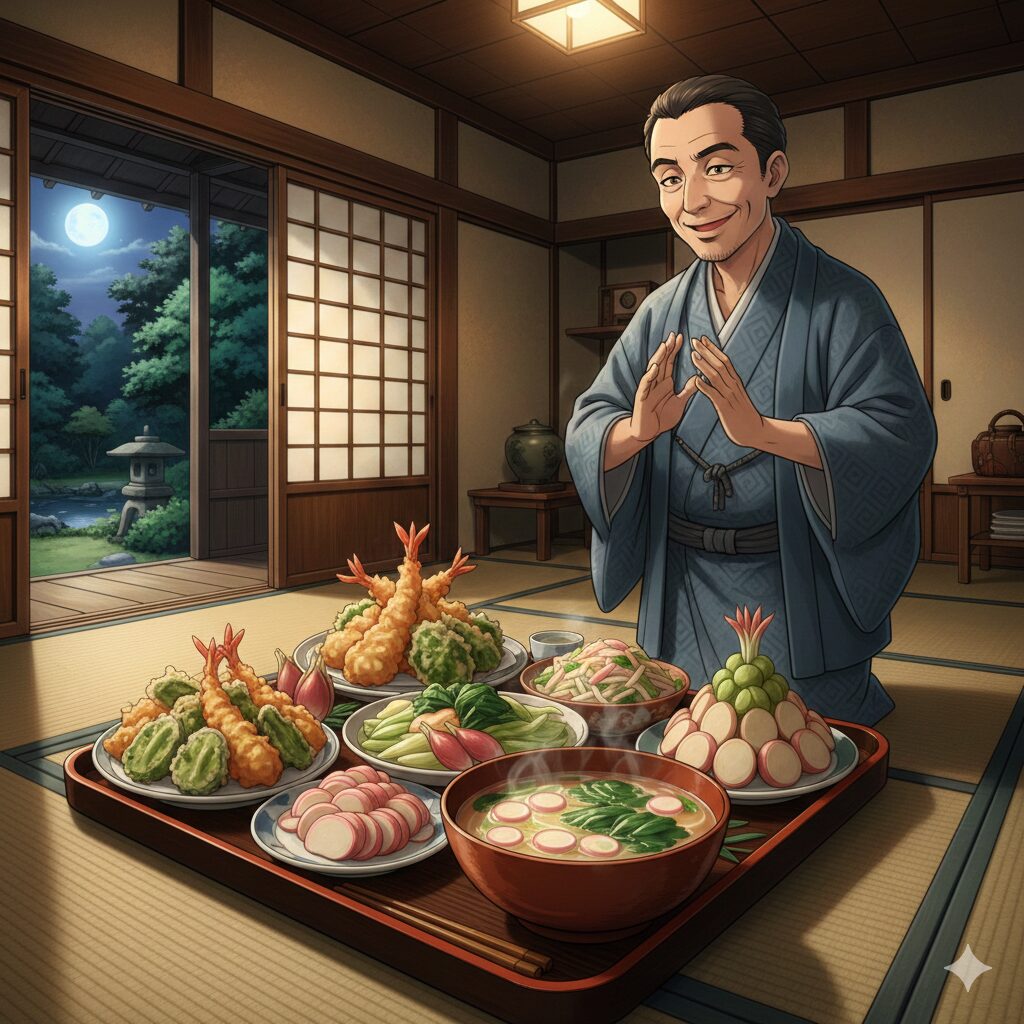
Myoga tempura, Myoga miso soup, vinegar-marinated Myoga, Myoga rice… The dining table became a magnificent “Myoga full-course meal.”
“Please, go ahead, sir. These are fresh vegetables from our inn’s garden. They are good for your stamina, so please eat plenty.”
The traveler was delighted.
“This is rare. I love Myoga. I’ve never had Myoga with such good flavor.”
The traveler devoured the dishes served and went to bed satisfied.
The next morning, the innkeeper woke up early, eagerly waiting for the traveler to depart.
“He ate so much last night. His memory must be blown away by now.”
Eventually, the traveler woke up.
“Thank you for your care. It was a good inn.”
The traveler got ready and left the inn.
The innkeeper watched until the traveler was out of sight, then rushed into the guest room.
“Now, let’s see! Where is the bag of gold!?”
The innkeeper searched everywhere—in the corners of the room, under the futon, on the shelves.
But there was nothing of value anywhere.
“Hey! There’s no money! Did that rascal take everything with him!?”
Shoulders dropping in disappointment, the innkeeper shouted to his wife in the kitchen.
“Unbelievable! The plan failed! He didn’t forget a single thing!”
Then, his wife answered in a laid-back voice.
“No, dear. That guest forgot something outrageous.”
“What!? You mean his wallet?”
“No, he forgot to pay the bill.”
2. Analysis: Why Did the Plan Fail, Yet Succeed?
This story is a very popular number in the traditional Japanese performing art of “Rakugo.” It layers human psychology and humor in a clever way.
Blind Faith in Superstition and Karma
The innkeeper blindly believed the superstition that “eating Myoga makes you forget” and plotted a scheme. However, the result rebounded on him in the most damaging way possible: “forgetting to pay the bill.” This illustrates the concept of Karma—”If you try to trap others, misfortune will fall upon you”—depicted through laughter.
The Essence of “Forgetting”
The traveler did indeed “forget.” However, what he forgot was not his “precious luggage” but his “obligation to pay.” Humans, when relaxed and satisfied with good food, often forget not only their caution but also their daily duties. Perhaps it wasn’t the chemical components of the Myoga, but the excessive hospitality that made the traveler so comfortable he simply forgot to pay.
3. Cultural Connection: Myoga and “Omotenashi”
We can decipher several aspects of Japanese culture from this story.
The Japanese Herb “Myoga”
The key item in the story, “Myoga,” is a flavorful vegetable unique to East Asia, heavily used in Japan. It has a distinct aroma and crisp texture, loved as a garnish for summer somen noodles or in miso soup. The idea that “eating it makes you forget” is a superstition without scientific basis. It is said to originate from a Buddhist tale about a disciple of Buddha who was a master of forgetfulness; Myoga grew from his grave. In reality, the scent component of Myoga (alpha-pinene) is said to increase concentration and relaxation, which is actually good for the brain!
“Excessive Service” Backfiring
Although the innkeeper had ulterior motives, he provided the traveler with the best meal possible. Japan has a culture of “Omotenashi” (hospitality), but this story is a rare example of it backfiring. The innkeeper’s effort (the massive Myoga feast) satisfied the traveler, but the innkeeper’s original goal (financial gain) was not achieved. This contains a Japanese irony: “Calculated kindness can lead to unexpected results.”
4. What Would You Do?
This story teaches us the foolishness of being too greedy, all while making us laugh. The innkeeper lost even the legitimate profit of the lodging fee.
If you were the innkeeper, what would you have done?
- Would you provide honest, excellent service to gain a repeat customer?
- Would you still dream of getting rich quick and come up with a different plan?
- Or, if you were the traveler, would you find an overly kind innkeeper suspicious?
They say “if something sounds too good to be true, it probably is,” but perhaps that delicious Myoga dish contains the innkeeper’s desperate “wish.”
Japanese folktales are filled with such human dramas. Please enjoy other stories as well.
If you want to read more Japanese folktales, please check out this series.
Japanese Folktale Series – Kiri53.com
Reference Link:
Wikipedia – Myoga (Zingiber mioga)
【日本の昔話】みょうがの宿:欲望とユーモアが織りなす「忘れ物」の物語
日本には数多くの昔話がありますが、その中でも特に人間味あふれ、思わずクスッと笑ってしまう話があります。それが今回紹介する「みょうがの宿(The Myoga Inn)」です。この物語は、単なる教訓話ではなく、人間の「欲」と「失敗」をユーモラスに描いた、落語のような小噺です。
なぜ日本人は「みょうが(Myoga)」を食べると物忘れをすると信じていたのでしょうか?そして、この物語が現代の私たちに伝えるメッセージとは?
今回は、この愛すべき日本の滑稽話をたっぷりとご紹介し、その背景にある日本文化を深掘りします。
1. ストーリー:みょうがの宿
むかしむかし、ある街道沿いに、あまり流行っていない小さな宿屋がありました。
その宿屋を営む主人は、根は悪い人ではないものの、少しばかり欲張りで、いつも「楽をして大金持ちになりたい」と考えていました。
ある日の夕暮れ時、一人の身なりの良い旅人が宿を訪れました。
「一晩、泊めてもらいたいのだが」
旅人はそう言うと、肩にかけていた大きな荷物を下ろしました。その時、「ズシリ」と重たい音が響きました。
(おや? あの重そうな音……間違いなく大量の小判が入っているに違いない!)
主人は直感しました。旅人は裕福な商人のようで、その財布の紐は固そうですが、中身はたっぷりと詰まっている様子です。
主人は裏へ回ると、女将さんにこっそり相談しました。
「おい、見たかあの客。すごい金を持ってるぞ。なんとかして、あの金を我々のものにできないものか……」
「あなた、そんなこと言って、泥棒でもするつもり? 捕まったらおしまいですよ」
「違う違う。手荒な真似はしねえ。向こうが勝手に置いていってくれればいいんだ」
そこで主人は、ある言い伝えを思い出しました。
『みょうがをたくさん食べると、物忘れがひどくなる』
「これだ! 今夜の食事に、庭のみょうがを全部使ってご馳走するんだ。そうすりゃあいつ、きっとあの大金を忘れて旅立つにちげえねえ!」
夫婦は急いで庭へ出て、生えているみょうがを根こそぎ収穫しました。
そして、みょうがの天ぷら、みょうがの味噌汁、みょうがの酢の物、みょうがご飯……。食卓は見事なまでの「みょうが尽くし」となりました。
「さあさあ、お客さん。当宿自慢の採れたて野菜です。精がつきますから、たくさん召し上がってください」
旅人は喜びました。
「これは珍しい。みょうがは大好物だ。こんなに風味が良いみょうがは初めてだ」
旅人は出された料理をペロリと平らげ、満足して床につきました。
翌朝、主人は早起きをして、旅人が出発するのを今か今かと待ち構えていました。
「昨夜はあんなに食ったんだ。きっと記憶も吹っ飛んでるはずだ」
やがて旅人が起きてきました。
「世話になったな。良い宿だった」
旅人は身支度を整え、宿を出て行きました。
主人は旅人の姿が見えなくなるまで見送り、慌てて客室へ駆け込みました。
「さあ、どうだ! 金の入った袋はどこだ!?」
主人は部屋の隅々、布団の下、棚の上まで必死に探しました。
しかし、どこにも金目のものはありません。
「おい! 金がないぞ! あの野郎、全部持って行きやがったか!?」
主人はがっくりと肩を落とし、台所にいる女将さんに叫びました。
「なんてことだ、作戦失敗だ! あいつ、何一つ忘れてねえぞ!」
すると女将さんが、のんびりとした声で答えました。
「いいえ、あなた。あのお客さん、とんでもないものを忘れていきましたよ」
「なんだと!? まさか財布か?」
「いいえ、宿代(やどだい)を払うのを忘れていきました」
2. 考察:なぜ作戦は失敗し、成功したのか?
この物語は、日本の古典芸能「落語」としても非常に人気のある演目です。ここには、人間の心理と滑稽さが幾重にも重なっています。
迷信への盲信と因果応報
宿屋の主人は「みょうがを食べると忘れる」という俗信を信じ込み、悪だくみを働きました。しかし、結果としてその企みは「宿代を払い忘れる」という、主人にとって最も損害となる形で跳ね返ってきました。これは、「他人を陥れようとすれば、自分に災いが降りかかる」という因果応報の教えを、笑いを通じて描いています。
「忘れる」ことの本質
旅人は確かに「忘れ物」をしました。しかし、彼が忘れたのは「大切な荷物」ではなく、「支払うべき義務」でした。人間は、リラックスしたり、美味しいものを食べて満足したりすると、警戒心だけでなく、日常の義務さえも忘れてしまう生き物です。みょうがの成分のせいではなく、過剰な「おもてなし」が旅人をあまりに心地よくさせ、支払いを忘れさせたのかもしれません。
3. 日本文化との関連:みょうがと「おもてなし」
この物語から、日本文化のいくつかの側面を読み解くことができます。
日本のハーブ「みょうが(Myoga)」
物語のキーアイテムである「みょうが」は、日本固有の香味野菜です。独特の香りとシャキシャキとした食感があり、夏のそうめんの薬味や、味噌汁の具として愛されています。「食べると物忘れする」というのは科学的根拠のない迷信ですが、これはかつて釈迦の弟子で物忘れの名人だった人物の墓からみょうが生えてきた、という仏教説話に由来すると言われています。実際には、みょうがの香り成分(アルファピネン)には、集中力を高めたりリラックスさせたりする効果があり、むしろ脳に良いとされています。
裏目に出る「過剰なサービス」
宿屋の主人は、下心があったとはいえ、旅人に最高の食事を提供しました。日本には「おもてなし(Omotenashi)」の文化がありますが、この物語はそれが「裏目」に出た稀有な例です。主人の努力(大量のみょうが料理)は、旅人を満足させましたが、主人の本来の目的(金銭的利益)は達成されませんでした。ここには、「作為的な親切心は、予期せぬ結果を招く」という日本的なアイロニーが含まれています。
4. あなたならどうしますか?
この物語は、私たちに「欲をかきすぎることの愚かさ」を笑いと共に教えてくれます。宿屋の主人は、宿代という正当な利益さえも失ってしまいました。
もしあなたが宿屋の主人だったら、どうしましたか?
- 地道に最高のサービスをして、リピーターになってもらう?
- やはり一攫千金を夢見て、別の作戦を立てる?
- あるいは、あなたが旅人の立場だったら、あまりに親切すぎる宿屋を怪しいと思いますか?
「うまい話には裏がある」と言いますが、美味しいみょうが料理には、もしかすると宿主の切ない「願い」が込められているのかもしれませんね。
日本の昔話には、こうした人間臭いドラマがたくさん詰まっています。ぜひ、他の物語も楽しんでみてください。
さらに多くの日本の昔話を読みたい方は、こちらのシリーズをご覧ください。
Japanese Folktale Series – Kiri53.com
参考リンク:
Wikipedia – ミョウガ(Myoga)


コメント